I’m glad to see some political groundswell against these data centers.
In late July, I took a tour with my choir through Eastern Oregon. To get there, we drove along the Columbia River on I-84, and one of the shocking new features of that highway is the huge data centers built along the river next to the dams at Hood River, Cascade Locks, and The Dalles. They are enormous, out of human proportions, and blandly ugly. They are uglier than the wildest phantasm of Socialist brutalism dreamed by a 1980’s Cold Warrior. Their presence by the river is a third theft, not just water and electricity but beauty, too.
We need data centers. Locate them somewhere else, and the power is dirtier and the water more scarce. I worry, though, about the scale of these buildings. There have always been upper limits on the economies of scales. Build too large of a factory, and there will not be enough workers. These buildings, these massive industrial park blanknesses, do nothing that you can see with the naked eye except turn electricity into steam. They have few workers. Everything goes in and out through a wire or a pipe.
Do we need this many data centers? Even under the logic of capitalism, which I am more friendly to than most I know, price is the outcome of a vast behavioral computer. Prices aren’t working right now. There’s a thumb on every scale. Vast stores of work and value and resources are being fed into a fire underneath a cauldron that might never come to boil.
I can’t bring this to any more of a coherent conclusion other than we need a global emissions tax system.
Romance is a continuum of male absurdity. On one end is Pepé Le Pew bothering you, the other is Young Werther committing suicide at you.
Romance is a glow. It’s the light that you shine on your beloved, that they shine back onto you.
Romance is a product. It’s the carnival teddy bear, the red rose bought from a 5-gallon bucket, it’s the couples massage in a tent on the beach.
Romance is a little bit sus. Romance is the lore of the chase, of seduction, and there’s a fine line between chase and pursuit, between seduction and coercion.
Romance is just a little bit sexless. It’s not very erotic. Its music has string instruments and words strung out on long notes, and you can’t always fuck to it.
Romance is a straightjacket. It’s a hacky old script that you’ve seen a million times so you know all of its beats. If you slow down in the middle you can actually feel yourself piloting your own meat suit, like the funny lil dude in Men in Black.
Romance is grand. It gives you these huge new roles, Lover and Beloved. You can’t speak it in any of the five love languages. It crushes crushes,
Ezra Klein had Jonathan Haidt to talk about the influence The Anxious Generation has had on school no-phone policies. Haidt is mostly right in his societal diagnosis, but I wish his ideas had a different messenger. Haidt is a fool, a boor, and a coward.
He’s a coward because underneath his innuendo about children losing a ‘coherent moral order’ is old-fashioned Bill Bennett conservatism: young people are fucked up because they weren’t taught good values. It can’t engage with the reality that people weight moral values differently, or have different opinions about how to express them. Taken to the extreme, only conservative people are given the agency to have their own moral stances–socially liberal people are brainwashed or “only doing what feels good.”
He’s a boor because he cannot help himself from bringing weird gender essentialist, heteronormative asides into his argument. There is no sense that he talked to young people about his ideas. In his world view, they are all damaged, maybe permanently. Why bother finding out what they think?
He’s a fool because he thinks the solutions to the problems he diagnoses are simple. Totalitarian age-verification systems are not a viable answer. The collateral damage would be tremendous, especially to repressed groups. We’ve decimated IRL social spaces for kids & teens and better age verification policies wouldn’t do a thing to make alternatives more accessible.
As the argument that I first encountered in Johann Hari’s book about depression goes, when mammalian environments are stimulating and social, we are not as attracted to quick dopamine buttons. The argle-bargle about morality is necessary for Haidt’s to explain how this generation of kids is different. It’s easier for him to conjure the specter of a zombie army of braindead amoral iPad kids than to confront the unique material conditions of the moment: lower birthrate, two income families, loss of recreational spaces, changed norms around childhood independence.
And despite all that I do think he’s more right than he’s wrong! It’s OK to consider how we are raising children right now, to compare them against the ideas from many wisdom traditions about how to live a good life, and to find it alarming. There is endless room for scientific debate about what something is and how it became that way, but the question of why it matters is always a values question.
I’m thinking about this a lot because I am preparing for the arrival of a child. The way I am wrapping my head around it is to think about positive interaction loops.
The oldest and most important positive loop is the secure attachment between parent and child. There are others, like between audience and performer or pupil and teacher. There are even non-human interaction loops, like the way that a cup and ball toy builds fine motor coordination. The things I’m looking for are that they provide true feedback (so, not like a modern videogame that adjusts its skill level down if you suck) and that the more interaction you give to them the more you walk away with (so not like Instagram, which takes your time and leaves you with nothing). I can’t see the future or understand how every parenting choice is going to affect my child, but I can tell which interaction looks are providing positive training or just wasting time. That’s enough to get started.
I quit my job today. I do not have another one lined up, and before getting this job I was out of work for months. I know quite a few people struggling to find work. It doesn’t feel like a smart thing to do, but I was miserable at work. The kind of totalizing miserable feeling that creates dissociation during the workday and persists in my body the way the intensity of a noxious fume lives on as a headache.
I am experiencing this as a setback, as a blow, and as a destabilization of my self-image. Part of my self-image has been that when push comes to shove, I can do anything I have to. Another important part of that self-image is that when faced with a set of choices, I make the smartest and most pragmatic choice.
I feel uncomfortable because over the past few years I have felt myself being pushed away from the zone of easily identifiable pragmatic choices. At every step, I think I have been making rational, good choices, with appropriate sized risks. And yet, I am struggling in a way that I didn’t imagine that I would. If I’m being forced to make riskier choices, what do I hope to gain?
I see interfaces. Interfaces are everywhere. They are simple, everyday, vital, like the doorknobs that let us use our apelike hands to manipulate the innards of a mechanical doorknobs. They are complex, obscure, ridiculous if we weren’t so dependent on them, like the computers simulating human users interacting with virtual mainframe programs from the 1980’s that operate critical pieces of our civic infrastructure. Pieces like banking, telecommunications, the military. The imposition of the interface of the interstate highway system on the landscape of the West unlocked it’s development. The imposition of the interface of the shipping container is a necessary condition of globalized trade.
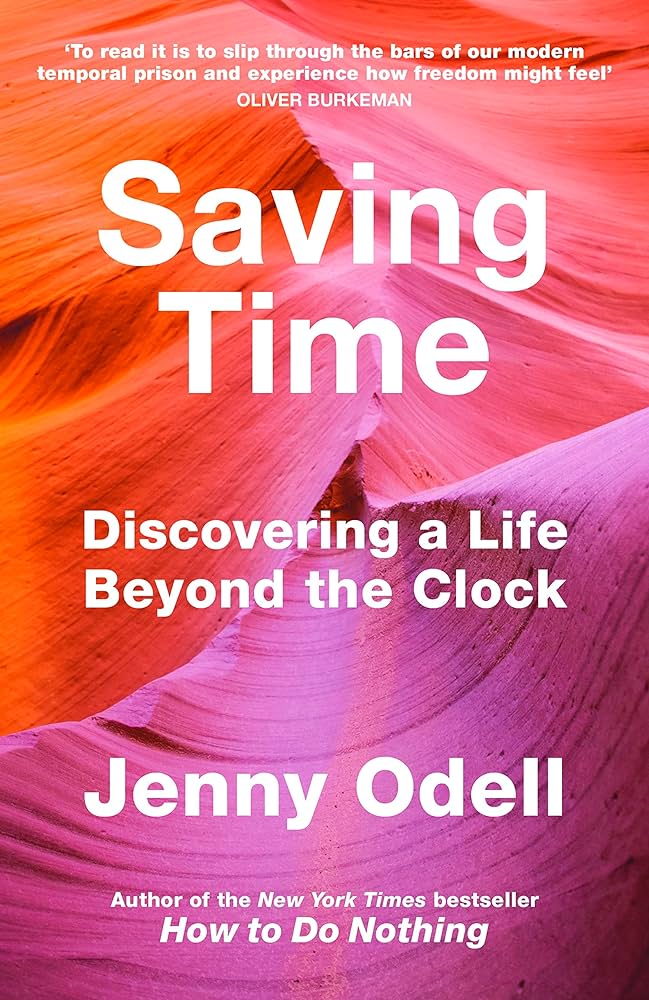
In How To Do Nothing, Jenny Odell explored resisting the interfaces and attitudes that make up modern (Millennial?) productivity culture. Some of her exploration involved naming and questioning foundational assumptions of the culture, e.g. why is it considered better to create the new and disruptive rather than the restorative? Another line of exploration was the incursion of the capitalist profit motive into our private lives. In Saving Time, she expands another idea opened in How To Do Nothing: that clock time is an interface imposed on many different natural rhythms and cycles for the benefit of capitalist growth, and that there may be benefits to attuning ourselves to other ways of tracking time.
It’s a great idea, and Odell curates a wonderful selection of texts to give various angles on the idea. She repeats a structure that worked well in How To Do Nothing: meandering, collage-like texts, sometimes extended paraphrases of anecdotes from other writers or long quotations, wrapped in a repetitive and bland account of a Bay Area walk. I didn’t mind this style in her first book, but this time I wanted either more artful prose or more disciplined synthesis of ideas. After making it about halfway through the book, the easiest way for me to open up more time was to put the book down and seek a richer experience.
I’m still looking for a book with sharper thought about how to shrink the power of the clock time interface. What kind of cultural practices would it take for there to be a society-wide floor of rest and leisure like the Jewish Sabbath? Or to resist unnecessary 24-hour work schedules? Seasonality of food?
other voices
Megan Garber at the Atlantic focused on the disruption of personal routines during COVID and responded more than I did to the part of the book that explored how we are being destabilized as climate change is disrupting natural cycles.
Sometimes, in her race to gather all of this information together, Odell elides narrative inconveniences or leaves things unexplained.
But singling out any specific moment in this book feels like a betrayal of the whole. The narrative logic is purposefully meandering and elliptical, a formal underline of the book’s arguments against a linear understanding of time.
Parul Sehgal for the New Yorker was more pointed, “Why does a book so concerned with the looming issues of our day, and possessed of such an urgent authorial voice, feel like such a time sink?”




 hammer & jack