2021

new year energy

It’s January once again. Predictable things that happen in January include the one weird week late in the month where clear skies and sun convince me and the daffodils that spring is around the corner, and a manic period where I’m convinced that I can change everything in my life that needs changing. I can, I will, and in my favored manner, with extreme effort all at once.

Instead of offering resolutions, here are some of the themes I think will be sounding throughout my next year:

play

I completed a coding bootcamp and switched careers last year. I spent a lot of time working on my focused work muscles, and it’s time to turn my attention to play. I really love the way that Cal Newport talks about ‘high-quality leisure’: the challenging, active ways of using downtime that restore and recharge us after focused work. https://www.calnewport.com/blog/2019/05/31/on-the-pleasures-and-sorrows-of-life-without-screens/ It’s kind of like exercise is to the body: sometimes rest requires more than sleeping, it may require stretches, breathing, reclaiming range of motion.

I’m particularly looking forward to trying to build relationships around writing and playing music. I have dearly felt their lack in the past years, particularly since the beginning of the pandemic. I’m ready to find others to play with.

finding space for books and music (aka cutting down on podcasts)

As my work has become more mentally taxing, demanding, and as it requires more single-task focus, I have found it harder to make space for reading and listening to music. I’m looking forward to continuing my journey toward cutting down on passive podcast consumption and doomscrolling to make that happen.

I dearly love podcasts, but it’s so easy to just keep listening to them. If podcasts were books, I’d read better books. If they were articles, I would abandon more of them. I have a few podcasts that I’m pretty attached to on a parasocial level, but I’m working on winding those down and trying not to get attached to new ones.

practicing networking

I could write a lot about this. I am hungry for in-person, social, group ways to experience my passions. Professionally, artistically, even among my friends. This year I am rededicating myself to making that happen and to putting social effort into participating in new ‘scenes’ that I have curiosity about.


toot or boot?

Twitter Mascot

My therapist asks And does this serve you? when I’ve been complaining about something and he’s trying to gently ask me to consider that ‘stop’ might be an easy way to improve the situation. It creates space to feel honest feelings about the things that we hate doing but we have to because it serves a purpose in our lives, and a way of double checking that the purposes they serve actually exist.

I joined Mastodon. This is the 3rd time. The first time was after some kind of Twitter corporate outrage. The second was after reading How to Do Nothing and hungering for richer online experiences.

This time around, Mastodon feels much more mature as a platform. There are still huge holes in the user experience that need attention. It’s hard to find people. It’s even harder to find people based on keywords and hashtags. The only way to build an audience is through word of mouth, like Follow Fridays. This time, I am questioning whether the habit of publishing anything online is serving me.

Out of the many dreams of what social media can do, two have been seductive to me. The first vision is social media as a public channel for keeping friends and family updated on big life events etc. That’s Instagram. The second is as a forum to get attention in a way that is difficult to get offline.

I read many bloggers in the period between the founding of Daily Kos and Huffington Post to the end of Google Reader. They were smart people, but not journalists or paid writers and sometimes from a marginalized group or young or from an unimportant place. The internet allowed them to compete for their share of the internet audience. Same with niche subjects or hobbies. All it took was four or five writers and their audiences on a beat to create an idea ecosystem. Generous attention to each other’s writing created that feeling of group cohesion.

The writing that I’ve shared on blogs on Twitter are the closest I come to asking for online attention. I struggle with that. The version of me that emerges from that body of work has less of my sense of humor, less of my sense of delight. He tends to emerge more often in anxiety and alienation than in joy or connectedness. He doesn’t share as much as he’s learned, and the only subject he has endless time for is himself.

My favorite online writers either focus on a narrow range of topics or they write in their own voice. Idiomatic blogs are conversational, fast pieces of writing. Books or works from publication have a higher bar for polish and accuracy. It’s understood that a blog post is more perishable. The thing that can perish is the voice of the mind working through its first reaction. First thought, best thought. It’s not always true, but it does have a strong flavor!

In the last 15 years, it has been very rare for me to get constructive feedback that inspires me to keep going. I tell myself that I keep writing because its rewarding. I worry that it’s because either I can’t give up on the idea of being discovered to be interesting, or that I don’t have the imagination to try something else. Does that serve me? I’m not sure. It takes practice to make perfect, sure. Audiences and artists train each other, though. There’s a ceiling for how far you can develop without high quality attention and feedback.

That’s what I’m really looking for: high quality attention and feedback.

I don’t know how to get it, online, in person, whatever. I write because even if I never get the feedback I want, I will end up with something to read back through. I hope it ends up more than that, but many people create even less.

I promise to myself that in 2023 I will seek more play, more attention, more good feedback. It’s time to be more brave.

tweet

photo of cheese fries
Mmm… chili cheese fries” by jeffreyw is licensed under CC BY 2.0.

When the restaurants shut down, one of my favorite neighborhood bars shut down too. They were lucky—the bar was on a quiet street that was easy to pedestrianize. They opened back up with outdoor cafe seating a few weeks later. There were changes. Order at the window. Sanitize your own table. The menu got smaller. My favorite dish, a platter of fries, bacon, and jalapeños covered in cheese and served with a strawberry ketchup, was cut from the menu.

About 18 months later, I was back in the bar, and delighted to learn that the full menu was back. Once I ordered my fries, I discovered that though the dish was on the menu, it wasn’t quite back. Even a blunt combination of cheese and meat and potatoes demands delicate balances to approach greatness. When the oven is too hot or the dish warmed too long, the cheese gets hard and dries out. The cheese should smother the fries, not cement them together. The salt in the bacon and cheese requires under-salting the fries. If there is not enough strawberry jam mixed into the ketchup, it conflicts with the jalapeño brine.

Eighteen months is a long time. Most likely, the kitchen turned over while the dish was off the menu, and there was no one there to teach the new people how to make it. Or a change in vendors led to a different cheese blend or ketchup order. It’s possible that it’s just a bad dish and I no felt nostalgic for it.

Many of the things we value in our everyday world, things that make up the texture of ordinary living, are contingent on relationships. A bar that doesn’t maintain relationship with its staff, a kitchen manager that doesn’t maintain relationship with its vendors, even a patron that doesn’t maintain relationship with his favorite dish, all of these can cause a dish to unravel.

I met a contractor that specialized in home renovations in small, out of the way, wealthy Ojai, California. He explained why he ordered his hardware from a small, independent hardware store. “I can get 25-30% better prices ordering from Home Depot. That’s real money. But sometimes I make an ordering mistake. Sometimes things break. I can run out and back to Ojai Lumber in 30 minutes. If there’s no hardware store in Ojai, then I have to go to the Home Depot in Oxnard. That’s a round trip of two hours, and my guys are standing around until I get back. My time is much more expensive than materials. There’s a big difference between one local hardware store and no local hardware stores, so I try to make sure that I give them business when I can.”

That’s attending to relationships.

Elon Musk goes out of his way to show contempt for anyone he does business with. Nothing attracts his attention faster than letting slip that you have your own goals and financial interests. I am not enjoying seeing Twitter fall apart. But I am enjoying him fail. He assumed that everyone would eventually give up on having their own interests in the platform, and that nobody else would have any human reaction to his abuse. Twitter may be more complicated and less perfect than my favorite plate of cheese fries, but it has turned out to be no less vulnerable to falling apart when the people who make it stop cooperating.

novel

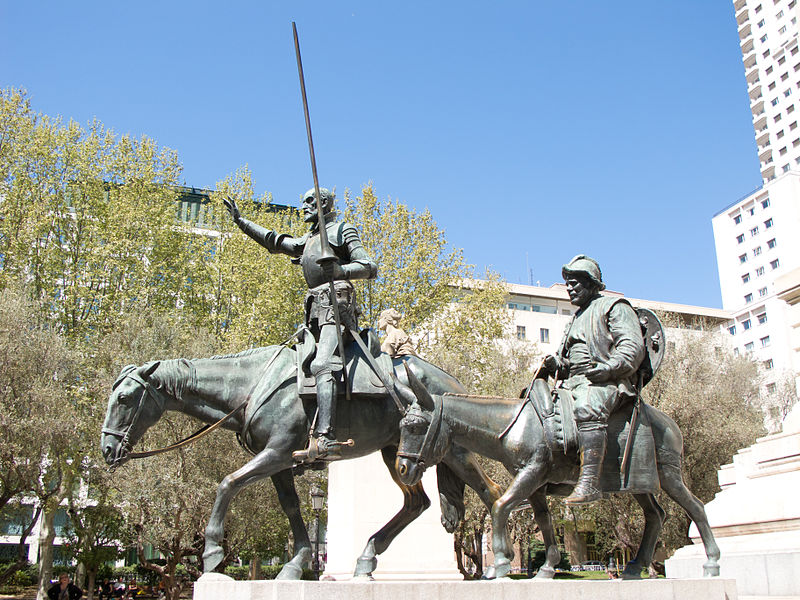
File:Monumento a Miguel de Cervantes – 05.jpg” by Carlos Delgado is licensed under CC BY-SA 3.0.

For almost 500 years the type of story most popular among literate Europeans was the chivalric romance. The Song of Roland, Troilus and Criseyde, the kind of stories that Monty Python and the Holy Grail makes fun of. In 1605, Miguel de Cervantes writes a bawdy little satire called Don Quixote. It takes all of the noble tropes of the romance and turns them upside down. In the place of a young noble undergoing a challenge of grave importance to earn the hand of a beautiful maiden, there is a destitute old crank and his wisecracking frenemy wasting their time shouting at windmills and fantasizing like incels about the feminine qualities of the beauties they’re totally going to find.

That’s how Cervantes accidentally invented the modern novel.

The novel embraced that it was a low, grubby kind of story. They didn’t have to be any more realistic than the romances. They just dealt with slightly more grounded people than Chosen Ones on a divine quest given to them by God. They made mistakes for petty, human reasons. That turned out to be relatable to people, and novels are still with us today.

I thought about the romance and the novel recently while watching TV, bored. I was watching It’s A Sin but it could have been any number of shows or movies. I realized that I wanted a drama but I was watching some new form of show that reminds me of school pageants.

Pageants present well-known stories about well-known people going through well-known situations. If the pageant is about George Washington, there will be a cherry tree and the Delaware will be crossed. About California history, expect Missions and Gold Rush and Silicon Valley. Any child actor is welcome to play their part artfully, if they so choose, but the form doesn’t demand it. A good pageant keeps the story moving along even when the people on stage aren’t behaving in ways that resemble any human let alone a particular character, or can’t remember their lines, forget how to speak, are having an out of body experience. It’s a funny art form!

Many shows and movies that get applause for being brave and diverse and bringing new stories are secretly pageants. It’s A Sin was about AIDS in the 1980’s, a rural, innocent looking twink moved to a big city and was taken under the wing of worldly club queens. There were tearful scenes of family betrayal and discrimination at work. Among a large cast of characters are stand-ins for straight allies, lesbians, older gay men, Black and Asian gay men.

Playing with pageantry can be great. Juno sends up the teen mom after school special by giving you a quirky, character-driven comedy. A lot of the pleasure of Ryan Murphy or Aaron Sorkin shows, Derek Jarman films, or Julie Taymor musicals are that they are pageants.

Pageants are blunt, though, and I don’t think they can ever introduce a new story as well as a drama. Work in Progress, The Bisexual, and Chewing Gum are all weird, flawed shows. But showing the messy ambivalence of the human, strange, lovable characters at the heart of those shows gave me a chance to fall in love with them. That’s what I need from TV.

trades

I’m a builder’s son. My father was a Northern California ski bum in the 70’s. There was a building boom going on. Construction jobs were easy to get, and they suited his lifestyle. Later, the construction industry got much more professionalized and licensed. A generation of lucky tradesmen got to keep licenses that were much easier to get than those that their apprentices were earning. My dad wasn’t particularly good at any one trade, but his ability to nose out a loophole was the best in the business. He recognized that the door was not going to be open forever. He paid the testing fees and ended up with full Electrician, Plumber, HVAC, and General Contractor licenses.

Now, as when I was a kid, getting a conversation going with my dad takes a lot of work. We have two safe topics always available to us: “I heard this piece of classical music recently,” and “I wonder how they built that?”

As a side effect of trying to connect with my dad, I learned a lot about building and architectural designs.

I developed an appreciation for well-constructed buildings. Buildings that suit their purpose. Buildings that were designed with integrity. Buildings that are solid enough to be repurposed.

Things that look expensive can be cheap. Things that are actually expensive can have no integrity in their design. Buildings are designed for someone, ideally the people that will use it. Often not. These are some of the things you think about when you notice the quality of construction around you.

A well designed, beautiful space can fill you with a sense of tranquility and abundance. Good design makes the activities that will take place in the space easier. Bad design adds friction.

There’s both delight and sadness when I am surprised by the beauty of an old building or public space. Beauty delights me. The bittersweet surprise is that this group, in this place, at one time, were worth spending enough money on to build something nice.