Percussion deux

I didn’t want to put this tangent in the other post, but as I was writing it, I was thinking, “Compared to being a rock drummer (or better yet, jazz), it really sucks to be a classical percussionist.” The reason that there are a ton of classical orchestral pieces that don’t have them is that they’re not really necessary in an orchestra. The conductor establishes the beat and everything is notated. Compared to drumming for anything else, it’s a really boring job.

But then I thought about some of these new pieces, especially minimalist pieces, that have extremely complex patterns. They often have some kind of pulse, from the pulses of In C and Music for 18 Musicians to the woodblock in John Adams’ Short Ride in a Fast Machine. Maybe as composers explore more complex (and fast) beat patterns, there will be more of a rôle for the classical percussionist.

Classical Percussion


There’s a story up on the Wall Street Journal about the recent(ish) trend in classical concert percussion pieces, including Philip Glass’ Concerto Fantasy for Two Timpanists and Tan Dun’s Concerto for Water Percussion. It mostly covers the growing corps of soloists and the number of new music composers that are growing the repertoire, but it also asks the question of why it is so popular.

And yet the extramusical elements may be the reason percussion music is so popular with audiences, and often draws crowds that are substantially younger than average. Sometimes it bridges the divide between classical music and rock: Mr. Yamashta remains an icon in alternative rock circles; a percussion concerto by Stewart Copeland, the former drummer of The Police, will be given its premiere next year by the Dallas Symphony Orchestra. Perhaps most intriguing is the fact that percussion music is in such demand despite its association with contemporary music—usually considered toxic for ticket sales.

“I think that concert presenters still scratch their heads and don’t understand why this phenomenon is occurring,” says Mr. Haas. “They don’t want to recognize the fact that drums, which not so long ago were considered to not be a concert instrument, have now taken over as the predominant attraction of new audiences.

I think I have an answer to this.

In a sense, rhythm is the last holdout of variety through geographic isolation. Throughout the history of Western classical music it has been possible to track rhythms (especially in dances) from their origin in folk and foreign traditions and the way that they spread around the continent. For example, the sarabande came to Spain from Central America in the middle of the 16th century, then became a staple of French dance suites a century later after it had been banned in Spain due its “obscenity.” With the internet, greater interest in world music, and a globalization fueled interest in cultural pluralism, Western music audiences of the 20th century have the ability to hear the music of any culture on earth.

It was a rhythmic century. Rock and Roll. Funk. Disco. Hip Hop. Jazz. And I think audience interest in percussion oriented pieces reflects a desire to hear concert music that is of its time. In other words, to have music written in the 21st century that ignores the experiments and sounds of percussion specialists like Aphex Twin, or the syncopation and rhythmic variety of a master MC is ignoring the sounds of their time.

There have been periods in music history characterized by growth in complexity of counterpoint, or changes in instrument building and orchestration, or innovations in form. I think this century is going to see a lot of experimentation in the rhythmic content of concert music.

End of the decade lists

I don’t think I’ll have one… I’ve been all over the map, and really don’t have anything original to contribute (then again, it is the internet…). But one thing that’s been intriguing me is the motivations behind those lists. I’m not sure that I completely agree with Umberto Eco’s idea that lists are the origin of culture, but I think there is something there.

In some ways, through these end of decade lists (and 10 years ago with the end of the century/millenium lists) establish the official history of critical consensus for that year. If I look at Pitchfork’s 20 best albums of 2004, I would get a pretty good idea of what they were talking about that year, and what contemporary records were compared to.

On the other hand, these kind of canons are bad at predicting long term recognition. For example, take a look at a list of Best Picture winners and see how that lines up with the history of US cinema. And so everybody wants to be the person that makes not only the right call now, but the correct call in the eyes of history.

Another thing that I’ve been wondering is how much these lists restrict our listening choices. For example, Pitchfork a couple of years ago did a list of the best songs of the 60’s. They might have a better handle on what those songs were than somebody writing in 1969 because it’s impossible to accurately predict influence. Retrospectives have that advantage. On the other hand, these canons build upon themselves, and history is littered with musicians who have gone out of print or been all but forgotten because, at times completely irrespective of their music or craft, they did not fit in with the narratives of their eras (or genres).

Flentrop Organ at St. Mark

This last weekend, I had the opportunity to travel to Seattle, WA and hear a concert by Thomas Joyce, assistant organist at St. Mark’s Episcopal Cathedral and then listen and play around with the organ. This trip was organized by my teacher, and I definitely felt like the odd man out on this trip; all the other students have had four or five years experience, while I am still playing children’s pieces. Still, I’m glad that I had the opportunity to get up close to this beautiful instrument.

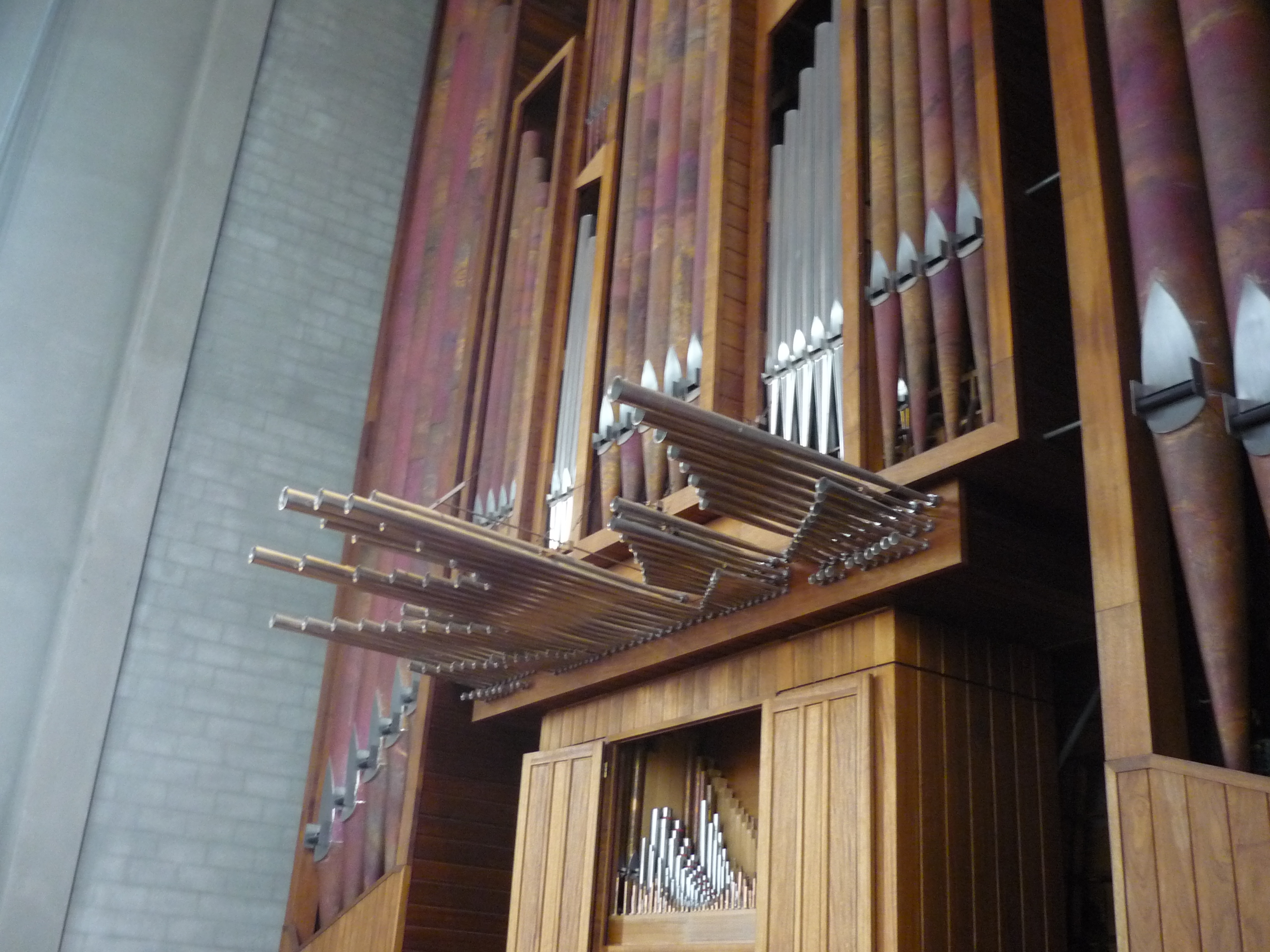
This organ was built by the Dutch organ builder D.A. Flentrop in 1965, and is particularly noteworthy as one of the first large all-tracker (mechanical) action organs built in the 20th Century, and became important in the movement towards traditional organ building practices. It was also the largest organ that Flentrop had built (4 manuals, 55 stops). My descriptions cannot possibly do the organ justice, you need to visit the cathedral in person to truly understand how large the organ appears. The cathedrals ceilings are 85 feet high, and the organ is on a gallery about 20 feet up. That puts the organ at somewhere between 45-55 feel tall. When I think about what was involved in getting all of those mechanical linkages to work across a span of that distance…
A complete stoplist is available from the St. Mark’s Website. Of note are the trompettes en chamade (horizontally mounted), the Rugwerk division that hangs over the balcony of the gallery (according to Joyce, the gallery was made large enough to fit a full orchestra and choir! I’d like to see that.), 32′ flue and reed pipes, and the small, intimate Brustwerk division. I’m still learning the conventions of the organ world, but I think this instrument is built with more of a French romantic tonal pallete in mind. This works really well with the large amount or reverberation that the cavernous unfinished concrete cathedral has.
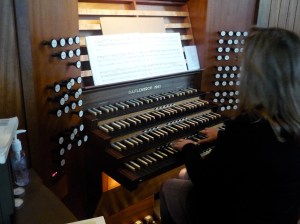
That’s all technical stuff. Which I don’t even have a solid handle on. I can only really speak to the aesthetics of looking and listening to it. I can tell you that the sound is as overwhelming as the size of the instrument. Joyce played a concert of mostly 19th and 20th century music, and on big dissonant chords, the sound became almost viscerally threatening. On the other hand, it was capable of very tender soft moments as well. I loved its Schalmei, a small reed stop, as well as its string stops (the way that this effect is achieved is by having two pipes playing the same pitch slightly out of tune with each other. It sounds much better than that might suggest).  Visually, it is staggeringly beautiful. Everything is in perfect proportion, and the pipes are covered in unusual oxidation patterns (the story goes that the pipes were constructed with higher-than-normal levels of copper, then soaked in urine to change their color). I don’t know about the historical correctness of inverse-colored keys on the console, but it looks cool too.

If anybody ever gets the chance to hear this instrument, I reccomend it.