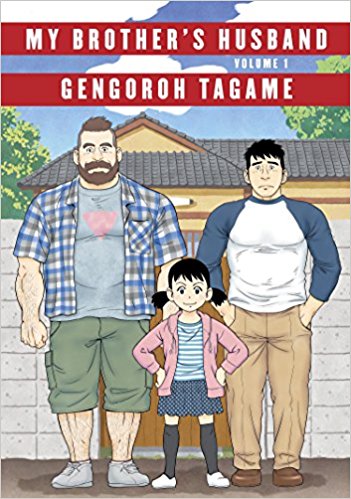
Bookshelf: My Brother's Husband, Vol. 1

516p0M0uyeL._SX349_BO1,204,203,200_The loveliest reading experience that exists is the experience of coming across the right book at the right time, and feeling so completely understood by it, and feeling like you completely understand it. I picked up My Brother’s Husband, by Gengoroh Tagame, because I read that it was going to be adapted into a live action TV series, and that made me think about how few Japanese LGBT narratives and stories I knew. There are many manga and anime series that play around with homoerotic subtexts and images (including my current favorite, Yuri on Ice!!!), however—and, please understand that I have a very superficial understanding of Japanese culture—my perception is that many of those tropes are a slightly performative and desexualized playgrounds of desire for (mostly) straight preteen girls. The other examples of queer tropes in the culture are probably worse, which are the eroticized bisexual/lesbian chic like Ghost in the Shell, a melange of  badass and charismatic characters that queer readers love but that were created for the pleasure of straight boys.
My Brother’s Husband is the story of Yaichi, who is forced to confront his feelings about his late twin brother, Ryōshi’s death and sexuality when Ryōshi’s widowed Canadian husband, Mike Flanagan, arrives at his doorstep to visit the town where the boys grew up. Mike is enthusiastically welcomed by Yaichi’s grade-school aged daughter, Kana, and this first of two volumes follows Yaichi through this brief visit as he struggles to balance his conflicted feelings about gay sexuality and his estrangement from his brother with his responsibility to his family and his love for his daughter. larger.jpg
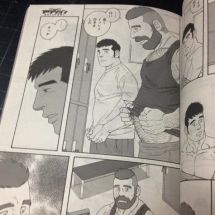
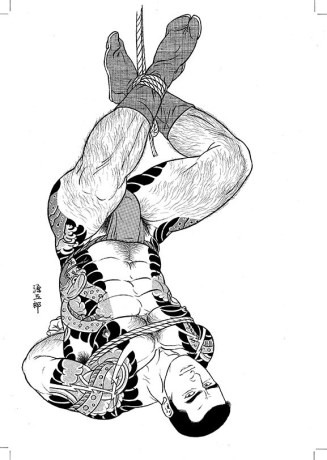
The sensuality of bodies is present on every page, in every panel. Tagame describes himself in his twitter bio as a “gay erotic artist,” and most of his work (which has not been officially published in English translation) is sexually explicit stories featuring BDSM themes and big, muscly, hyper-masculine men presented as both figures of fear and figures of desire. My Brother’s Husband, at least through the first volume, is completely G rated, however the art style is shot through with his aesthetic. When Yaichi meets Mike, he is overwhelmed by the reality of Mike and his brother’s relationship, but he is also overwhelmed by Mike’s physical self, his size, his strength, his beard, the hair on his body.
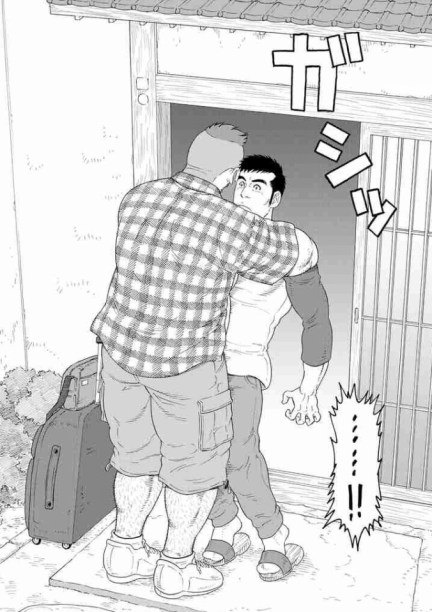
There’s not a whole lot of action on the surface; this is a very quiet domestic drama with lots of talking, Yaichi’s internal dialogues as he explores his own discomfort with Mike, and getting lost in his memories and regrets. But underneath all that is a whole story expressed through touch and care for the body. When Mike first arrives, he wraps Yaichi in a bear hug and calls him brother.
My-Brothers-Husband-1.jpg
This freaks Yaichi out, and he breaks out of the embrace and asks Mike not to call him that. As Yaichi explains to his daughter, Kana, “Japanese people don’t hug,” but he also admits to himself later that there is an undercurrent of homophobia and xenophobia to his response as well. Kana is completely unfazed by Mike, and is so excited to have a Canadian uncle that Yaichi’s standoffish attitude becomes rude by contrast. Yaichi’s comfort with Mike is shown without words through a growing physical intimacy, not through sex but through food, coffee and tea, the offer of a hot bath, a walk through a playground, and a shared visit to the gym.
I couldn’t help think about the deeper connection to Tagame’s erotic BDSM work. I only have an outsider’s understanding of that community, and on the kink spectrum, I think of myself as fresh vanilla bean ice cream (basic, but pretentious with an overinflated sense of self). That being said, I’ve always been fascinated to hear people share their experiences, and a big part of BDSM for a lot of people is that it provides a context for exploring pleasure and disgust, gender roles, toxic emotions, power dynamics, internalized homophobia, self-esteem, fight or flight responses, anxiety, sexual trauma, and a whole host of other really complex human experiences. Furthermore, it’s a way to cultivate an embodied understanding, completely different than understanding it intellectually. In other words, there’s a level of self-understanding that Tagame’s hypermasculine men can only access when they are having these heightened and risky sexual encounters. And in that same way, there is a level of acceptance of his dead brother that Yaichi can only get to, no matter what he thinks he thinks about him, that can only happen when he hugs his brother’s husband and feels love and connection and not discomfort.
53d0efd13ee39488a084f6514107ef5d.jpg
This is what really blew me away, and why I remain completely emotionally lit up about this manga: in some ways this is a very quiet, very small-scale, and almost a didactic domestic drama. These are the type of queer stories that are told to straight society, and every time there is a movement for queer liberation, there is a need to teach the same lessons: we’re just like everyone else, love is love, who I am is bigger than who I fuck, etc. And they’re beautiful stories, and they’re important stories. But they are the queer stories that are always told before the queer queer stories get told. But Tagame has told this very tame queer story in a very queer way, and in that sense he has queered the queer acceptance narrative*. That’s so cool, and it’s incredible that at this time, when LGBT visibility is still in early formation in Japan, that this artist has created this work with such a clear sense of social purpose without ceding any of his individuality and sensibility.

*Postscript: Queering the Text

I wanted to briefly explain what I mean by “queering the queer acceptance narrative,” which is an extension of the concept of queering the text. Wikipedia has a truly dreadful definition:

Queering is an interpretive method used in historical or literary study. It is based on the re-appropriated term “queer“, used for LGBT issues, but used as a verb. “Queering” means to reevaluate or reinterpret a work with an eye to sexual orientation and/or to gender, by applying interpretive techniques from queer theory. An example of “queering” would be to reexamine the primary sources from the life of King Richard I of England, to search for evidence that he exhibited homosexual behavior or attitudes.

This definition gets a little bit right, but a lot of bits wrong. Queering is definitely an interpretive theory, but it is way more of a reinterpretation (or reinvention) than it is a reevaluation. The way that queering works is to take something, and to upend it by changing some of its underlying assumptions. It’s similar to Juvenalian satire (treating something elevated with the contempt and disdain of the low, and treating the low with the seriousness and gravitas of the elevated), and has roots in one of the early forerunners of queer identity, the invert (the man who acts like a woman and the woman who acts like a man). Queering as a praxis is one of the true essentials of queer culture and you can spot it everywhere. Its in the mock seriousness (but also actual seriousness) with which queer culture treats reality television and campy melodramas. It’s there in the cultivated banal tone in which we talk about high culture.
So when I say that My Brother’s Husband queers the queer acceptance narrative, what I mean is that Tagame has taken something that is familiar, targeted towards a homophobic straight reader, and almost commodified, and told the story in a way that has roots in something edgy, sexual, and boundary-pushing, he changes it into something new.
Bookshelf: My Brother’s Husband, Vol. 1

516p0M0uyeL._SX349_BO1,204,203,200_The loveliest reading experience that exists is the experience of coming across the right book at the right time, and feeling so completely understood by it, and feeling like you completely understand it. I picked up My Brother’s Husband, by Gengoroh Tagame, because I read that it was going to be adapted into a live action TV series, and that made me think about how few Japanese LGBT narratives and stories I knew. There are many manga and anime series that play around with homoerotic subtexts and images (including my current favorite, Yuri on Ice!!!), however—and, please understand that I have a very superficial understanding of Japanese culture—my perception is that many of those tropes are a slightly performative and desexualized playgrounds of desire for (mostly) straight preteen girls. The other examples of queer tropes in the culture are probably worse, which are the eroticized bisexual/lesbian chic like Ghost in the Shell, a melange of  badass and charismatic characters that queer readers love but that were created for the pleasure of straight boys.
My Brother’s Husband is the story of Yaichi, who is forced to confront his feelings about his late twin brother, Ryōshi’s death and sexuality when Ryōshi’s widowed Canadian husband, Mike Flanagan, arrives at his doorstep to visit the town where the boys grew up. Mike is enthusiastically welcomed by Yaichi’s grade-school aged daughter, Kana, and this first of two volumes follows Yaichi through this brief visit as he struggles to balance his conflicted feelings about gay sexuality and his estrangement from his brother with his responsibility to his family and his love for his daughter. larger.jpg

The sensuality of bodies is present on every page, in every panel. Tagame describes himself in his twitter bio as a “gay erotic artist,” and most of his work (which has not been officially published in English translation) is sexually explicit stories featuring BDSM themes and big, muscly, hyper-masculine men presented as both figures of fear and figures of desire. My Brother’s Husband, at least through the first volume, is completely G rated, however the art style is shot through with his aesthetic. When Yaichi meets Mike, he is overwhelmed by the reality of Mike and his brother’s relationship, but he is also overwhelmed by Mike’s physical self, his size, his strength, his beard, the hair on his body.

There’s not a whole lot of action on the surface; this is a very quiet domestic drama with lots of talking, Yaichi’s internal dialogues as he explores his own discomfort with Mike, and getting lost in his memories and regrets. But underneath all that is a whole story expressed through touch and care for the body. When Mike first arrives, he wraps Yaichi in a bear hug and calls him brother.

My-Brothers-Husband-1.jpg

This freaks Yaichi out, and he breaks out of the embrace and asks Mike not to call him that. As Yaichi explains to his daughter, Kana, “Japanese people don’t hug,” but he also admits to himself later that there is an undercurrent of homophobia and xenophobia to his response as well. Kana is completely unfazed by Mike, and is so excited to have a Canadian uncle that Yaichi’s standoffish attitude becomes rude by contrast. Yaichi’s comfort with Mike is shown without words through a growing physical intimacy, not through sex but through food, coffee and tea, the offer of a hot bath, a walk through a playground, and a shared visit to the gym.

I couldn’t help think about the deeper connection to Tagame’s erotic BDSM work. I only have an outsider’s understanding of that community, and on the kink spectrum, I think of myself as fresh vanilla bean ice cream (basic, but pretentious with an overinflated sense of self). That being said, I’ve always been fascinated to hear people share their experiences, and a big part of BDSM for a lot of people is that it provides a context for exploring pleasure and disgust, gender roles, toxic emotions, power dynamics, internalized homophobia, self-esteem, fight or flight responses, anxiety, sexual trauma, and a whole host of other really complex human experiences. Furthermore, it’s a way to cultivate an embodied understanding, completely different than understanding it intellectually. In other words, there’s a level of self-understanding that Tagame’s hypermasculine men can only access when they are having these heightened and risky sexual encounters. And in that same way, there is a level of acceptance of his dead brother that Yaichi can only get to, no matter what he thinks he thinks about him, that can only happen when he hugs his brother’s husband and feels love and connection and not discomfort.
53d0efd13ee39488a084f6514107ef5d.jpg

This is what really blew me away, and why I remain completely emotionally lit up about this manga: in some ways this is a very quiet, very small-scale, and almost a didactic domestic drama. These are the type of queer stories that are told to straight society, and every time there is a movement for queer liberation, there is a need to teach the same lessons: we’re just like everyone else, love is love, who I am is bigger than who I fuck, etc. And they’re beautiful stories, and they’re important stories. But they are the queer stories that are always told before the queer queer stories get told. But Tagame has told this very tame queer story in a very queer way, and in that sense he has queered the queer acceptance narrative*. That’s so cool, and it’s incredible that at this time, when LGBT visibility is still in early formation in Japan, that this artist has created this work with such a clear sense of social purpose without ceding any of his individuality and sensibility.

*Postscript: Queering the Text

I wanted to briefly explain what I mean by “queering the queer acceptance narrative,” which is an extension of the concept of queering the text. Wikipedia has a truly dreadful definition:

Queering is an interpretive method used in historical or literary study. It is based on the re-appropriated term “queer“, used for LGBT issues, but used as a verb. “Queering” means to reevaluate or reinterpret a work with an eye to sexual orientation and/or to gender, by applying interpretive techniques from queer theory. An example of “queering” would be to reexamine the primary sources from the life of King Richard I of England, to search for evidence that he exhibited homosexual behavior or attitudes.

This definition gets a little bit right, but a lot of bits wrong. Queering is definitely an interpretive theory, but it is way more of a reinterpretation (or reinvention) than it is a reevaluation. The way that queering works is to take something, and to upend it by changing some of its underlying assumptions. It’s similar to Juvenalian satire (treating something elevated with the contempt and disdain of the low, and treating the low with the seriousness and gravitas of the elevated), and has roots in one of the early forerunners of queer identity, the invert (the man who acts like a woman and the woman who acts like a man). Queering as a praxis is one of the true essentials of queer culture and you can spot it everywhere. Its in the mock seriousness (but also actual seriousness) with which queer culture treats reality television and campy melodramas. It’s there in the cultivated banal tone in which we talk about high culture.

So when I say that My Brother’s Husband queers the queer acceptance narrative, what I mean is that Tagame has taken something that is familiar, targeted towards a homophobic straight reader, and almost commodified, and told the story in a way that has roots in something edgy, sexual, and boundary-pushing, he changes it into something new.

Night Sky With Exit Wounds – Ocean Vuong


The dedication to Night Sky With Exit Wounds reads: “for my mother [& father]” and the brackets between mother and father is one of the strongest threads in the weave of this collection of poetry. Ocean (I use his first name because I feel like I know him now and I’ve already fallen in love with his author photo & it’s a beautiful name too) writes sharply about the deep unembraceable hunger for love and touch and wanting that comes with a father that hits your mother and hugs you with liquor on his breath and scares you with his weapons and his physicality. But he also has that poets eye, compassionate and cosmic, that sees his father as the survivor of a terrible war and a terrible time. Sexuality is ever present and always questioned with suspicion in these poems. Straight women worry about becoming their mother in their relationships. Straight men worry about whether they are becoming their fathers. Gay men worry about whether they are their mother who sublimates her self for a man or their father who possesses another (not all straight relationships are like this, but I don’t see the value in pretending like most are not). 

Mixed race and immigrant children take the hard work of coexistence and assimilation into their bodies. The political status of your people are the winds that can blow self-esteem and security away. When I’m with white people, I say that I’m Mexican-American. When I’m with Latinos, I say nothing at all, because the real truth of it is that my home culture is neither Mexican nor American, it is the negotiated culture of my parent’s marriage. 

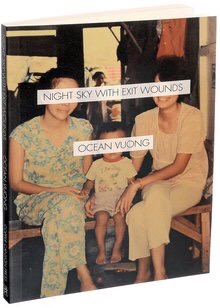
The cover photo is of Ocean as a young boy seated between two women. On his shirt is written—I gasped out loud when I made out the faded words—”I Love Daddy.” White bars with the title and author hide their eyes, echoing documents censored by the military, but also maybe protecting the people in the photos from being completely seen. You can still make out the scared expression on the little boy’s face.

The good: a cosmic and compassionate sense of the billiard balls of history, frank and steamy erotic images, aching heart like a bruise. 

The bad: I thought the collection could have trimmed a few poems and emerged stronger, some of the poems sprawled in a way that seemed messy, I thought that “Our Daily Bread” should have closed the collection. 

The ugly: no ugliness, except maybe for an ugly cry. 

🌟🌟🌟🌟🌟/😶✍🏼🌏🌊🌈🛠

The Handmaid's Tale

red stencil walkers
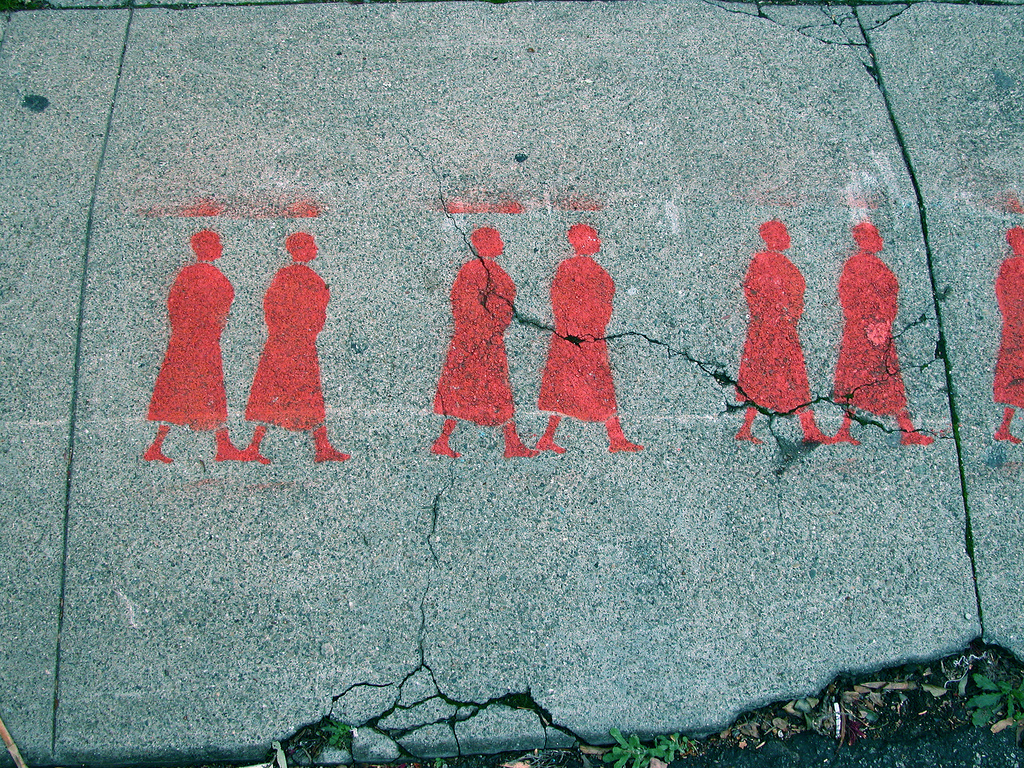
Many people that I know read The Handmaid’s Tale in high school. I didn’t. Because so many people come to it when they are younger, when they are developing their consciousnesses, I thought the book would be more polemical, more manifesto. The book makes a clear statement, and has the anger and righteousness of a manifesto, but I was surprised to discover that Offred’s voice was an ambivalent, human voice. I thought it was an extremely brave thing of Atwood to do to have so much of Offred’s internal monologues, especially her regrets, to focus on the loss of her child and husband. It would be less complicated to have a character that only has hate for men, only resents her own ability to create children, but by embracing that complication, the book seems more truthful to me. It’s incredible to think how much time has passed since the publication of the book, and how nothing so substantial has changed that it seems to invalidate the premise of the story.
I’m thinking of this story in Fortune about women in the tech industry. One way of saying that “Everyone was the same, and no one was like me.” is that these jobs are not designed to be filled by people who have a family. Sometimes that means no women, but even their male workers are expected to have a “traditional” family structure simply because these men cannot contribute in that way to the household. There’s a scene in the Tale where all women workers are summarily fired and their financial accounts frozen. We despise the men in that story for saying nothing. Maybe that wouldn’t happen in reality today, but if there was suddenly a new law that meant that maternity leave was more inconvenient/more expensive for employers and women workers suddenly found their careers stalled or themselves forced out, how many workplaces are there in which men would stand up? Would we say anything if it didn’t happen all in one day? Would I notice?

I’m also thinking of an episode of The Dick Cavett Show  I watched once while I was fucked up. Carole Burnett was the guest.I thought it was the craziest thing I had ever seen, because she was so comfortable, relaxed, bantery, funny. And also because she seemed to have the cool/funny girl schtick that I associate with entertainers like Mindy Kaling, Tina Fey or Lena Dunham. The pose that says that Sexism is bullshit and totally happens to me but I can joke about it and I’m not going to let it stop me because eh, what are you going to do? But then again, there’s something aggressive about a male interviewer opening his segment by grilling her about her sexual history. And we look at that as both banter and also as something uncomfortable, something that probably wouldn’t happen today. But if it did, it would seem “edgy” and “honest” and we would all get a thrill out of breaking the same taboo that Burnett and Cavett were breaking. Especially now as Lena Dunham becomes the center, again, of whether she is or is not a Feminist Icon of Our Times, I can’t help but look back and forth between Dunham and Burnett and the context of their times and think This will never be enough. And then I think about how lonely Margaret Atwood must get sometimes if she’s spent her entire life thinking that all of it will never be enough.

Slaughterhouse-Five

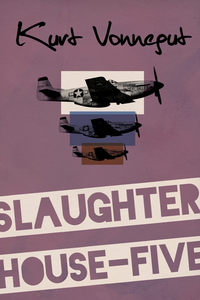
Slaughterhouse-Five book cover.


I finished Slaughterhouse-Five last night.

The first time I remember coming across the name Kurt Vonnegut was on Keith’s bookshelves. Keith was my music teacher’s husband, and while my sister was having music lessons, I would go upstairs and keep Keith company, watching him work on music projects or work in the yard, or talk about books. Keith’s studio was filled with tchotchkes and posters, furniture and figurines. It was such an exotic space to me: books about Orson Welles and Kurasawa, a large CD collection, reproductions of entertainment posters from Italy between the wars. That was the inception of an omnivorous and catholic appetite that later would lead me to Portland—I see his studio in Voodoo Doughnuts, or Hollywood Vintage, or any of the shadows of Old Portland—and now that I’m thinking about how I want to furnish my own space, all I want is to recreate it.

Keith had a lot of books too. Once I got a little older, the only reason that I got to read some of these books that might be talked about on NPR, The Corrections, The Island of the Day Before, was because Keith would pass them on. At the time, all I had to offer in return was the Left Behind series and Tom Clancy books. He also loved old detective noir: Earle Stanley Gardner, Dashiell Hammett, Rex Stout. And the only writer that had his own shelf was Kurt Vonnegut.

I have the mature person’s ability to look back on my own past, and with new perspective on living find new information in my own memory. I have the immature person’s desire to find tidy meanings in everything. After finishing Slaughterhouse-Five I thought back to Keith’s dry and sardonic humor, and then I decide to leave it.

I read Cat’s Cradle and didn’t get much out of it. There are some writers that write like the most polished and poetic versions of the best voices in my head: Zadie Smith, David Mitchell, James Agee. Vonnegut’s voice is their opposite: not bad or offputting, but completely alien. There’s a ferocity, and aggression to his sense of humor, and he has a way of hitting you with an insight or an idea or a horror, and never letting up to pause or consider but moving on to the next thing. That said, I really enjoyed Slaughterhouse, and I have a couple of naive thoughts to give:

The message is the message. In Slaughterhouse, the most tragicomic figures are those who no one listens to. Billy Pilgrim on the radio show. Wild Bob and his delusional belief that he will ever see Casey, Wyoming again. Kilgore Trout, who wrote over seventy books, not a single one of which made a penny. Conversely, scorn is heaped on those who corrupt the stories, who obscure the truths of what has happened, like Bertram Rumfoord, or the American Nazi Howard Campbell, Jr*. With this in mind, these repeated phrases, “So it goes,” “Po-te-weet,” and these mantras, “Everything was beautiful and nothing hurt,” and the serenity prayer, are like cultural deprogramming. They are powerful slogans, catchphrases upon which to build a foundation of peace in the same way that Wilfred Owen stole Dolce et decorum est forever from Virgil. Of course, the despair of the book is that Vonnegut does not believe in our own ability to change ourselves: even the closest human to the divine, Jesus, put into the world the same weapon that was used to hurt him.

There’s a way in which quotations, creeds, mantras have a lifecycle from obscure/profound to recognizable/tribal to ubiquitous/cheap. I never knew that  “Everything was beautiful and nothing hurt,” recognizable to me from hipster crosstich, email signatures, and tattoos, came from this book. I don’t think that Vonnegut would feel that this cheapens his idea. I think he would be proud.

Horror. I loved the way that Vonnegut moves around in time, and as we approach the horrific memory that is the center of gravity of the story, all rules of fiction come apart, like a body entering a black hole. The line between Billy and the narrator and the author becomes blurred. The extraterrestrial experiences that we want to believe are made up of bad pulp fiction and porn. The exotic countries of History and Past and Literature are threatened by the globalization of Vietnam and Reagan.

Beauty. I went back and forth between whether I thought this was an artless book or not. His prose is extremely plainspoken. Occasionally there would be an image of such spare, naive beauty that made me forget that debate at all. The passage where Billy watches a bombing raid in reverse is heartbreaking and universal and intimate all at the same time:

“It was a movie about American bombers in World War II and the gallant men who flew them. Seen backwards by Billy, the story went like this: American planes, full of holes and wounded men and corpses took off backwards from an airfield in England. Over France, a few German fighter planes flew at them backwards, sucked bullets and shell fragments from some of the planes and crewmen. They did the same for wrecked American bombers on the ground, and those planes flew up backwards to join the formation.

The formation flew backwards over a German city that was in flames. The bombers opened their bomb bay doors, exerted a miraculous magnetism which shrunk the fires, gathered them into cylindrical steel containers , and lifted the containers into the bellies of the planes. The containers were stored neatly in racks. The Germans below had miraculous devices of their own, which were long steel tubes. They used them to suck more fragments from the crewmen and planes. But there were still a few wounded Americans though and some of the bombers were in bad repair. Over France though, German fighters came up again, made everything and everybody as good as new.

When the bombers got back to their base, the steel cylinders were taken from the racks and shipped back to the United States of America, where factories were operating night and day, dismantling the cylinders, separating the dangerous contents into minerals. Touchingly, it was mainly women who did this work. The minerals were then shipped to specialists in remote areas. It was their business to put them into the ground, to hide them cleverly, so they would never hurt anybody ever again. The American fliers turned in their uniforms, became high school kids. And Hitler turned into a baby.”


*Any ideas about who Rumfoord is supposed to be? When I saw the name, I thought Bertram Russell, but that makes no sense. Howard Campbell, Jr. seems to be an analogue to George Lincon Rockwell.