It’s 8 in the morning, and I’m contemplating the philosophical difference between not practicing because I’m lazy, and not practicing because I’m crazy overscheduled every day. On one hand, it doesn’t matter. Skills only get better with consistent time invested, and regardless of the reasons, if the time doesn’t get put in, the skills are not going to improve. Still, it’s a little galling to be running and running and–in this arena–standing still.
Category: Journal
I almost impulse bought a piano
I don’t have any money. I don’t have any room for it. I have easy access to pianos elsewhere. But I almost bought a piano a couple of days ago.
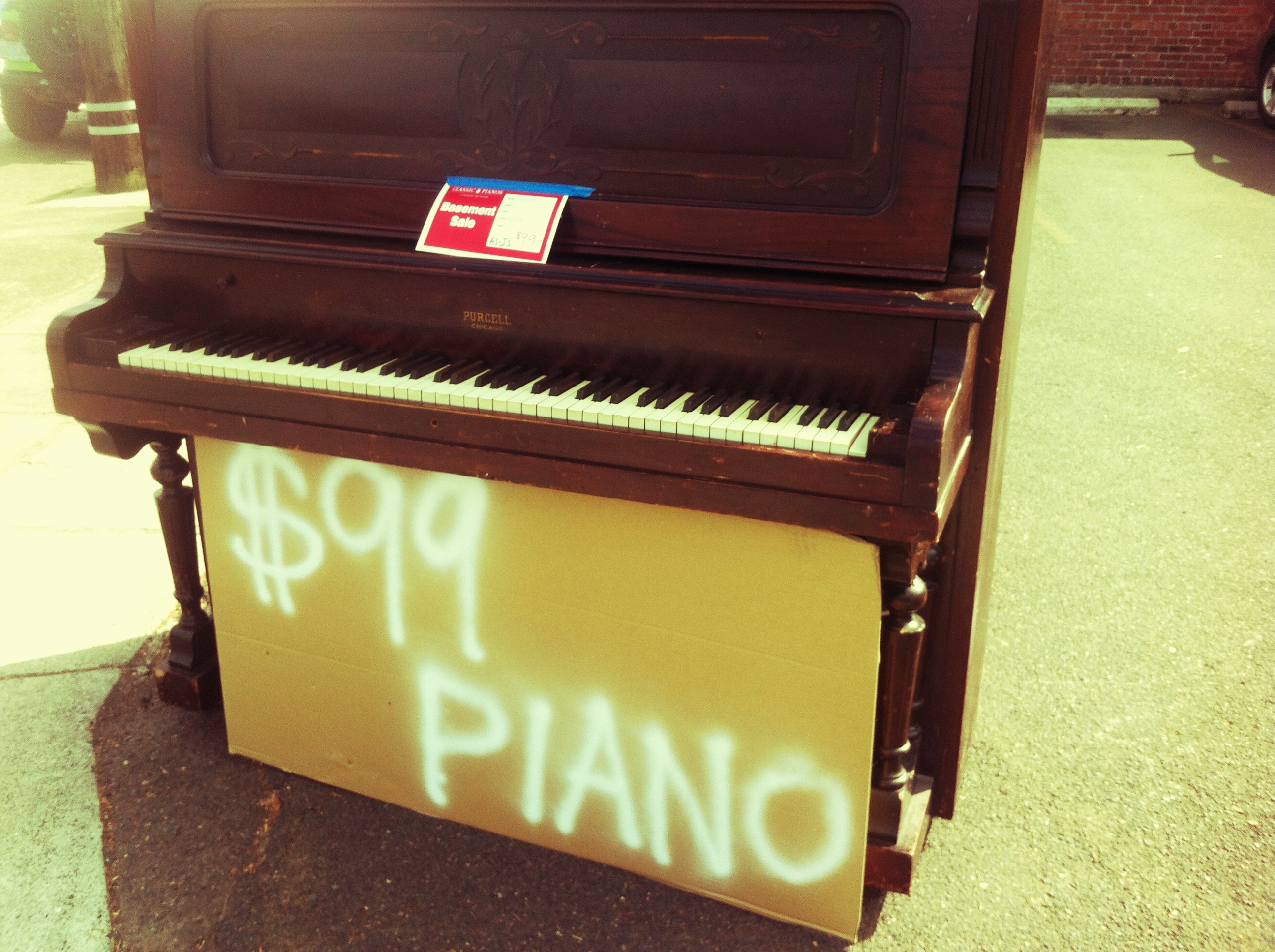
Classic Pianos, on Milwaukie and Powell here in Portland, has been having a basement sale to clear out inventory. As I was riding a bus into Downtown, that sign above, $99 piano, caught my eye. I don’t care what the piano sounds like, or how it’s been taken care of. If it plays and is capable of holding tune, 99 dollars is a ludicrously low price for a piano. I had an appointment with my therapist, but the whole time I was in session, a small part of my brain was arguing: “Dude, you have no money.” “Yeah, but, come on, I have $99. And you’re never going to see that price again.” “But you’re starting school next week, you’re going to need money.” “But it’s a piano.”
By the time the appointment was over, common sense had returned. It’s a hundred dollars, but that’s not the only cost associated with owning a piano. Plus, there was no was I was going to get my roommates to go for it. I decided that there was no way that it was going to happen, and I should head home after the appointment.
When my bus stopped at Milwaukie and Powell, there was a person in a wheelchair getting off, so we were stopped a little longer than usual. And in that brief extra time, my heart really wanted to touch the piano on the street, and my brain gave its OK. There was an upright, the one in the picture, as well as a charming spinet. The spinet was more in tune, as well as having a clearer tone, but as soon as I went over to check to make sure all the keys were working, a salesman came outside and invited me to check out the showroom and the basement pianos.
I walked into the store, and was immediately assaulted by the memories of wild pianos I have known. There was a black Bösendorfer, the same size as the one in the Reed College practice rooms. A gaudy white Yamaha baby grand that my 11 year old self would have drooled over. A classic shiny black upright, the piano that I always imagined I would have in my sophisticated apartment, or cloistered away in my home studio. A blonde parlor grand, like that owned by my music teacher. When I went downstairs to the basement, I was even able to find a couple of Baldwin Acrosonic spinets, like the one in my childhood home, though none of them was exactly the same model. Good thing, too. I might have lost it.
I was overtaken with some mixture of happiness, sadness, and a kind of deep excitement. Part of it was the nostalgia of recognizing the different pianos that I’ve formed an attachement to. Part of it was the simple regret that I don’t have a spare $3,000 or $5,000 to throw around right now to do it right. But the best part was a little of the childlike enthusiasm that used to be inseparable from the experience of playing and listening to music for me.
Once I had decided that I really wasn’t in a place to buy a piano, I just spent some time playing. I sat down at a beautiful Yamaha grand, and launched into my memorized five or six minutes of the Schubert Piano Sonata in B-flat Major, D.960. I haven’t made the progress with it that I’ve wanted, but for that amount of time, I can fake some level of virtuosity. There was a feeling of security and confidence that came to me, that this world is not a mystery, that these are things that I know, that this arrangement of black and white levers is neither foreign nor mysterious nor intimidating. These are my tools.
That was such a rush. That feeling of play and excitement often feels like something I misplaced. And retracing my steps these last couple of years can feel like being an amnesiac recovering lost memory. It’s frustrating, because at this point in my life, time feels like this ever accelerating force, like the frontiers of an expanding universe, but unless I have that sense of play, I will always be fighting myself musically. It was good to sit down in that room and play. It reassured me that, you know what, I’ve been doing this a while. I’m not the best, but I know some things. And I can do even better, even greater, if I get out of my own way.

Beck's Song Reader

Man, do I love this project.
In December 2012, Beck is set to release an “album” of sheet music. From the project page at publisher McSweeney’s:
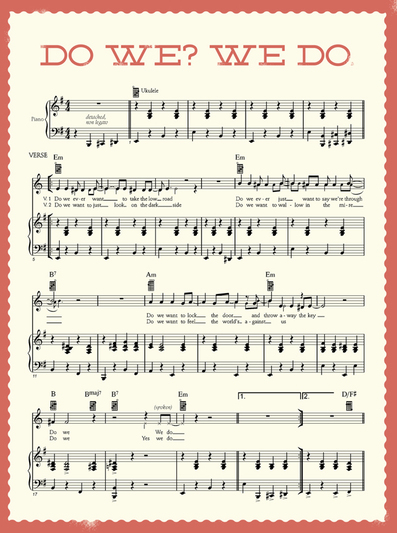
In the wake of Modern Guilt and The Information, Beck’s latest album comes in an almost-forgotten form—twenty songs existing only as individual pieces of sheet music, never before released or recorded. Complete with full-color, heyday-of-home-play-inspired art for each song and a lavishly produced hardcover carrying case (and, when necessary, ukelele notation), Song Reader is an experiment in what an album can be at the end of 2012—an alternative that enlists the listener in the tone of every track, and that’s as visually absorbing as a dozen gatefold LPs put together. The songs here are as unfailingly exciting as you’d expect from their author, but if you want to hear “Do We? We Do,” or “Don’t Act Like Your Heart Isn’t Hard,” bringing them to life depends on you.
This project is pushing every one of my music-nerd buttons. Of course it’s a gimmick, of course it’s a little precious. But we are going through a revolutionary time in music history, and this project is folding that history back on itself to bring back another time where the economic math of music was being recalculated.
Commercial music publishing is not a very important facet of the music business today. You can walk into any music store and see sheet music singles for Top 40 hits, but it’s also true that it’s easier to make a piano/vocal reduction of The Carpenter’s “We’ve Only Just Begun” than Ke$ha’s “TiK ToK.*” It’s hard to imagine from today’s perspective how disruptive a technology popular song sheet music was.
*Sheetmusicplus.com did have one hit for Ke$ha, surprisingly.
Notation (which is a kind of recording) introduced two important concept to music: the idea of a definitive version of a musical piece, and the idea of authorship of a musical piece. That first idea is inherent to the project of notation; just like speech, somebody might say things many different ways, or vary the way that they say it, but when you write something down, you’re only writing one thing down. The concept of authorship evolved over time. At first, as in Gregorian chant, a piece of music might be tied to the church or court that used it, the composer being anonymous. But as the composer evolved to become a separate artistic entity, there became only one Beethoven’s Fifth, and it was in one form and it was written by Beethoven.
But even through the invention of notation, even through the elevation of the composer, there was still no fixed concept of ownership of melody. Classical music constantly borrowed, stole, or arranged popular music or folk tunes; words were added to catchy classical melodies; people wrote new lyrics to popular tunes, dances and melodies disseminated and combined with each other. But when the commercial printing press combined with printed music, and the legions of newly middle-class women (usually) for whom a piano in the home and piano training were the markers of gentle society, you have a situation where independent songwriters can make a living by filling the void of new music. Remember, no record players. If you wanted music in the house, you made it yourself. And just as today, everybody wants new.
It’s impossible to overstate how influential these songs and songwriters were. Many of their compositions survive today, mistaken for folk songs: “Oh, Susanna” “Camptown Races” “Beautiful Dreamer” (Stephen Foster); “My Grandfather’s Clock” (Henry Clay Work); “The Daring Young Man on the Flying Trapeze” (Gaston Lyle); all of these were songs written and distributed as sheet music before the avent of recordings. Early recordings, in fact, were promotional material to sell sheet music! And even as revenue from the sale of recordings overtook that of sheet music, the dynamics of that era survive today through the power of the professional association for songwriters (ASCAP) and the large royalty payment that goes to the songwriter with every recording sold or licensed, often larger than that to the performer, largely because the songwriter holds copyright.
So let’s bring it back to Beck, and his song collection, and what it says about today.
First, I see it as a reminder that the economics of the music business are not set in stone, not given by God. The idea that I hand someone money for a physical object that contains a recording of a particular song by a particular artist is fairly new. Before that, I would pay money for a piece of sheet music that represented a particular song, but I was the performer. And before that I paid musicians, but there was no such thing as the definitive version of a song or a melody. Once, recordings were promotions for sheet music. Now, recordings may just be promotions for live shows. Of course this is going to change the quantity and the quality of the music we produce, but we’ll figure out how to make it work. Until something else comes along.
Second, I think this project is interesting in light of the conversations we’re having about remix culture and “audience” participation in works of culture. Think about it as a three-way tug-of-war between songwriter (or composer), performer, and audience. For all the talk of sampling, remixes, mash ups, YouTube covers, etc., we have to remember that the recording era had less audience participation than the sheet music era that preceded it. Beck is bringing music back to an era in which the act of consuming music was also an act of creation. It’s a nice reminder that, in an era where musicians are experimenting with interactive apps, or releasing workfiles to facilitate remixing, or even creating new music through fan videos, that the thing that hath been, it is that which shall be; and that which is done is that which shall be done: and there is no new thing under the sun.
tumblrwatch: mars edition
Tumblr mistakes a 2005 photo for the first image from the Mars rover Curiosity. *facepalm*
some housekeeping
I threw up a couple of rotating headers, just some pictures I’ve taken. Enjoy.