skyrim

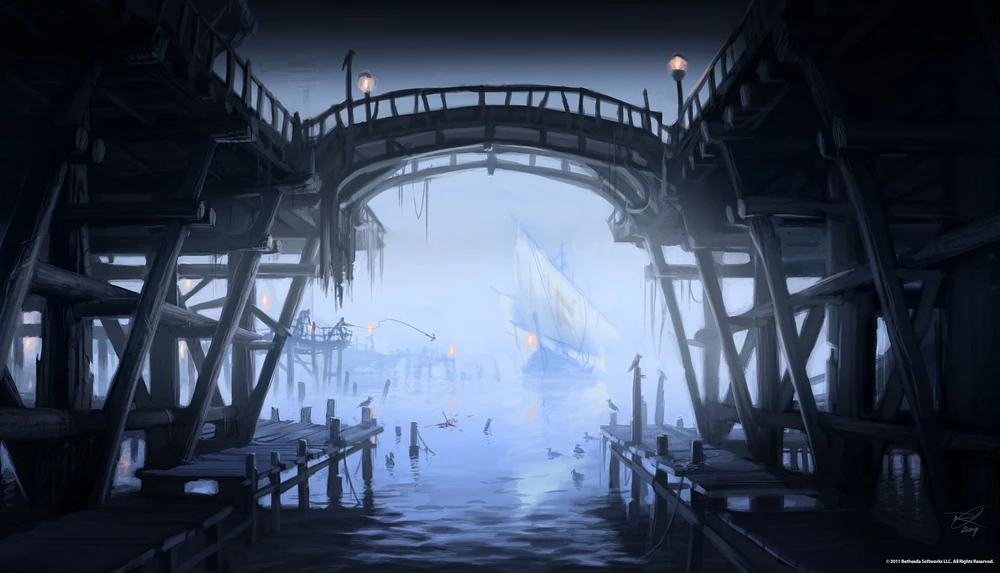
It’s dark in the tailor’s shop. As I extinguish each candle, the light dims and the bright yellow children’s dresses, green ladies’ gowns, and smart purple waistcoats settle deeper into dull nighttime grey. In a few minutes, I will close the front door and return to my rooms above the shop for a quiet supper. A bottle of cheap Alto wine and a heavy volume of A Dance in Fire will keep me company on the journey into sleep.


The door opens, and a striking woman made of cuts and muscle walks in wearing nothing but her smallclothes and a gaudy Amulet of Diabella perched on her head. She carries no knapsack, she has no pockets, but she walks slowly, groaning under the weight of a vast unseen treasure. An unhappy looking woman in full battle gear follows, too ashamed to meet my eyes.


“What do you sell here?,” the unclothed woman asked. “Ah, fuck it. Doesn’t really matter, does it? Here’s the deal: I would like to take all of your gold, and in return I will sell you these 700 decorative spider carcasses I found, for premium prices.”


What the fuck would I do with one decorative spider carcass, I wondered,  but when I opened my mouth to answer, the words that came out of my mouth were “I do hope you’ll remain in Solitude. The city could do with some new blood.”

I play video games one of two ways: like an addict or not at all. It’s not easy for me to complete a game. Online multiplayer stresses me out, I don’t have the interest or patience to refine my skills enough to master platformers or racing games, and sports games mean less than nothing to me. I can get very immersed in single player narrative games, but I quit in frustration when a puzzle or battle gets hard, and over time it becomes demotivating to boot up the console and immediately be faced with a difficult and frustrating scenario to move through before I can get back to having fun. I like action RPGs because their controls tend to be pretty simple and their short missions can produce a reward relatively quickly.


In the week between Christmas and New Year’s, I spent a lot of time playing Skyrim. Skyrim is over 10 years old but I tend to play the same games over again rather than seeking out new ones. RPGs fascinate me because they are nothing like life. Even if they do not have a fantastical setting (Is The Sims a deconstructed RPG?) they incorporate the fantasy that skills advance linearly, that we get to make informed decisions at the crossroads of our lives, and that we can reliably predict the consequences of those choices. If RPGs were more like real life, skill descriptions would all have conflicting information, all of it bad. Advancing one more level in one skill might close off others without warning. Halfway through your game a new tool might make all of the skill points you allocated obsolete, and you might discover late in the game that your buddy with all of the achievements started the game with a handful of advantages that you aren’t allowed to mention in their presence.


If you look at RPGs not as games, but as spiritual training tools—and why not so look?—you might notice that even though RPGs simulate the hero’s journey of growth and empowerment with all of the uncertainty and unpredictability  edited out of that process, there is one deeply human dilemma that emerges late in every RPG: the featureless boredom of a life lived too long or with too much ease or with too many resources.

In this play-through of Skyrim, I have progressed to the level where no battles are that challenging, loot and potions are plentiful, and the acquisition of trophies make no emotional impact. Take too much friction out and there is no story in the world that will keep a players interest. Most people are not inherently interested in optimizing weapons or endlessly visiting shopkeepers in a circuit to try and convert loot into gold.  There are different strategies out there to try and mitigate that boredom. GTA: V  brings in a property ownership layer to slowly convert the game into a simple resource management game; Destiny points you increasingly firmly toward online multiplayer content; Fallout 4 slows down your progression by introducing side quests that must be completed quickly to not lose conquered territory. 


So you start to do the things that are rewarding: weird collections, dressing up avatars, making virtual dollhouses, playing the parts of the game that you still find fun and ignoring the rest. I had a friend who tried to collect every coffee mug in Fallout 3, and in another game he kept a house filled with human skulls picked up elsewhere. Which—forget the skulls—is about the range of options that any human has left, once your needs are attended to. You also have the option of trying to figure out ways to break it, there’s a huge catalog of Youtube videos of players catching the perfect bug or perfect coincidence.


This also explains some of the stranger, anti-social behavior of the hyper-wealthy, behavior that I do not understand and yet affects my life so much directly and indirectly. Anybody with any interesting qualities or a healthy self-esteem would have taken the freedom to not have to work and done something more interesting with their time well before their wealth could be measured in billions. Gamers, playing an RPG past the point where the game had any challenge, compulsively optimizing their gameplay for gold acquisition is as good a lens as any to describe their affect and behavior. Time to prestige.

“knowledge and productivity are like compound interest”

Embed from Getty Imageswindow.gie=window.gie||function(c){(gie.q=gie.q||[]).push(c)};gie(function(){gie.widgets.load({id:’I4Pn5rcdQCBNBFhUe6TKcw’,sig:’UkLgFhnDVghlHVRh15Q898eEJLCTr4E2fdtDt0ngjQ4=’,w:’541px’,h:’318px’,items:’94993137′,caption: true ,tld:’com’,is360: false })});//embed-cdn.gettyimages.com/widgets.js

Richard Hamming was a mathematician and computer programmer who worked for 30 years at Bell Laboratories. In 1985, he gave a talk called “You and Your Research” in which he shared insights from his career doing mathematics research and, at Bell Laboratories, working near scientists at the leading edge of their field in math, physics, and chemistry*. Hamming’s talk is aimed at the researcher at the beginning of their career, and really any scientist who is interested in taking their work from “good” to “truly outstanding.” Although it keeps focus on research on fundamental math and science problems, Hamming notes, “Outstanding work is characterized very much the same way in most fields.”

Hamming’s talk is packed with clear insights about all sorts of things, from the importance of surrounding yourself with sharp people, the trade-off between pushing to reform bureaucracies and getting your own work done, aiming at the hardest problems in your field, to the ego issues that prevent people from doing their best work. I want to highlight a couple—although I could have chosen five or ten other ideas to focus on just as well.

we are socialized to value luck over work

In order to [reach] you individually […] I have to get you to drop modesty and say to yourself, “Yes, I would like to do first-class work.” Our society frowns on people who set out to do really good work. You’re not supposed to; luck is supposed to descend on you and you do great things by chance.

I initially bumped on the harshness of Hamming’s phrasing, mistaking it for contempt. As I read further, I realized that Hamming wasn’t making a value judgement on those who are not interested in doing the extraordinary work that Hamming is talking about, merely noting that the wider society does not value the kind of sacrifices and trade-offs that come with choosing ambitious work. Most of the stories that our society tells about people who do extraordinary work tend not to focus very much on the large amounts of time and focus invested in the work in favor of easier-to-dramatize storytelling devices like divine favor, transformational episode, or divine intervention.

(One red-hot example of this is the Netflix show Queen’s Gambit, which basically turns a story of a chess prodigy into a superhero origin story. Her progression from not knowing how all of the pieces move to a level of mastery such that she only loses two games in the whole show takes place in a single scene.)

A side effect of over-representing the role of luck in great work is that it imputes a kind of arrogance to those who are interested in pursuing that kind of work, as though they were saying not “I want to do great work” but “I’m a special person who can do great work.” Thinking of yourself as special is not a popular attitude to take in American society, but it’s a barrier to ambition that is completely artificial.

there is no quality time without a quantity of time

Knowledge and productivity are like compound interest. Given two people of approximately the same ability and one person works 10% more than the other, the latter will more than twice outperform the former.

The more you know, the more you learn; the more you learn, the more you can do; the more you can do, the more opportunity—it is very much like compound interest. I don’t want to give a rate, but it is a very high rate.

Given two people with exactly the same ability, the one person who manages day in and day out to get in one more hour of thinking will be tremendously more productive over a lifetime.

One idea that I encounter over and over in many domains (mastering an instrument and parenting are coming to mind) is the idea that, while not all time spent has the same value, the idea that a small amount of high-quality time can be a shortcut for large quantities of time is a delusion. In a cultural context in which we are pressured to monetize every spare moment and talent and in which economic pressure seems to never stop increasing, that delusion is very attractive. There is just no pathway to mastery of any field that skips investing lots and lots and lots of time and attention.

I felt a little implicated by this remark. I am well aware that I have things in my life that are “time vampires,” that keep me from following my curiosity and learning to its fullest potential. I feel very much that my challenge at this point in my life is learning how not to chase every rabbit, how to continue to focus, and preserve the conditions where my mind can do its best noticing and best synthesis.

That’s all for today. I hope you’ll check out the rest of the talk if any of this resonates.

*This talk was brought to my attention by Spencer Wright, in his excellent newsletter called The Prepared about various news, problems, and cool facts relating to physical manufacturing. Even though I have nothing to do with that field, I have learned so much about what is coming down the line in the coming decades as the internet and the build environment will continue to converge. Wright wrote his own post about the Hamming talk on his personal blog.

welcome back

Little Matt in 2008/09 ish.

I started this blog in the fall of 2008. It was a welcome project in my first year of college, in a new city and a new climate that made me want to stay indoors all the time. It was a distraction, a way to channel opinionated energy. During the zenith of the blogosphere, it felt like spending all of this time writing into littler browser windows was worthwhile because we all had firsthand experience of stumbling upon (r.i.p. StumbleUpon) a blog and falling down a rabbit hole of individual obsession and personal expression.

You had to be there, just like you had to be there when Tumblr was good and still had porn, or when Twitter was good and wasn’t full of Nazi grandmothers.

You do anything long enough and it accumulates its own gravity. Even though 95% of everything I’ve posted reflects a self that’s no longer around, I’m glad that it exists. I’ve been doing this long enough that I have learned to skip the apology post about not posting. No money is changing hands, this is something I do for my own satisfaction. Here’s what’s changed this time, though:

For the first time, I have moved to my own domain and I am managing my own hosting. In the summer of 2019, I took a programming class with Epicodus, a programming boot camp based here in Portland, and had a great experience. I learned how to use command line tools and got a very shallow introduction to the web development stack. I’ve been eager to get my own little piece of the web set up, and because this has been the most side of side projects, it took me a couple months to migrate the blog.

As frustrating as it has been, it has been very fun to learn more about how the internet works one level deeper than I understood before: how to configure DNS records, how to implement security certificates to serve the site over HTTPS rather than HTTP. Connecting remotely over SSH and FTP. I have invested a little money and a whole lot of time to get the blog to almost exactly what it was on the WordPress-hosted site. All of the positives are intangible, but they mean something to me.

I am hoping to keep writing. I thought I wrote about this already, but if I did I can’t find it: I do think that 2009 was the height of social media and the internet for me. Social media had not been monetized yet, let alone changed to serve us dark feedback loops of anxiety and desire. There were great people writing about film and tv and movies in a way that was so much fresher and obsessive than magazines and newspapers permitted. Gawker was incredible, music was easy to find. Doxxing was rare and the general tone was optimistic.

I am trying to find my way to the best of that. Engaging in slower, better writing than faster, worse writing. (Quickness is a valuable quality in wit, scorn, and parody, and not so valuable in other registers of writing.) Taking my recommendations from real people, not algorithms. Going away and coming back from the internet, like a hunter leaves the cave, rather than having everything brought to me predigested.

Part of that 2009 ethic is coming back to “long form” (1.e. more than 280 character) writing. I have the time to think right now. 2020 is a high-water year for distraction because everything is a distraction while nothing quite distracts. I hope you’ll read along with me.

hey there mister bisexual

Processed with VSCO with c1 preset

It is bi visibility day. One lovely thing about bisexuals is that—because it’s a tricky identity to wrap your head around—although folks come out as gay and lesbian according to a more or less microwave popcorn distribution centered around late high school and young adulthood, folks seem to steadily come out as bi as they assimilate that self-knowledge into the life and relationships they have.

I identified in high school as bisexual, but in college that didn’t last very long. I got really in my head about whether I was adopting the label because I was afraid to identify as gay, something that felt more taboo in the religious context I was raised in (more on that in a bit). In college I decided that because my attraction leaned heavily towards men, I might as well identify as gay and at the time it brought me a lot of satisfaction.

If the process of creating myself has been imperfect and absurd, coming to terms with my sense of desire has been downright chaotic. Boxes, labels… when we are looking for words to tell us who we are, they can be extremely helpful. Being named can help us feel less alone and make us feel like others who are like us have lived and have had meaningful lives. They are only ever shortcuts to self-understanding, though, and in the best case scenario, where they help you grow, one eventually grows out of them.

Once I put away some of my issues around body shame and being outside of the beauty ideal—a fucked up hierarchy that has so much power invested in it, particularly by gay men—I was able to rediscover my sense of play and exploration in regards to sexuality. It’s painful to think about how grim and serious my mental models for sex were 10 years ago. It was a hunger that could only be satisfied by metaphorically feeding off of, taking away from, someone else and (at best!) letting them feed off of you. Each the only one to see the true face of hunger. It was not a popular offer! Once I was able to trust others a little better and believe more in my own capacity to give pleasure, a whole different attitude that was light and playful and improvisatory and spontaneous and experimental opened up, and with that came better sex.

And an interest in exploring bodies other than cis men.

I think that I would have been fine with the (imperfect, contradictory) identity of “gay man who sometimes has sex with women sometimes and is pretty indifferent to the continuing decoupling of sex and gender,” but reading through Shiri Eisner’s Bi: Notes for a Bisexual Revolution. In addition to going through some of the negative stereotypes of bisexuals in media—the vampire/serial killer/sociopathic/hedonist, the bi-until-graduation, I Kissed A Girl And I Liked It—Eisner points out that bisexuals are particularly destabilizing to patriarchal values because every deviation from its rules is a choice. It’s true that there are not very many visible bi male icons, and there is nowhere near the level of definition about what their (our) role is in society, much less than the roles of straight man or gay man.

I’m still figuring out what it means to be bi in practice. I’m happy to be visible, to be counted, to surprise anybody that has known me for a long time and people who form expectations instantly when they meet me alike. If I can open up the idea that the world around you is messier and more complicated than it looks on the surface, that’s a good day’s work done.

The wind rises, we must try to live

I have spent the last week laid low by the extreme air pollution caused by multiple wildfires across northern California, Oregon, and Washington. Physical symptoms include burning eyes, nausea, migranes, nosebleeds, cough, wheeze, and dryness. Emotional symptoms include despair, helplessness, inability to focus, insomnia, and anhedonia. For several days in the middle of the week, the air in Oregon was the worst in the entire world.

The wildfires here are different than in California. Forest fires are a natural part of the life cycle in California, and the large fires we are seeing in the last 20 years are the result of catastrophically bad management. Forest managers and/or the politicians that supervise them decided to cut down the number of managed burns to almost nothing, leading up to a huge amount of fuel in the forests over large areas without managed fire breaks. In Oregon, forest fires happen but are once in a few generation events.

When British colonists arrived here, they found an abundance of large white oak trees, perfect for shipbuilding, which they—true to their nature as disastrous incompetents that ruined every ecosystem they came into contact with—cut down in great numbers. White oaks are hardier against fire than their faster-growing neighbors that they compete with, the Douglas fir. The pre-colonial landscape of Oregon contained a slow dance between the white oak and the Douglas fir: the firs would light-smother young oak trees, building up a dense stand, which would then burn down to the advantage of a lucky white oak that resisted the fire, earning enough light to get established and remain alive for several hundred years. It’s a beautiful dance, one that colonists put a stop to when they logged the white oak to near extinction, then stopped the wildfires, then started clearcutting the remaining monoculture leaving nothing but sterile mountainsides full of decay.

The forest are the land’s lungs, and they are burning.

For my entire lifetime, the forests of Oregon and Washington have been dangerous traps that look like enchanted landscapes. These traps are everywhere, and they are starting to knock into each other and go off: overfished oceans, pumped out aquifers leading to ground collapse, disruption of the water cycle, destruction of the atmosphere, mass extinction of animal species. They are all connected by one phenomenon: the capitalist market system assumes that the earth’s natural resources are infinite.

It’s comforting to think of the market as a circulatory system where money flows through exchanges of value, but if you zoom out far enough it looks like a giant system of roots, and at the tip of every root is someone extracting something out of the earth and not putting it back: mining, harvesting, slaughtering, fishing, felling. For all our talk of progress, there has never been a year since the Industrial Revolution where we have restored more than we have destroyed, planted more than we have harvested, or rested more than we have disrupted. The resources of the earth are not infinite, however, and we are starting to experience that collapse.

It has been difficult to accept that the slow disaster of ecological collapse is going to be the entire story of my lifetime, and nothing that I do professionally, artistically, or socially, will be more important than that story. Teenagers and folks in their early to mid-20’s got there a lot faster than I did. I had a childhood where environmentalism was a niche political issue instead of the loudest story forever, and that has opened a big generational divide between me and those just a little younger than me.

Despite the large challenges of climate change—and the more that I learn about the different policy choices that led to the world being as it is right now and the more that I learn about economics and the more that I learn about our scientific research system, the more truly convinced I am that we have all of the tools and resources, right now, to decarbonize the global economy—the fact that we don’t have a full consensus about the existence and scale of the problem is what makes me despair the most. I wish I could scapegoat uneducated white people as the roadblock, but I’ve seen ignorance about this problem from wealthy, educated white East Coast cousins and working class, high-school educated Southwest cousins both white and latino.

Individual actions are not going to be enough to fix this problem, and I set myself apart from a lot of my anticapitalist liberal friends because I don’t think that nationalizing industry or banning categories of businesses are going to do it either. It can be solved with a combination of aggressive taxes for the wealthy and taxes and regulation for industry and manufacturing that are polluting or have a negative effect on the ecosystem. This idea seems to make older folks nervous, but I don’t see why the status quo isn’t making them more nervous. It may seem like confiscating wealth to highly tax the wealthiest 50 people in the country, but it’s also confiscating wealth to set the conditions for unstable weather events, make property uninsurable, then do nothing as people lose their homes.

Voting isn’t going to be enough. There’s no question that **** has to be dismissed, but the center-left party is too reliant on the status quo to meet this challenge. I’ve used a lot of words to get here, but this is what I want to say: we have reached a tipping point of rolling, painful natural disasters. There is no longer a choice between change and no-change. The choice is between managed change and violent change.

I am a peace loving person, I love growth and building for the future and cycles. I am trying to find acceptance with the fact that those will not be the conditions under which I get to build my life.