
I started taking organ lessons at the beginning of the semester. The organ, partially because of its liturgical use and partially because of its fundemental complexity, exists in its own hermetically sealed sphere; there is a tremendous amount to learn about every aspect of the instrument. One of the most useful things an organ student is to try and gain experience and perspective by visiting, playing and experimenting with many different instruments. Although these updates will not be regular, I hope to post about the different organs I visit in my own language to the extent of the education I have now.
One of the most fun afternoons of my spring break was the brief time I had to visit the Rosales Op. 10 organ at St. Andrew’s Episcopal Church in Ojai, California. Manuel Rosales is a Los Angeles based organ builder who builds in a tonally postmodern style heavily influenced by French and Mexican organs. His magnum opus is the organ at the Walt Disney Concert Hall (Op. 24), however he first gained national attention with the organ at Trinity Cathedral in Portland, Oregon (the Trinity organ was build right after the instrument at St. Andrew’s).
The organ at St. Andrews is much more modest than those organs (15 stops and two manuals), however it has the same craftsmanship, sweet tone, and strong point of view that have come to characterize Rosales organs. There were some physical features that I noticed immediately. The pedalboard is flat, without the curved array ususal for American organs. The stops on the console are physically large (perhaps taking influence from Mexican organs). Because of the small size of the organ, the expression pedal controls small hinged doors on the case, not the usual louvres. This, and the facade prestant, gives the organ an incredible dynamic range; the chimney flute with the doors closed is nearly inaudible. Sara Edwards, resident organist, pointed out to me the decoration on the case; it incorporates local motifs like the oak leaves and acorns of the California live oaks that grow in abundance in Ojai, and the crossed fishes of St. Andrew.
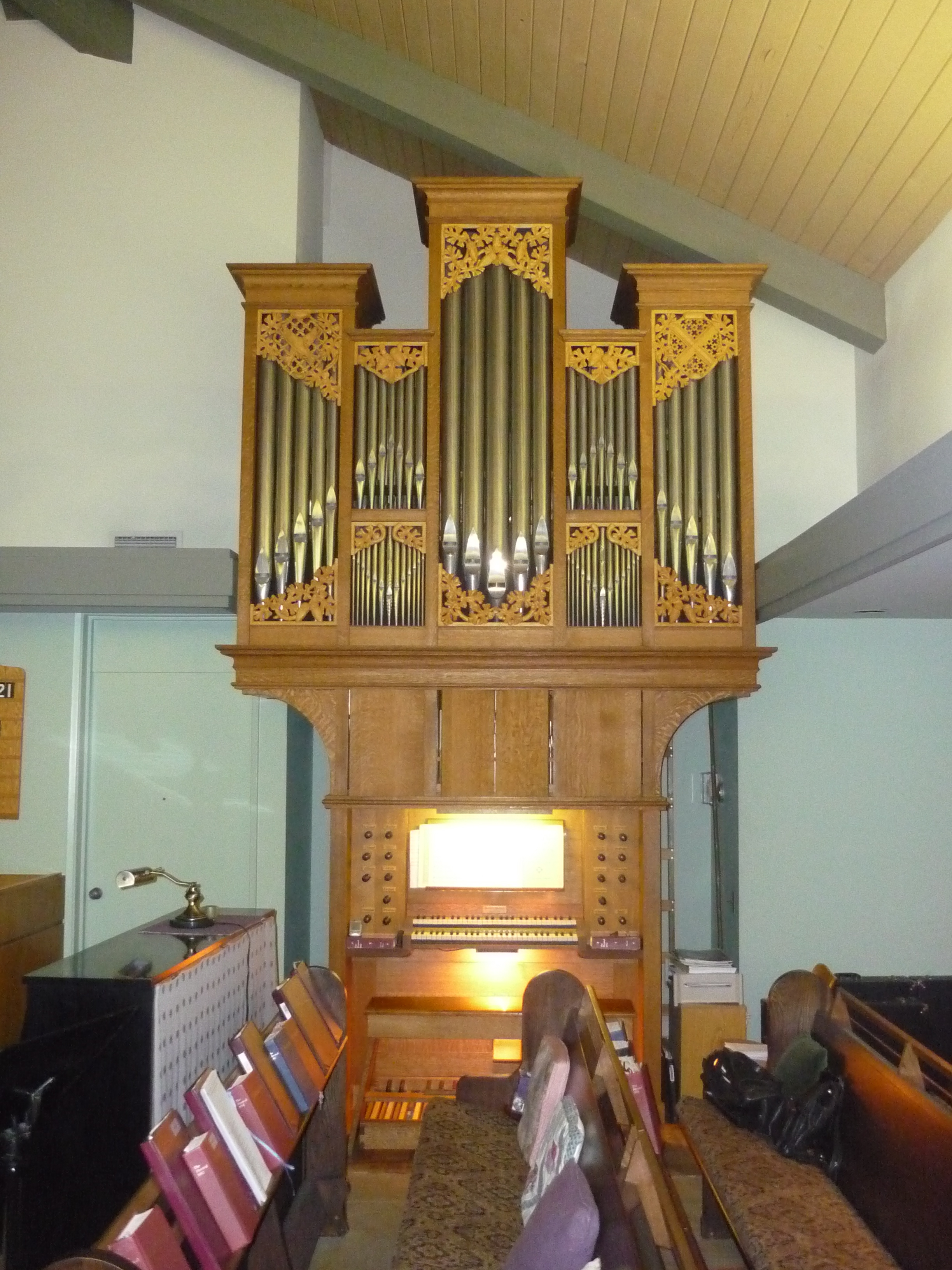
I’m still new at this, so I don’t have much of a palate to distinguish between different tonal palletes, however the organ did seem very sweet and mellow. As befits an organ of this size, the different stops seemed to be quite versatile. Almost all of them seemed like they could hold their own as a solo stop; I was particularly taken with the delicate 8′ chimney flute. Although I found the mechanics sluggish (it is a tracker [completely mechanical] organ), the 8′ trumpet sounded quite nice. I am generally suspicious of reed stops, but this one balanced boldness with richness. One thing that I found interesting when I first began to learn about organ building traditions is that, outside of a few basic stops, there is no standardized naming convention for organ pipes, they depend on the imagination and poetry of the builder. The stops at St. Andrews are named with traditional French labels, however the presense of the Dulciana in the choir division show Rosales’ Mexican influence (his Disney organ in particular has this in abundance with stops labeled Llamarada, Clarín armonico and Pajaritos*).
It was a real pleasure to play. I had heard the organ before, but didn’t know anything about them. It was interesting to find that there was such a treasure in my backyard.
*Pajaritos (little birds) is a stop that controls four birdolas, a kind of trick organ stop. Basically, before you play, you fill a small chamber with water, and the keys on the manuals control air burbling through it (almost like those plastic whistles you fill with water). One of my favorite things is all these trick stops on organs. They are most present on theater organs (like classic Wurlitzers) but they are also present in concert or liturgical organs. The St. Andrew’s organ has a Cymbal Star: basically air pressure spins a tine around which strikes a series of fixed cymbals.
Category: Music
Tuesday's Top Tune – L'Horloge de Flore
Jean Françaix was a French (approprately enough) neoclassical composer that lived through almost the entire 20th Century. L’Horloge de Flore is a suite for oboe and chamber orchestra, almost an oboe concerto in a different form. A floral clock is either a lansdscaping feature with a subterranean mechanics below a flower bed in the shape of a clock, or (as Françaix was inspired by) a bed in the shape of a clock that tells time based on the different times of the day that a flower blooms. Each movement of the suite takes its inspiration from one of these flowers.
I heard this on the radio as I was driving to the airport on Sunday. It pushes my musical buttons in all the right way; I really like the neoclassical technique of preserving the form and structure of traditional music while incorporating what were forbidden or alienating harmonies. I think it’s perfectly lovely, especially this first movement:
I. Galant du Jour (Poisonberry)
Quartet for the End of Time
These two videos (each illustrating one movement from Olivier Messiaen’s A Quartet for the End of Time) are truly remarkable. They feature artist Zack Smithey, and were produced by the Chamber Music Society of Lincoln Center for an upcoming concert.
Listening to these pieces in the context of the video was interesting for me as it allowed me to see my own musical growth. I remember listening to the Quartet after reading Alex Ross’ The Rest is Noise, and not being able to follow it musically. This time I had no trouble (due in no small part to the fact that I have just finished an intensive music theory unit on Debussy’s harmony).
Samuel Barber
Reed’s chamber choir is doing the Samuel Barber choral song set “Reincarnations” this semester. I had heard the pieces last year at the Chanticleer concert I blogged about last year. At the time, it didn’t make much of an impression on me, but as I have been listening to the pieces these past couple of days, I’m appreciating how good they are, and exactly why I love Samuel Barber’s music (it must be said that I think one of the reasons I didn’t think much of the piece at the time was that Chanticleer is an all male chorus. I really think that something in the piece is lost when there aren’t sopranos screeching in the ether.).
I’ve always found vertical harmony more interesting than voice leading. I guess there’s something to be said for the idea that those two things cannot be separated, but one of my favorite things about the late Romantic period and 1930’s-50’s Americana is the big, meaty, interesting chords they use and the sudden changes in tonality they bring. I sometimes wonder if that perspective is an artifact of my immersion in rock and pop right as I gained critical maturity. Barber’s use of vertical harmony is always interesting. His most famous piece, Adagio for Strings is basically just beautiful chords moving from one to another.
Barber also makes me think about what it means to be a genius. I’m taking a class on Minimalism right now, and one of my teacher’s favorite aphorisms is that, “All great composers have been avant-garde.” Barber was never really avant-garde. His music used all of the techniques available of the time (according to Wikipedia, he even wrote some atonal music late in his career) but he was never known for pushing the boundaries of the tonality of his time. He worked in traditional genres and orchestration arrangements. And yet, I think some of his music is truly sublime, and near-perfect. Now, it’s possible that it’s just too early to say that Barber will be remembered by music history. It’s also true that he is probebly not the first name that pops up in someone’s head when talking about 20th century composers. But I do think that to ignore him becuase he wasn’t avant-garde would be a mistake, because his music is well crafted, unique, and genuine.
This is a little bit of a non sequiter, but that last idea reminded me of an article that I once read somewhere that framed the conflict between Schoenberg-style serialism and Coplandesque simplicity as one between straights and gays. Schoenberg, Stockhausen, Berg, all straight. Barber, Copland, Berenstein, huge queens. It’s not a serious argument, but sometimes I wonder if that delicacy and sensitivity to aesthetics found in their music is a wierd expression of the person. Probebly not. There were/are gay serialists, and the whole idea rests on stereotypes. Still, I wonder if my aesthetic preferences have something to do with the way that they wrote their music.
*The CD that the above YouTube video steals from is The Dale Warland Singer’s Reincarnations, which is top notch. I cannot reccomed it highly enough. I would have embedded the other pieces in the set, however they are not all available on YouTube, and the live versions there are a little inconsistent. Here’s the two other pieces in renditions that are not too bad:
Reincarnations I: Mary Hynes
RIP Alicia De Larrocha

Spanish pianist Alicia De Larrocha has died. When I was about ten, I recieved a CD of Romantic classics. Totally cheezy album art (it was called Dreams of Love: The Ultimate Romantic Piano Collection) and packaging, but it was really good for me at the time. It was my first exposure to some of the biggest solo piano standards of that period, and definitely reinforced my love for rubato and the pedal-heavy virtuosity of that literature.
One of the tracks was Alicia De Larrocha playing one of Grieg’s Lyrics Pieces. I remember imagining what she might look at. Alicia De Larrocha is one of the greatest names ever; it is stacatto in the given name and a precipitando in the double r building toward a climax. I imagined that she was thin, with dark hair and an inscrutable expression that spoke to the depth of emotion that she accessed to play her music.
Of course, De Larrocha was a short woman that looks like she could be a cool granny. But still I feel like we have a connection, and I am sorry to hear that she has passed.
 hammer & jack