
Now that it’s only a couple of days away, I am really excited for the release of Watchmen. Last night, my brethren and I (the men and women of the Mediaphilia dorm) had a great time picking apart various early reviews, including this stinker from Anthony Lane of the New Yorker. Now, I haven’t seen the movie and it’s entirely possible that the movie is merely ok or even bad, but a review that lambasts the movie for being pseudo-intellectual and pretentious is really ironic coming from the New Yorker.
Lane manages to load the review with comic book reader stereotypes (“leering 19-year olds” “whose deepest fear [is]… meeting a woman who requests intelligent conversation”) that are so tired they’re laughable, all while missing the point of the comic and movie so completely that it led a fellow Mediaphiliac to smirk, “It’s so much fun to see a New Yorker writer completely outsmarted by a comic book.” Lane claims that, “Whether [the] Watchmen have true superpowers, as opposed to a pathological bent for fisticuffs, I never quite worked out” and that “The problem is that Snyder, following Moore, is so insanely aroused by the look of vengeance, and by the stylized application of physical power, that the film ends up twice as fascistic as the forces it wishes to lampoon.” No shit. Congratulations, you recognized the two things about the comic book that made it stand out from the genre when it was published and for which it is beloved, and yet completely failed to understand them.
All of that was a long preamble to this discussion about the soundtrack to the film.
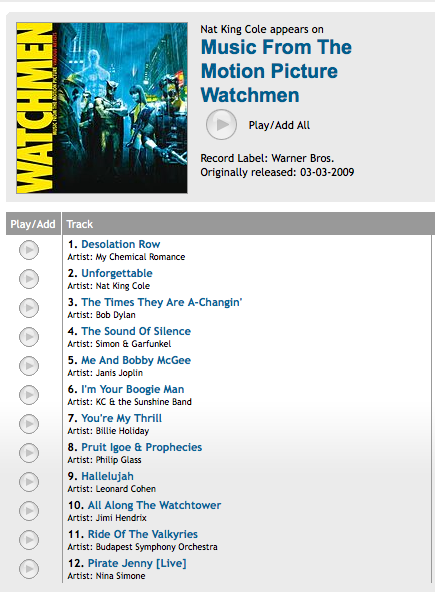 I think it’s an incredibly interesting, bordering on weird, selection of songs. I’m going to guess that “Ride of the Valkyries” is going to be used in a Comedian Vietnam flashback, considering how that usage in Apocalypse Now is so firmly ingrained in the popular culture. The Philip Glass track from Koyyanisqatsi was used in a trailer and I can see it being used in the film. Because its a cover of a classic Dylan track and that its from the only artist of the 21st century, I think “Desolation Row” will be playing over the credits. As you can see from the lyrics here, “Pirate Jenny” is the Kurt Weill song that narrates the story of the Black Freighter (which we have been promised will appear on the DVD).
Taking those songs out of consideration, we are left with a collection of songs from classic 20th century songwriters. I am a little concerned that some of these songs will be used a little too heavy-handedly. I am already imagining a wince from the line “freedom’s just another word for nothing left to lose” in “Me and Bobby McGee.” But, in keeping with the original goal of this series, all are top tunes.
———————————————————–
Now, the contest. In Anthony Lane’s review, he uses the phrase “cod mythology,” a Google search of which brings up only references to literal cod mythology and message boards trying to figure out what cod mythology means in reference to the review. I will give a digital blue ribbon, and a place on my new contests page, to the person who comes up with the definition of cod mythology or the most entertaining attempt. Here’s the original context:
The world of the graphic novel is a curious one. For every masterwork, such as “Persepolis” or “Maus,” there seem to be shelves of cod mythology and rainy dystopias, patrolled by rock-jawed heroes and their melon-breasted sidekicks.
Category: Music
Tuesday’s Top Tune – Clementi Sonatina No. 3, Op. 36
The sonatina begins nice and gently, a C major arpeggiated scale over a rocking left hand accompaniment. I close my eyes, the muscle memory established almost six years ago taking over. As soon as the memories return, so did the bad habits. I open my eyes and told myself to pay more attention to the dynamic markings and observe the staccato. I remember to take my foot off the pedal, an amazing dynamic tool that recklessly when I was last taking lessons in middle school. Get off the pedal! my music teacher used to say, you’re drowning out the sound. On Baroque pieces where pedal is completely stylistically inappropriate, we would have an argument that ended up being repeated so much it could have been scripted. This music was written for pianoforte or harpsichord, she would say, they didn’t have pedals. How are you going to observe the staccato markings if the pedal is always down? But it sounds better this way, I used to respond with exaggerated exasperation. There would be a little back and forth. I always won.
I make my way through the second movement, a beautiful, short piece of music that moves at such a slow pace that although my memory is a little hazy, I am able to sight read it. That’s what surprises me most. Although I have rarely looked at piano music these last few years, I find that I am much better at sight reading. It’s part of what pushed me to restart lessons. After always thinking of myself as a piano player that sings for fun, after a few years of choral singing, voice lessons, and no piano lessons, I find myself in the uncomfortable position of being more technically accomplished at my “on the side” singing than I am at what I thought of as my primary instrument.
I start in on the third movement. At once I start to feel things falling apart. After too long of only playing octave bass lines, my left hand is having a hard time playing the even and precise accompaniment. My scales in my right hand are lagging. I feel like I am just starting the scale and hoping for dear life that I can hang on. Sure enough, I screw up the Alberti bass in the left hand and get completely off the scale in my right. Fuck, I mutter to myself. I immediately play a jazzy show tune cadence. It’s a tic I’ve developed lately, probably a desperate action to persuade myself that I am not as bad at piano as my current studies make it seem. But I should be better because I’ve played this before.
Muzio Clementi (1752-1832) was an Italian composer that worked most of his life in England. He was a friend to both Mozart and Beethovan, an excellent harpsichordist and organist, and is acknowledged as the first composer of solo piano music. He wrote over 100 piano sonatas, and many more shorter works of which Op. 36, a collection of sonatinas used often as teaching pieces, is, by volume alone, his most performed work. Ironically, it is this popularity that until recently hurt his reputation as a composer. Of course, being in competition with Moz’ and the ‘Thovan is no easy business for any composer, but the popularity of his sonatinas led to Clementi being dismissed as a “children’s composer.”
And what children! As I was looking for videos of this piece on Youtube, I found about thirty videos. The oldest pianist that I saw was 16. The youngest was 4. They range from videos taken in living rooms to recitals (including one recital where they had grafted some Frankensteinian string and woodwind accompaniment. It literally made me want to vomit. They changed the chord structure and everything. No respect). The performances ranged from mechanical and robot-like to excessively rubato and, yes, too much pedal.
Probably the way that I performed it when I was thirteen. I remember the first time I played it in a recital. I had the piece completely memorized. Sigh. I used to be able to do that. Unfortunately, I hadn’t paid particular attention to the repeat symbols, and found myself trapped in a circle, playing repeats over and over again while I desperately tried to remember how the transitions worked and the piece ended. Finally, I just improvised an ending. I’m still good at that. Only my music teacher noticed.
I also remember when I was applying for a place at the private prep school I attended. My personal reccomendation from my music teacher was the crown jewel of my application, so when my interviewer invited me to play for him, I jumped at the opportunity. The sonatina was the most impressive-sounding thing I had memorized, so I played that for him. I was accepted to the school, and when that admissions officer left the school the same year that I graduated, he told me that he still remembered that performance.
I return to the first movement, but the mistakes in the third have made me nervous, and so I decide to step out and have a drink of water. As I walk down the stairs, I can hear everybody in the building practicing. It used to be the residence of the president of the college, and there was no soundproofing done when the house was converted. I can hear a piano student practicing a Brahms sonata. A bassoonist is practicing arpeggios. A clarinet is wailing and squeaking out the opening solo from Rhapsody in Blue. All seem to be taunting me. I get a cup of cold water and step outside. It feels so humiliating, to be showing my piano skills in college to a new teacher with the same piece that I started high school with. That I started learning in middle school. I feel so much older and mature than I was then, but it seems like some things haven’t grown along with everything else.
Of course, I still played piano. But without formal lessons, the repertoire that I had built up languished and was finally forgotten. No new technical skills were gained. I started singing, and used the piano to accompany myself, and gradually found a fairly unique gospel influenced piano style that I could use to play anything. The performances I gave in high school sparked a fire that I hope are never extinguished. And yet, as I try and reorient myself as an academic musician, I realized that my stagnating formal piano skills were going to become a liability.
I go back inside, and check my cell phone. It’s getting late. The building technically closes at midnight, but I’ve never been kicked out. I practice for a while longer, finally getting the piece to where I am confident that I won’t embarrass myself. My new teacher is a specialist in historical pianoforte and harpsichord performance, and I worry that she will look down on my crude approximation of a Classical piano piece. At any rate, it’s too late to do anything about it now, the lesson is tomorrow and I have class before the lesson. I go back to sleep, grateful that my dreams appear to be largo, not vivace.
I exhale, hands trembling. I am never nervous about performing for others, but I have so little confidence in myself as a classical pianist that I am as jittery as an abused cat. I start to play, but immediately have to restart; the shakes in my hand caused me to not press hard enough on the keys, giving a weak, inconsistent tone. I start again, playing fine through the first repeat, getting ready for the scales ahead-
“You can stop now. I’ve heard all I need to hear,” she interrupts
I stop, trying to reorient myself, still mentally rehearsing the phrases to come. Belatedly, I start to process her words. I don’t know her very well, is this good or bad?
“You play very well, and very easily and smoothly.”
Good.
I may have been humiliated to open lessons with that piece, but recently old Muzio and I have come to an understanding. Now that I will never have to play it again, I can accept it as a beautiful piece. At the very least, I have a debt of honor to the piece, considering how it has helped me at various stages in my life. Now that lessons have again become a part of my weekly routine, the old feeling that I am going somewhere with my music comes back. Who knows? Maybe the sonatina will be a part of my music if I can progress to a professional level. If it is at all in my power, however, it will be just as an encore.
MP3’s feat. Monical Alianello courtesy of http://pianosociety.com/cms/index.php
Bach and Beyond – Gabriela Montero

One of the more interesting moments of the Obama inauguration on January 20th was, for me, the John Williams penned “Air and Simple Gifts.” Many classical music bloggers were happy to have a piece of classical music featured as part of such a high visibility ceremony. Of course, it pales in comparison to other historical offerings; for example, Abraham Lincoln staged Flowtow’s opera Martha for his second inauguration. But even though the piece was light (Yo-Yo Ma referred to it as the “Quartet for the Next Four Minutes”), it was nice and tonal.
One thing that I did not know however, was who Gabriela Montero, the pianist of the quartet, was. Unfortunately, it seemed as if at any one time, either Montero or the clarinetist, Anthony Gill, was cut out of the frame. I went googling to track her down. Thats where I saw this video:
Needless to say, after this, I was in love.
I next hunted down her 2006 CD, Bach and Beyond. I don’t know how much I could hold it up as one of the essential albums of all time, but it’s certainly way fun. The songs are basically extended improvisations on Bach warhorse piano repertoire like Jesu Joy of Man’s Desiring, Sheep May Safely Graze, and pieces from the Well Tempered Clavier. All are pieces that people who don’t listen to classical music would recognize. For those of us who do, many of these pieces we have heard too many times to count, and it’s a lot of fun to hear when she breaks off from the written music and explore the chords and melodic possiblilities.
Another part of why this is so fun is the sheer amount of sources she draws from in her improvisations. In addition to the ragtime that you hear in the video above, she also throws in swing, neo-impressionist piano, jazz, Rachmaninoff-esque big Romantic gestures, as well as the Latin rhythems of her native Venezuela.
I highly recommend giving it a listen, even if it’s only as background music. Then you can do a double take when she seamlessly turns the Toccata in D Minor into a funky Latin jam.
You Are The Blood – Sufjan Stevens
I literally cannot shut up about this song. I know that I have annoyed two of my friends to within an inch of their life by playing this song over and over. So, I think the best way to do this is to give the top 5 reasons why this is my favorite song right now;
1. It’s the last thing that I would have expected from Sufjan. He has made his fame by doing songs that are too fully orchestrated to be called folk, and yet sound like almost nothing else from the indie rock genre. Before this, I guess I had heard some electric bass and guitar on some tracks, and digital distortion on some of his throwaway songs from leftover compilations (like Seven Swans), but here he embraces everything from Radioheadesque noise to drum machines.
2. One of the features that I have always liked most from his music is the rich brass orchestration found in many of his songs. He does that and puts it on steroids. His brass sounds dark and rich, and with jazzy chords and precise rhythms that bring to mind 60’s film scores with jazz orchestras (think James Bond scores). Now that I write this, I would be extremely curious to hear a Sufjan Stevens film score.
3. Another one of my favorite things in all music is the postmodern concept of the mixture of high and low art. Often, the product of these marriages is irredeemably kitschy, like Tiësto’s Adagio for Strings. But when done right, and here I think it is, it can be unbelievably cool to go from a neo-Romantic piano cadenza to a drum machine and brass finale.
4. Another thing that I like a lot is that this song is unafraid to have a full dynamic range. This song has sections that are really quiet, while the loud parts could shake buildings. There has been a documented trend in popular music to make music uniformly louder, often by sacrificing dynamic range. It’s actually a little insulting. What you are basically saying to the musicians is to keep your music at a uniform level so that when we turn it down, it stays quiet so that we don’t have to listen to it (or, conversely, when people are bumping to your music, don’t blow out their speakers). I could do a whole other rant about how nobody actively listens to music anymore, but I don’t really want to.
5. Finally, I like what it says about Sufjan as an artist. I listened to the original version (a pretty good song by the Castanets), and it’s pretty cool to listen to that source, then hear the little nuances that must have given him ideas about how to interpret the song.
Freeze The Saints – Stephen Malkmus
Finally! A Tuesday’s Top Tune that actually makes it to press on a Tuesday! Maybe I am getting the hang of this thing after all…
“Freeze The Saints” appears on Pavement frontman Stephen Malkmus’ solo album Face The Truth. The song opens with its piano hook, a simple iteration of the major scale. Likewise, the most memorable line, “Help me languish here” is a simple arpeggiation of a major chord. The most simple, uncomplicated unit in music. Like the rest of the song, it is simple and carefully controlled; forgoing loud displays of passion and dissonance and allowing the beauty found in simplicity.
The lyrics have some value as well. I don’t want to parse “We meet again, riding our divisible bodies,” but the central line of the song sums up its tone well: “Help me languish here.” Richard Rodriguez recently did a very interesting episode of blogginheads.tv (that I will write about later this week), and one of the things that he mentioned was that the notion that happiness should be our ultimate personal ideal is a uniquely modern, and uniquely American invention. For much of human history, no doubt as a consequence of harsh living conditions and religion, the ultimate reward in life was peace, or grace. When viewed in this light, the narrator’s plea that the person that he loves stay with him and help him fade and grow weak becomes a statement of resignation, of resolve, of acceptance.
Or maybe I’m just reading too much into this.
 hammer & jack