
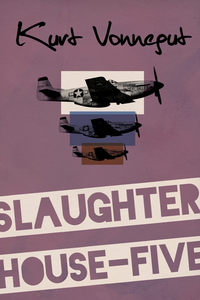
Slaughterhouse-Five

Slaughterhouse-Five book cover.


I finished Slaughterhouse-Five last night.

The first time I remember coming across the name Kurt Vonnegut was on Keith’s bookshelves. Keith was my music teacher’s husband, and while my sister was having music lessons, I would go upstairs and keep Keith company, watching him work on music projects or work in the yard, or talk about books. Keith’s studio was filled with tchotchkes and posters, furniture and figurines. It was such an exotic space to me: books about Orson Welles and Kurasawa, a large CD collection, reproductions of entertainment posters from Italy between the wars. That was the inception of an omnivorous and catholic appetite that later would lead me to Portland—I see his studio in Voodoo Doughnuts, or Hollywood Vintage, or any of the shadows of Old Portland—and now that I’m thinking about how I want to furnish my own space, all I want is to recreate it.

Keith had a lot of books too. Once I got a little older, the only reason that I got to read some of these books that might be talked about on NPR, The Corrections, The Island of the Day Before, was because Keith would pass them on. At the time, all I had to offer in return was the Left Behind series and Tom Clancy books. He also loved old detective noir: Earle Stanley Gardner, Dashiell Hammett, Rex Stout. And the only writer that had his own shelf was Kurt Vonnegut.

I have the mature person’s ability to look back on my own past, and with new perspective on living find new information in my own memory. I have the immature person’s desire to find tidy meanings in everything. After finishing Slaughterhouse-Five I thought back to Keith’s dry and sardonic humor, and then I decide to leave it.

I read Cat’s Cradle and didn’t get much out of it. There are some writers that write like the most polished and poetic versions of the best voices in my head: Zadie Smith, David Mitchell, James Agee. Vonnegut’s voice is their opposite: not bad or offputting, but completely alien. There’s a ferocity, and aggression to his sense of humor, and he has a way of hitting you with an insight or an idea or a horror, and never letting up to pause or consider but moving on to the next thing. That said, I really enjoyed Slaughterhouse, and I have a couple of naive thoughts to give:

The message is the message. In Slaughterhouse, the most tragicomic figures are those who no one listens to. Billy Pilgrim on the radio show. Wild Bob and his delusional belief that he will ever see Casey, Wyoming again. Kilgore Trout, who wrote over seventy books, not a single one of which made a penny. Conversely, scorn is heaped on those who corrupt the stories, who obscure the truths of what has happened, like Bertram Rumfoord, or the American Nazi Howard Campbell, Jr*. With this in mind, these repeated phrases, “So it goes,” “Po-te-weet,” and these mantras, “Everything was beautiful and nothing hurt,” and the serenity prayer, are like cultural deprogramming. They are powerful slogans, catchphrases upon which to build a foundation of peace in the same way that Wilfred Owen stole Dolce et decorum est forever from Virgil. Of course, the despair of the book is that Vonnegut does not believe in our own ability to change ourselves: even the closest human to the divine, Jesus, put into the world the same weapon that was used to hurt him.

There’s a way in which quotations, creeds, mantras have a lifecycle from obscure/profound to recognizable/tribal to ubiquitous/cheap. I never knew that  “Everything was beautiful and nothing hurt,” recognizable to me from hipster crosstich, email signatures, and tattoos, came from this book. I don’t think that Vonnegut would feel that this cheapens his idea. I think he would be proud.

Horror. I loved the way that Vonnegut moves around in time, and as we approach the horrific memory that is the center of gravity of the story, all rules of fiction come apart, like a body entering a black hole. The line between Billy and the narrator and the author becomes blurred. The extraterrestrial experiences that we want to believe are made up of bad pulp fiction and porn. The exotic countries of History and Past and Literature are threatened by the globalization of Vietnam and Reagan.

Beauty. I went back and forth between whether I thought this was an artless book or not. His prose is extremely plainspoken. Occasionally there would be an image of such spare, naive beauty that made me forget that debate at all. The passage where Billy watches a bombing raid in reverse is heartbreaking and universal and intimate all at the same time:

“It was a movie about American bombers in World War II and the gallant men who flew them. Seen backwards by Billy, the story went like this: American planes, full of holes and wounded men and corpses took off backwards from an airfield in England. Over France, a few German fighter planes flew at them backwards, sucked bullets and shell fragments from some of the planes and crewmen. They did the same for wrecked American bombers on the ground, and those planes flew up backwards to join the formation.

The formation flew backwards over a German city that was in flames. The bombers opened their bomb bay doors, exerted a miraculous magnetism which shrunk the fires, gathered them into cylindrical steel containers , and lifted the containers into the bellies of the planes. The containers were stored neatly in racks. The Germans below had miraculous devices of their own, which were long steel tubes. They used them to suck more fragments from the crewmen and planes. But there were still a few wounded Americans though and some of the bombers were in bad repair. Over France though, German fighters came up again, made everything and everybody as good as new.

When the bombers got back to their base, the steel cylinders were taken from the racks and shipped back to the United States of America, where factories were operating night and day, dismantling the cylinders, separating the dangerous contents into minerals. Touchingly, it was mainly women who did this work. The minerals were then shipped to specialists in remote areas. It was their business to put them into the ground, to hide them cleverly, so they would never hurt anybody ever again. The American fliers turned in their uniforms, became high school kids. And Hitler turned into a baby.”


*Any ideas about who Rumfoord is supposed to be? When I saw the name, I thought Bertram Russell, but that makes no sense. Howard Campbell, Jr. seems to be an analogue to George Lincon Rockwell.
A new start

I never wanted to be one of those people on Cory Arcangel’s project “Sorry, I haven’t posted.” I try to keep perspective on who reads this, and I never wanted to feel like I had a responsibility to a hobby on the internet. But this blog hasn’t been actively updated in years, and it feels like one of these moments that might be the start of something different, and I want to start with why I haven’t been writing on the internet.

The past year has been different for me, with a lot of change and changes. At some point I lost faith in my voice, and I’m just now dreaming about finding it again. When I look at old posts on this blog, all I read are the qualifications on my thoughts, my uncertainty to voice opinions, my wordiness. I feel like my inner monologue is different these days, and I want my writerly self to reflect that difference.

Good writing comes from bad writing. That’s what they say. I have faith in that power of practice, but the thing that I’ve yet to discover is that freedom from inhibition, that freedom to be funny, to be fresh.

I hope this is the beginning of something new.

Geology is destiny

For a time in late childhood, I would spend a week every summer at a Christian summer camp in the mountains north of San Luis Obispo, in central California. Typical of that region, the wild- of its wilderness was not provided by, as it is in the Northwest, a density of trees and brush and water and leaves. The land itself—its small sagelike scrub, infrequently encountered live oaks, dirt— did not resist its wanderers. But stray too far from established paths, and you are still confronted with the impossibility of moving forward: a valley that ends in sheer cliff, a sudden drop of elevation, the crest of a ridge that magically leads to more ridge.

In front of the camp’s parched dining hall and main building, there was a small courtyard landscaped with the black slate rock found in the area. I have many tactile memories of this rock: the treachery of its seemingly orderly and level surface, the way its sharp edges always seemed to end up between my toes and my sandals, the way it would become so hot in the naked ultraviolet August sun that I felt like I was being cooked from above and below. The most interesting thing about those rocks were how they were both hard and fragile at the same time. These rocks—Wikipedia tells me it is because they are metamorphic—have tiny little fracture points. Hit the rock from one angle, and it will break skin, a window, damage concrete. Exert even the smallest amount of pressure on one of those fracture points, even just the gentle friction of your finger pads, and it will flake off as though it was always sand.

There was a young man named Jeremiah there. He was both our drill sergeant and our first among equals, a young seminarian with an intense scowl and an affect that now I might recognize as a byproduct of an intense struggle for self control. He was reading a book called Wild at Heart, a Christian book from the Promise Keeper era about how men are knights and need a cause and women want to be rescued and all men are like this and all women are like this and you will never be happy until you embrace your knight and. Jeremiah was reading this book by the pool and because I was a boy that liked reading, I asked him what the book was about. “You’ll understand when you’re older,” Jeremiah scowled, because he was the worst.

I haven’t yet been able to release that exchange into forgetting. At the time, I didn’t believe that there there was anything that I would understand better with more time—the delusional belief in my own maturity has remained my most immature trait. Later, I’m fascinated by this exchange because I cannot believe that Jeremiah could not see with his own eyes how wrong he was.

I’m not going to tear into Wild At Heart, because I have not read the book and it would kind of feel like a step backwards for me to really fight those old internal fights. But sometimes I think about those assumptions: all men want a cause to fight for, a dragon to slay, so that they can get the girl. I think about those people, the Good Christian Men and how different I would be if I didn’t end up in social situations with different conditions. How long would I have held on to that model of manhood? Would I have been more unhappy? I can’t imagine I would be less unhappy?

I don’t think Jeremiah was particularly happy. Instead of a picture of him in my head, memory has dimmed to an emotional tone palette, swatches of color, none of them very bright. Young men with beliefs have a hard time because the world is such a persistent contrafactotum. Sometimes I think that all “life experience” is is an either/or condition, a binary, of accepting that, shit, anything can happen. [n.b. Remember obnoxious false maturity] Reconciling the belief and the hope and the want for consequence requires either tremendously painful reflection or a massively willful reordering of reality.

I had to leave those people and those places behind, because I no longer believed that they were doing good in the world. I’m still looking for my dragon, how messed up is that.

tuesday

This is going to be loose. Long Facebook status loose, with no shaping, and no filter. Today it seems very important to me that I write tonight.


(We’ll come back to that.)


I had a very fun, very drunken weekend. This meant that I outsourced some of my social decision making to a chemical—Hi, alcohol!—and because I am also cripplingly insecure in some ways, engaged in this weird Mobius strip of personality where the alcohol gave me the courage and looseness to be more assertive and outgoing than my everyday self, but the insecurity and second-guessing and paranoia about being an asshole led me to be a little more mellow and easy-going than I usually am too.


I don’t really need to explain myself. I didn’t need to say all that. What is really essential is this: I spent a few hours on Sunday talking and having a really good time with someone that I would usually deflect attention away from/filter out as not one of my people.


He had crazy intense eyes. He “shit, I haven’t had a real job in years.” He evaluated experiences by how many times it got him laid, and bragged that he knew every hot chick at his college, and referred to the library kids as “the real freak show” at a school where everybody secretly believes that they are the library kids. In short, he exuded that aggro, young straight dude vibe that usually drives me as far away as possible, right now.


He was a little over half a decade older than me, long enough that our high school experiences and college experiences were enough different that there was a little distance. I can’t remember exactly what he said, and I can’t remember exactly what the context was (the drink, remember), but it was something like his was the last generation to experience adolescent rebellion as a “fuck you” attitude, instead of <disdain>posting about it to twitter or some shit.</disdain>


I can’t remember exactly where I was going with that, because I was drunk then and tired now. Probably something about how I think the kids that were rebellious in generations past would be rebellious now, and are probably not on twitter. People kinda keep doing the same shit, I think.


Anyway, I’ve been mulling that little encounter over and over again as I’ve pieced together my weekend and started to move forward—


Oh yeah, that’s where I was going with that: basically he said the weird flipped version of what the olds say about the millenials. Back when people liked us, back when they needed us to elect Obama, there was all this stuff about how settled we are on social issues, how much we like all kind of diversity, how much we were dreamers and wanted to solve the big problems. This dude was basically like you guys are all pussies because when you’re supposed to shake things up and break shit, we’re all trying to get along and be nice. Hold on to this.


—with processing all of the big emotions that came up during the weekend. Because I’ve been thinking about all the effort that I’ve put into living as a better human being, to live with more awareness, to live with a better spiritual balance, and at the same time how weird a thing it is to be a young man with spiritual questions. At least in my culture, in my time. Part of it is gendered. I grew up in a church where men were expected to be leaders of the church, to get involved or whatever, but where women were the spiritual heart of worship. I also was raised partially in a culture of devout Catholicism, but where Sunday was another country.


I need to wrap this up. Feet don’t fail me now.


Am I totally off base? Are not young men, 18-25 the avatar of our current unwritten morality that starts and ends with “have as much fun as possible but try not to be an asshole,” and isn’t it weird when they believe things, like really believe things with prayers and scriptures and beards and robes or white collared shirts and bikes or tattoos or hats or languages?


I’m just trying to have as much fun as possible without being an asshole.


I’m trying to do better. I got some morning pages done. I’m writing right now. This is my second full day without a cigarette—that hasn’t happened in months, maybe years. I’m hoping to have a more consistent presence here. Let’s see what happens.

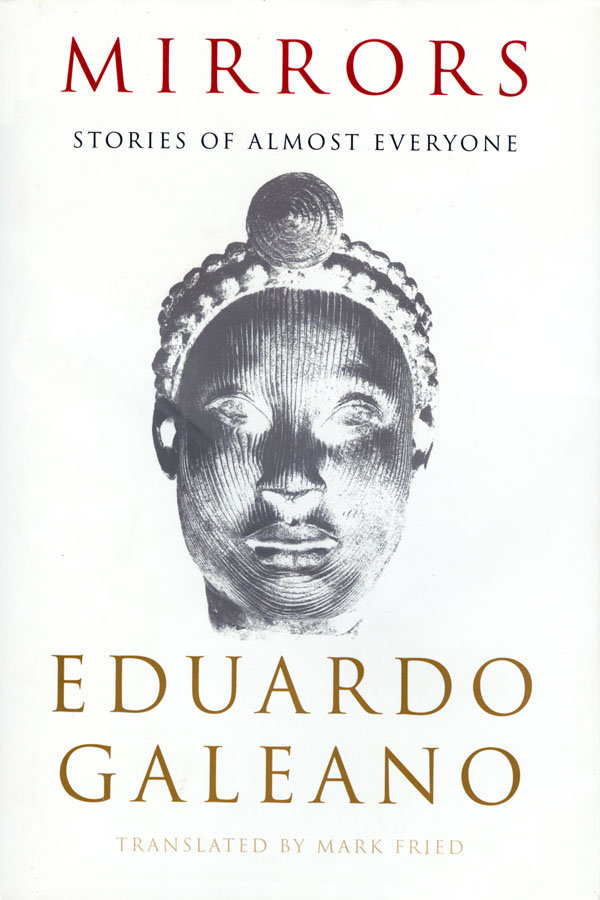
Mirrors: Eduardo Galeano

Eduardo Galeano - Mirrors - cover

  • Mirrors: Stories of Almost Everyone. Eduardo Galeano, translated from Spanish by Mark Fried. 400p, Nation Books, 2010. (Powell’s)

It all began at Christmas two years ago, when my daughter was four-years-old. And it was the first time that she’d ever asked about what did this holiday mean? And so I explained to her that this was celebrating the birth of Jesus. And she wanted to know more about that. We went out and bought a kids’ bible and had these readings at night. She loved him. Wanted to know everything about Jesus.

So we read a lot about his birth and his teaching. And she would ask constantly what that phrase was. And I would explain to her that it was, “Do onto others as you would have them do unto you.” And we would talk about those old words and what that all meant.

And then one day we were driving past a big church and out front was an enormous crucifix.

She said, who’s that?

And I guess I’d never really told that part of the story. So I had to sort of, yeah, oh, that’s Jesus. I forgot to tell you the ending. Well, you know, he ran afoul of the Roman government. This message that he had was so radical and unnerving to the prevailing authorities of the time that they had to kill him. They came to the conclusion that he would have to die. That message was too troublesome.

It was about a month later, after that Christmas, we’d gone through the whole story of what Christmas meant. And it was mid-January, and her preschool celebrates the same holidays as the local schools. So Martin Luther King Day was off. I knocked off work that day and I decided we’d play and I’d take her out to lunch.

We were sitting in there, and right on the table where we happened to plop down, was the art section of the local newspaper. And there, big as life, was a huge drawing by a ten-year-old kid from the local schools of Martin Luther King.

She said, who’s that?

I said, well, as it happens that’s Martin Luther King. And he’s why you’re not in school today. So we’re celebrating his birthday, this is the day we celebrate his life.

She said, so who was he?

I said, he was a preacher.

And she looks up at me and goes, for Jesus?

And I said, yeah, actually he was. But there was another thing that he was really famous for. Which is that he had a message.

And you’re trying to say this to a four-year-old. This is the first time they ever hear anything. So you’re just very careful about how you phrase everything.

So I said, well, yeah, he was a preacher and he had a message.

She said, what was his message?

I said, well, he said that you should treat everybody the same no matter what they look like.

She thought about that for a minute. And she said, well that’s what Jesus said.

And I said, yeah, I guess it is. You know, I never thought of it that way, but yeah. And it is sort of like “Do onto others as you would have them do unto you.”

And she thought for a minute and looked up at me and said, did they kill him, too?

This American Life, episode 188, “Kid Logic”

History doesn’t repeat itself, but it does rhyme.

Mark Twain

I often have profound reading experiences, but I rarely have transformative reading experiences. While a work might challenge and open my sense of what is possible in writing, or present me with a different level of human empathy than I thought myself capable of, or open up worlds beyond my own imagination, it is rare that I read something that completely changes the way I look at the world. I can really only think of two books that held their power.* The first was Randy Shilts’ And The Band Played On. I thought I had some idea of how politics worked in this country. I thought I had some idea what gay identity and culture was like. Reading that book exposed my own naiveté, and since then I have become more cynical about the notion of a government’s responsibility to its people and the capability of the US government to respond to crisis. The second book that has had this effect is Eduardo Galeano’s Mirrors. 

*There are doubtless more, especially from when I was younger and knew less. But these are the two books where reading them felt like an intellectual, spiritual, and aesthetic transformation.

I want to talk about form first. This is a history of the world in 400 pages, in a sequence of one-third of a page to one and a half-page stories. The presentation of material is roughly chronological. Sometimes they are connected by region or theme. Sometimes these are the stories of individuals, sometimes whole cultures. Sometimes politicians, sometimes artists. Sometimes gods. Each of them is perfect, yet I cannot say for sure what they are. I call them stories because that’s what the title of the book calls them, but they could just as easily be called short stories, or prose poems. The language in each of them is beautiful; in the rare story of positivity Galeano’s words can make you feel the ecstasy of human possibility. In the majority of the stories of violence, ignorance, and waste, the beauty of Galeano’s words cut deeply into the soul, as a threnody. Each story works as a dab of color in a pointillist’s painting, or an individual figure in a tapestry. Alone, they are radically subjective (Galeano occasionally quotes or paraphrases words, and even more rarely references dates, but there is no sourcing and the overall effect is like an oral or folk history of the world) and perhaps crude, but together they form a whole that seems large and durable enough to encompass the world.

The other trick that Galeano accomplishes is so unique and so subtle that I feel inadequate in my ability to describe it. To do so properly, I have to take a quick detour through anecdote:

The required freshman year seminar at my college was a year-long “Great Books” -styled class based on Greek and Roman classics. It was a competitive environment (in the best way), as all of the students that were big fish in their small ponds vied to distinguish themselves academically through insight and precocious command of academic language. One of the common conflicts within the class was an inability to settle on a common frame of inquiry. There were kids that were perfectly happy to examine a work like Lucretius’ On The Nature of Things within the frame of ancient Greek cultural assumptions.* There were kids who were more interested in taking the greater scientific knowledge and socially progressive attitudes from our present and using it to undermine the philosophical conclusions of the past. And then there were the savvy kids with enough knowledge of various postmodern perspectives to argue about a given work’s misogynistic or cryptofeminist implications, etc. None of these frames are in any useful sense “correct.” Each brings insights that would be missed or devalued within the frame of the other. And a common source of tangent and fruitless argument was an inability to reconcile these frames with each other.

*A trait I found correlated with the interest in becoming a Classics major, for what that’s worth.

The magic of Galeano’s Mirrors is that it manages to present a history of the world as though one could experience all of these frames simultaneously. These effects are most pronouced at the chronological extremes of the book. Various origin stories and foundational myths are recounted, but Galeano is unsentimental about the way in which these stories have hatred for women and the Other encoded in them. At the other extreme, bloody conflicts of the 20th century are presented as yet another episode of the overflow of triabalism, geographic destiny, and European paranoia. To call the former pedantic and and the latter oversimplified would miss the point, as Galeano’s supreme achievement is to bring these histories together to the point where we can, as per the Twain aphorism, see the rhymes: hatred for women, hatred for the poor, the power of the wealthy, the disposability of the marginal, the difference between an advanced civil culture and an advanced martial culture, the pointless destruction of knowledge, the desecration of the earth.

This is where form and content meet. Galeano’s prose is deeply beautiful and deeply sad at the same time. The register of the stories is such that the combination of childlike simplicity and clear moral authority comes together to produce something that is wise.

I do have one caveat to note. While Mirrors is not an academic book, Galeano blurs the line between fact and metaphor to a degree that I imagine will turn off some readers. There were a couple of times where a story seemed so perfect that I followed up by taking a quick look at Wikipedia and found that the history was more complicated than presented (although just as often the history was presented completely accurately in distilled form). And with any story that touched any of my areas of expertise, I found that Galeano never fudged facts, but clearly shaped them.* Galeano also has particular scorn for the legacies of colonization and the Catholic Church in a way that will certainly turn off some of the potential readers of this book that could perhaps need it most.

*It reminded me of something that I came across once, and wish I could find again, that basically commented on the contradiction that “A butcher will read an article in the paper about the meat industry and find it to be over-simplistic and only half-true yet will accept that same paper as accurate about foreign policy or politics.”

Read this book. It was brutal to read, like drinking from a firehose of sadness and violence. But those rare episodes of true goodness also shine, their light brighter in the true comprehension of darkness.