
I don’t think there will be many pieces that call for over a thousand performers in the future.
Louis CK on Tracy Morgan
Unless you live under a rock, or have something better to do with your time, you’ve been reading the fallout over Tracy Morgan’s standup rant in which he joked that if his son was gay he would stab him. Morgan has apologized, and while I think what he said on stage was despicable and irredeemable, I think his apology was sincere. A dialogue between Morgan and Russel Simmons was released and the personal nature of his apology rings true and, while I’m sure that much of his contrition is driven by career considerations, I think he does regret stepping over the line. I was completely over this “controversy” until Louis CK, a comedian that I greatly respect and admire, decided to open his dumbfool mouth:
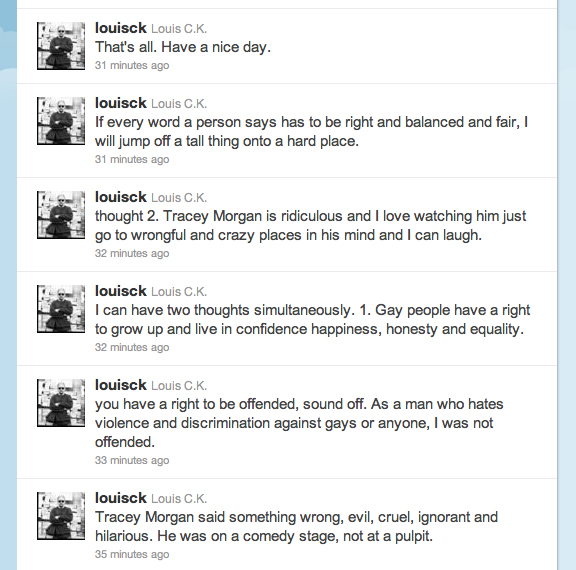 Gabe at Videogum has a pretty good response to how disingenuous this is, and how this is a way smaller issue than CK seems to think. I have a couple of thoughts to add:
First, I think it’s really hard for someone to advocate violence against other people and be funny. Now, I wasn’t there that night. Neither, by the way, was Louis C.K. So I think we have to be agnostic about whether Morgan’s rant was funny. We also need to keep in mind that there isn’t any audio or video of that night; all we have is a quasi-transcript that was posted on Facebook. Still, I think that there’s a difference between deriving humor from cultural taboos and stereotypes and reinforcing them. This has even been played out in the pop culture-sphere recently, in the form of Marc Maron’s aborted interview with the comedian Gallagher. Because Louis CK pushes these buttons, toes these lines in his own stand up, and is very articulate about his decisions, his defense of Tracy Morgan comes off as disingenuous.
The second thing I wanted to mention is that I find it really annoying how the “fuck ’em if they can’t take a joke” can lead to a self-righteous attitude about audience feedback. It’s such a lazy out to just put all responsibility on the audience, to say that if they aren’t going along with your routine that it’s because they can’t take a joke. I don’t think any topic or group is off limits to comedians, but I do feel that every comedian is responsible for how they get their laughs. One of the reasons that I appreciate CK’s comedy is that I feel like he has such confidence in his material, that he believes so strongly that he is funny and on the right side of the line, that he would perform his stand up in front of any kind of crowd. I can’t imagine that Morgan would perform that routine in front of a roomful of gay people. Just because a joke kills in front of an audience doesn’t mean that it’s a vile piece of shit.
Fleet Foxes – Helplessness Blues
“The Shrine/An Argument” Fleet Foxes Helplessness Blues. Sub Pop, May 3, 2011.
I drove up from California to Oregon with an iPod full of music I had never heard before, so I’m processing way more music than I can reasonably write about, but I wanted to say something about the new Fleet Foxes record, Helplessness Blues.
I was not a huge fan of their first album. I thought it was twee, boring, and exactly the wrong kind of retro. Even though their vocal harmonies were a selling point to their fans, I thought they were a crutch to distract from generic, uninspired songwriting.
Helplessness Blues is a big step up, in my opinion. I’m starting to get a sense for a real voice emerging from the pastiche of influences. There’s still plenty of harmony, gauzy production and prog rock-like lyrical nonsense (I went down among the dust and pollen/to the old stone fountain in the morning after dawn/underneath were all these pennies fallen from the hands of children/they were there and then they were gone), but there’s also an effort to assimilate more and varied sounds.
Some songs: “Montezuma” is a well-crafted and catchy opener. “Bedouin Dress” has a violin hook that I really like. The two song stretch of “The Shrine/An Argument” to “Blue Spotted Tail” is absolutely fantastic. “The Shrine” has a searing and devastating vocal performance by Robin Pecknold that transforms into a refrain with a driving groove, making it one of the few Fleet Foxes that rocks in a traditional sense. “An Argument” contains an instrumental tag that is the single most musically interesting thing that I’ve heard from them. Not coincidentally, this is the point in the song where the blurry reverb effects drop out and the music gets to speak for itself. “Blue Spotted Tail” is simply beautiful; it sounds like it’s a Pecknold solo.
In which I roll my eyes twice
Just a couple of articles I wanted to respond to:
BBC: Why do people play music in public through a phone?
For many, teenagers playing tinny music to each other on public transport on their mobile phones can be intensely irritating. Why do they do it?
With mobile phones in many a teenager’s pocket, the rise of sodcasting – best described as playing music through a phone in public – has created a noisy problem for a lot of commuters.
First, stop using the term “sodcasting.” No matter how many times you repeat it in the article, it’s not going to take. Continuing,
“I don’t think it is intrinsically anti-social, what I would say is that it is a fascinating human phenomenon of marking social territory,” says Dr Harry Witchel, author of You Are What You Hear.
“With young people, usually loud music corresponds very strongly to owning the space.
“They are creating a social environment which is suitable for them and their social peers. But for those not in this group – a 50-year-old woman for example – instead of confidence, she’ll feel weakness and maybe even impotence as there’s nothing that she can do about it.”
I guess there’s some truth in that. The British legal use of the term “anti-social” has always struck me as really creepy, and it’s downright Orwellian in this instance. As with cameras, the best speaker is the one you have on you, and if that means that the only way you can listen to music with your friends is through a shitty phone speaker, that’s what you do. What could be a more social activity than that?
Bruce Haynes creates “new” Bach concertos by arranging cantata movements.
These so-called Brandenburgs are actually instrumentalized groupings of Bach cantata movements. The original idea was Haynes’s, a Bach expert who had already used Bach cantata movements to score a concerto for oboe and harpsichord obbligato in 1982, almost thirty years before starting this new Brandenburg project last year. Tragically, Haynes passed away on May 17, just over a month before the premiere of what will be the last of his projects.
Why would somebody do this, you ask?
Why new instrumental concertos, instead of vocal or solo pieces? Because the small number of chamber pieces by Bach that have survived has always frustrated musicologists and musicians. Bach gave his chamber music to Wilhelm Freidemann Bach, his favourite child. Unfortunately, W.F. was also a drunkard and lost most of the music. Compare this to the cantatas, which were bequeathed to another son, Carl Philipp Emanuel. Those were carefully preserved and indexed. Today, we know of six Brandenburg concertos and a few other Bach concerti. There were probably many more.
It was also a very well known practice in the baroque era to re-score cantatas without singers. “Several composers and writers mention this,” said Napper. She added while laughing, “No singer, no problem!”
No problem! Hahaha. Seriously. Fuck you.
I’m sorry that you love Bach’s music so much that you feel like you need to take those terrible vocal parts out. Oh no, definitely, the music is much better without them. Yes, it’s totally a good idea to rearrange 18th Century music to fit contemporary aesthetics. No, nobody has ever done that before. Okay, some people have tried that before. But we totally respect them for their efforts and play their “improved” arrangements all the time.
Right?
Right?
Sarcasm aside, the point that we probably hold too tightly to Bach’s scores and that he reused and rearranged his music all of the time is a valid and important one. But that’s not where the trail of breadcrumbs ends. The fact is, we know little about Bach’s personal attitude toward his music. We don’t know if he viewed the cantatas as artistic works or only as things he composed for his day job. There are remarkably few Bach compositions that seem to be deliberately intended for posterity or as an artistic demonstrations (these include, off the top of my head, the Mass in B Minor, the Art of the Fugue, and his French and Italian keyboard suites). Almost every aspect of Bach performance includes some speculation or artistic decisions, many based on aesthetic preference alone. Still, sticking to what actually survives on the page seems to me to be a perfectly reasonable line in the sand.
Digging Into Schubert
Alfred Brendel playing Schubert’s Piano Sonata in B-flat, D. 960.
Over the past few months, I’ve been going through a little bit of a gloomy period, and I think a big part of the reason why I was feeling melancholic was that I wasn’t playing or making as much music as I had been, and not nearly as much as I’d like. One of my summer resolutions to change that is to start tackling a piano sonata that I’ve really fallen in love with, Schubert’s Piano Sonata in B-flat.
One consequence of not getting into classical music in a serious and studious way until I started college is that there are still large gaps in my knowledge of the canonical works and composers of the past, even as I try and nurture all of my interests in music. One of those gaps is Schubert. Outside of a couple of lied, I really don’t have much exposure to his music (as it turns out, however, my sister (also a pianist) has been working on an Impromptu that she presented in recital a week ago). I was introduced to this piano sonata through a school assignment, and discovered that Schubert’s piano writing calls to me deeply, both as a pianist and as a listener.
I’m not a great pianist. I took some time away from serious keyboard study in high school, which could have been a very productive and fruitful time of study. I have a very strong ear that I have to work to control, and so learning piano and learning to improvise have always gone hand in hand. I’ve also always had a great love for chords; if I had had different teachers or different exposure when I was younger I might have had a lot of fun playing jazz. I don’t want to equate myself and Schubert, but I can imagine that we might mess around at the piano in the same way, albeit at different levels of skill. Schubert’s piano music is almost entirely chords and chord voicings. There are long stretches of the sonata that are composed of nothing but melody embedded in chord voicings and arpeggios.
But how good are those voicings? It goes so far beyond chord inversions, or what the bass note of the chord is. To play his music is to realize that he had control of everything: what the root and bass note of the chord is, how much space needs to be around the melody for it to be heard within the texture, how much repetition can be used without becoming monotonous, how to arrange the intervals within a chord. And he does it with standard chord progressions and very controlled amounts of dissonance.
Schubert presents completely different problems for a pianist than, say, Bach or Beethoven. It’s much easier, in a sense. There’s little to none of the counterpoint that makes Bach difficult, and he doesn’t (in this piece) call for the virtuosic tricks that Beethoven might have wrote. In fact, I’m sure that there are many child prodigies that have the technique to conquer this piece. What they might not have is the hand span to do so. Six- and eight-note chords are common in this piece, and it requires a tremendous amount of control to play them evenly. It’s even harder to play them softly, as Schubert calls for. His practice of embedding the melody in large chords also means that the performer has to switch smoothly and often between wide hand positions, and I can see that this is going to be a big difficulty for me. Another difficult point of classical technique are his smooth, sweeping broken chords. They carry the melody as well, so there’s nowhere for bad technique to hide.
I’m pretty confident in my ability to get this under my belt, and I’m excited to dig into the piece.
 hammer & jack