
For today in hyper-specific blogs, Poor Yorick Entertainment, a Tumblr dedicated to graphics inspired by the corporate apocalypse in David Foster Wallace’s Infinite Jest, as well as film posters for the imagined filmography of James Incandenza.


web log (late 20th c. – early 21st c.)
For today in hyper-specific blogs, Poor Yorick Entertainment, a Tumblr dedicated to graphics inspired by the corporate apocalypse in David Foster Wallace’s Infinite Jest, as well as film posters for the imagined filmography of James Incandenza.
Ahmad Jamal Trio with Gary Burton “One” (1981)
Gary Burton’s reflexes in this performance make me so jealous. Ahmad Jamal is actively trying to fuck with him and throw him off, and once he catches on to that, his responses are genius.
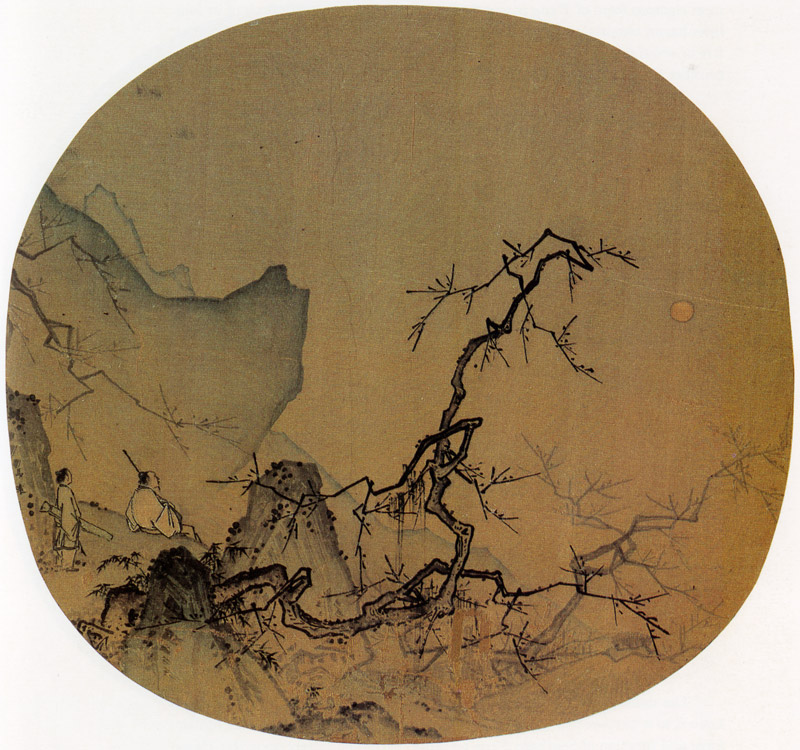
Ma Yuan (active ca. 1190–1225). Viewing Plum Blossoms by Moonlight. Fan mounted as an album leaf; ink and color on silk; 25.1 x 26.7 cm. Metropolitan Museum of Art
This last year, I had the privilege of taking a year-long course in Chinese Humanities, studying the literature, philosophy and history of the Qin/Han and Song dynasties for a semester each. One of the hallmarks of a Reed College education is the introductory humanities class (Hum 11o) that is required of all entering students and functions as an interdisciplinary writing seminar and common point of reference for Reed students. Hum 110 surveys Greek and Roman studies, with detours through Egyptian, Jewish and early Christian texts. The humanities model continues in upper level classes with medieval (Hum 210) and Early Modern/Enlightenment (Hum 220) studies.
Chinese Humanities, Hum 230, is an attempt to take that same model and apply it to Chinese studies. The first semester focuses on the Qin and Han dynasties (221 BC-220 AD) in order to look at the birth of the Chinese state and the rise of Confucianism, and the second semester focuses on the Song dynasty (960-1279 AD), which has remarkable parallels with early modern Europe (and, indeed, our own time). The course is taught by a team of lecturers and conference leaders, with a mixture of language experts, historians, art historians, and Chinese literature professors. I was speaking with one of our visiting professors, a modern China specialist, and he remarked that Reed’s program was unique in teaching this material in this way.
I came into the course with very little knowledge of China, ancient or modern, and one of the things that impressed me constantly was just how old the literary tradition of the country is. The stability of the Chinese literary canon, and the cultural emphasis and importance of the written word through such a long history is unparalleled by any culture the world has ever seen.
One fascinating manifestation of this tradition is functional poetry from the Tang dynasty (618-907 AD). The poetry from this period was so vibrant and masterful that it was held up as a model for the next thousand years. Some of the most charming of these poems were simply mementos of a visit from a friend, or written to preserve the memory of an arresting vista, or even left at the door to show that one had visited while the master of the house was out. For example, this poem, “Visiting and Old Friend at His Farmhouse” by Meng Haoran, is a simple poem that captures the bliss of friendship, conversation, and the comfort of the countryside:
An old friend prepared a meal of chicken and rice,
And invited me to join him at his farmhouse.
The village is surrounded by green trees
And the pale blue of outlying mountains.
The window opens to the garden and field,
While holding wine in our hands, we talked of mulberry and hemp.
We are looking forward to the Autumn Festival,
when I will return to visit the chrysanthemum bloom.
All of this is a very circumspect way to get at the singular pleasure that maintaining a Tumblr blog has given me in the past few months.
When I first encountered this blogging platform, I was convinced that it was not for me. It was first established as an image sharing service, and several aspects of it’s design and use are still a product of that function. It places an emphasis on sharing and reblogging over content creation, text-only posts are awkward, and the traditional blogger-commentator dialogue is unwieldy. Tumblr’s fluidity of display can also be a bewildering experience. Reading posts in Tumblr’s dashboard or arranging posts by tags is more akin to reading Facebook’s news feed than a traditional blog, and the infinite scrolling functionality can give the impression that one is wading through an infinite stream of consciousness rather than a deliberate arrangement of thought. As someone with more of a traditional bent than most of my age, the lack of constancy was frustrating.
As I’ve explored the service, however, and especially through my efforts to take a photograph each day, I’ve come to appreciate Tumblr less as a platform for artistic or personal expression and more as a tool for ordering and preserving subjective experience. The process of being aware of my surroundings, of constantly looking out for that moment or view with which I will represent my day has made me more engaged with myself. There is no question that it took more intellectual engagement and artistic technique for the Tang poets to preserve their own experience in verse, however I think they are at heart the same response to the same impulse. And in the way that a poet’s body of work became a literary avatar for the poet’s experience, so have my photos become a digital avatar for my own life, my own mind.
The internet confronts us constantly with the knowledge of just how unspecial we are, just how common our experiences and thoughts are. As a response, we look inward. Everyone is special. Everyone is unique. It just takes a little more effort to find what those special qualities and unique perspectives are. I think the internet has made us more aware, as a global culture, of the value of those with a compelling and unusual point of view.
This is why I can never take seriously the charge that my generation is a narcissistic generation of navel-gazers. We have become a culture unstuck in time, where the products of culture grow ever more available: streaming audio of every record ever made, online archives of writing, television, etc. In such a culture, the only thing that can be truly cultivated is one’s own artistic efforts and the lens that you view art through.
This blog is a lot more “serious” than my Tumblr, which can be found at iconochasm.tumblr.com. I usually try and keep the projects separate, however I’ve become lately convinced of the futility of segregating one’s online life.
Posting has been scarce of late due to my normal post-semester crash. Hopefully my brain will be up and running soon. I plan on tackling Jonathan Franzen’s Freedom and Edward Abbey’s Monkey-Wrench Gang this week. In lieu of in-depth thoughts, here’s a potpourri of impressions:
Krzysztof Penderecki’s Threnody for the Victims of Hiroshima, one of the most powerful, political pieces of modern music. Interestingly, especially in the context of the essays below, the piece was fully composed before the title was added.
Martin Bresnick’s fascinating account of a very special musical exhibition in Prague, 1970 has been going around the classical internet. It’s a remarkable piece of writing, powerful even to those who don’t know the musical names invoked:
On March 6, 1970, at the close of the Second International Free Composers Tribune in Prague, the final composer to be represented at the conference, Luigi Nono, spoke for more than 10 minutes before a large audience of mostly Czech musicians, vigorously criticizing my score for the short film “Pour,” which preceded his presentation. Although the protocol of the tribune permitted each composer only 10 minutes to speak about his or her own music, Nono took those 10 minutes to speak about mine, concluding with a scathing condemnation of my use of vernacular music.
Nono then went on for another 10 minutes about the making of his own work, especially pointing out the theoretically correct choice of the pre-recorded sounds he had employed. He then played a tape of his composition “Non Consumiamo Marx.” When the piece was over there were three people left in the hall at the Janacek Composers’ Club at 3 Besedni Street: Luigi Nono, Mr. Okurka (the technician who operated the tape recorder and sound system) and me.
I won’t spoil the punchline to the piece, save to observe that the goal of infusing music with political meaning is perpetually one of the greatest challenges a composer can undertake. It’s interesting to read Bresnick’s piece as counterpoint to David T. Little’s piece on contemporary music:
Historically, political composers believed that, since politics was going to concern itself with the arts — (as rulers like Hitler and Stalin proved) — art had better concern itself with politics. It was as if this was the artists’ preemptive duty. During the 1930s, the revolutionary tide reached the ivory towers, and composers began to see themselves as standing in solidarity with the worker. “Whether composers know it, admit it or not … they most of them belong to the proletariat,” wrote Charles Seeger in a 1934 essay.
But my reasons, approach and techniques are different, because this historical moment is different. We are no longer amidst a social(ist) revolution in the United States (despite what the Tea Party says) and as such music with a strong ideological or revolutionary message can often feel out of place and out of touch. As a result, political composers are no longer the revolutionaries we once were. Instead, we function as critics.
For that matter, the entirety of the New York Times column “The Score”–from which these pieces are taken–is great.
Roger Ebert reprints Ben Dobbins’ article on the dwindling production of film.
Perhaps because of my age, the demise of film production only merits a shrug. I would, of course, be very sad if film was altogether unavailable in the future, or if production standards were likewise diminished. But other once popular media, like woodblock printing, lithographs, etchings, are still alive and well and their traditions maintained by artists and craftsmen that love the tradition. I would imagine that the same will hold for film.
What I think is truly gross, however, is the rise of fake vintage camera effects, à la Hipstamatic. They hold all of the false charm and tackiness as stock Photoshop “impressionistic” or “fresco” effects. By appropriating the visual signatures of the past, we further unstick ourselves in time.
Marc Parry writes in the Chronicle of Higher Education (behind paywall, sorry) of conductor Lawrence Golan’s David-and-Goliath fight against Big Media’s effort to keep 20th century artworks out of the public domain ad infinitum:
For 10 years, the music professor has been quietly waging a legal campaign to overturn the statute, which makes it impossibly expensive for smaller orchestras to play certain pieces of music.
Now the case is heading to the U.S. Supreme Court. The high-stakes copyright showdown affects far more than sheet music. The outcome will touch a broad swath of academe for years to come, dictating what materials scholars can use in books and courses without jumping through legal hoops. The law Mr. Golan is trying to overturn has also hobbled libraries’ efforts to digitize and share books, films, and music.
The conductor’s fight centers on the concept of the public domain, which scholars depend on for teaching and research. When a work enters the public domain, anyone can quote from it, copy it, share it, or republish it without seeking permission or paying royalties.
The dispute that led to Golan v. Holder dates to 1994, when Congress passed a law that moved vast amounts of material from the public domain back behind the firewall of copyright protection. For conductors like Mr. Golan, that step limited access to canonical 20th-century Russian pieces that had been freely played for years.
“It was a shocking change,” Mr. Golan says over dinner at a tacos-and-margaritas dive near the University of Denver’s mountain-framed campus. “You used to be able to buy Prokofiev, Shostakovich, Stravinsky. All of a sudden, on one day, you couldn’t anymore.”
I think the ethics of copyright are very much up in the air right now (and the ethical issues are much more complicated than both the “rights protect artists” and the “information wants to be free” camps seem to acknowledge) but I think one thing that’s clear is that efforts like these–and big music publisher’s draconian crackdown on live performers–are creating an environment that is toxic for future performers and composers, or at the very least, turning them into rulebreakers.

The great Portland arts blog PORT has a great feature on the design elements incorporated into a new no-income housing/homeless shelter project in Portland’s Pearl District.
I’ve seen some critical posts elsewhere in the blogosphere (I’m not going to dignify them by linking) that have focused on the high-value design and stylish materials to attack the project. As with some other publicly funded services, especially prisons and public housing, any element of comfort seems to be a waste of taxpayer dollars, or “too good” for the target population.
That’s probably just an ugly side of human nature, but it’s always amazing to me how much resistance there is to public projects that are, you know, effective.
This Slate piece by Ron Rosenbaum on the cult of Bob Dylan, musical politics in China, and the neverending mystery of the man is one of the best pieces of music writing I’ve heard in a long time.
Here’s a taste:
And then they twisted themselves into pretzel-like contradictions: Dylan was never really a protest singer anyway; he only faked being one early in his career to get a leg up the ladder of fame from the folkies then fashionable when he arrived in New York at the beginning of the ’60s. So he shouldn’t have been expected to do anything confrontational in China; he was, like, above mundane political considerations.
Great defense! They’re saying—his defenders!—that he was a scheming careerist liar. (Do they really believe the emotion in that beautiful ballad “Song to Woody” was all faked?) But he’s Dylan so it’s OK.
What’s amusing is that they’re willing to accept his explanation that he was never sincere in the first place politically so he shouldn’t be bothered by it now. Don’t they realize that this itself could be insincere. That he might be insincere in his protestations of insincerity about his protest songs? They’re just such suckers for anything that issues from Bob’s mouth they don’t know when or whether they’ve been conned by one of the great put-on artists.
Still you have to love Dylan for creating all the mystery—and for that immortal line from the disclaimer-of-sincerity period when the folkies were on his case: “Folk music is a bunch of fat people.”
But if Dylan was never really a protest singer, how can you claim at the same time that his songs, whatever he played, had the effect of a powerful protest on the Chinese torturers? Oh, and one of the most peculiar Bobolator defenses was that he really didn’t, as Maureen Dowd implied, inspire anti-Vietnam War protesters with his music because, despite all the anti-war songs Maureen Dowd wanted him to play, like “Masters of War,” he wasn’t really against the Vietnam War! It may be true: The entire Vietnam protest movement was mistaken if they took any inspiration from him. They had the wrong exegesis!
 hammer & jack