
Wonderblood | Julia Whicker

Cover of Wonderblood by Julia Whicker.
Wonderblood cover.

Faith, reason, morality, progress all come into conflict under the shadow of the launch tower at Cape Canaveral! Kings, magicians, doctors, executioners, all bound to their own arcane rituals. A girl appears just like in a prophecy. And then a new bright light appears in the sky.

I really did not care for this book. Whicker has imagined a world where mad cow disease has led to a societal collapse, and after thousands of years, people in the United States have devolved into followers of mystic religions that believe in blood sacrifice to bring about the return of the space shuttles, which will save the world.

You have to invest a lot in this setting to get anything out of the book–which is another way of saying that the plot, character, and prose style didn’t do much for me–and so much of the setting didn’t make any sense. Whicker clearly loved this idea of a medieval/feudal world that has adopted NASA as its religious symbols, but never quite explains how that could have come about. Yes, there is prion disease and societal breakdown, but how are there artifacts from the 20th century but no city ruins? Given what we know about how tribalism forms in times of scarcity, is it really plausible that no characters notice each others skin colors? For that matter, in Florida of all places, why does everybody speak English?

For that matter, Whicker doesn’t have very much respect for medieval knowledge either. In an interview with The Qwillery, Whicker mentions being inspired by figures like Johannes Kepler and Tycho Brahe and yet none of that seems to have made it onto the page, except in cutesy character names.

I’d suggest skipping this book and watch Waterworld instead.
The Handmaid’s Tale

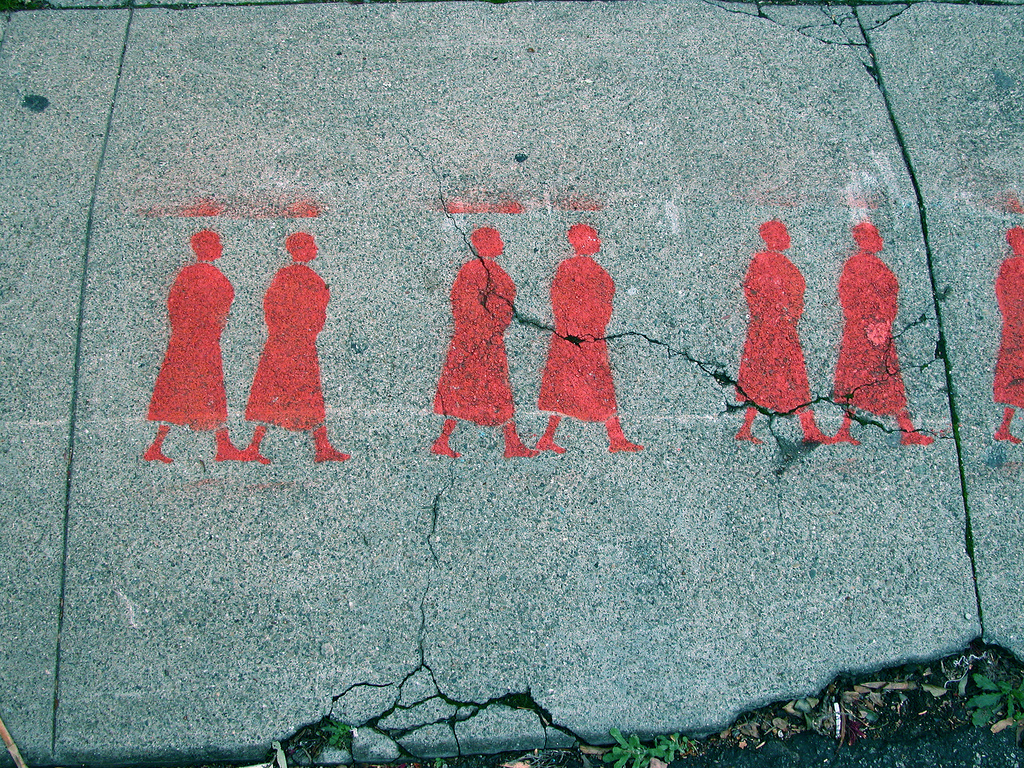
red stencil walkers

Many people that I know read The Handmaid’s Tale in high school. I didn’t. Because so many people come to it when they are younger, when they are developing their consciousnesses, I thought the book would be more polemical, more manifesto. The book makes a clear statement, and has the anger and righteousness of a manifesto, but I was surprised to discover that Offred’s voice was an ambivalent, human voice. I thought it was an extremely brave thing of Atwood to do to have so much of Offred’s internal monologues, especially her regrets, to focus on the loss of her child and husband. It would be less complicated to have a character that only has hate for men, only resents her own ability to create children, but by embracing that complication, the book seems more truthful to me. It’s incredible to think how much time has passed since the publication of the book, and how nothing so substantial has changed that it seems to invalidate the premise of the story.

I’m thinking of this story in Fortune about women in the tech industry. One way of saying that “Everyone was the same, and no one was like me.” is that these jobs are not designed to be filled by people who have a family. Sometimes that means no women, but even their male workers are expected to have a “traditional” family structure simply because these men cannot contribute in that way to the household. There’s a scene in the Tale where all women workers are summarily fired and their financial accounts frozen. We despise the men in that story for saying nothing. Maybe that wouldn’t happen in reality today, but if there was suddenly a new law that meant that maternity leave was more inconvenient/more expensive for employers and women workers suddenly found their careers stalled or themselves forced out, how many workplaces are there in which men would stand up? Would we say anything if it didn’t happen all in one day? Would I notice?

I’m also thinking of an episode of The Dick Cavett Show  I watched once while I was fucked up. Carole Burnett was the guest.I thought it was the craziest thing I had ever seen, because she was so comfortable, relaxed, bantery, funny. And also because she seemed to have the cool/funny girl schtick that I associate with entertainers like Mindy Kaling, Tina Fey or Lena Dunham. The pose that says that Sexism is bullshit and totally happens to me but I can joke about it and I’m not going to let it stop me because eh, what are you going to do? But then again, there’s something aggressive about a male interviewer opening his segment by grilling her about her sexual history. And we look at that as both banter and also as something uncomfortable, something that probably wouldn’t happen today. But if it did, it would seem “edgy” and “honest” and we would all get a thrill out of breaking the same taboo that Burnett and Cavett were breaking. Especially now as Lena Dunham becomes the center, again, of whether she is or is not a Feminist Icon of Our Times, I can’t help but look back and forth between Dunham and Burnett and the context of their times and think This will never be enough. And then I think about how lonely Margaret Atwood must get sometimes if she’s spent her entire life thinking that all of it will never be enough.

The Handmaid's Tale

red stencil walkers
Many people that I know read The Handmaid’s Tale in high school. I didn’t. Because so many people come to it when they are younger, when they are developing their consciousnesses, I thought the book would be more polemical, more manifesto. The book makes a clear statement, and has the anger and righteousness of a manifesto, but I was surprised to discover that Offred’s voice was an ambivalent, human voice. I thought it was an extremely brave thing of Atwood to do to have so much of Offred’s internal monologues, especially her regrets, to focus on the loss of her child and husband. It would be less complicated to have a character that only has hate for men, only resents her own ability to create children, but by embracing that complication, the book seems more truthful to me. It’s incredible to think how much time has passed since the publication of the book, and how nothing so substantial has changed that it seems to invalidate the premise of the story.
I’m thinking of this story in Fortune about women in the tech industry. One way of saying that “Everyone was the same, and no one was like me.” is that these jobs are not designed to be filled by people who have a family. Sometimes that means no women, but even their male workers are expected to have a “traditional” family structure simply because these men cannot contribute in that way to the household. There’s a scene in the Tale where all women workers are summarily fired and their financial accounts frozen. We despise the men in that story for saying nothing. Maybe that wouldn’t happen in reality today, but if there was suddenly a new law that meant that maternity leave was more inconvenient/more expensive for employers and women workers suddenly found their careers stalled or themselves forced out, how many workplaces are there in which men would stand up? Would we say anything if it didn’t happen all in one day? Would I notice?

I’m also thinking of an episode of The Dick Cavett Show  I watched once while I was fucked up. Carole Burnett was the guest.I thought it was the craziest thing I had ever seen, because she was so comfortable, relaxed, bantery, funny. And also because she seemed to have the cool/funny girl schtick that I associate with entertainers like Mindy Kaling, Tina Fey or Lena Dunham. The pose that says that Sexism is bullshit and totally happens to me but I can joke about it and I’m not going to let it stop me because eh, what are you going to do? But then again, there’s something aggressive about a male interviewer opening his segment by grilling her about her sexual history. And we look at that as both banter and also as something uncomfortable, something that probably wouldn’t happen today. But if it did, it would seem “edgy” and “honest” and we would all get a thrill out of breaking the same taboo that Burnett and Cavett were breaking. Especially now as Lena Dunham becomes the center, again, of whether she is or is not a Feminist Icon of Our Times, I can’t help but look back and forth between Dunham and Burnett and the context of their times and think This will never be enough. And then I think about how lonely Margaret Atwood must get sometimes if she’s spent her entire life thinking that all of it will never be enough.