loops

Chow Chun Fai –– “Last Supper“, Renaissance Trilogy I (2005)

This story tickled me:


Hundreds of thousands of Chinese citizens have gone to work in Africa, where they have encountered foreign cultures that leave many of them feeling alienated. For some of these disaffected Chinese workers, a source of comfort has come from religion, most notably the Evangelical Christianity that pervades much of sub-Saharan Africa. Evangelicalism prioritises conversion of non-believers, and the Chinese, heavily discouraged from practicing religion at home, are attractive potential converts.


Many local African churches have reached out to Chinese workers, including incorporating Mandarin into services.  A number of Chinese, in turn, have welcomed the sense of community and belonging that these Christian churches offer. And a small but growing number of ethnically Chinese missionaries from Taiwan and other countries are specifically targeting Chinese nationals in Africa, preaching to them with a freedom they’d never be allowed in the People’s Republic.


Many of these Chinese workers are returning home, and they’re bringing their newfound religion with them.  Visitors to the coastal province of Fujian, for example, now hear South African accented English and see houses adorned with crosses.  African migrants are also moving to China in larger numbers, many of them practitioners of very evangelistic forms of Pentecostal Christianity who are willing to flout the rules placed on religious activity in China.

Christopher Rhodes “How Africa is converting China,” The Unherd

First things first, I cannot evaluate the accuracy of this story in pretty much any way, and The Unherd is a new media venture with maybe ideological leanings (?) that are giving me Quilette vibes. Nevertheless, I love hearing globalization stories that have nothing to do with the United States. One of the defining characteristics of US culture is its indifference to anything outside of it. Plus, both China (because of its ascendancy and trade powers) and Africa (because of its color and post-colonial politics) often operate as political opposite poles to the United States to the extent that Americans think about foreign policy at all.

It reminded me of this working definition of religion I’ve been toying with:

A religion is a system of attaching meaning to behavioral choices that creates a positive feedback loop whereby adherents gain a greater survival advantage as some combination of strict adherence to precepts, size of the community of adherents, or access to spiritual experience increases.

I have never had any formal education in religious studies, so maybe this is a 101 level insight, but it feels like it’s all my own and it speaks to some of the uneasiness I feel when some of the people around me go in on religious people. I think about the people in my own life for whom religion was a way to feel control and agency in their life, or for whom religion was the opening to being able to talk about and access an inner emotional life. Religious people can be shitty, but, like, maybe they would be even shittier without it?

I’m fascinated by dying churches. I play piano every now and then for a Norwegian Presbyterian Church here in a Portland Suburb, a dwindling congregation that once served an ethnic community that barely exists anymore. The churches and religions that are thriving right now are the ones who have figured out how to give a survival advantage to those who walk through their door. These Chinese, workers, for example, get to walk in the door and experience a feeling of community and common struggle in a context where that is hard to find.

It’s why I can’t imagine they will ever die. As long as living remains a challenge, there will be a need for some way to teach adaptation, and a secondary need to attach meaning to that adaptation. What used to be called New Age religion so thoroughly dominates American culture its practically indistinguishable from it. We might have way more atheists in this country than ever before, but there are also more folks practicing yoga, going on meditation retreats, consuming bone broth. Scientologists get it, you join, they get you auditions. Mormons understand it, if you’re a man they’ll set you up with a career and a family.

You want to start a new religion? Come up with your survival advantage. The rest of the patter will write itself.

update: apple

Quick update to the Mike Daisey/Foxconn/Apple story I wrote about last week: The New York Times has written a long article about conditions in the factory and about Apple’s efforts to reduce labor violations in their supply chain. Two things that I thought were particularly noteworthy:

First, I thought it was very interesting that the article chose as its central human figure one of the relatively high-paid, skilled workers in the plant. The fact that this worker had high wages and extra perks relative to most of the other workers in the plant highlights the failure to protect workers from hazardous conditions as well as the callous way that large manufacturers treat the lives of their workers.

Also deeply fascinating was this selection of reader comments on the article from Caixin, a Chinese business magazine that the Grey Lady partnered with to publish the article in China. Granted, these comments come from people that both have internet access and are on a business magazine side, but they show the same range of opinions on the labor abuses that you would find in the US, from

Even though Apple should be ethically condemned, the key point is: whether the working conditions inside the factories are supervised by law. This (supervision) is the duty of judicial officers and labor unions. Now everything is driven only by G.D.P., so which government official would dare supervise those companies? They (the governments) have long reduced themselves to the servant of the giant enterprises.

to 

 By the way, construction workers and farmers are also living a harsh life in China, shall we also boycott housing and grains?

The This American Life episode struggled with this ambivalence; it’s true that China’s mass manufacturing industry has raised more people out of poverty than any other endeavor/period in history, but its also true that this has come at a staggering human cost. The queasy discomfort that we feel at buying these products is also felt by the countries that sell them.

Tumblr, Poetry, and the Structuring of Experience

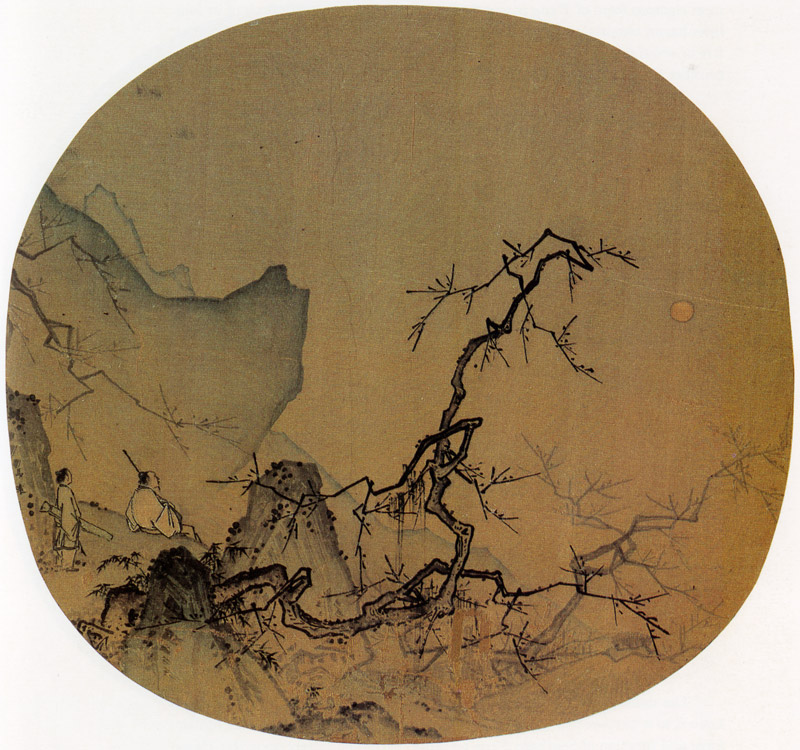
Ma Yuan (active ca. 1190–1225). Viewing Plum Blossoms by Moonlight. Fan mounted as an album leaf; ink and color on silk; 25.1 x 26.7 cm. Metropolitan Museum of Art

This last year, I had the privilege of taking a year-long course in Chinese Humanities, studying the literature, philosophy and history of the Qin/Han and Song dynasties for a semester each. One of the hallmarks of a Reed College education is the introductory humanities class (Hum 11o) that is required of all entering students and functions as an interdisciplinary writing seminar and common point of reference for Reed students. Hum 110 surveys Greek and Roman studies, with detours through Egyptian, Jewish and early Christian texts. The humanities model continues in upper level classes with medieval (Hum 210) and Early Modern/Enlightenment (Hum 220) studies.

Chinese Humanities, Hum 230, is an attempt to take that same model and apply it to Chinese studies. The first semester focuses on the Qin and Han dynasties (221 BC-220 AD) in order to look at the birth of the Chinese state and the rise of Confucianism, and the second semester focuses on the Song dynasty (960-1279 AD), which has remarkable parallels with early modern Europe (and, indeed, our own time). The course is taught by a team of lecturers and conference leaders, with a mixture of language experts, historians, art historians, and Chinese literature professors. I was speaking with one of our visiting professors, a modern China specialist, and he remarked that Reed’s program was unique in teaching this material in this way.

I came into the course with very little knowledge of China, ancient or modern, and one of the things that impressed me constantly was just how old the literary tradition of the country is. The stability of the Chinese literary canon, and the cultural emphasis and importance of the written word through such a long history is unparalleled by any culture the world has ever seen.

One fascinating manifestation of this tradition is functional poetry from the Tang dynasty (618-907 AD). The poetry from this period was so vibrant and masterful that it was held up as a model for the next thousand years. Some of the most charming of these poems were simply mementos of a visit from a friend, or written to preserve the memory of an arresting vista, or even left at the door to show that one had visited while the master of the house was out. For example, this poem, “Visiting and Old Friend at His Farmhouse” by Meng Haoran, is a simple poem that captures the bliss of friendship, conversation, and the comfort of the countryside:

An old friend prepared a meal of chicken and rice,
And invited me to join him at his farmhouse.
The village is surrounded by green trees
And the pale blue of outlying mountains.
The window opens to the garden and field,
While holding wine in our hands, we talked of mulberry and hemp.
We are looking forward to the Autumn Festival,
when I will return to visit the chrysanthemum bloom.

All of this is a very circumspect way to get at the singular pleasure that maintaining a Tumblr blog has given me in the past few months.

When I first encountered this blogging platform, I was convinced that it was not for me. It was first established as an image sharing service, and several aspects of it’s design and use are still a product of that function. It places an emphasis on sharing and reblogging over content creation, text-only posts are awkward, and the traditional blogger-commentator dialogue is unwieldy. Tumblr’s fluidity of display can also be a bewildering experience. Reading posts in Tumblr’s dashboard or arranging posts by tags is more akin to reading Facebook’s news feed than a traditional blog, and the infinite scrolling functionality can give the impression that one is wading through an infinite stream of consciousness rather than a deliberate arrangement of thought. As someone with more of a traditional bent than most of my age, the lack of constancy was frustrating.

As I’ve explored the service, however, and especially through my efforts to take a photograph each day, I’ve come to appreciate Tumblr less as a platform for artistic or personal expression and more as a tool for ordering and preserving subjective experience. The process of being aware of my surroundings, of constantly looking out for that moment or view with which I will represent my day has made me more engaged with myself. There is no question that it took more intellectual engagement and artistic technique for the Tang poets to preserve their own experience in verse, however I think they are at heart the same response to the same impulse. And in the way that a poet’s body of work became a literary avatar for the poet’s experience, so have my photos become a digital avatar for my own life, my own mind.

The internet confronts us constantly with the knowledge of just how unspecial we are, just how common our experiences and thoughts are. As a response, we look inward. Everyone is special. Everyone is unique. It just takes a little more effort to find what those special qualities and unique perspectives are. I think the internet has made us more aware, as a global culture, of the value of those with a compelling and unusual point of view.

This is why I can never take seriously the charge that my generation is a narcissistic generation of navel-gazers. We have become a culture unstuck in time, where the products of culture grow ever more available: streaming audio of every record ever made, online archives of writing, television, etc. In such a culture, the only thing that can be truly cultivated is one’s own artistic efforts and the lens that you view art through.

This blog is a lot more “serious” than my Tumblr, which can be found at iconochasm.tumblr.com. I usually try and keep the projects separate, however I’ve become lately convinced of the futility of segregating one’s online life.