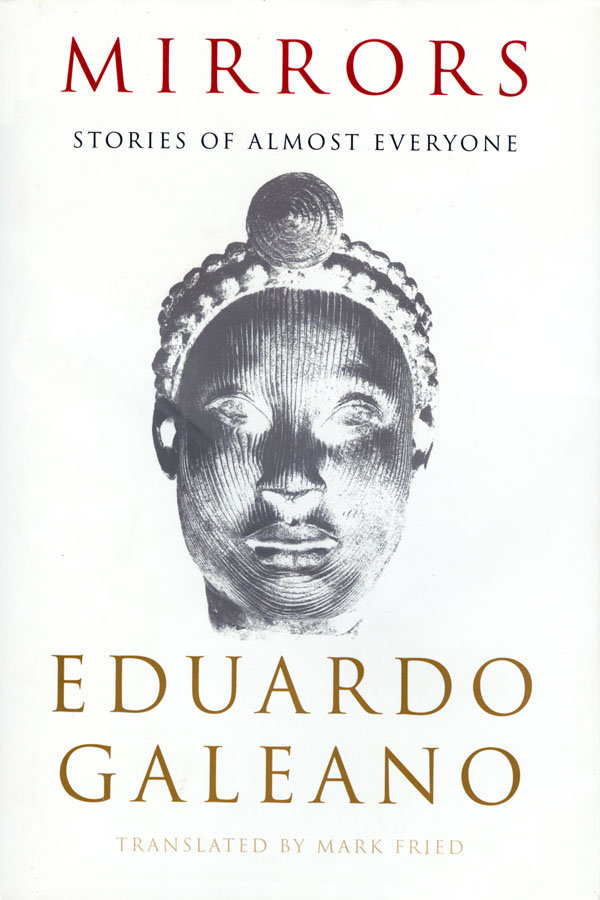
- Mirrors: Stories of Almost Everyone. Eduardo Galeano, translated from Spanish by Mark Fried. 400p, Nation Books, 2010. (Powell’s)
It all began at Christmas two years ago, when my daughter was four-years-old. And it was the first time that she’d ever asked about what did this holiday mean? And so I explained to her that this was celebrating the birth of Jesus. And she wanted to know more about that. We went out and bought a kids’ bible and had these readings at night. She loved him. Wanted to know everything about Jesus.
So we read a lot about his birth and his teaching. And she would ask constantly what that phrase was. And I would explain to her that it was, “Do onto others as you would have them do unto you.” And we would talk about those old words and what that all meant.
And then one day we were driving past a big church and out front was an enormous crucifix.
She said, who’s that?
And I guess I’d never really told that part of the story. So I had to sort of, yeah, oh, that’s Jesus. I forgot to tell you the ending. Well, you know, he ran afoul of the Roman government. This message that he had was so radical and unnerving to the prevailing authorities of the time that they had to kill him. They came to the conclusion that he would have to die. That message was too troublesome.
It was about a month later, after that Christmas, we’d gone through the whole story of what Christmas meant. And it was mid-January, and her preschool celebrates the same holidays as the local schools. So Martin Luther King Day was off. I knocked off work that day and I decided we’d play and I’d take her out to lunch.
We were sitting in there, and right on the table where we happened to plop down, was the art section of the local newspaper. And there, big as life, was a huge drawing by a ten-year-old kid from the local schools of Martin Luther King.
She said, who’s that?
I said, well, as it happens that’s Martin Luther King. And he’s why you’re not in school today. So we’re celebrating his birthday, this is the day we celebrate his life.
She said, so who was he?
I said, he was a preacher.
And she looks up at me and goes, for Jesus?
And I said, yeah, actually he was. But there was another thing that he was really famous for. Which is that he had a message.
And you’re trying to say this to a four-year-old. This is the first time they ever hear anything. So you’re just very careful about how you phrase everything.
So I said, well, yeah, he was a preacher and he had a message.
She said, what was his message?
I said, well, he said that you should treat everybody the same no matter what they look like.
She thought about that for a minute. And she said, well that’s what Jesus said.
And I said, yeah, I guess it is. You know, I never thought of it that way, but yeah. And it is sort of like “Do onto others as you would have them do unto you.”
And she thought for a minute and looked up at me and said, did they kill him, too?
—This American Life, episode 188, “Kid Logic”
History doesn’t repeat itself, but it does rhyme.
—Mark Twain
I often have profound reading experiences, but I rarely have transformative reading experiences. While a work might challenge and open my sense of what is possible in writing, or present me with a different level of human empathy than I thought myself capable of, or open up worlds beyond my own imagination, it is rare that I read something that completely changes the way I look at the world. I can really only think of two books that held their power.* The first was Randy Shilts’ And The Band Played On. I thought I had some idea of how politics worked in this country. I thought I had some idea what gay identity and culture was like. Reading that book exposed my own naiveté, and since then I have become more cynical about the notion of a government’s responsibility to its people and the capability of the US government to respond to crisis. The second book that has had this effect is Eduardo Galeano’s Mirrors.
*There are doubtless more, especially from when I was younger and knew less. But these are the two books where reading them felt like an intellectual, spiritual, and aesthetic transformation.
I want to talk about form first. This is a history of the world in 400 pages, in a sequence of one-third of a page to one and a half-page stories. The presentation of material is roughly chronological. Sometimes they are connected by region or theme. Sometimes these are the stories of individuals, sometimes whole cultures. Sometimes politicians, sometimes artists. Sometimes gods. Each of them is perfect, yet I cannot say for sure what they are. I call them stories because that’s what the title of the book calls them, but they could just as easily be called short stories, or prose poems. The language in each of them is beautiful; in the rare story of positivity Galeano’s words can make you feel the ecstasy of human possibility. In the majority of the stories of violence, ignorance, and waste, the beauty of Galeano’s words cut deeply into the soul, as a threnody. Each story works as a dab of color in a pointillist’s painting, or an individual figure in a tapestry. Alone, they are radically subjective (Galeano occasionally quotes or paraphrases words, and even more rarely references dates, but there is no sourcing and the overall effect is like an oral or folk history of the world) and perhaps crude, but together they form a whole that seems large and durable enough to encompass the world.
The other trick that Galeano accomplishes is so unique and so subtle that I feel inadequate in my ability to describe it. To do so properly, I have to take a quick detour through anecdote:
The required freshman year seminar at my college was a year-long “Great Books” -styled class based on Greek and Roman classics. It was a competitive environment (in the best way), as all of the students that were big fish in their small ponds vied to distinguish themselves academically through insight and precocious command of academic language. One of the common conflicts within the class was an inability to settle on a common frame of inquiry. There were kids that were perfectly happy to examine a work like Lucretius’ On The Nature of Things within the frame of ancient Greek cultural assumptions.* There were kids who were more interested in taking the greater scientific knowledge and socially progressive attitudes from our present and using it to undermine the philosophical conclusions of the past. And then there were the savvy kids with enough knowledge of various postmodern perspectives to argue about a given work’s misogynistic or cryptofeminist implications, etc. None of these frames are in any useful sense “correct.” Each brings insights that would be missed or devalued within the frame of the other. And a common source of tangent and fruitless argument was an inability to reconcile these frames with each other.
*A trait I found correlated with the interest in becoming a Classics major, for what that’s worth.
The magic of Galeano’s Mirrors is that it manages to present a history of the world as though one could experience all of these frames simultaneously. These effects are most pronouced at the chronological extremes of the book. Various origin stories and foundational myths are recounted, but Galeano is unsentimental about the way in which these stories have hatred for women and the Other encoded in them. At the other extreme, bloody conflicts of the 20th century are presented as yet another episode of the overflow of triabalism, geographic destiny, and European paranoia. To call the former pedantic and and the latter oversimplified would miss the point, as Galeano’s supreme achievement is to bring these histories together to the point where we can, as per the Twain aphorism, see the rhymes: hatred for women, hatred for the poor, the power of the wealthy, the disposability of the marginal, the difference between an advanced civil culture and an advanced martial culture, the pointless destruction of knowledge, the desecration of the earth.
This is where form and content meet. Galeano’s prose is deeply beautiful and deeply sad at the same time. The register of the stories is such that the combination of childlike simplicity and clear moral authority comes together to produce something that is wise.
I do have one caveat to note. While Mirrors is not an academic book, Galeano blurs the line between fact and metaphor to a degree that I imagine will turn off some readers. There were a couple of times where a story seemed so perfect that I followed up by taking a quick look at Wikipedia and found that the history was more complicated than presented (although just as often the history was presented completely accurately in distilled form). And with any story that touched any of my areas of expertise, I found that Galeano never fudged facts, but clearly shaped them.* Galeano also has particular scorn for the legacies of colonization and the Catholic Church in a way that will certainly turn off some of the potential readers of this book that could perhaps need it most.
*It reminded me of something that I came across once, and wish I could find again, that basically commented on the contradiction that “A butcher will read an article in the paper about the meat industry and find it to be over-simplistic and only half-true yet will accept that same paper as accurate about foreign policy or politics.”
Read this book. It was brutal to read, like drinking from a firehose of sadness and violence. But those rare episodes of true goodness also shine, their light brighter in the true comprehension of darkness.



 hammer & jack