The main chord progression from Radiohead’s “Everything in it’s Right Place”…
…is the same as the string riff in Marlena Shaw’s “California Soul.”

web log (late 20th c. – early 21st c.)
The main chord progression from Radiohead’s “Everything in it’s Right Place”…
…is the same as the string riff in Marlena Shaw’s “California Soul.”

I started taking organ lessons at the beginning of the semester. The organ, partially because of its liturgical use and partially because of its fundemental complexity, exists in its own hermetically sealed sphere; there is a tremendous amount to learn about every aspect of the instrument. One of the most useful things an organ student is to try and gain experience and perspective by visiting, playing and experimenting with many different instruments. Although these updates will not be regular, I hope to post about the different organs I visit in my own language to the extent of the education I have now.
One of the most fun afternoons of my spring break was the brief time I had to visit the Rosales Op. 10 organ at St. Andrew’s Episcopal Church in Ojai, California. Manuel Rosales is a Los Angeles based organ builder who builds in a tonally postmodern style heavily influenced by French and Mexican organs. His magnum opus is the organ at the Walt Disney Concert Hall (Op. 24), however he first gained national attention with the organ at Trinity Cathedral in Portland, Oregon (the Trinity organ was build right after the instrument at St. Andrew’s).
The organ at St. Andrews is much more modest than those organs (15 stops and two manuals), however it has the same craftsmanship, sweet tone, and strong point of view that have come to characterize Rosales organs. There were some physical features that I noticed immediately. The pedalboard is flat, without the curved array ususal for American organs. The stops on the console are physically large (perhaps taking influence from Mexican organs). Because of the small size of the organ, the expression pedal controls small hinged doors on the case, not the usual louvres. This, and the facade prestant, gives the organ an incredible dynamic range; the chimney flute with the doors closed is nearly inaudible. Sara Edwards, resident organist, pointed out to me the decoration on the case; it incorporates local motifs like the oak leaves and acorns of the California live oaks that grow in abundance in Ojai, and the crossed fishes of St. Andrew.
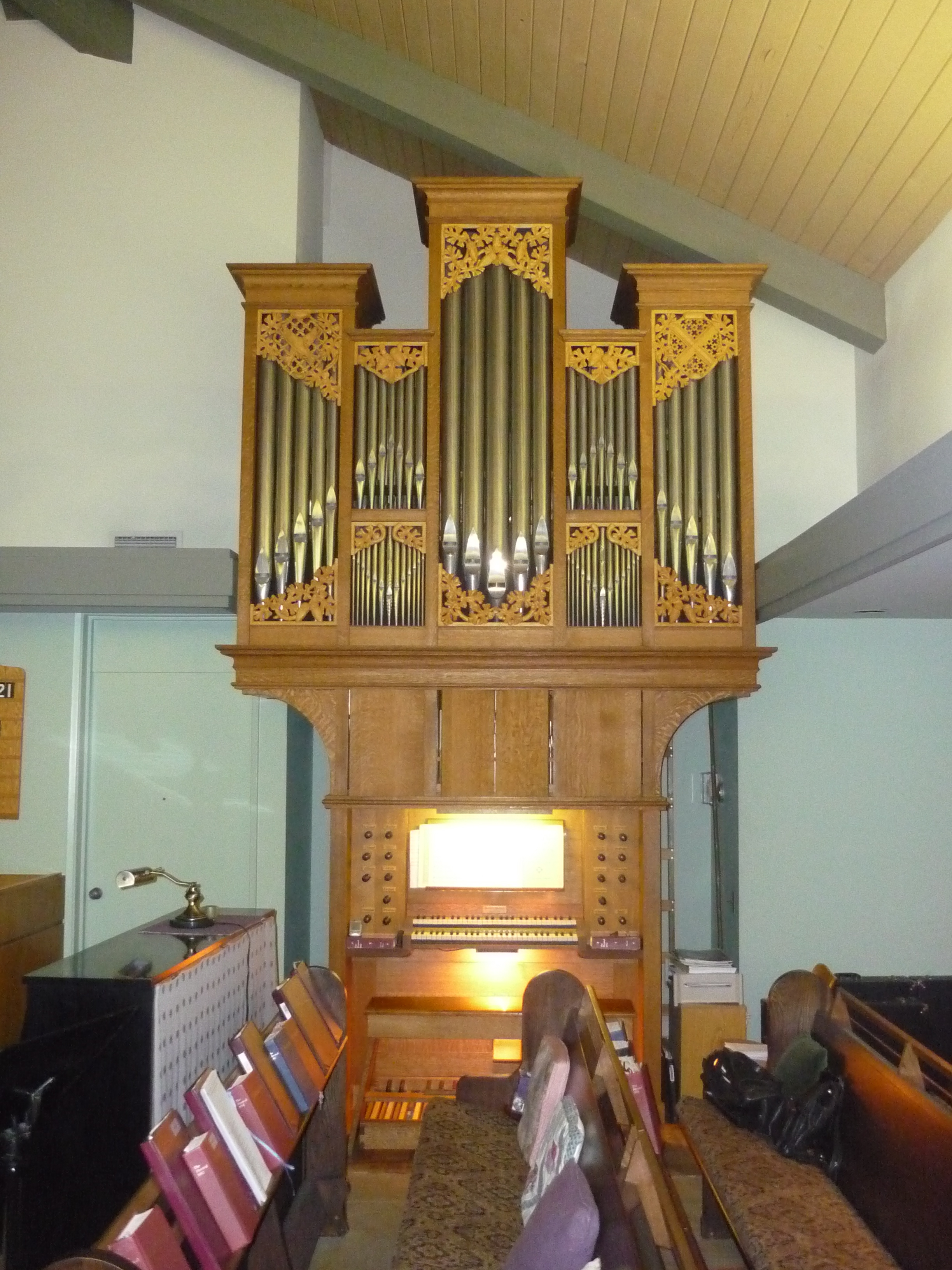
I’m still new at this, so I don’t have much of a palate to distinguish between different tonal palletes, however the organ did seem very sweet and mellow. As befits an organ of this size, the different stops seemed to be quite versatile. Almost all of them seemed like they could hold their own as a solo stop; I was particularly taken with the delicate 8′ chimney flute. Although I found the mechanics sluggish (it is a tracker [completely mechanical] organ), the 8′ trumpet sounded quite nice. I am generally suspicious of reed stops, but this one balanced boldness with richness. One thing that I found interesting when I first began to learn about organ building traditions is that, outside of a few basic stops, there is no standardized naming convention for organ pipes, they depend on the imagination and poetry of the builder. The stops at St. Andrews are named with traditional French labels, however the presense of the Dulciana in the choir division show Rosales’ Mexican influence (his Disney organ in particular has this in abundance with stops labeled Llamarada, Clarín armonico and Pajaritos*).
It was a real pleasure to play. I had heard the organ before, but didn’t know anything about them. It was interesting to find that there was such a treasure in my backyard.
*Pajaritos (little birds) is a stop that controls four birdolas, a kind of trick organ stop. Basically, before you play, you fill a small chamber with water, and the keys on the manuals control air burbling through it (almost like those plastic whistles you fill with water). One of my favorite things is all these trick stops on organs. They are most present on theater organs (like classic Wurlitzers) but they are also present in concert or liturgical organs. The St. Andrew’s organ has a Cymbal Star: basically air pressure spins a tine around which strikes a series of fixed cymbals.

I started taking organ lessons at the beginning of the semester. The organ, partially because of its liturgical use and partially because of its fundemental complexity, exists in its own hermetically sealed sphere; there is a tremendous amount to learn about every aspect of the instrument. One of the most useful things an organ student is to try and gain experience and perspective by visiting, playing and experimenting with many different instruments. Although these updates will not be regular, I hope to post about the different organs I visit in my own language to the extent of the education I have now.
One of the most fun afternoons of my spring break was the brief time I had to visit the Rosales Op. 10 organ at St. Andrew’s Episcopal Church in Ojai, California. Manuel Rosales is a Los Angeles based organ builder who builds in a tonally postmodern style heavily influenced by French and Mexican organs. His magnum opus is the organ at the Walt Disney Concert Hall (Op. 24), however he first gained national attention with the organ at Trinity Cathedral in Portland, Oregon (the Trinity organ was build right after the instrument at St. Andrew’s).
The organ at St. Andrews is much more modest than those organs (15 stops and two manuals), however it has the same craftsmanship, sweet tone, and strong point of view that have come to characterize Rosales organs. There were some physical features that I noticed immediately. The pedalboard is flat, without the curved array ususal for American organs. The stops on the console are physically large (perhaps taking influence from Mexican organs). Because of the small size of the organ, the expression pedal controls small hinged doors on the case, not the usual louvres. This, and the facade prestant, gives the organ an incredible dynamic range; the chimney flute with the doors closed is nearly inaudible. Sara Edwards, resident organist, pointed out to me the decoration on the case; it incorporates local motifs like the oak leaves and acorns of the California live oaks that grow in abundance in Ojai, and the crossed fishes of St. Andrew.
I’m still new at this, so I don’t have much of a palate to distinguish between different tonal palletes, however the organ did seem very sweet and mellow. As befits an organ of this size, the different stops seemed to be quite versatile. Almost all of them seemed like they could hold their own as a solo stop; I was particularly taken with the delicate 8′ chimney flute. Although I found the mechanics sluggish (it is a tracker [completely mechanical] organ), the 8′ trumpet sounded quite nice. I am generally suspicious of reed stops, but this one balanced boldness with richness. One thing that I found interesting when I first began to learn about organ building traditions is that, outside of a few basic stops, there is no standardized naming convention for organ pipes, they depend on the imagination and poetry of the builder. The stops at St. Andrews are named with traditional French labels, however the presense of the Dulciana in the choir division show Rosales’ Mexican influence (his Disney organ in particular has this in abundance with stops labeled Llamarada, Clarín armonico and Pajaritos*).
It was a real pleasure to play. I had heard the organ before, but didn’t know anything about them. It was interesting to find that there was such a treasure in my backyard.
*Pajaritos (little birds) is a stop that controls four birdolas, a kind of trick organ stop. Basically, before you play, you fill a small chamber with water, and the keys on the manuals control air burbling through it (almost like those plastic whistles you fill with water). One of my favorite things is all these trick stops on organs. They are most present on theater organs (like classic Wurlitzers) but they are also present in concert or liturgical organs. The St. Andrew’s organ has a Cymbal Star: basically air pressure spins a tine around which strikes a series of fixed cymbals.
These two videos (each illustrating one movement from Olivier Messiaen’s A Quartet for the End of Time) are truly remarkable. They feature artist Zack Smithey, and were produced by the Chamber Music Society of Lincoln Center for an upcoming concert.
Listening to these pieces in the context of the video was interesting for me as it allowed me to see my own musical growth. I remember listening to the Quartet after reading Alex Ross’ The Rest is Noise, and not being able to follow it musically. This time I had no trouble (due in no small part to the fact that I have just finished an intensive music theory unit on Debussy’s harmony).
I have a fickle relationship with mass opinion. I’m not talking about boom-and-bust buzz, like the sucess and subsequent backlash towards Juno. Rather, I really enjoy looking for things to read, listen to and watch, but once something passes a certain threshold of critical acclaim, or “belovedness” I get almost afraid of it (closely related to this phenomenon is when I find something, tell everybody about it, then find out that a) everybody has heard of it and b) it was recent enough that I can’t ride the wave of “rediscovery” or “reevaluation” [Damn the day I found out Mitch Hedberg died!]).

Really, I’m afraid of being moved in the same way as everybody else is. That is to say, I’m scared of being the suburban white kid talking about his three months in Costa Rica changing his life, or the adolescent philosopher pontificating on the deep truth in the Matrix, or the Lilith Fair chick talking about how Exile in Guyville said in song what she could not in words.
The thing is, they’re not even wrong.
There’s probably a lot to be learned from time in another, non-anglophone non-western (-ish, don’t hate!) country for a sheltered American. Liz Phair is the liberated Sappho of our time, and circulation numbers alone have to put the Wachowski brothers at the top of any list of influential American philosophers. The only problem (to be clear, the only problem for me) is that those emotional responses are so common.
That’s why I hate, to use today’s example, when I (a teenaged musician) fall in love with Stravinski’s The Rite of Spring after reading about the crowd of young Parisian musicians’s love for the ballet, or about the multiple composers who fetishized their copy of the score in their youth.
I just recently acquired a copy of the score. My father’s college music professor, with whom he was close, died earlier this spring, and I had the opportunity to keep his considerable sheet music library. One of my favorite finds was a pocket edition of the Rite.
It’s such a famous piece, and has touched so many people of my age, that there is literally nothing that I could write that would be original. Not my analysis. Not my emotional response.
Maybe it’s better. Maybe the overwhelming judgment of it externalizes all other opinions on the piece, and I can just enjoy it.

