
Worlds Collide

I was fascinated by this profile, in The Smart Set of Henry Steel Olcott, the American leader of a Buddhist revival in Sri Lanka in the late 19th century. It would be hard to find a better example of an extraordinary person doing extraordinary things than Olcott’s life, spanning from antebellum United States:

Henry Steel Olcott began life in 1832 on a farm in Orange, New Jersey, the eldest of six children. His parents were devout Presbyterians who traced their lineage to the Puritans. Olcott would study agricultural science at what is now New York University, and then work in experimental agriculture, publishing several influential studies that gave him international renown. Olcott was a confident man and a modern man, unconventional and independent, excelling at whatever he did, an embodiment of the American ethic. He allied himself with the liberal causes of mid-19th century America: the abolition movement, the women’s movement, the temperance movement, the cremation movement. There is some evidence that a young Olcott dabbled in Spiritualism, a fad at the time. Everyone who knew Olcott thought of him as a man of principle, and also a kook, and maybe a visionary, too. When he tired of agriculture, Olcott decided he would be a journalist, writing for the New York Tribune and a few other papers. Around this time, Olcott married the pious daughter of an Episcopalian minister who bore Olcott two sons. But husband and wife were destined to grow apart, and eventually they divorced, leaving Olcott to explore his more experimental side.

At the onset of the American Civil War, Olcott joined the Union Army and served as the special commissioner of the War Department investigating fraud, corruption, and graft at the New York Mustering and Disbursement Office. By the time he was through, Olcott had achieved the rank of colonel. He became so well respected as a man who could get to the bottom of any injustice, the secretary of war appointed him to investigate the conspiracy behind the Lincoln assassination, which was accomplished in two weeks’ time. At the war’s end, Olcott decided he would leave government service and become a private lawyer specializing in insurance, revenue, and fraud.

and ending as a leader of men:

By the time Olcott died in 1907, it was clear he had played a crucial role as just such a leader. In Sri Lanka, Henry Steel Olcott would create scores of Buddhist schools, and many more would be built in his name. It was Henry Steel Olcott who initiated the design of the international Buddhist flag, and you see it everywhere in Sri Lanka, from temples to trishaws. His Buddhist Catechism has been translated into more than 20 languages and is still used in Buddhist education all over the world. And Olcott has been honored in kind. There are Henry Steel Olcott statues in Sri Lanka, and Henry Steel Olcott streets. There is a Henry Steel Olcott Memorial Cricket Tournament (perhaps the greatest honor Sri Lanka could bestow upon a man) held across the country each year.

In 1967, at a ceremony for the commemorative stamp issued in Sri Lanka to celebrate the 60th anniversary of Olcott’s death, then-Prime Minister Dudley Senanayake summed up Olcott thus: “At a time when Buddhism was on the wane in Ceylon, Colonel Henry Steel Olcott…awakened its people to fight to regain their Buddhist heritage. Colonel Olcott was one of the heroes in the struggle of Lankan independence…. Colonel Olcott’s visit to Ceylon was a landmark in the history of Buddhism.”

On a more personal level, I was intrigued by this tidbit: “At his funeral in India in 1907, his successor as resident of the Theosophical Society, Annie Besant, told the gathering of mourners that they were not to say goodbye to Colonel Henry Steel Olcott but merely to the cast-off garment that once held his spirit.” It turns out that this woman, Dr. Annie Besant, was one of the founders of Besant Hill School, a competing boarding school located in the town that I attended school in, Ojai, California. Ojai has a long history of strange religious establishment; the school that I attended is located next to a compound run by the followers of Jiddu Krishnamurti.

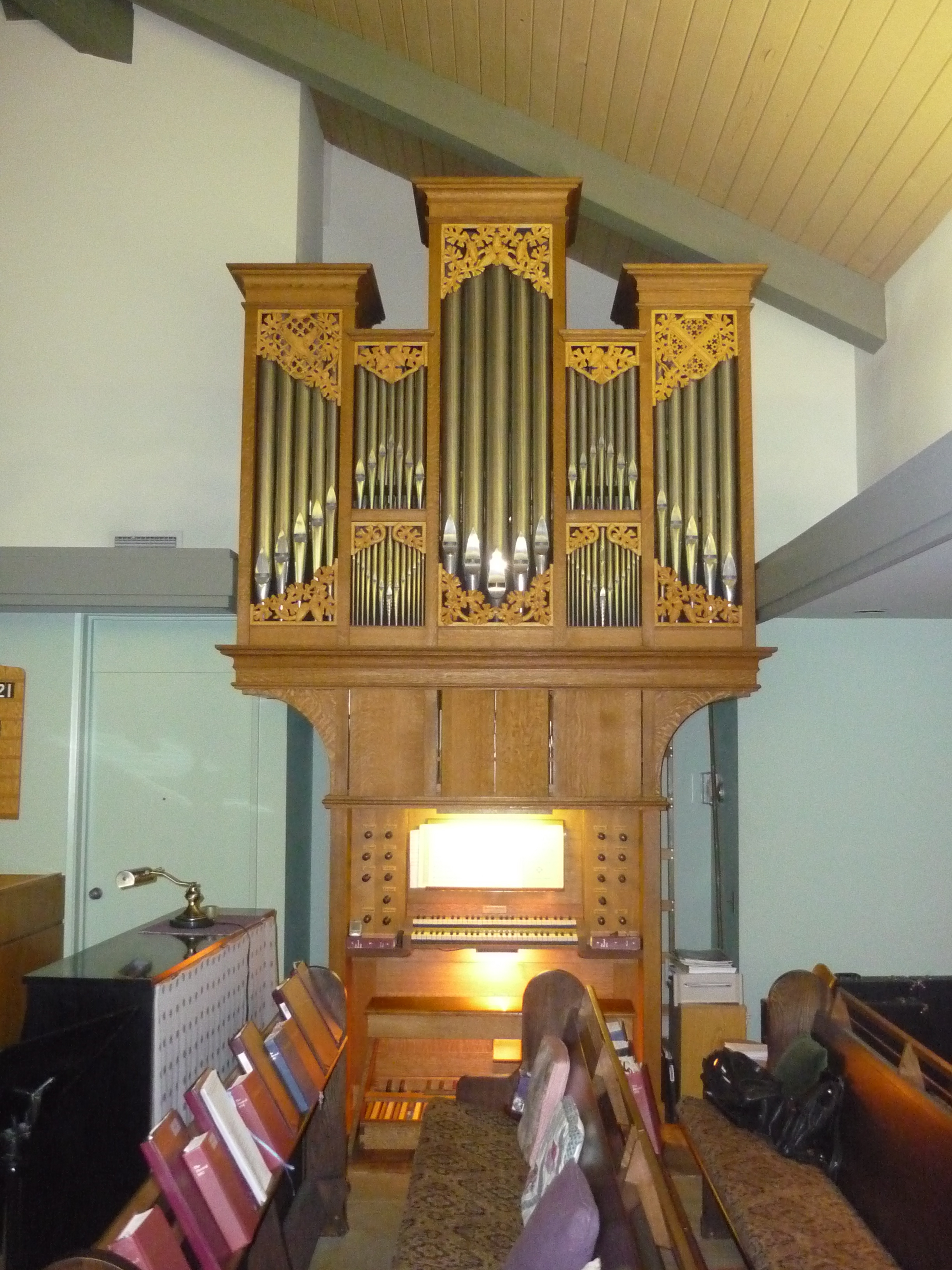
Organ Case File #1: St. Andrew’s Church

P1000566

I started taking organ lessons at the beginning of the semester. The organ, partially because of its liturgical use and partially because of its fundemental complexity, exists in its own hermetically sealed sphere; there is a tremendous amount to learn about every aspect of the instrument. One of the most useful things an organ student is to try and gain experience and perspective by visiting, playing and experimenting with many different instruments. Although these updates will not be regular, I hope to post about the different organs I visit in my own language to the extent of the education I have now.

One of the most fun afternoons of my spring break was the brief time I had to visit the Rosales Op. 10 organ at St. Andrew’s Episcopal Church in Ojai, California. Manuel Rosales is a Los Angeles based organ builder who builds in a tonally postmodern style heavily influenced by French and Mexican organs. His magnum opus is the organ at the Walt Disney Concert Hall (Op. 24), however he first gained national attention with the organ at Trinity Cathedral in Portland, Oregon (the Trinity organ was build right after the instrument at St. Andrew’s).

The organ at St. Andrews is much more modest than those organs (15 stops and two manuals), however it has the same craftsmanship, sweet tone, and strong point of view that have come to characterize Rosales organs. There were some physical features that I noticed immediately. The pedalboard is flat, without the curved array ususal for American organs. The stops on the console are physically large (perhaps taking influence from Mexican organs). Because of the small size of the organ, the expression pedal controls small hinged doors on the case, not the usual louvres. This, and the facade prestant, gives the organ an incredible dynamic range; the chimney flute with the doors closed is nearly inaudible. Sara Edwards, resident organist, pointed out to me the decoration on the case; it incorporates local motifs like the oak leaves and acorns of the California live oaks that grow in abundance in Ojai, and the crossed fishes of St. Andrew.

P1000563

I’m still new at this, so I don’t have much of a palate to distinguish between different tonal palletes, however the organ did seem very sweet and mellow. As befits an organ of this size, the different stops seemed to be quite versatile. Almost all of them seemed like they could hold their own as a solo stop; I was particularly taken with the delicate 8′ chimney flute. Although I found the mechanics sluggish (it is a tracker [completely mechanical] organ), the 8′ trumpet sounded quite nice. I am generally suspicious of reed stops, but this one balanced boldness with richness. One thing that I found interesting when I first began to learn about organ building traditions is that, outside of a few basic stops, there is no standardized naming convention for organ pipes, they depend on the imagination and poetry of the builder. The stops at St. Andrews are named with traditional French labels, however the presense of the Dulciana in the choir division show Rosales’ Mexican influence (his Disney organ in particular has this in abundance with stops labeled Llamarada, Clarín armonico and Pajaritos*).

It was a real pleasure to play. I had heard the organ before, but didn’t know anything about them. It was interesting to find that there was such a treasure in my backyard.

*Pajaritos (little birds) is a stop that controls four birdolas, a kind of trick organ stop. Basically, before you play, you fill a small chamber with water, and the keys on the manuals control air burbling through it (almost like those plastic whistles you fill with water). One of my favorite things is all these trick stops on organs. They are most present on theater organs (like classic Wurlitzers) but they are also present in concert or liturgical organs. The St. Andrew’s organ has a Cymbal Star: basically air pressure spins a tine around which strikes a series of fixed cymbals.

Organ Case File #1: St. Andrew's Church

P1000566
I started taking organ lessons at the beginning of the semester. The organ, partially because of its liturgical use and partially because of its fundemental complexity, exists in its own hermetically sealed sphere; there is a tremendous amount to learn about every aspect of the instrument. One of the most useful things an organ student is to try and gain experience and perspective by visiting, playing and experimenting with many different instruments. Although these updates will not be regular, I hope to post about the different organs I visit in my own language to the extent of the education I have now.
One of the most fun afternoons of my spring break was the brief time I had to visit the Rosales Op. 10 organ at St. Andrew’s Episcopal Church in Ojai, California. Manuel Rosales is a Los Angeles based organ builder who builds in a tonally postmodern style heavily influenced by French and Mexican organs. His magnum opus is the organ at the Walt Disney Concert Hall (Op. 24), however he first gained national attention with the organ at Trinity Cathedral in Portland, Oregon (the Trinity organ was build right after the instrument at St. Andrew’s).
The organ at St. Andrews is much more modest than those organs (15 stops and two manuals), however it has the same craftsmanship, sweet tone, and strong point of view that have come to characterize Rosales organs. There were some physical features that I noticed immediately. The pedalboard is flat, without the curved array ususal for American organs. The stops on the console are physically large (perhaps taking influence from Mexican organs). Because of the small size of the organ, the expression pedal controls small hinged doors on the case, not the usual louvres. This, and the facade prestant, gives the organ an incredible dynamic range; the chimney flute with the doors closed is nearly inaudible. Sara Edwards, resident organist, pointed out to me the decoration on the case; it incorporates local motifs like the oak leaves and acorns of the California live oaks that grow in abundance in Ojai, and the crossed fishes of St. Andrew.
P1000563
I’m still new at this, so I don’t have much of a palate to distinguish between different tonal palletes, however the organ did seem very sweet and mellow. As befits an organ of this size, the different stops seemed to be quite versatile. Almost all of them seemed like they could hold their own as a solo stop; I was particularly taken with the delicate 8′ chimney flute. Although I found the mechanics sluggish (it is a tracker [completely mechanical] organ), the 8′ trumpet sounded quite nice. I am generally suspicious of reed stops, but this one balanced boldness with richness. One thing that I found interesting when I first began to learn about organ building traditions is that, outside of a few basic stops, there is no standardized naming convention for organ pipes, they depend on the imagination and poetry of the builder. The stops at St. Andrews are named with traditional French labels, however the presense of the Dulciana in the choir division show Rosales’ Mexican influence (his Disney organ in particular has this in abundance with stops labeled Llamarada, Clarín armonico and Pajaritos*).
It was a real pleasure to play. I had heard the organ before, but didn’t know anything about them. It was interesting to find that there was such a treasure in my backyard.
*Pajaritos (little birds) is a stop that controls four birdolas, a kind of trick organ stop. Basically, before you play, you fill a small chamber with water, and the keys on the manuals control air burbling through it (almost like those plastic whistles you fill with water). One of my favorite things is all these trick stops on organs. They are most present on theater organs (like classic Wurlitzers) but they are also present in concert or liturgical organs. The St. Andrew’s organ has a Cymbal Star: basically air pressure spins a tine around which strikes a series of fixed cymbals.