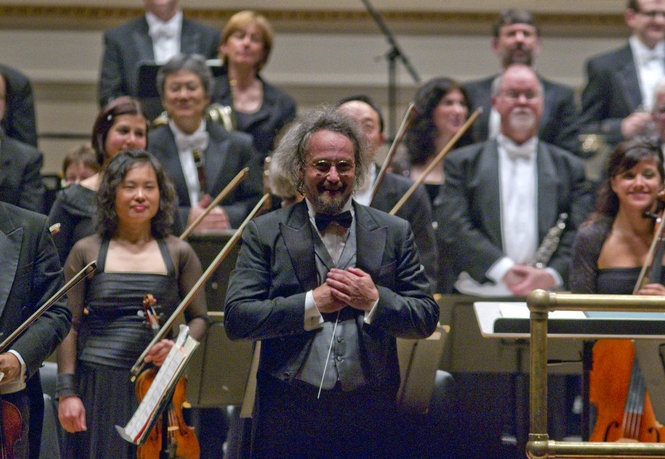
Congratulations to all of the musicians of the Oregon Symphony, who have just finished their very first Carnegie Hall concert. Early word has it that the concert was a great success; Alex Ross tweeted “Triumphant Carnegie debut for the Oregon Symphony — best of Spring for Music so far. Eloquent Sylvan, explosive Vaughan Williams.”
So, I may be posting a little this week to procrastinate, but I wouldn’t really expect regular updates for another couple of weeks. It’s the end of the year, and there is a whole lot of crazy going around. I did have enough time, however, to go to hear the Oregon Symphony on Sunday night conducted by conductor laureate James DePriest. DePriest conducted from a wheelchair (I couldn’t find the story on that anywhere online, but he is 72) and it was clear that the audience had affection for the man who led the orchestra for 23 years as they went nuts every time there was an opportunity for applause (You know how there are always old ladies who bolt for the door as soon as the last note sounds (I think they want to get out of the parking lot first)? The final curtain call was so long that they were able to get all the way out of the hall before the rest of the audience started leaving.).
Christopher Theofanidis
The program opened with Christopher Theofanidis’ Rainbow Body. Although the president of the Oregon Symphony has admitted that, in an effort to raise ticket sales, the orchestra has tried to program mostly warhorse classics and take it easy on the modern music, this was the piece that I emptied my bank account to go hear. If I might take a moment, if you are a student in the Portland metro area, there is no reason for you to skip any of these concerts. The Oregon Symphony has a standing, $10 student tickets an hour before showtime, deal. That’s less than a trip to the movies. You should go. Anyway, Rainbow Body, as explained in the lecture before the concert, is a work inspired by the Buddhist concept that when our bodies die we all return to the universe in the form of energy and light (I am sure that I am not geting that quite right, and the Wikipedia article on it is not exactly helpful). The piece incorporates melody from chants composed by Hildegard von Bingen, the 12th Century German abbess polymath. I didn’t really hear the chant; it was a little deconstructed and I wasn’t familiar with it in its original form anyway. What did strike me is the amazing color that Theofanidis writes into the music. One technique that I really liked is his use of cluster chords, where (for example) the string section plays a line of music, but on every note, there are a few musicians that hold on a little longer. Think of a piano; it is like playing a scale with the pedal down, and while you still hear the scale, you also hear every note interacting with the notes that came before. Or think of beads of paint on a canvas, it is like taking your finger and smearing the colors together. It was really lovely.
I guess the thing that sticks with me most about the piece is the way that it is able to synthesize musical tradition into something that is both beautiful and reverent of the past, while being firmly rooted in our time. The piece was tonal, and there were moments of throwback technique: for a brief passage the woodwinds broke into counterpoint that could have come from an 19th century textbook. And yet the harmonies had a dissonant edge (most notably in the brass) that could only have come from a composer that had studies 20th century music. Some of the sonorites and textures could have also come from experimental or ambient pop music. In this respect he reminded me of Eric Whitacre, who I first encountered via Chanticleer. They assimilate material from many different strains of music without being cheap and also without the millitant idealism of some 2oth century schools of composing. Two final notes about Christopher Theofanidis: 1. His name is really fun to pronounce. 2. He looks like John Ritter.
Garrick Ohlsson
Next was Garrick Ohlsson, a close friend of DePriest (a fact which I heard repeated no less than five times), to play Beethoven’s Piano Concerto No. 4. I don’t really have a lot to say about the piece itself, but I will say that I was really impressed with Ohlsson’s technique. I know that it is the least I could say, but I was genuinely enthralled by his tone. He managed to both play clearly and with great passion.
The other highlight of the evening was Ohlsson’s encore: Chopin’s Nocturnes Op. 9 No.2. We would all like to believe that every member of the audience is concentrating all the time on the music, but we know that’s not true. Nevertheless, when Ohlssohn began to play, you could almost hear everybody fix their attention on the piano. Nobody coughed. Nobody’s watch went off. We just listened. You almost never see it, even in concertos with solo passages, but you could also see the entire orchestra just listening. DePriest listened from his chair with his eyes closed. The adorable viola player that looks like he could have been the crypt keeper’s college roommate swayed with the music.
It is a thing that I occassionaly marvel at. In one sense, the stage, the sound of music is completely relative. In that moment with everybody listening, the piano was filling the hall as much as the full orchestra could. When the last note faded away, the audience hesitated, not wanting to break the silence.
Finally, Sibelius’ Symphony No. 1. After reading The Rest is Noise earlier this year, I went out and got all of the Sibelius Symphonies and downloaded all of the scores from the International Music Scores Library Project (which is a fantastic resource). So, lately I’ve been feeling a little chummy with the guy. One thing that I was particularly struck by was a beautiful passage where the timpani was sustaining a soft roll while the harp played a solo. Something about the tension between the sound at the low and high extremes of frequencies made an impression on me. Actually, the timpani is one of my favorite features of Sibelius’ orchestral music. Often it is used not as a percussive accent, but as a subsonic drone, like a roar that is just out of earshot and only the lowest freqencies carry through the distance.
One last note: the Oregon Symphony and the members of the section should be very proud of the brass section. On all three of the pieces, but mostly in the Theodfanidis, I was struck at how tight they sounded.
On Monday night, I had the privilege of scoring free tickets to the Oregon Symphony. I had been wanting to go that weekend, mostly to hear Rachmaninov’s sublime Rhapsody on a Theme by Paganini, and when the offer came up, I jumped at it.
Interior of the Arlene Schnitzer Concert Hall
It was my first time at the beautiful Arlene Schnitzer Concert Hall, an Art Deco monstrosity (and I use that term with the utmost affection) that reminded me strongly of the theater that I will always associate with orchestral music, the Alex Theater in Glendale, CA (home of the Los Angeles Chamber Orchestra). I had orchestra level seats, and the view of the ceiling was breathtaking.
The program started off with Mozart’s Symphony No. 36. The orchestra was tight and had a great sound (although from my seat, it would have been impossible for me not to hear the full sound of the orchestra) and although in general I can never find anything to differentiate one Mozart orchestral piece from another, it did give me time to observe the style of the guest conductor, Hannu Lintu of Finland.
Lintu is a virtual caricature of a conductor, tall and thin with the body type that tuxedos with tails are made for. I don’t know how useful he was for keeping the beat , but he was certainly entertaining, and clear enough in his gestures that only the blind wouldn’t pick up on the effects that he was trying to achieve. He jumped about, throwing his hands in the air when he wanted a big statement, shaking like an overcaffinated David Byrne when he wanted clear stacatto notes. In the Mozart, the orchestra was hanging on his every gesture, and you could almost see the connection between the orchestra and the conductor.
Unfortunately, that connection was nonexistent between the soloist and the conductor during the Rhapsody. Horatio Gutierrez was the piano soloist, and he played clearly and with the seemingly effortless grace and fluidity that only comes with practice and mastery. Gutierrez, at least physically, is the complete opposite of Lindu. He is an enormous man, which made it all the more astonishing to me that he played with such ease. All of the rapid scalar and chordal passages were flawless and clear, but the piece was plagued by tempo problems. A few times the soloist got so much faster than the orchestra that the conductor actually had to turn to him and make a desperate, “There are other people playing, you know” face. Things finally got together enough that the famous Variation 18 was executed flawlessly. I am not the first person to say this, but it is truly amazing that by simply inverting a fraction of the original melody by Paganini, Rachmaninov creates a passage that seems as though it is his own creation. In other words, I could play a recording of that variation and say to someone, “That. That is what Rachmaninov sounds like.”
Hannu Lintu
On the other hand, even after seeing it live, I could not tell you what Magnus Lindberg’s Feria sounds like. The conductor prefaced the piece in heavily accented English, “You see, we have a deal tonight. You listen to 13 minutes of modern Finnish music and then we play for you the Bolero.” Feria is a Spanish word meaning (obviously) an open air fair or carnival. All I can say is I don’t know what kind of carnivals Lindberg has been to, but by the sound of the music, it would be the scariest carnival ever. This type of modern composition always provokes in me an intense feeling of inferiority. I really don’t posses the knowledge or the experience to tell whether it is any good or not. There were parts that were flashy; the composer made full use of an expanded percussion section to make broad dramatic gestures. But I really don’t know what I thought of it. Tangentially, it did provide one of the most entertaining moments of the concert. At one point, the score called for a muted tuba. I got a kick out of seeing the tuba player pull out an enormous mute. It was about the size and rough shape of a motorcycle gasoline tank.
Finally, in the words of the conductor (and I really wish I could convey his accent and slightly sarcastic cadence), the Bolero. It takes balls to write an orchestral piece (in C no less!) that has an unchanging rhythm and one melody. And even though we have heard the melody played over and over by the time we get to it, the full orchestra playing fortissimo at the end is genuinely thrilling. On the other hand, it does feel a little like brainwashing by the final notes.
I was hoping for a little better Rachmaninov, especially considering that it was the third night, but the Oregon Symphony has a standing deal on student tickets, and I look forward to returning many times to the Schnitz.



 Unfortunately, that connection was nonexistent between the soloist and the conductor during the Rhapsody. Horatio Gutierrez was the piano soloist, and he played clearly and with the seemingly effortless grace and fluidity that only comes with practice and mastery. Gutierrez, at least physically, is the complete opposite of Lindu. He is an enormous man, which made it all the more astonishing to me that he played with such ease. All of the rapid scalar and chordal passages were flawless and clear, but the piece was plagued by tempo problems. A few times the soloist got so much faster than the orchestra that the conductor actually had to turn to him and make a desperate, “There are other people playing, you know” face. Things finally got together enough that the famous Variation 18 was executed flawlessly. I am not the first person to say this, but it is truly amazing that by simply inverting a fraction of the original melody by Paganini, Rachmaninov creates a passage that seems as though it is his own creation. In other words, I could play a recording of that variation and say to someone, “That. That is what Rachmaninov sounds like.”
 hammer & jack