You can find more information at Atlas Obscura.
Tag: pipe organ
Flentrop Organ at St. Mark

This last weekend, I had the opportunity to travel to Seattle, WA and hear a concert by Thomas Joyce, assistant organist at St. Mark’s Episcopal Cathedral and then listen and play around with the organ. This trip was organized by my teacher, and I definitely felt like the odd man out on this trip; all the other students have had four or five years experience, while I am still playing children’s pieces. Still, I’m glad that I had the opportunity to get up close to this beautiful instrument.
This organ was built by the Dutch organ builder D.A. Flentrop in 1965, and is particularly noteworthy as one of the first large all-tracker (mechanical) action organs built in the 20th Century, and became important in the movement towards traditional organ building practices. It was also the largest organ that Flentrop had built (4 manuals, 55 stops). My descriptions cannot possibly do the organ justice, you need to visit the cathedral in person to truly understand how large the organ appears. The cathedrals ceilings are 85 feet high, and the organ is on a gallery about 20 feet up. That puts the organ at somewhere between 45-55 feel tall. When I think about what was involved in getting all of those mechanical linkages to work across a span of that distance…
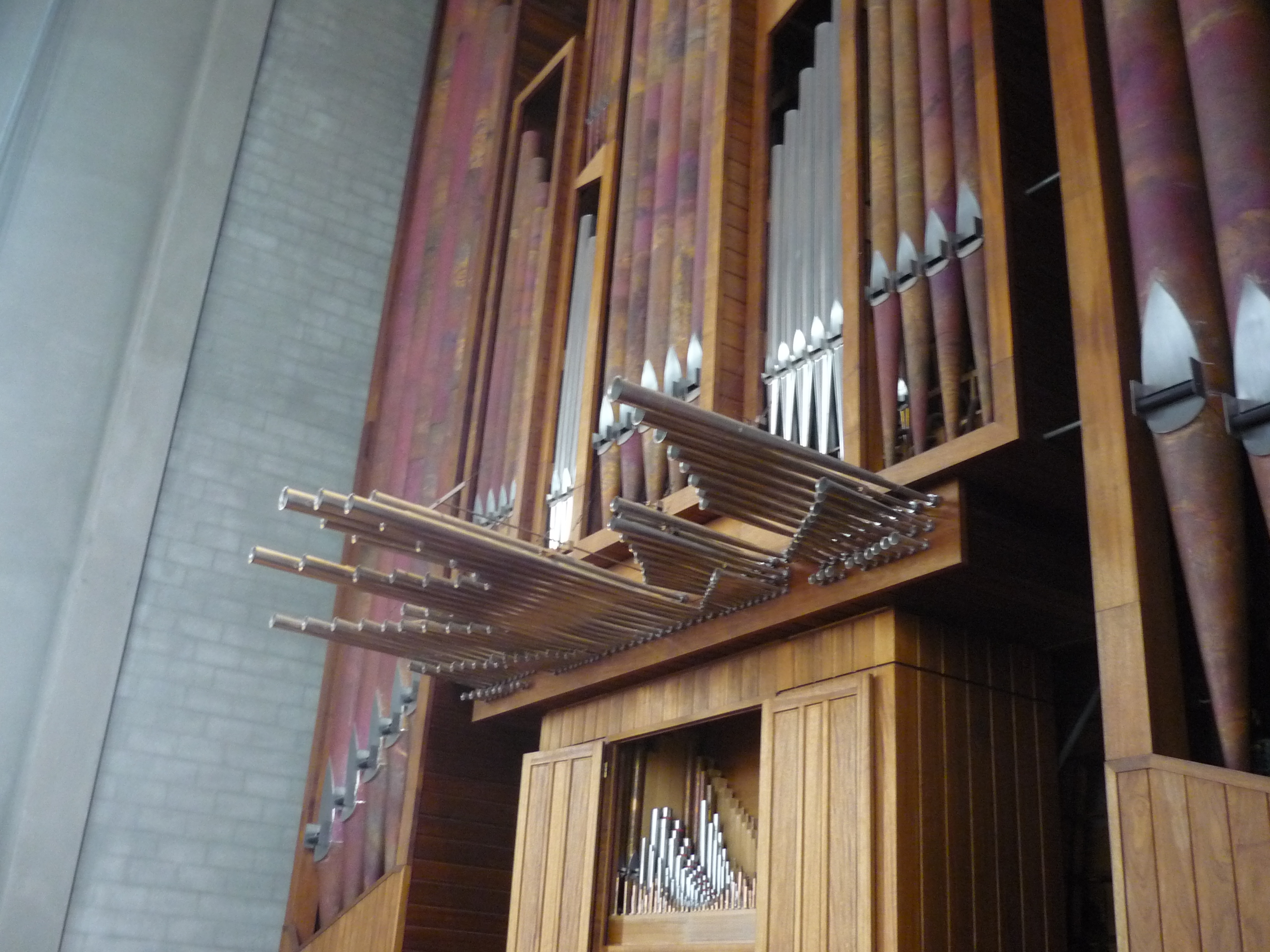
A complete stoplist is available from the St. Mark’s Website. Of note are the trompettes en chamade (horizontally mounted), the Rugwerk division that hangs over the balcony of the gallery (according to Joyce, the gallery was made large enough to fit a full orchestra and choir! I’d like to see that.), 32′ flue and reed pipes, and the small, intimate Brustwerk division. I’m still learning the conventions of the organ world, but I think this instrument is built with more of a French romantic tonal pallete in mind. This works really well with the large amount or reverberation that the cavernous unfinished concrete cathedral has.

That’s all technical stuff. Which I don’t even have a solid handle on. I can only really speak to the aesthetics of looking and listening to it. I can tell you that the sound is as overwhelming as the size of the instrument. Joyce played a concert of mostly 19th and 20th century music, and on big dissonant chords, the sound became almost viscerally threatening. On the other hand, it was capable of very tender soft moments as well. I loved its Schalmei, a small reed stop, as well as its string stops (the way that this effect is achieved is by having two pipes playing the same pitch slightly out of tune with each other. It sounds much better than that might suggest). Visually, it is staggeringly beautiful. Everything is in perfect proportion, and the pipes are covered in unusual oxidation patterns (the story goes that the pipes were constructed with higher-than-normal levels of copper, then soaked in urine to change their color). I don’t know about the historical correctness of inverse-colored keys on the console, but it looks cool too.
If anybody ever gets the chance to hear this instrument, I reccomend it.
Organ Case File #1: St. Andrew’s Church

I started taking organ lessons at the beginning of the semester. The organ, partially because of its liturgical use and partially because of its fundemental complexity, exists in its own hermetically sealed sphere; there is a tremendous amount to learn about every aspect of the instrument. One of the most useful things an organ student is to try and gain experience and perspective by visiting, playing and experimenting with many different instruments. Although these updates will not be regular, I hope to post about the different organs I visit in my own language to the extent of the education I have now.
One of the most fun afternoons of my spring break was the brief time I had to visit the Rosales Op. 10 organ at St. Andrew’s Episcopal Church in Ojai, California. Manuel Rosales is a Los Angeles based organ builder who builds in a tonally postmodern style heavily influenced by French and Mexican organs. His magnum opus is the organ at the Walt Disney Concert Hall (Op. 24), however he first gained national attention with the organ at Trinity Cathedral in Portland, Oregon (the Trinity organ was build right after the instrument at St. Andrew’s).
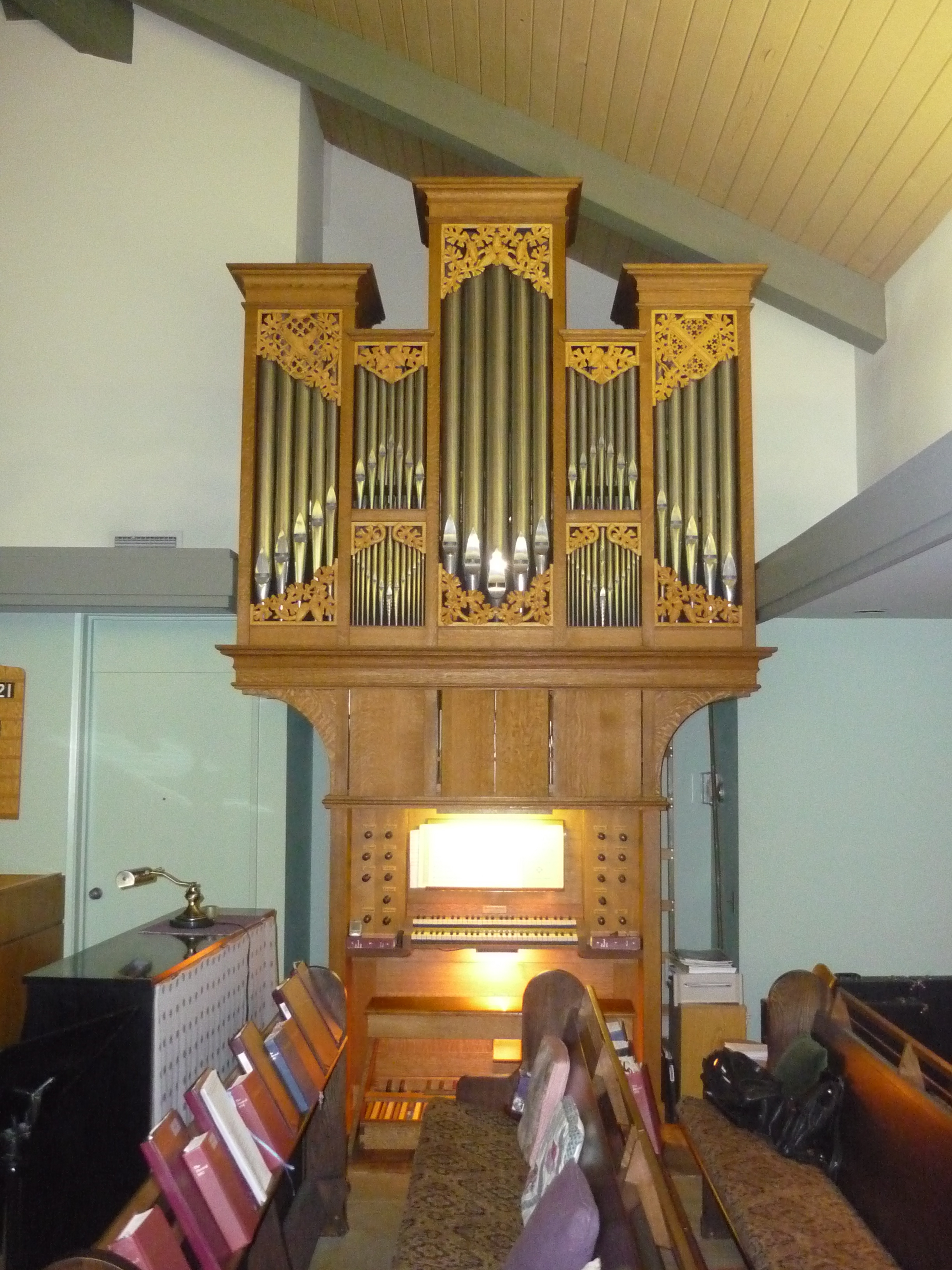
The organ at St. Andrews is much more modest than those organs (15 stops and two manuals), however it has the same craftsmanship, sweet tone, and strong point of view that have come to characterize Rosales organs. There were some physical features that I noticed immediately. The pedalboard is flat, without the curved array ususal for American organs. The stops on the console are physically large (perhaps taking influence from Mexican organs). Because of the small size of the organ, the expression pedal controls small hinged doors on the case, not the usual louvres. This, and the facade prestant, gives the organ an incredible dynamic range; the chimney flute with the doors closed is nearly inaudible. Sara Edwards, resident organist, pointed out to me the decoration on the case; it incorporates local motifs like the oak leaves and acorns of the California live oaks that grow in abundance in Ojai, and the crossed fishes of St. Andrew.
I’m still new at this, so I don’t have much of a palate to distinguish between different tonal palletes, however the organ did seem very sweet and mellow. As befits an organ of this size, the different stops seemed to be quite versatile. Almost all of them seemed like they could hold their own as a solo stop; I was particularly taken with the delicate 8′ chimney flute. Although I found the mechanics sluggish (it is a tracker [completely mechanical] organ), the 8′ trumpet sounded quite nice. I am generally suspicious of reed stops, but this one balanced boldness with richness. One thing that I found interesting when I first began to learn about organ building traditions is that, outside of a few basic stops, there is no standardized naming convention for organ pipes, they depend on the imagination and poetry of the builder. The stops at St. Andrews are named with traditional French labels, however the presense of the Dulciana in the choir division show Rosales’ Mexican influence (his Disney organ in particular has this in abundance with stops labeled Llamarada, Clarín armonico and Pajaritos*).
It was a real pleasure to play. I had heard the organ before, but didn’t know anything about them. It was interesting to find that there was such a treasure in my backyard.
*Pajaritos (little birds) is a stop that controls four birdolas, a kind of trick organ stop. Basically, before you play, you fill a small chamber with water, and the keys on the manuals control air burbling through it (almost like those plastic whistles you fill with water). One of my favorite things is all these trick stops on organs. They are most present on theater organs (like classic Wurlitzers) but they are also present in concert or liturgical organs. The St. Andrew’s organ has a Cymbal Star: basically air pressure spins a tine around which strikes a series of fixed cymbals.
Organ Case File #1: St. Andrew's Church

I started taking organ lessons at the beginning of the semester. The organ, partially because of its liturgical use and partially because of its fundemental complexity, exists in its own hermetically sealed sphere; there is a tremendous amount to learn about every aspect of the instrument. One of the most useful things an organ student is to try and gain experience and perspective by visiting, playing and experimenting with many different instruments. Although these updates will not be regular, I hope to post about the different organs I visit in my own language to the extent of the education I have now.
One of the most fun afternoons of my spring break was the brief time I had to visit the Rosales Op. 10 organ at St. Andrew’s Episcopal Church in Ojai, California. Manuel Rosales is a Los Angeles based organ builder who builds in a tonally postmodern style heavily influenced by French and Mexican organs. His magnum opus is the organ at the Walt Disney Concert Hall (Op. 24), however he first gained national attention with the organ at Trinity Cathedral in Portland, Oregon (the Trinity organ was build right after the instrument at St. Andrew’s).
The organ at St. Andrews is much more modest than those organs (15 stops and two manuals), however it has the same craftsmanship, sweet tone, and strong point of view that have come to characterize Rosales organs. There were some physical features that I noticed immediately. The pedalboard is flat, without the curved array ususal for American organs. The stops on the console are physically large (perhaps taking influence from Mexican organs). Because of the small size of the organ, the expression pedal controls small hinged doors on the case, not the usual louvres. This, and the facade prestant, gives the organ an incredible dynamic range; the chimney flute with the doors closed is nearly inaudible. Sara Edwards, resident organist, pointed out to me the decoration on the case; it incorporates local motifs like the oak leaves and acorns of the California live oaks that grow in abundance in Ojai, and the crossed fishes of St. Andrew.
I’m still new at this, so I don’t have much of a palate to distinguish between different tonal palletes, however the organ did seem very sweet and mellow. As befits an organ of this size, the different stops seemed to be quite versatile. Almost all of them seemed like they could hold their own as a solo stop; I was particularly taken with the delicate 8′ chimney flute. Although I found the mechanics sluggish (it is a tracker [completely mechanical] organ), the 8′ trumpet sounded quite nice. I am generally suspicious of reed stops, but this one balanced boldness with richness. One thing that I found interesting when I first began to learn about organ building traditions is that, outside of a few basic stops, there is no standardized naming convention for organ pipes, they depend on the imagination and poetry of the builder. The stops at St. Andrews are named with traditional French labels, however the presense of the Dulciana in the choir division show Rosales’ Mexican influence (his Disney organ in particular has this in abundance with stops labeled Llamarada, Clarín armonico and Pajaritos*).
It was a real pleasure to play. I had heard the organ before, but didn’t know anything about them. It was interesting to find that there was such a treasure in my backyard.
*Pajaritos (little birds) is a stop that controls four birdolas, a kind of trick organ stop. Basically, before you play, you fill a small chamber with water, and the keys on the manuals control air burbling through it (almost like those plastic whistles you fill with water). One of my favorite things is all these trick stops on organs. They are most present on theater organs (like classic Wurlitzers) but they are also present in concert or liturgical organs. The St. Andrew’s organ has a Cymbal Star: basically air pressure spins a tine around which strikes a series of fixed cymbals.
 hammer & jack