
interaction loops

Ezra Klein had Jonathan Haidt to talk about the influence The Anxious Generation has had on school no-phone policies. Haidt is mostly right in his societal diagnosis, but I wish his ideas had a different messenger. Haidt is a fool, a boor, and a coward.

He’s a coward because underneath his innuendo about children losing a ‘coherent moral order’ is old-fashioned Bill Bennett conservatism: young people are fucked up because they weren’t taught good values. It can’t engage with the reality that people weight moral values differently, or have different opinions about how to express them. Taken to the extreme, only conservative people are given the agency to have their own moral stances–socially liberal people are brainwashed or “only doing what feels good.”

He’s a boor because he cannot help himself from bringing weird gender essentialist, heteronormative asides into his argument. There is no sense that he talked to young people about his ideas. In his world view, they are all damaged, maybe permanently. Why bother finding out what they think?

He’s a fool because he thinks the solutions to the problems he diagnoses are simple. Totalitarian age-verification systems are not a viable answer. The collateral damage would be tremendous, especially to repressed groups. We’ve decimated IRL social spaces for kids & teens and better age verification policies wouldn’t do a thing to make alternatives more accessible.

As the argument that I first encountered in Johann Hari’s book about depression goes, when mammalian environments are stimulating and social, we are not as attracted to quick dopamine buttons. The argle-bargle about morality is necessary for Haidt’s to explain how this generation of kids is different. It’s easier for him to conjure the specter of a zombie army of braindead amoral iPad kids than to confront the unique material conditions of the moment: lower birthrate, two income families, loss of recreational spaces, changed norms around childhood independence.

And despite all that I do think he’s more right than he’s wrong! It’s OK to consider how we are raising children right now, to compare them against the ideas from many wisdom traditions about how to live a good life, and to find it alarming. There is endless room for scientific debate about what something is and how it became that way, but the question of why it matters is always a values question.

I’m thinking about this a lot because I am preparing for the arrival of a child. The way I am wrapping my head around it is to think about positive interaction loops.

The oldest and most important positive loop is the secure attachment between parent and child. There are others, like between audience and performer or pupil and teacher. There are even non-human interaction loops, like the way that a cup and ball toy builds fine motor coordination. The things I’m looking for are that they provide true feedback (so, not like a modern videogame that adjusts its skill level down if you suck) and that the more interaction you give to them the more you walk away with (so not like Instagram, which takes your time and leaves you with nothing). I can’t see the future or understand how every parenting choice is going to affect my child, but I can tell which interaction looks are providing positive training or just wasting time. That’s enough to get started.

toot or boot?

Twitter Mascot

My therapist asks And does this serve you? when I’ve been complaining about something and he’s trying to gently ask me to consider that ‘stop’ might be an easy way to improve the situation. It creates space to feel honest feelings about the things that we hate doing but we have to because it serves a purpose in our lives, and a way of double checking that the purposes they serve actually exist.

I joined Mastodon. This is the 3rd time. The first time was after some kind of Twitter corporate outrage. The second was after reading How to Do Nothing and hungering for richer online experiences.

This time around, Mastodon feels much more mature as a platform. There are still huge holes in the user experience that need attention. It’s hard to find people. It’s even harder to find people based on keywords and hashtags. The only way to build an audience is through word of mouth, like Follow Fridays. This time, I am questioning whether the habit of publishing anything online is serving me.

Out of the many dreams of what social media can do, two have been seductive to me. The first vision is social media as a public channel for keeping friends and family updated on big life events etc. That’s Instagram. The second is as a forum to get attention in a way that is difficult to get offline.

I read many bloggers in the period between the founding of Daily Kos and Huffington Post to the end of Google Reader. They were smart people, but not journalists or paid writers and sometimes from a marginalized group or young or from an unimportant place. The internet allowed them to compete for their share of the internet audience. Same with niche subjects or hobbies. All it took was four or five writers and their audiences on a beat to create an idea ecosystem. Generous attention to each other’s writing created that feeling of group cohesion.

The writing that I’ve shared on blogs on Twitter are the closest I come to asking for online attention. I struggle with that. The version of me that emerges from that body of work has less of my sense of humor, less of my sense of delight. He tends to emerge more often in anxiety and alienation than in joy or connectedness. He doesn’t share as much as he’s learned, and the only subject he has endless time for is himself.

My favorite online writers either focus on a narrow range of topics or they write in their own voice. Idiomatic blogs are conversational, fast pieces of writing. Books or works from publication have a higher bar for polish and accuracy. It’s understood that a blog post is more perishable. The thing that can perish is the voice of the mind working through its first reaction. First thought, best thought. It’s not always true, but it does have a strong flavor!

In the last 15 years, it has been very rare for me to get constructive feedback that inspires me to keep going. I tell myself that I keep writing because its rewarding. I worry that it’s because either I can’t give up on the idea of being discovered to be interesting, or that I don’t have the imagination to try something else. Does that serve me? I’m not sure. It takes practice to make perfect, sure. Audiences and artists train each other, though. There’s a ceiling for how far you can develop without high quality attention and feedback.

That’s what I’m really looking for: high quality attention and feedback.

I don’t know how to get it, online, in person, whatever. I write because even if I never get the feedback I want, I will end up with something to read back through. I hope it ends up more than that, but many people create even less.

I promise to myself that in 2023 I will seek more play, more attention, more good feedback. It’s time to be more brave.

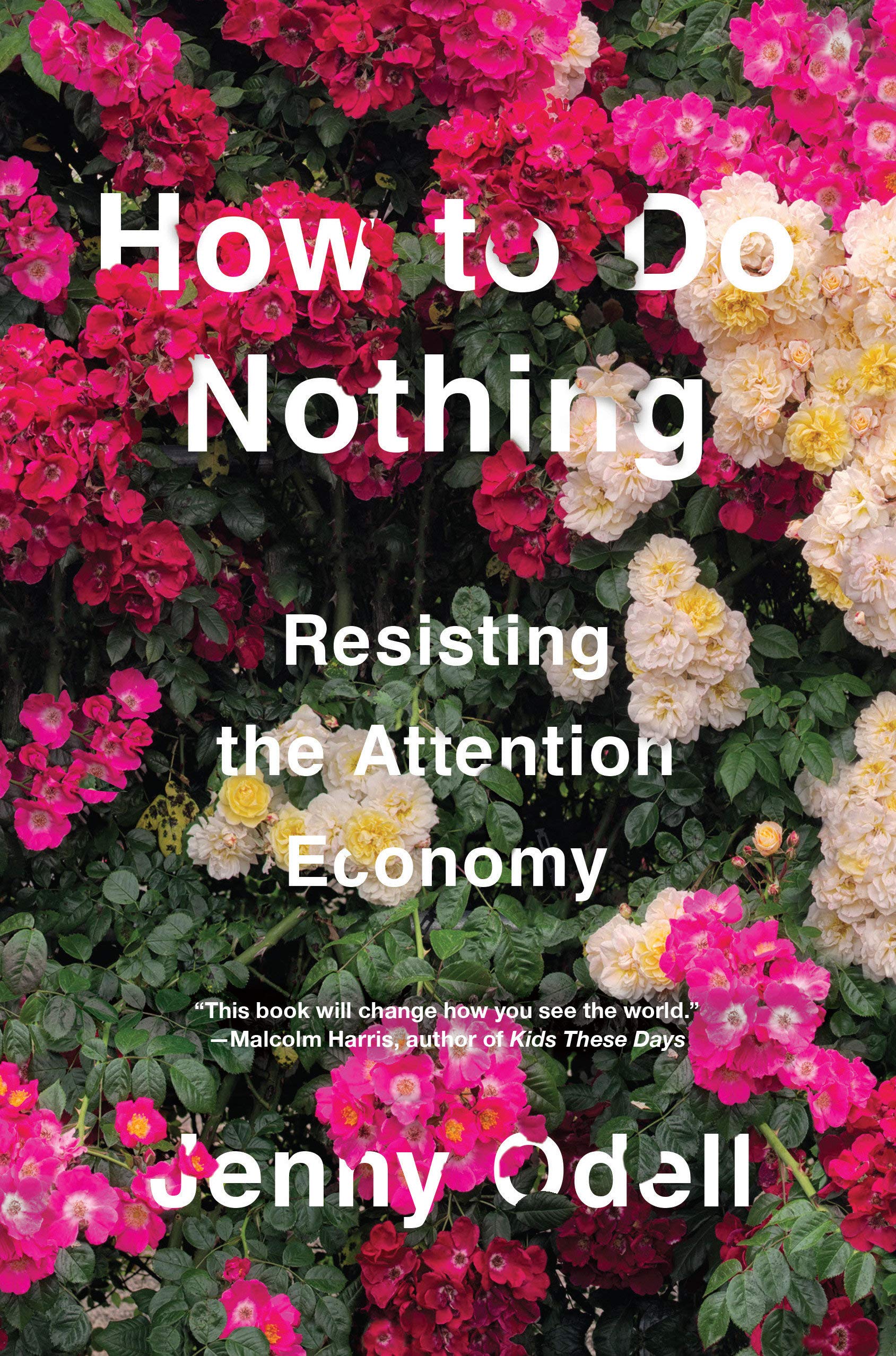
How to Do Nothing

How to Do Nothing by Jenny Odell book cover.

My attention is important to me, and I’ve been writing and reading a lot this year about ways to navigate a world that is increasingly filled with traps designed to capture, monetize, and waste my curiosity. Earlier this spring, I came across Jenny Odell’s artist talk “How to Do Nothing”, given at EYEO in 2017, and I have been eagerly anticipating her full-length book expanding some of the ideas she shared in her talk. It’s here, and I finished it this week.

How to Do Nothing is anchored by the ideas Odell shares in her artist talk: that grounding oneself in specific real places and paying attention to their physical, geographic, ecological, historical, and social characteristics is an act of anti-capitalist refusal against the various social media and big data businesses who monetize our attention and behaviors. In her book, she expands her scope to consider other questions: How much of a real possibility is it to opt-out of digital connectedness, and would that be a good thing anyway? Does the act of refusing to follow directions have any power or meaning beyond our individual choice? How, specifically, does one “grounding oneself”? How are the attention economy and the fiction of independence linked? Can we change how we think about production to include not just making something that wasn’t there before, but maintaining something that was there before, or even removing something to make room for something else that hasn’t had any room to develop?

These are wonderful, rich questions, and one of the real pleasures of this book is that Odell draws on so many different ways to contextualize these questions. Odell draws on sociology and economics to explain shifts in how jobs are structured, and history and journalism to bring context to the history of the East Bay places that she spends time in. There’s a little smattering of philosophy and theory, which I am a little allergic to so I was happy there wasn’t too much of it. But where Odell really shines for me are in her close readings (and connecting to the other ideas in her book) of conceptual art pieces, the life of Diogenes the Cynic, John Cage’s sound pieces, Melville’s “Bartleby the Scrivener,” and David Hockney’s polaroid collage pieces.

Maybe these are ideas that you could find in other books, off the top of my head I’m thinking of Cal Newport’s Deep Work, Tim Wu’s The Attention Merchants, or Jaron Lanier’s Ten Arguments for Deleting Your Social Media Accounts Right Now. One thing that sets this book apart is Odell’s fierce resistance to framing her argument around “productivity.” This is not a book that argues that changing your frame of attention is going to make you better at your job, or faster at creating career ideas, or anything of the sort—in that respect, she is the anti-Cal Newport (who I respect a lot also, but I think his idea that we can all just be “winners” by becoming more productive is a bit shallow by ducking systemic questions). The other thing that sets her apart is a fierce, humanistic commitment to encouraging us to think in terms of ecosystems and social systems in which no individual is completely apart. I look forward to some of these most delicate and precious ideas continuing to move through my brain.

I loved this book. Read it and try something different.

Other perspectives I liked

  • Cory Doctorow, praises the book but thinks her central argument will continue to get sharper over time.
  • Terri Windling: an artist’s perspective.
  • Haley Haltom: a perspective from someone who spent a year sailing around the world.

It’s important to me to link my critique of the attention economy to the promise of bioregional awareness because I believe that capitalism, colonialist thinking, loneliness, and an abusive stance toward the environment all coproduce one another. It’s also important because of the parallels between what the economy does to an ecological system and what the attention economy does to our attention. In both cases, there’s a tendency toward an aggressive monoculture, where those components that are seen as “not useful” and which cannot be appropriated (by loggers or by Facebook) are the first to go.

Jenny Odell How to Do Nothing

the three part test

I am not a lawyer, but there was a time when I wanted to be one, or admired them or something. It might have been the John Grisham thrillers, which are written for (as well as many other groups of people) 13 year old boys and men who think they totally could have been a lawyer. If it wasn’t them, it was probably The West Wing, which is written for 16 year old boys and men who think they totally could have been president.

If I’m really telling the truth, I have to confess that lawyers were the closest thing I could find in real life to the magic wielding characters I loved in fantasy stories. Like wizards, lawyers come in (lawful) good, evil, neutral alignments, memorize incantations in Latin, and the old ones get to wear robes. Is a trial a metaphor for combat, or is combat a metaphor for a trial?

One of the things I like most from legal culture is the idea of the legal test. From the Wikipedia:

Legal tests are often formulated from the logical analysis of a judicial decision or a court order where it appears that a finder of fact or the court made a particular decision after contemplating a well-defined set of circumstances. It is assumed that evaluating any given set of circumstances under a legal test will lead to an unambiguous and repeatable result.

Legal tests, Wikipedia

I love a well-constructed test. At their best, they are a way to cut through all of the distractions, all the stray bits of context that we think are important, in order to get to the really meaningful questions. I’ve been developing a test for myself to help me evaluate my media choices. I call it “Matt’s Three-Part Test for Deciding Whether To Hit Play Next Episode or Get The Fuck Out Now.” Here are the three questions:

  1. How does this make me feel?
  2. How active do I have to be to engage with it?
  3. How does this change my behavior?

Let’s look at a couple of test cases:

  • An episode of Fresh Air about the Muller investigation makes me feel anxious and bad, I listen to it passively, and after I finish the episode it makes me so angry that I go out and send bad and boring tweets, like Donald Trump himself is reading my Twitter feed and he just hadn’t heard from me before deciding to resign.
  • The new season of Queer Eye makes me feel human and connected, when I watch it it makes me think deeply about my own life, and after I finish watching it it gives me motivation to connect with people I love.
  • Reading a genre book from a genre that pushes my buttons—maybe a steamy gay romance or a sci-fi novel or a mystery—makes me feel entertained and relaxed. It might be empty entertainment, but afterwards I feel rested and refreshed.

The wild thing is that sometimes we do choose to read/watch/listen to the thing that makes us feel bad, that doesn’t stimulate us, and that makes us act shitty afterwards. Some social media communities are nothing but toxic circle jerks of feel-bad propaganda, and that includes groups that I feel a closeness to and groups that I feel un-included from. There are times when I feel like using the test—insulating myself from information that makes me feel bad—feels like a real first-world luxury. It seems cruel to decide I don’t want to engage with something upsetting when it’s related to an issue that could use attention. When I’m on the fence, I add this additional question:

  • Right now, does the media I am accessing make me feel empowered to attend to the problems that exist in the spheres where I have influence, or does it make me feel disempowered like my choices don’t matter any nothing can ever get better?

That usually tells me whether I should take on the one more upsetting thing, or whether I should take care of myself so that I can win the battles I am actually in.

How do you decide what to let into your brain?