interaction loops

Ezra Klein had Jonathan Haidt to talk about the influence The Anxious Generation has had on school no-phone policies. Haidt is mostly right in his societal diagnosis, but I wish his ideas had a different messenger. Haidt is a fool, a boor, and a coward.

He’s a coward because underneath his innuendo about children losing a ‘coherent moral order’ is old-fashioned Bill Bennett conservatism: young people are fucked up because they weren’t taught good values. It can’t engage with the reality that people weight moral values differently, or have different opinions about how to express them. Taken to the extreme, only conservative people are given the agency to have their own moral stances–socially liberal people are brainwashed or “only doing what feels good.”

He’s a boor because he cannot help himself from bringing weird gender essentialist, heteronormative asides into his argument. There is no sense that he talked to young people about his ideas. In his world view, they are all damaged, maybe permanently. Why bother finding out what they think?

He’s a fool because he thinks the solutions to the problems he diagnoses are simple. Totalitarian age-verification systems are not a viable answer. The collateral damage would be tremendous, especially to repressed groups. We’ve decimated IRL social spaces for kids & teens and better age verification policies wouldn’t do a thing to make alternatives more accessible.

As the argument that I first encountered in Johann Hari’s book about depression goes, when mammalian environments are stimulating and social, we are not as attracted to quick dopamine buttons. The argle-bargle about morality is necessary for Haidt’s to explain how this generation of kids is different. It’s easier for him to conjure the specter of a zombie army of braindead amoral iPad kids than to confront the unique material conditions of the moment: lower birthrate, two income families, loss of recreational spaces, changed norms around childhood independence.

And despite all that I do think he’s more right than he’s wrong! It’s OK to consider how we are raising children right now, to compare them against the ideas from many wisdom traditions about how to live a good life, and to find it alarming. There is endless room for scientific debate about what something is and how it became that way, but the question of why it matters is always a values question.

I’m thinking about this a lot because I am preparing for the arrival of a child. The way I am wrapping my head around it is to think about positive interaction loops.

The oldest and most important positive loop is the secure attachment between parent and child. There are others, like between audience and performer or pupil and teacher. There are even non-human interaction loops, like the way that a cup and ball toy builds fine motor coordination. The things I’m looking for are that they provide true feedback (so, not like a modern videogame that adjusts its skill level down if you suck) and that the more interaction you give to them the more you walk away with (so not like Instagram, which takes your time and leaves you with nothing). I can’t see the future or understand how every parenting choice is going to affect my child, but I can tell which interaction looks are providing positive training or just wasting time. That’s enough to get started.

doing nothing

Today was a good day, and one of the good things in it is that I came across this wonderful piece of writing called How To Do Nothing, by Jenny Odell. It’s a Medium post based on a speech she gave that she has expanded out into a book, which I immediately put a library hold on. It weaves together so many of the things I’ve been thinking about this year: how do we decide what is worth paying attention to, why do we all feel unbalanced by the internet and what has changed, how to communicate through the internet without being on the internet. The single, electrifying thought that Odell expands upon is this:

The function of nothing here, of saying nothing, is that it’s a precursor to something, to having something to say. “Nothing” is neither a luxury nor a waste of time, but rather a necessary part of meaningful thought and speech.

https://medium.com/@the_jennitaur/how-to-do-nothing-57e100f59bbb

Oh, I am so resistant to this idea.

There are some plants that only start to continue growing when old, dead matter is cut away. I am in a growth phase right now, and for every new idea tried, for every moment of understanding, there is also deep regret and loss for old ideas that I was just wrong about. One identity that I’m trying to let go of is as an “information junkie,” this persona who is curious and creative and constantly hungry for new information and stimulus. As a kid, I was always bored. I felt cut off from the information and cultural pathways that other people had access to because it was pre-broadband (if you were born after Google, pre-internet) and our household didn’t have a television set. Not even for VHS tapes. I went away to school in 9th grade, and one of the most precious freedoms I gained was internet access, and nothing was ever the same again, really. Since then, as each social network has been founded and attention has been fragmented and collated and monetized and optimized, there has only ever been the direction of more and more stimulation, more and more information. And over time, I think it’s drowned out my own thoughts.

Here’s the part that hurts, and here’s where the regret comes in: I thought that my ability to process and assimilate information was a rare gift. I thought that my peers who didn’t have the patience or stamina to sit down and power through a book, or the adults who didn’t seem to be in touch with news of the world or politics, or busy adults who didn’t have much time to read—all of these people deserved compassion, but they did not have the gift I had. In humble honesty, I thought that this made me better than other people. What I have to confront now is that other people may have just chosen to strike a different balance between what they give attention to in the wider world/culture, and what they give attention to in their own life.

This may seem like a small things, but there are implications that I’m very sensitive to. One is: if this is simply a different balance point struck, how satisfied am I with mine? Right now I am very unhappy with that balance—the stimulus I get from the internet and social media is addicting but makes me feel bad. Another is: if I have staked my identity on being a big brain, and the internet is a construct where the mind has complete dominance over body, what does it mean about me that I am washing out of being Extremely Online? Was I an animal the whole time, did I have bodily needs that a brain in a jar doesn’t have. Of course I was. A bleaker question: what did I miss out on while I was ignoring those needs?

Jenny Odell speaks to this, too:

What is missing from that surreal and terrifying torrent of information and virtuality is any regard, any place, for the human animal, situated as she is in time and in a physical environment with other human and nonhuman entities. It turns out that groundedness requires actual groundedness, in the ground.

[…]

 This is real. The living, breathing bodies in this room are real. I am not an avatar, a set of preferences, or some smooth cognitive force. I’m lumpy, I’m an animal, I hurt sometimes, and I’m different one day to the next. I hear, I see, and I smell things that hear, see, and smell me. And it can take a break to remember that, a break to do nothing, to listen, to remember what we are and where we are.

We have powerful forces that keep us from attending to the “soft animal of our body”: social platforms that don’t exist in real space and need our constant engagement with them to operate; our primate brain’s fear that if we don’t keep posting and ❤️ing, the troop will move on without us; and even our survival instinct:

In a situation where every waking moment has become pertinent to our making a living, and when we submit even our leisure for numerical evaluation via likes on Facebook and Instagram, constantly checking on its performance like one checks a stock, monitoring the ongoing development of our personal brand, time becomes an economic resource that we can no longer justify spending on “nothing.” It provides no return on investment; it is simply too expensive.

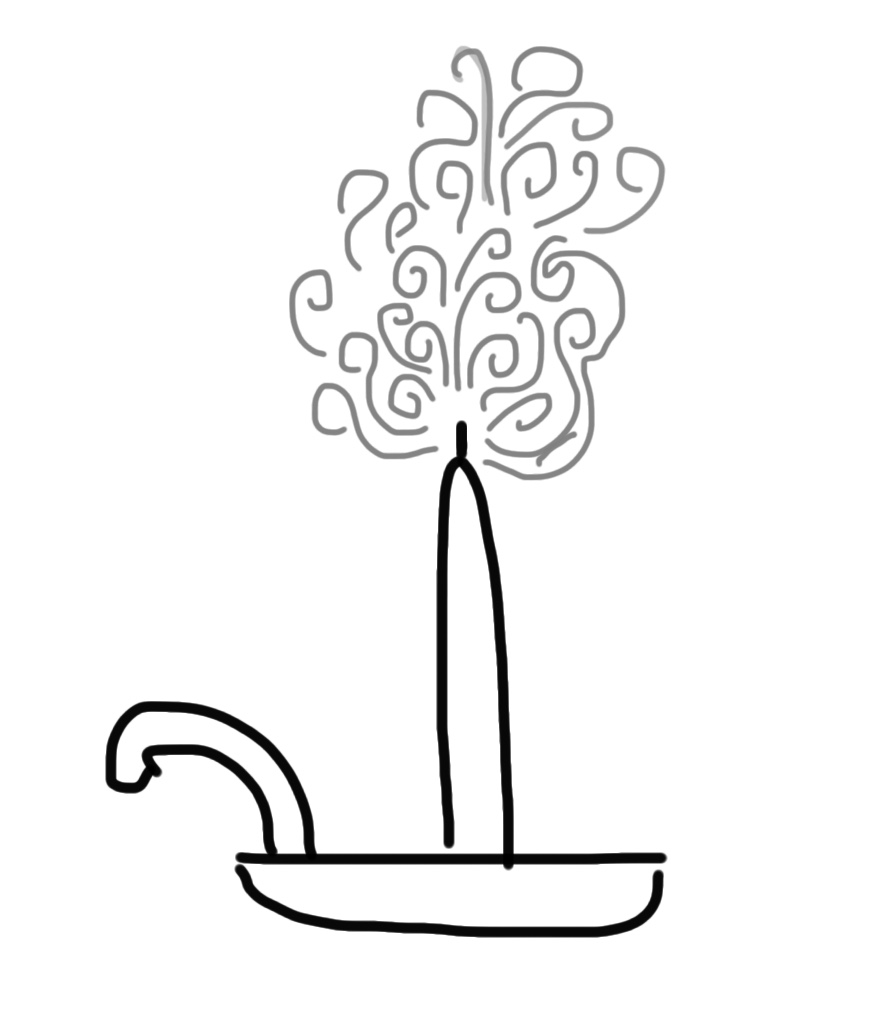
This is the biggest fear that I’m working through right now, as I’m changing my habits to incorporate more silence, more time for synthesis rather than stimulus. There’s an image I return to over and over again: the wonderful shapes in smoke after you blow out a candle. Move or talk too much, or if the room is too busy or drafty, and the smoke will just be blown around. But in stillness, in silence, the smoke makes wonderful patterns as it follows minute eddies of air. When I choose silence on a walk over browsing twitter as I walk, or listening to a podcast or music, I fear that I will become bored and it will have been a “waste of time.” An even deeper fear is that I will end up tuning into my own thoughts, and there will be nothing there.

But, of course, there always is something to be found there, if we’re brave enough to be patient. I hope. And if that turns out not to be the case, then I will set this idea down and try the next thing, which is all we ever can do anyway.

drawing of a candle with smoke


eyePhone

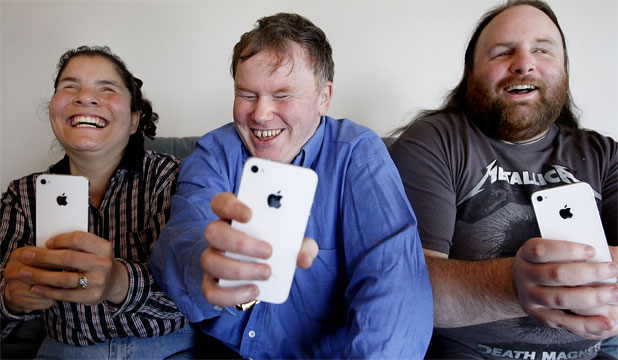
Blind iPhone users, via stuff.co.nz.

I was fascinated by this story from The Atlantic, describing how accessibility features of the iPhone are rapidly changing blind users’ daily lives. A description of some of the features:

Tatum is what Edmead calls “a techie.” She had a previous, failed experience with the Android, which almost made her give up the touch technology. Luckily, she kept her mind open enough to see how those around her are adapting to the iPhone. “I started ‘Info share’ five years ago, where a group for visually impaired people can share information.

A young lady, Eliza, got an iPhone, and she was entranced.” The sales representatives at the Verizon store, she says, were very nice and helped her set up her email account and sync her contacts. They didn’t know much besides that, and she had to teach them how accessibility is turned on (through Settings.) “They all went ‘Whoa!’,” she says.

Tatum and Rios happily volunteer to show off all their iPhone can do. “See, I tap it,” says Tatum, her iPhone stretched in front of her, “and it started reading out what is on the screen.”

Blind people use their iPhones slightly different than the sighted because, well, they can’t see what they’re tapping on. So instead of pressing down and opening up an app, they can press anywhere on the screen and hear where their finger is. If it’s where they want to be, they can double-tap to enter. If it isn’t, they’ll flick their finger to the right, to the left, towards the top or the bottom, to navigate themselves. The same for the simple “slide to unlock” command.

The article goes on to describe the way that apps developed specially for the blind, including navigational apps, color identifiers, and paper money identifiers, have started to replace single-use machines and even open up new sensory experiences. Austin Seraphin describes on his blog some of his first impressions in his first week of using an iPhone. Here, he describes being able to explore and share the world of color with the aid of an app:

The other night, however, a very amazing thing happened. I downloaded an app called Color Identifier. It uses the iPhone’s camera, and speaks names of colors. It must use a table, because each color has an identifier made up of 6 hexadecimal digits. This puts the total at 16777216 colors, and I believe it. Some of them have very surreal names, such as Atomic Orange, Cosmic, Hippie Green, Opium, and Black-White. These names in combination with what feels like a rise in serotonin levels makes for a very psychedelic experience.

I have never experienced this before in my life. I can see some light and color, but just in blurs, and objects don’t really have a color, just light sources. When I first tried it at three o’clock in the morning, I couldn’t figure out why it just reported black. After realizing that the screen curtain also disables the camera, I turned it off, but it still have very dark colors. Then I remembered that you actually need light to see, and it probably couldn’t see much at night. I thought about light sources, and my interview I did for Get Lamp. First, I saw one of my beautiful salt lamps in its various shades of orange, another with its pink and rose colors, and the third kind in glowing pink and red.. I felt stunned.

The next day, I went outside. I looked at the sky. I heard colors such as “Horizon,” “Outer Space,” and many shades of blue and gray. I used color cues to find my pumpkin plants, by looking for the green among the brown and stone. I spent ten minutes looking at my pumpkin plants, with their leaves of green and lemon-ginger. I then roamed my yard, and saw a blue flower. I then found the brown shed, and returned to the gray house. My mind felt blown. I watched the sun set, listening to the colors change as the sky darkened. The next night, I had a conversation with Mom about how the sky looked bluer tonight. Since I can see some light and color, I think hearing the color names can help nudge my perception, and enhance my visual experience. Amazing!

Some other interesting links: AppAdvice has a list of apps targeted toward blind users, or with thoughtful support for accessibility functions, as well as a list of games that blind users may enjoy.  MacWorld has a rundown of where these settings are located, and what each means. One feature not on the list, but mentioned by Seraphin in the post linked above, is that blind users have the option of disabling the screen and camera, which strikes me as pretty badass in the same way that when I was a kid I thought it was awesome that people who could read Braille could read in the dark. Finally, in a different realm of accessibility, David Pogue of the New York Times describes Apple’s implementation of custom gestures and options for users that don’t have the physical mobility to use multitouch gestures. Comments on the post from users are very interesting. Here’s one sample:

My 11 year old nephew has cerebral palsy. The iPad has opened up a whole world for him. Before the iPad, Nick needed help to surf the web, type, etc., with a regular computer. He lacks the strength and accuracy to press down on a physical keyboard. In addition to motor control problems, Nick’s speech can be difficult to understand. He has used and benefitted from two different AAC devices (assistive and augmentative communication) but they never became something he used in his daily life, only at/for school.

But Nick can use the iPad 100% independently, even without Assistive Touch, because he can tap, swipe and type on the large on screen keyboard, which is much larger than any smartphone. He can do everything on it and with it that any other kid can. He WANTS to use it because it’s cool and because it’s NOT for the disabled. He’s not different when he uses his iPad, he’s just like any other kid. Only luckier, cuz most of his friends don’t have one!

I am a speech-language therapist and I use Android text to speech apps with my adult patients with aphasia, but only has a demonstration of what’s possible because the keyboards are too small for them to use. I was already thinking of switching to an iPhone, and this is another reason to do so. I know that there is a risk of simply giving people with disabilities, especially kids, iPads and expecting them to develop communication skills. It doesn’t work that way, and over using iPads for therapy and education does more harm than good. But in the hands of capable teachers, iPads, iPhones and iOS can change lives.

All of this is super cool and super interesting, but the thing that I was really tickled by in the Atlantic story was this comment from one of the blind advocates:

Yet for all that technology has helped achieve, many in the blind community fear it might result in illiteracy in the generations to come.  “I think the technology that’s coming out right now is wonderful,” says Chalkias,”but I also think it’s dumbing us down because it’s making everything so easy. I have a lot of teens who have speech technology and they don’t know how to spell, and it’s horrifying to see that.”

Rios has encountered the same problem. She is an administrative assistant at the music school of Lighthouse International “an organization dedicated to overcoming vision impairment,” based in Manhattan, and a tutor at CCVIP who helps Maria with teenagers. “Even now I come in contact with kids who can’t spell,” she says. “Young adults don’t read Braille because they have screen readers who read for them.”

“I definitely think there’s benefits to this technology” Chalkias says. ”But if it keeps getting easier we’re just going to be a society of idiots that can’t do anything except tell our computers what to do for us.”

Among all populations, the more things change, the more things stay the same.
Losing Touch With The Young Folk

I was pretty gobsmacked by this story out of Portland, Maine*:

Over the next two weeks, Portland’s school district will install filtering software on laptops issued to high school students, in order to block access to pornography, social networking sites and video streaming sites when the laptops are at home.

Access to those sites is blocked now only at school, through the school network. The current filter doesn’t work when laptops are off school property.

The district will install filtering software made by Sophos, an Internet security company based in Boston. The software will be downloaded automatically when the students boot up their computers at school. Only when students get home will they discover that their lives have changed in a big way.

No longer will they have access to social networking sites like Facebook and video-streaming sites like Hulu and YouTube. Also blocked will be forums and news groups, games, dating sites, gambling sites and chat rooms.

Fortunately, the Kennebec Journal didn’t shy from the implications of this decision:

[School board Chairwoman Kate] Snyder said the school district shouldn’t give students equipment that makes it harder for parents to do their job, which is to help children stay focused on academics. She said the district has the right to filter the Internet.

“It’s a school-issued laptop,” she said. “If that’s something that the student wants to do on their own time and on a family computer, that’s OK.”

The change’s impact on students will depend on whether they have access to other computers at home. For many poor families, the school-issued laptop is the only computer in the house.

In interviews with Portland High students last week, those from middle-class families expressed various degrees of annoyance when told of the new filtering measures. A group of immigrant students reacted with anger.

“When we are at home, we need to have something else to look at besides homework,” said Fatush Jama, a senior.

“Where can we go to share if we don’t have Facebook?” asked Nateho Ahmen, a 17-year-old junior. “Who came up with this idea? We are going to have a long talk.”

This is not a legal question. Of course the school district has every right to install whatever software it wants on the computers it owns. But it’s hard for me to see this decision as anything but smallminded and passive aggressive.

First of all, I think it’s pretty uncontroversial to state that internet filters are nothing but odious joy killing vectors of hate. We’ve all had that experience of being interrupted at school, or at work in our quest for the answer to a question by an overzealous filter. Using the internet behind a filter is like browsing with a doddering uncle on your shoulder. He’s not entirely sure what’s going on, but he’s pretty sure that he disapproves. Not being able to leave him behind at the end of the school day sounds hellish.

Second, I think it’s pretty galling that a small group of parents pushed this through and made parenting decisions for the entire school district (that’s conjecture–there’s nothing mentioned about it in the article–but given that the school board member was the one dishing out the quote about giving control to parents, I think it’s pretty solid). I’m pretty sure the low income parents that use the computer as part time family computer are not the ones complaining. Sure, it’s primarily intended as a tool for school, but giving computer access to these families is a pretty valuable secondary social function. There’s something frankly ugly about denying access to families that don’t have other options.

But third, and most important, this decision shows a real failure of empathy on the part of the parent groups for the students they are responsible. Becoming out of touch with the culture is somthing I’ve been thinking about a lot, as I’ve reconsidered my relationship to pop culture and what’s popular. As I grow older, and my tastes more specialized, I’ve had to think about what responsibility I have to keep up with the culture at large. Another mental milestone passed by when I was reading a review for the new YA novel Fear, by Michael Grant, which posits a world in which everyone over the age of 15 mysteriously vanishes, and I realized that I had joined the masses of the dead. They told me to never trust anybody over the age of 25, and now that doesn’t seem very far away at all.  

But being out of touch with the chatter of the world happens, and I don’t really worry about it. There’s so much much in the world, and I don’t think anybody cares that much when a sheep drops out of the herd. What I really worry about is this exact kind of losing touch, where new technologies, new ideas, new social dynamics cut you off from your own experiences and your own former selves. Empathy is a plastic thing; I’ve met people in high school that will never be able to see themselves in people that did not grow up like them, and I’ve met older people that have stayed young, despite growing up in a world that may not exist anymore. Facebook is a new thing. But wanting to talk to your friends, gossiping about your enemies, developing a personality apart from your parents, even avoiding homework, these are very old things. And the smallmindedness of banning Facebook from school computers is the same smallmindedness of banning conversation during lunch, or restricting recess.

And we’ll all become old things too, whether that means over 15, or over 25, or over 55; age is a moving target. The boundaries of us and them will change whether we listen to top 40 or read the news or go to the movies. But we can resist forgetting what it means to be young.

*Which is, as regional allegiances require me to point out, the worst Portland.

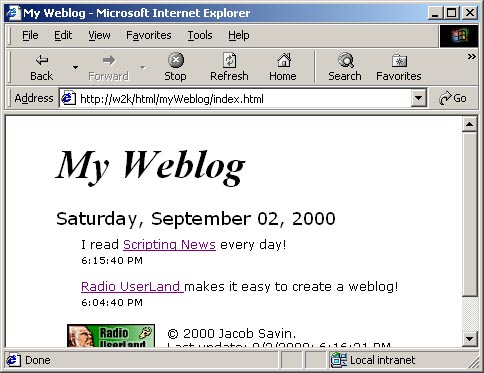
The Agony and the Ecstacy of Web Logs

I was poking around kottke.org and saw a post referencing the 10th anniversary of another blog, waxy.org. It’s a very high quality blog, and I had a great time poking through the archives. What’s been sticking with me, though, are some of the thoughts in the birthday post arguing for a personal vision and less content as the key to a great blog in the new internet landscape:

Ten years ago, I started this site with three simple rules: no journaling, no tired memes, and be original. 18 months later, I added a little linkblog.

In those ten years, I’ve posted 415 entries, including this one, and over 13,000 links.

….
 

Personal homepages and weblogs have long since faded from the popular trends. They’re no longer hip and nobody’s launching the hot new startup to reinvent them or make them better.

Most of the interest in writing online’s shifted to microblogging, but not everything belongs in 140 characters and it’s all so impermanent. Twitter’s great, but it’s not a replacement for a permanent home that belongs to you.

And since there are fewer and fewer individuals doing long-form writing these days, relative to the growing potential audience, it’s getting easier to get attention than ever if you actually have something original to say.

The particular information economics of the internet mean that the world of personal blogs and homepages have gone through as much change, though on a smaller scale, as the newspaper industry, though in an even more compressed timeline–and this is coming from someone who wasn’t even writing online in those early days. There’s way more competition for space; almost nobody gets attention anymore by being simply an X [stripper, line cook, police officer] that blogs. Even project blogs, á la Julie and Julia have become passé. And the early standbys of blogs: link aggregation, tv show recaps and the like have been almost entirely consumed by professional bloggers, whether they work for traditional news outlets, non-profit organizations, or commercial blogs. The point that Andy Biao (of waxy) makes is that personal blogs are not going to be able to compete on frequency of updates or density of coverage. The only way that they can compete is with personal vision and quality of content.

This is something I’ve been thinking about a lot as I go through another period of social media self-loathing. I’ve learned not to delete Twitter or Tumblr accounts because I inevitably will want to update or access the network, but just as predictable is the dissatisfaction at spending my time filling my thoughts with what is essentially disposable information.

In a culture where sharing of information has never been as easy. We are pressured to share our opinions and preferences both on a personal level, through peers on social networks, and in the aggregate, through the advertising that supports them. It has become the case that the rules of knowing when to speak, and knowing when to be silent, have broken. Though his famous quotation “Whereof one cannot speak, thereof one must be silent.” easily fits in a 160 character limit, one suspects that Wittgenstein would not have been a prolific Twitterer.

So I’ve come around to the idea that in a world where we’re constantly incentivized to give our own opinions, in a world where we’re constantly reminded how many of our opinions are shared with so many people, the most radical act of self expression is to discern which are those unique thoughts, to discern which thoughts must be expressed. And if that means that I only update a couple times a month, perhaps that is the exact amount I should be updating.