I don’t know very much about Jazz. Or rather, I know enough about Jazz to understand the immensity of what I don’t know. Nevertheless, one of the best things that I have found on the internet in the last year is Ethan Iverson of The Bad Plus‘ blog, Do The Math! Iverson, in addition to being a fine pianist, has a scholar’s knowledge of Jazz and a fine critic’s writing style. Something that has been particularly helpful to me has been his long-form interviews with musicians from across the musical spectrum (my favorites have been with Wynton Marsalis and Marc-André Hamelin). I find it interesting and useful to hear any musician talking about their creative processes and, in particular, the way that they listen to music. A side benefit has been that Iverson has pointed me towards a lot of interesting music (even if I don’t understand it all!).
One of his recent posts focused on Hall Overton, a Jazz arranger and Modernist composer active in the 1950’s and 60’s. The post was prompted by an NPR story in their series about the Jazz Loft Project (which I had been meaning to blog about anyway). Overton was an extremely interesting guy. He was both a Juliard composition professor and a jazz orchestra arranger most famous for notating Thelonious Monk scores. It’s well worth your time to surf over and listen to the 10 minute radio segment.
The audio tapes from that segment comes from the thousands of feet of tape amassed by photographer W. Eugene Smith. From the Jazz Loft Project homepage.
From 1957 to 1965 legendary photographer W. Eugene Smith made approximately 4,000 hours of recordings on 1,741 reel-to-reel tapes and nearly 40,000 photographs in a loft building in Manhattan’s wholesale flower district where major jazz musicians of the day gathered and played their music. Smith’s work has remained in archives until now. The Jazz Loft Project is dedicated to uncovering the stories behind this legendary moment in American cultural history.
Again, I won’t pretend that I’m the worlds biggest Jazz fan (because I don’t have a ton of experience with it, not because I don’t like it), but I’ve been reading the articles that have resulted from this research, and I think it’s pretty cool that we have these documents.

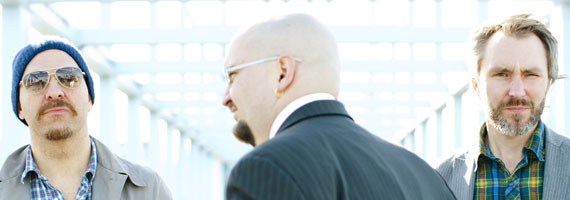 I’ll be up late writing a paper on the significance of the compositional chronology of the last section of J.S. Bach’s Mass in B minor,* but I wanted to link to a release of the premiere performance of On Sacred Ground, The Bad Plus’ reworking of Stravinsky’s The Rite of Spring. Pianist Ethan Iverson is a beast on the recording, and his blog post on his creative process is a must-read. I’m also grateful to him for pointing to pianist Serhiy Salov’s album The Sacred Spring of Slavs. The album contains Salov’s own transcription of the Rite for solo piano as well as a suite of character pieces by the Ukrainian composer Igor Shamo. The transcription is rough and edgy, while at the same time showing off near-superhuman piano technique (there were several times where I had to repeat a section to try and figure out how he was producing these sounds with only two hands), and the Shamo pieces are strong in their own right, a combination of the folk melodies of Stravinsky/Bartók and the atmospheric washes of color of Debussy.
 hammer & jack