
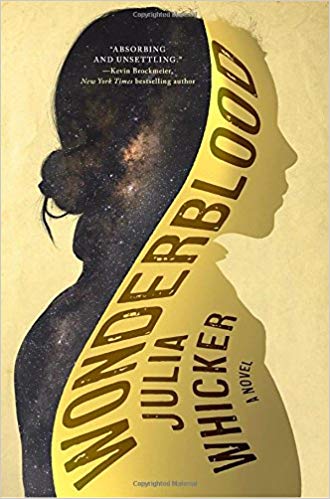
Wonderblood | Julia Whicker

Cover of Wonderblood by Julia Whicker.
Wonderblood cover.

Faith, reason, morality, progress all come into conflict under the shadow of the launch tower at Cape Canaveral! Kings, magicians, doctors, executioners, all bound to their own arcane rituals. A girl appears just like in a prophecy. And then a new bright light appears in the sky.

I really did not care for this book. Whicker has imagined a world where mad cow disease has led to a societal collapse, and after thousands of years, people in the United States have devolved into followers of mystic religions that believe in blood sacrifice to bring about the return of the space shuttles, which will save the world.

You have to invest a lot in this setting to get anything out of the book–which is another way of saying that the plot, character, and prose style didn’t do much for me–and so much of the setting didn’t make any sense. Whicker clearly loved this idea of a medieval/feudal world that has adopted NASA as its religious symbols, but never quite explains how that could have come about. Yes, there is prion disease and societal breakdown, but how are there artifacts from the 20th century but no city ruins? Given what we know about how tribalism forms in times of scarcity, is it really plausible that no characters notice each others skin colors? For that matter, in Florida of all places, why does everybody speak English?

For that matter, Whicker doesn’t have very much respect for medieval knowledge either. In an interview with The Qwillery, Whicker mentions being inspired by figures like Johannes Kepler and Tycho Brahe and yet none of that seems to have made it onto the page, except in cutesy character names.

I’d suggest skipping this book and watch Waterworld instead.
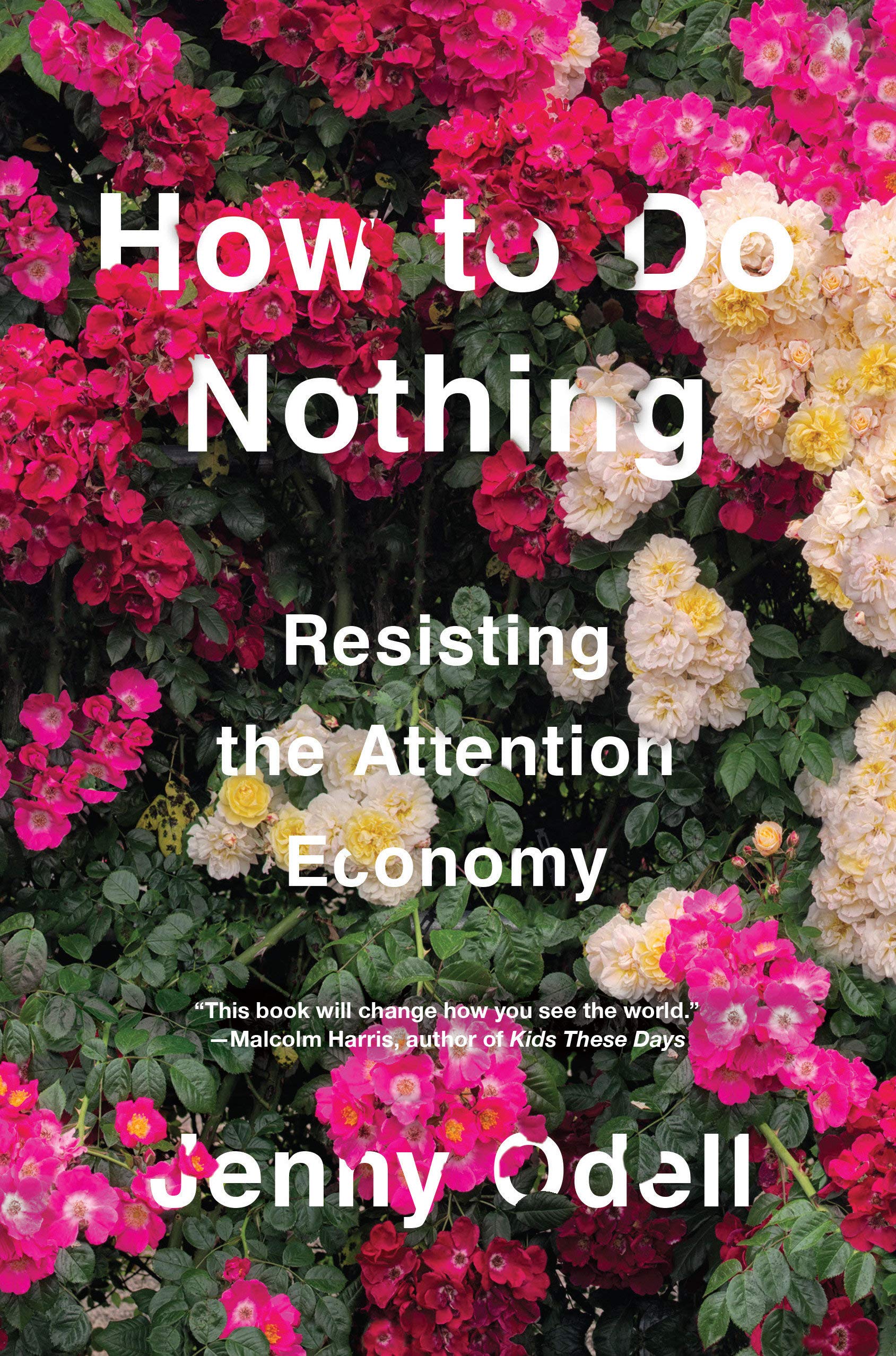
How to Do Nothing

How to Do Nothing by Jenny Odell book cover.

My attention is important to me, and I’ve been writing and reading a lot this year about ways to navigate a world that is increasingly filled with traps designed to capture, monetize, and waste my curiosity. Earlier this spring, I came across Jenny Odell’s artist talk “How to Do Nothing”, given at EYEO in 2017, and I have been eagerly anticipating her full-length book expanding some of the ideas she shared in her talk. It’s here, and I finished it this week.

How to Do Nothing is anchored by the ideas Odell shares in her artist talk: that grounding oneself in specific real places and paying attention to their physical, geographic, ecological, historical, and social characteristics is an act of anti-capitalist refusal against the various social media and big data businesses who monetize our attention and behaviors. In her book, she expands her scope to consider other questions: How much of a real possibility is it to opt-out of digital connectedness, and would that be a good thing anyway? Does the act of refusing to follow directions have any power or meaning beyond our individual choice? How, specifically, does one “grounding oneself”? How are the attention economy and the fiction of independence linked? Can we change how we think about production to include not just making something that wasn’t there before, but maintaining something that was there before, or even removing something to make room for something else that hasn’t had any room to develop?

These are wonderful, rich questions, and one of the real pleasures of this book is that Odell draws on so many different ways to contextualize these questions. Odell draws on sociology and economics to explain shifts in how jobs are structured, and history and journalism to bring context to the history of the East Bay places that she spends time in. There’s a little smattering of philosophy and theory, which I am a little allergic to so I was happy there wasn’t too much of it. But where Odell really shines for me are in her close readings (and connecting to the other ideas in her book) of conceptual art pieces, the life of Diogenes the Cynic, John Cage’s sound pieces, Melville’s “Bartleby the Scrivener,” and David Hockney’s polaroid collage pieces.

Maybe these are ideas that you could find in other books, off the top of my head I’m thinking of Cal Newport’s Deep Work, Tim Wu’s The Attention Merchants, or Jaron Lanier’s Ten Arguments for Deleting Your Social Media Accounts Right Now. One thing that sets this book apart is Odell’s fierce resistance to framing her argument around “productivity.” This is not a book that argues that changing your frame of attention is going to make you better at your job, or faster at creating career ideas, or anything of the sort—in that respect, she is the anti-Cal Newport (who I respect a lot also, but I think his idea that we can all just be “winners” by becoming more productive is a bit shallow by ducking systemic questions). The other thing that sets her apart is a fierce, humanistic commitment to encouraging us to think in terms of ecosystems and social systems in which no individual is completely apart. I look forward to some of these most delicate and precious ideas continuing to move through my brain.

I loved this book. Read it and try something different.

Other perspectives I liked

  • Cory Doctorow, praises the book but thinks her central argument will continue to get sharper over time.
  • Terri Windling: an artist’s perspective.
  • Haley Haltom: a perspective from someone who spent a year sailing around the world.

It’s important to me to link my critique of the attention economy to the promise of bioregional awareness because I believe that capitalism, colonialist thinking, loneliness, and an abusive stance toward the environment all coproduce one another. It’s also important because of the parallels between what the economy does to an ecological system and what the attention economy does to our attention. In both cases, there’s a tendency toward an aggressive monoculture, where those components that are seen as “not useful” and which cannot be appropriated (by loggers or by Facebook) are the first to go.

Jenny Odell How to Do Nothing

Welcome!

I still believe in the internet.

You power the internet. Your preferences, fed back to you in the form of ads, fund the internet. Your attention and your anger give it political power. Your experiences and preferences and interactions shape design on the internet and in the built world. Someone is always trying to take your personality and behaviors and monetize them for themselves.

This is my own little digital homestead. I like using all the feed based apps as much as anybody else, but to have a little archive of my own is important to me too. Please enjoy, and if you want to follow me elsewhere, please do!

big canvases

the new Star Wars trailer dropped today

The Last Jedi was a really beautiful and important movie to me, and there are others who have written longer and better than I can about why (most especially Film Crit Hulk, both about the movie and the reactionary culture clash that followed).

While the Star Wars movies were certainly a part of my childhood* but they never captured my imagination to the extent that other media would, like Harry Potter or Dune. Maybe to some, that would be enough to discount my opinion. But I did like them, and I’m grateful that I was able to be exposed to the original trilogy in the quiet years before the prequels were released, when the culture at large was not interested in them beyond extended universe books and video games.

*In fact, the copy of Star Wars that we had in the house was a single extremely long playing VHS with all three movies taped from a TV broadcast. Honestly, I think this is very legit, fandom wise.

There’s a funny paradox at the heart of the mega-franchise dominated culture we live in now: the health of franchises is determined by the attention they attract, which determines which get sequels. At the same time, the more attention a franchise has, the more any given movie in it is required to include characters and events to support the infrastructure of the universe, which leads to the movies becoming thematically incoherent, long and boring (see: every Marvel movie with a colon in its title).

The wild thing about The Last Jedi, the thing that makes it such an outlier, is that it managed to have artistic depth in a form and a creative structure that are difficult to work within. It did three very difficult things: it worked as a movie (it was fun to watch, the story made sense, there were good jokes), it had a thematic gestalt, and—the most difficult part—the thematic ideas of the movie complicate and enrich our understanding of the stories we have bonded with.

Put another way, it’s hard to make one of these movies that say anything, and it’s even harder to make one of these movies say something that makes sense, and it’s even harder to make one of these movies say something that both makes sense and is meaningful.

There are a whole host of good but flawed movies in which a clear director’s sensibility shines through: Sam Rami’s Spider-Man, Christopher Nolan’s Batman, as well as Ryan Coogler’s Black Panther and James Mangold’s Logan. And there’s also many other movies that are workmanlike but are so much fun that we don’t care that they don’t say anything: James Gunn’s Guardians of the Galaxy, Jon Favreau and Shane Black’s Iron Man. And then there are a whole bunch of hacks, turning out movies that are fun enough and are forgotten the second you walk out of the theater.

The most depressing part of the followup to The Last Jedi is that J.J. Abrams is the king of the hacks. And so this movie is going to end how all of his movies end, with slowly moving shots of characters we don’t quite understand experiencing what seem like profound emotions that aren’t quite proportional to the events that just happened, all set to shimmering strings in Michael Giacchino’s score. And none of it will have meant anything, and we’ll walk out of the theater and it will be like none of it ever happened.