doing nothing

Today was a good day, and one of the good things in it is that I came across this wonderful piece of writing called How To Do Nothing, by Jenny Odell. It’s a Medium post based on a speech she gave that she has expanded out into a book, which I immediately put a library hold on. It weaves together so many of the things I’ve been thinking about this year: how do we decide what is worth paying attention to, why do we all feel unbalanced by the internet and what has changed, how to communicate through the internet without being on the internet. The single, electrifying thought that Odell expands upon is this:

The function of nothing here, of saying nothing, is that it’s a precursor to something, to having something to say. “Nothing” is neither a luxury nor a waste of time, but rather a necessary part of meaningful thought and speech.

https://medium.com/@the_jennitaur/how-to-do-nothing-57e100f59bbb

Oh, I am so resistant to this idea.

There are some plants that only start to continue growing when old, dead matter is cut away. I am in a growth phase right now, and for every new idea tried, for every moment of understanding, there is also deep regret and loss for old ideas that I was just wrong about. One identity that I’m trying to let go of is as an “information junkie,” this persona who is curious and creative and constantly hungry for new information and stimulus. As a kid, I was always bored. I felt cut off from the information and cultural pathways that other people had access to because it was pre-broadband (if you were born after Google, pre-internet) and our household didn’t have a television set. Not even for VHS tapes. I went away to school in 9th grade, and one of the most precious freedoms I gained was internet access, and nothing was ever the same again, really. Since then, as each social network has been founded and attention has been fragmented and collated and monetized and optimized, there has only ever been the direction of more and more stimulation, more and more information. And over time, I think it’s drowned out my own thoughts.

Here’s the part that hurts, and here’s where the regret comes in: I thought that my ability to process and assimilate information was a rare gift. I thought that my peers who didn’t have the patience or stamina to sit down and power through a book, or the adults who didn’t seem to be in touch with news of the world or politics, or busy adults who didn’t have much time to read—all of these people deserved compassion, but they did not have the gift I had. In humble honesty, I thought that this made me better than other people. What I have to confront now is that other people may have just chosen to strike a different balance between what they give attention to in the wider world/culture, and what they give attention to in their own life.

This may seem like a small things, but there are implications that I’m very sensitive to. One is: if this is simply a different balance point struck, how satisfied am I with mine? Right now I am very unhappy with that balance—the stimulus I get from the internet and social media is addicting but makes me feel bad. Another is: if I have staked my identity on being a big brain, and the internet is a construct where the mind has complete dominance over body, what does it mean about me that I am washing out of being Extremely Online? Was I an animal the whole time, did I have bodily needs that a brain in a jar doesn’t have. Of course I was. A bleaker question: what did I miss out on while I was ignoring those needs?

Jenny Odell speaks to this, too:

What is missing from that surreal and terrifying torrent of information and virtuality is any regard, any place, for the human animal, situated as she is in time and in a physical environment with other human and nonhuman entities. It turns out that groundedness requires actual groundedness, in the ground.

[…]

 This is real. The living, breathing bodies in this room are real. I am not an avatar, a set of preferences, or some smooth cognitive force. I’m lumpy, I’m an animal, I hurt sometimes, and I’m different one day to the next. I hear, I see, and I smell things that hear, see, and smell me. And it can take a break to remember that, a break to do nothing, to listen, to remember what we are and where we are.

We have powerful forces that keep us from attending to the “soft animal of our body”: social platforms that don’t exist in real space and need our constant engagement with them to operate; our primate brain’s fear that if we don’t keep posting and ❤️ing, the troop will move on without us; and even our survival instinct:

In a situation where every waking moment has become pertinent to our making a living, and when we submit even our leisure for numerical evaluation via likes on Facebook and Instagram, constantly checking on its performance like one checks a stock, monitoring the ongoing development of our personal brand, time becomes an economic resource that we can no longer justify spending on “nothing.” It provides no return on investment; it is simply too expensive.

This is the biggest fear that I’m working through right now, as I’m changing my habits to incorporate more silence, more time for synthesis rather than stimulus. There’s an image I return to over and over again: the wonderful shapes in smoke after you blow out a candle. Move or talk too much, or if the room is too busy or drafty, and the smoke will just be blown around. But in stillness, in silence, the smoke makes wonderful patterns as it follows minute eddies of air. When I choose silence on a walk over browsing twitter as I walk, or listening to a podcast or music, I fear that I will become bored and it will have been a “waste of time.” An even deeper fear is that I will end up tuning into my own thoughts, and there will be nothing there.

But, of course, there always is something to be found there, if we’re brave enough to be patient. I hope. And if that turns out not to be the case, then I will set this idea down and try the next thing, which is all we ever can do anyway.
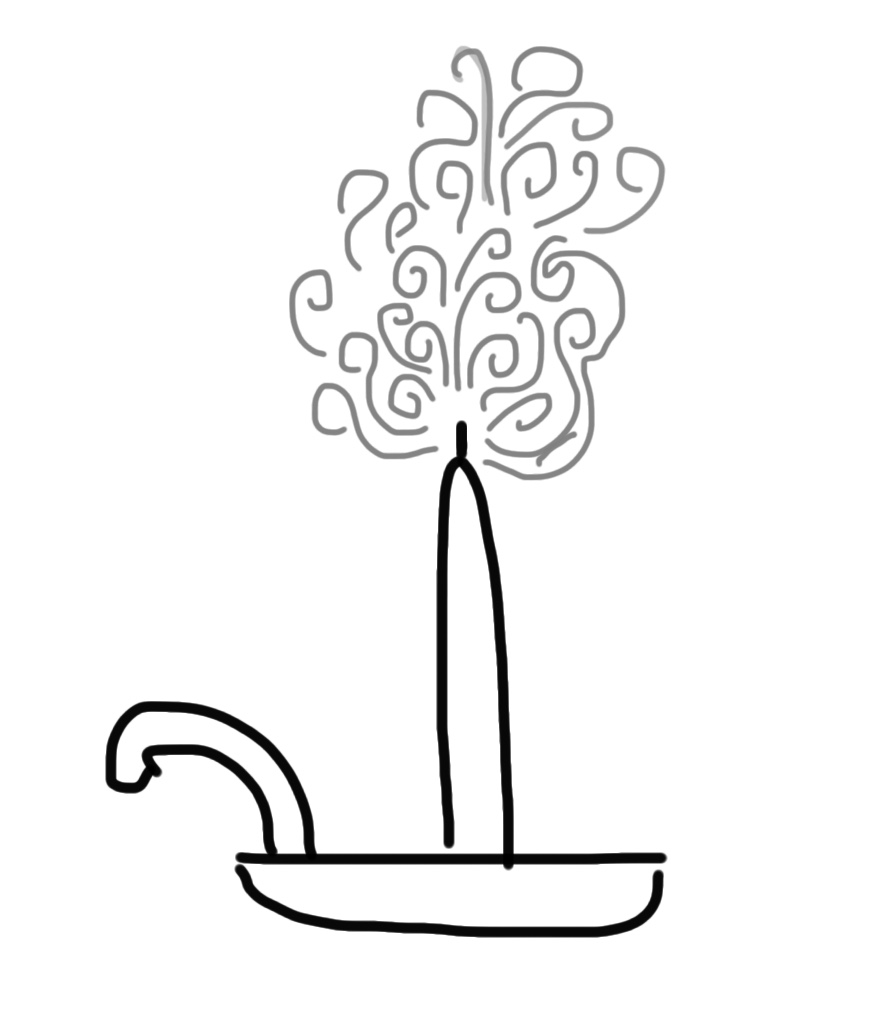
drawing of a candle with smoke


the three part test

I am not a lawyer, but there was a time when I wanted to be one, or admired them or something. It might have been the John Grisham thrillers, which are written for (as well as many other groups of people) 13 year old boys and men who think they totally could have been a lawyer. If it wasn’t them, it was probably The West Wing, which is written for 16 year old boys and men who think they totally could have been president.

If I’m really telling the truth, I have to confess that lawyers were the closest thing I could find in real life to the magic wielding characters I loved in fantasy stories. Like wizards, lawyers come in (lawful) good, evil, neutral alignments, memorize incantations in Latin, and the old ones get to wear robes. Is a trial a metaphor for combat, or is combat a metaphor for a trial?

One of the things I like most from legal culture is the idea of the legal test. From the Wikipedia:

Legal tests are often formulated from the logical analysis of a judicial decision or a court order where it appears that a finder of fact or the court made a particular decision after contemplating a well-defined set of circumstances. It is assumed that evaluating any given set of circumstances under a legal test will lead to an unambiguous and repeatable result.

Legal tests, Wikipedia

I love a well-constructed test. At their best, they are a way to cut through all of the distractions, all the stray bits of context that we think are important, in order to get to the really meaningful questions. I’ve been developing a test for myself to help me evaluate my media choices. I call it “Matt’s Three-Part Test for Deciding Whether To Hit Play Next Episode or Get The Fuck Out Now.” Here are the three questions:

  1. How does this make me feel?
  2. How active do I have to be to engage with it?
  3. How does this change my behavior?

Let’s look at a couple of test cases:

  • An episode of Fresh Air about the Muller investigation makes me feel anxious and bad, I listen to it passively, and after I finish the episode it makes me so angry that I go out and send bad and boring tweets, like Donald Trump himself is reading my Twitter feed and he just hadn’t heard from me before deciding to resign.
  • The new season of Queer Eye makes me feel human and connected, when I watch it it makes me think deeply about my own life, and after I finish watching it it gives me motivation to connect with people I love.
  • Reading a genre book from a genre that pushes my buttons—maybe a steamy gay romance or a sci-fi novel or a mystery—makes me feel entertained and relaxed. It might be empty entertainment, but afterwards I feel rested and refreshed.

The wild thing is that sometimes we do choose to read/watch/listen to the thing that makes us feel bad, that doesn’t stimulate us, and that makes us act shitty afterwards. Some social media communities are nothing but toxic circle jerks of feel-bad propaganda, and that includes groups that I feel a closeness to and groups that I feel un-included from. There are times when I feel like using the test—insulating myself from information that makes me feel bad—feels like a real first-world luxury. It seems cruel to decide I don’t want to engage with something upsetting when it’s related to an issue that could use attention. When I’m on the fence, I add this additional question:

  • Right now, does the media I am accessing make me feel empowered to attend to the problems that exist in the spheres where I have influence, or does it make me feel disempowered like my choices don’t matter any nothing can ever get better?

That usually tells me whether I should take on the one more upsetting thing, or whether I should take care of myself so that I can win the battles I am actually in.

How do you decide what to let into your brain?

nouvelle vague(book)

This one’s for you, Miche.

There’s a moment that I love while performing. It might be before an entrance, or maybe behind a curtain that’s about to lift. Or right before launching into a solo. There’s a moment when I know what is going to happen in the immediate future, something that nobody else in the room knows. I’m holding that future in my mind, getting into the position that I need to be in to begin, collecting my breath and my body. In the space of as little as 10 or 20 seconds I run through the next sequence. My heart is humming with adrenaline, so I know that my timing is going a little fast. I take one extra moment to find a little bit of calm.

And then I leap.

That’s what right now feels like. I once heard an episode of Andy J. Pizza’s Creative Pep Talk podcast about how one’s relationship to a creative body of work has seasons. Some times, the land lies fallow. Other times, there are ideas ready to harvest. And other times, there are seeds going into the ground, germinating, and growing. It’s something I like to keep an eye on, asking myself from time to time, “Does this feel like a harvest time? Does this feel like a time for planting?”

Right now feels like a growing time. This year, as I’ve written about before, I am trying so hard to escape the tides of feed-based social media and recommendation engines. That’s a seed that’s growing. I’m reading more. That’s another seed. Something that I hope to write about more in due time is the work that I’m doing to really take a hard look at sex and sexuality, which is something that I was inspired by this new/ish crop of shows like Big Mouth, Sabrina, Steven Universe, Pen15, and Sex Education to talk about with my therapist and which has opened up so many different questions for me. Many days I am incredibly optimistic about the heavy things in my heart that I am starting to believe that I can set down. I’m also often emotional, tending to and reassuring the tender inner child who has learned to put his needs last.

One of the most difficult questions I deal with on a daily basis is how to answer the question, “How are you?” I can think of so many over-honest ways to answer that question.

I am frustrated because I need to tend to myself, but instead I am here.

I can’t possibly answer how I am because I’m barely able to answer when I am or where I am. DEFINITELY not why I am.

Please don’t ask me that. Even better, please don’t look at me or talk to me.

I have never identified so much with the teenager-y desire to be invisible (this is an exaggeration, please don’t fact check me). To bring it back up to the point of where I started, in order to get to the point where I am ready to take that breath and take the leap involves a lot of preparation, a lot of contemplating choices, and a confidence that this is the choice. I don’t have that yet, but I’m getting there. And more than anyone else, I’m so ready to discover what comes out.

sharon van etten

Last night I went to see Sharon Van Etten at the Crystal. Seeing music there is a little dicey because the proportions of the room make me uncomfortable, and as much as I want to enjoy myself, a full 1/3 of my brain is tied up tamping down my claustrophobia.

I went with somebody with an extra ticket, and I wasn’t very familiar with her music beyond some cramming on my drive home from work. There’s something nice about coming fresh to someone in concert. I may have not had the sweet anticipation of her super-fans, the ones who had been waiting five years for new music and were losing their minds, but I think that is balanced by an openness to the new material.

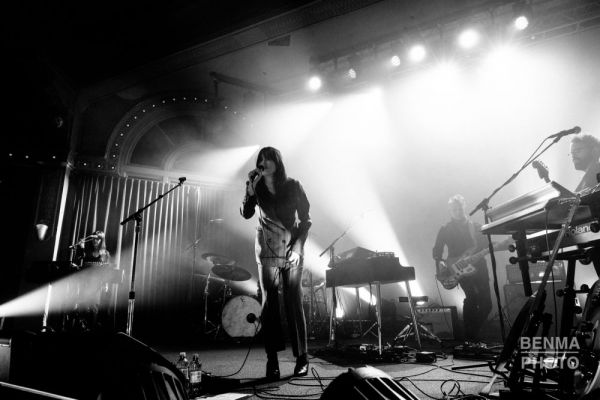
She came out in a gray trouser suit, double breasted and with pinstripes that echoed wartime fashion to me. During the first song, the thin material shook with nerves for just a second. Her voice was swooping, somewhere in the neighborhood of Florence Welch and Stevie Nicks. At first, she hid behind long black bangs, mumbling and moaning into the microphone, stomping chunky black heels and feeling the beat by slapping her legs. Over the course of the set, she loosened up. During “Seventeen,” a track on her new album–so many great songs about that age: “Edge of Seventeen”, “Anthems for a Seventeen Year Old Girl” “Dancing Queen”, “It Was a Very Good Year”–there is this climactic line, I know what you’re gonna be, where all of the sudden she dropped into a new gear of energy and rage and betrayal and power and screamed, and the crowd screamed back because the song speaks to the part of us that is hurt that we all thought we would be different, and we really weren’t, or at least not in the way our seventeen year-old selves thought we would be, those idiots.

(My seventeen year old self would have hated me forever for calling him an idiot, and he’s not wrong, one day one of us will finally kill the other.)

How cool are bands? People that get together to play music. That’s what I was thinking. I was close enough to the stage to see their faces, to see when patches were switched, when folks tuned in breaks, furtive hand signals to the sound guy. It seemed like they were having a great time.

loops

Chow Chun Fai –– “Last Supper“, Renaissance Trilogy I (2005)

This story tickled me:


Hundreds of thousands of Chinese citizens have gone to work in Africa, where they have encountered foreign cultures that leave many of them feeling alienated. For some of these disaffected Chinese workers, a source of comfort has come from religion, most notably the Evangelical Christianity that pervades much of sub-Saharan Africa. Evangelicalism prioritises conversion of non-believers, and the Chinese, heavily discouraged from practicing religion at home, are attractive potential converts.


Many local African churches have reached out to Chinese workers, including incorporating Mandarin into services.  A number of Chinese, in turn, have welcomed the sense of community and belonging that these Christian churches offer. And a small but growing number of ethnically Chinese missionaries from Taiwan and other countries are specifically targeting Chinese nationals in Africa, preaching to them with a freedom they’d never be allowed in the People’s Republic.


Many of these Chinese workers are returning home, and they’re bringing their newfound religion with them.  Visitors to the coastal province of Fujian, for example, now hear South African accented English and see houses adorned with crosses.  African migrants are also moving to China in larger numbers, many of them practitioners of very evangelistic forms of Pentecostal Christianity who are willing to flout the rules placed on religious activity in China.

Christopher Rhodes “How Africa is converting China,” The Unherd

First things first, I cannot evaluate the accuracy of this story in pretty much any way, and The Unherd is a new media venture with maybe ideological leanings (?) that are giving me Quilette vibes. Nevertheless, I love hearing globalization stories that have nothing to do with the United States. One of the defining characteristics of US culture is its indifference to anything outside of it. Plus, both China (because of its ascendancy and trade powers) and Africa (because of its color and post-colonial politics) often operate as political opposite poles to the United States to the extent that Americans think about foreign policy at all.

It reminded me of this working definition of religion I’ve been toying with:

A religion is a system of attaching meaning to behavioral choices that creates a positive feedback loop whereby adherents gain a greater survival advantage as some combination of strict adherence to precepts, size of the community of adherents, or access to spiritual experience increases.

I have never had any formal education in religious studies, so maybe this is a 101 level insight, but it feels like it’s all my own and it speaks to some of the uneasiness I feel when some of the people around me go in on religious people. I think about the people in my own life for whom religion was a way to feel control and agency in their life, or for whom religion was the opening to being able to talk about and access an inner emotional life. Religious people can be shitty, but, like, maybe they would be even shittier without it?

I’m fascinated by dying churches. I play piano every now and then for a Norwegian Presbyterian Church here in a Portland Suburb, a dwindling congregation that once served an ethnic community that barely exists anymore. The churches and religions that are thriving right now are the ones who have figured out how to give a survival advantage to those who walk through their door. These Chinese, workers, for example, get to walk in the door and experience a feeling of community and common struggle in a context where that is hard to find.

It’s why I can’t imagine they will ever die. As long as living remains a challenge, there will be a need for some way to teach adaptation, and a secondary need to attach meaning to that adaptation. What used to be called New Age religion so thoroughly dominates American culture its practically indistinguishable from it. We might have way more atheists in this country than ever before, but there are also more folks practicing yoga, going on meditation retreats, consuming bone broth. Scientologists get it, you join, they get you auditions. Mormons understand it, if you’re a man they’ll set you up with a career and a family.

You want to start a new religion? Come up with your survival advantage. The rest of the patter will write itself.