lost in the cosmos pt.2

Yesterday I finished with Lost in the Cosmos, by Walker Percy. Finished with, not finished.
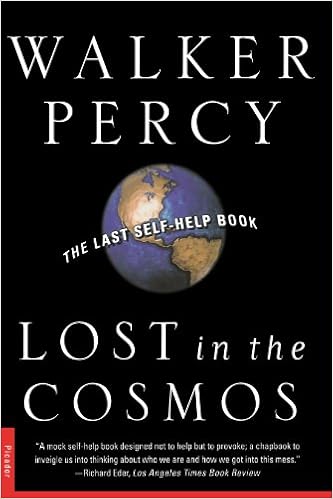
It was so easy to nod along with his argument. I get this way with particularly nerdy hard sci-fi—particularly Neal Stephenson books—, I am not so good at knowing when the science ends and the fiction begins and it can be so disappointing to learn that, no, it couldn’t actually happen like that.

Walker Percy starts in such a lost and lonely place:

With the passing of the cosmological myths and the fading of [religion]… the self becomes dislocated… imprisoned by its own freedom… so that the very attempts to free itself, e.g., by ever more refined techniques for the pursuit of happiness, only tighten the bondage and distance the self ever farther from the very world it wishes to inhabit as its homeland… Every advance in an objective understanding of the Cosmos and in its technological control further distances the self from the Cosmos precisely in the degree of the advance—so that in the end the self becomes a space-bound ghost which roams the very Cosmos it [scientifically] understands perfectly.

Who could not be sucked into that? A space-bound ghost is how I feel a lot of the time. It was thrilling to read such a witty deconstruction of the modern condition (this was published in 1983 but Percy so perfectly anticipates the nihilistic and cheery tone of internet humor like McSweeny’s or The Toast it really wouldn’t be very hard to do an update by making the language less sexist and reformatting it into a Buzzfeed quiz). I felt seen (ghosts feel invisible).

Next followed a very funny section of mock self-help exercises deconstructing this modern alienation. For example, the situation of walking into a party a dreading starting a conversation with a stranger. Percy presents several plausible and blackly funny reasons one might be feeling that. This is followed by a section which teaches basic semiotics and sets up his big idea for the second half of the book:

The self is literally unspeakable to itself. One cannot speak or hear a word which signifies oneself, as one can speak or hear a word signifying anything else… no signifier applies. All signifiers apply equally.

[…]

For me, certain signifiers fit you, and not others. For me, all signifiers fit me, one as well as the other. I am rascal, hero, craven, brave, treacherous, loyal, at once the secret hero and asshole of the cosmos.

which feels like many many conversations I’ve had in therapy. It’s why I cannot hear my own accent. It’s why I have trouble unpacking my own privileges—when others encounter me, which of the advantaged or disadvantaged identities do they think is most important?

At this point I’m eating out of Walker Percy’s hand. I follow him through a meandering and mostly coherent rundown of some strategies for placing the self in one’s own world of meaning, and I end up following him right off the rails. Because it goes then to some bizarre places. My red flags go up when he describes Southern (American) writers as the most strange and disconnected of all people—Percy was a Southern writer. It goes in some reactionary places about sexuality and violence being worse in modernity (not that he was all reactionary, but open-mindedness to the early 80’s still looks like something different today). He starts describing alcohol as a coping mechanism for reconciling the escape of the self from itself through art (although Percy links this alienation and coping mechanism to 20th-century phenomenon like media, mass production and mechanized warfare, he is basically writing like a sadder E.T.A. Hoffman) and I gradually realizing that he’s just writing about his self.

And then I couldn’t read any more. Because it made me too sad.

There are still like 5 or 6 things in this book that fascinated me, that I may want to pick apart, but the first most honest thing that I should say is that I quit reading it because I was a coward. I want to believe that self-awareness means that you don’t make the same mistakes again, and Percy’s bleak outlook is that true self-awareness is categorically out of our grasp. I realized he was trapped in the same problem he was showing me, and all of the sudden my relationship to the text turned and it was like being at a party after it has peaked and you’re too drunk to get home and there’s nothing to do but sit with the host, drinking water, starting a conversation, realizing that neither of you have the energy to have it, and letting it drop.

cover her face

If you dream like I dream you know that dreams are heavy, and they make you sensitive to other people’s dreams. It’s like walking around with a bellyful of strong magnets, and getting close to other’s success and failures pulls at you like an electromagnetic field. I want to be a person that has the confidence to stay in my own body and my own dream, but I am not that person yet. The more I see a likeness of myself in another, the more I sense that kinship, the more jealous I get of their success. It’s small-minded.

That’s why it’s nice from time to time to be reminded that even—or especially!—good creators had their own growth process.

First edition of P.D. James’ Cover Her Face

I just finished listening to Cover Her Face, the first Adam Dalgleish novel by mystery writer P.D. James (1920-2014). I was a mystery-novel addict for a couple years at the end of middle school and end of high school. In that way where small stretches of time leave deep impressions when they come during periods of identity formation and reformation, it was only a couple years and maybe 200 books read, but I was a Mystery Reader™️ and I considered myself a connoisseur. I loved P.D. James’ novels because her police inspector hero Dalgleish was a former Anglican seminarian and sometimes poet who often got lost in introspective musings about good and evil as he investigated crimes. As I reflect with a little more knowing eye, I think there was probably something attractive to me about Dalgleish’s non-threatening attractive sexlessness (the characters that he encounters often note his blond English handsomeness, decency of character, and perfect manners).

Cover Her Face, however, is a bit of a mess. It seems to belong to a different generation of mystery novels, it’s set in an English country estate with lots of judgmental villagers. Not too much different than Agatha Christie’s Mrs. Marple novels, just without the…uh… charming ethnic stereotypes?* Dalgleish is a bit of a non-entity, there’s none of the depth that comes in into her later novels featuring the character. There’s a lot of judgey slut and victim shaming and maybe that’s an accurate depiction of village morés, but it’s still not that fun to read. And, frankly, the puzzle box plot was not that interesting and I found it extremely tedious to finish.

*It’s a joke, they’re not charming, although they were very confusing to a 12-year old Mexican-American boy in California who had no idea that you were supposed to find Turkish, Greek or Italian characters inherently suspicious.

But here comes the little bit of positivity!: what a remarkable accomplishment to keep growing and changing throughout such a long career! There’s little in this book that couldn’t have been written in the 1940’s, and yet one of my very favorite of her books, Children of Men, is fully contemporary*. Even though it was written in 1992, it anticipated today’s anxieties about the environment, demographic changes, and made some very good predictions about how modern media culture would handle an atmosphere of slow catastrophic decline.

*One of my very favorite phenomena is when a book is very good and it’s movie adaptation is  different but very good too. The book is more interested in the ideas of how a culture responds when it knows it has an ending date. What do you do with the artwork? What’s the point of keeping scholarly work going—or politics? How do you make meaning when none of your choices will outlive you. The movie is more interested in how scarcity creates a zero-sum mentality, and the way that in a civilization under threat, pluralism becomes threatened too. Both very good, and in very different ways. 

That seems to be all I’ve got.

Cover Her Face: I recommend skipping and reading one of her later Dalgleish novels. For completists only.

the favourite

I really liked the new movie from that guy who did The Lobster


The Favourite was a joy to watch from start to finish, all the actors are doing their best work, and I finally like a Yorgos Lanthimos movie!

Spoilers!

Continue reading “the favourite”

lost in the cosmos

One of the true pleasures of reading something interesting is to take the ideas in it and move them around, sticking them to another idea and seeing what happens. Trial and error. Stick it on this idea and it falls right to the floor, nothing happens. Stick it to this other idea and both completely transform, synthesizing into something new. Stick your new idea to this other idea and it gets ruined completely.

My sister has read Walker Percy’s Lost in the Cosmos: The Last Self-help Book. Something I said about my 2019 resolution (“It’s be brave!” I bravely tell everyone I’ve talked to so far this year) has reminder her of it and then she says something about “real life” —something like “…but, like, at some point you have to get back to real life, right?”—and it snaps me out of the conversation and I’m thinking about the way that the whole concept of real life can be weaponized against your state of mind. In love, optimistic, hopeful, these are all moods that can be disrupted by the idea of real life like a drop of dish soap breaking the surface tension of a pool of water.

I am a person who can throw hideous amounts of happiness away like this. One of my favorite lines from one of my favorite movies, the 2007 adaptation of the musical Hairspray belongs to Edna Turnblad. Trying to convince her daughter Tracy that it’s a waste of time to audition for her favorite TV dance show, she shares that she’s a person who once had a dream: “Well, I had a dream that I would own a coin-operated laundromat, but I came down from that cloud real quickly!”

It makes me laugh and laugh and laugh because its so pathetic and because I see myself in it too.

“‘Real life’ is not a phrase I would use, though,” I replied to my sister.

“But you know how like you’re having those deep conversations or high or whatever and it doesn’t all make sense but you’re so open and positive, but then at a certain point…” she responds, because she thinks I’m being obtuse.

“Yeah, but I think a lot of spiritual traditions would say that that is the most heightened way of being. Like, maybe we can’t sustain that for very long, but you widen out what you can do in that state and for how long.”

But it takes me a couple days to figure out what I actually mean. I think what I actually mean is that true enlightenment is living each day like it’s detention in The Breakfast Club.

In The Breakfast Club, the sheer amount of time involved and boredom and insularity (or safety?) leads to social and class barriers collapsing. Violence and conflict still happen, but with total awareness of the subjectivity of victim and perpetrator. A visit to a trophy case connects the teens to an awareness of time, entropy, and the decay of all things. By the end of the movie, enlightenment has been reached with a total death of the ego, the self has dissolved and the students speak with a collective voice:

But what we found out is that each one of us is a brain and an athlete and a basket case a princess and a criminal. Does that answer your question? Sincerely yours, The Breakfast Club.

In both the movie and in the real world, the real question is what happens on Monday.


11.4.18 Midterms

Processed with VSCO with s1 preset
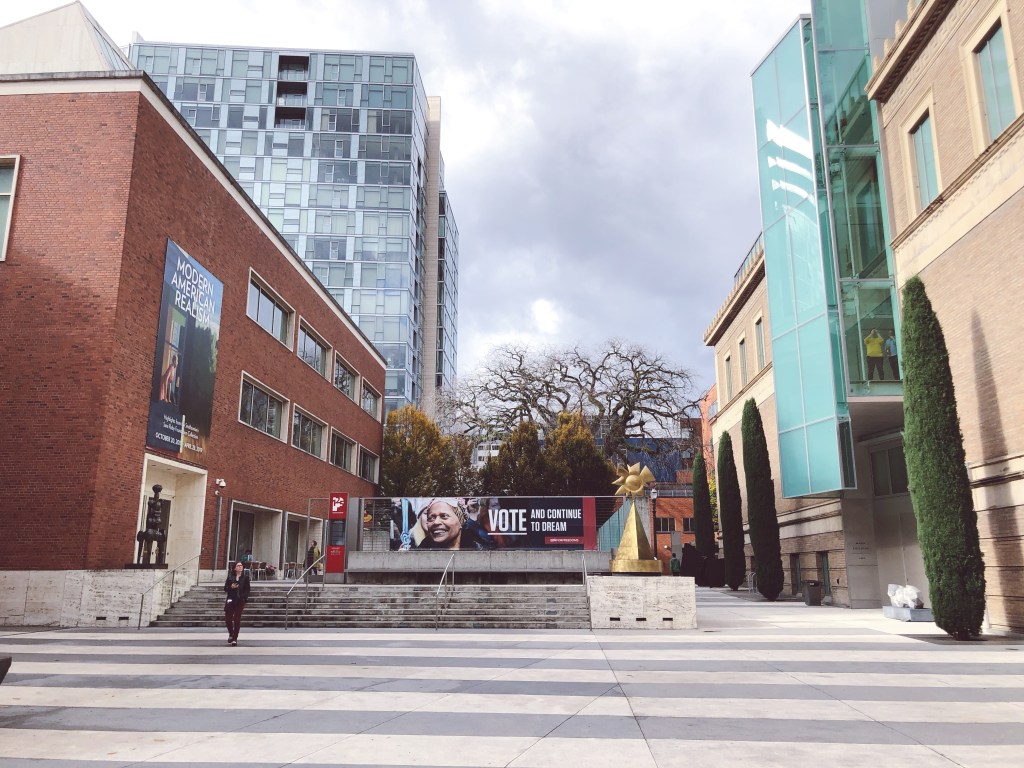
A large banner saying “VOTE” in front of the Portland Art Museum this afternoon.

“I’m going crazy about these midterms. I can’t wait for these next few days to be over” is how I’ve started conversations with about six or eight people this last week. This sounds sociopathic but I’m an external processor, which is a plausibly sciency sounding way to describe how I need to talk things out with others to know what I think (I didn’t make it up, but it still could be bullshit, I guess). It’s led to lots of other conversations:

  • “Ugh. Yes.”
  • “What were you doing on the last Election night? It seems like everybody has a bad story.”
  • “What’s going to happen is going to happen. There’s not really a “good” result and a “bad” result.”
  • “Me too. I keep reading and refreshing 538.”
  • “You’ve done your part, now your focus can go back to your lived life.”

All of which are good and valid responses, fine. What I really want is for somebody to hear the anxiety in my voice and gently show me that I’ve completely misread the course of world history for the last two years, that I’ve made all a big mistake, a hallucination I created myself and that there’s nothing to be worried about. In the absence of that, I’ll share and take comfort in what I can.

On Saturday, I did something about it. Earlier this week, a friend, Z, texted me if I had voted. I texted her that I was walking it over, then she replied by asking if I would be willing to text friends to turn out the vote, and I didn’t reply back because the idea made me uncomfortable, and I felt ashamed for feeling uncomfortable. She wasn’t even asking me to text strangers, just my own friends and network. Still I struggled with the idea of asking.

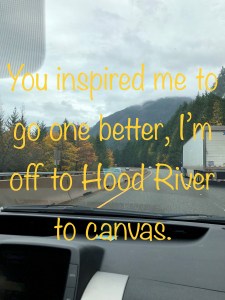
Later in the week, when another friend that works in state government asked if anyone wanted to join him in canvassing in Hood River, I knew that something was calling me out of my comfort zone, and I was going to feel bad if I didn’t listen to that voice. I texted Z:

IMG_0989

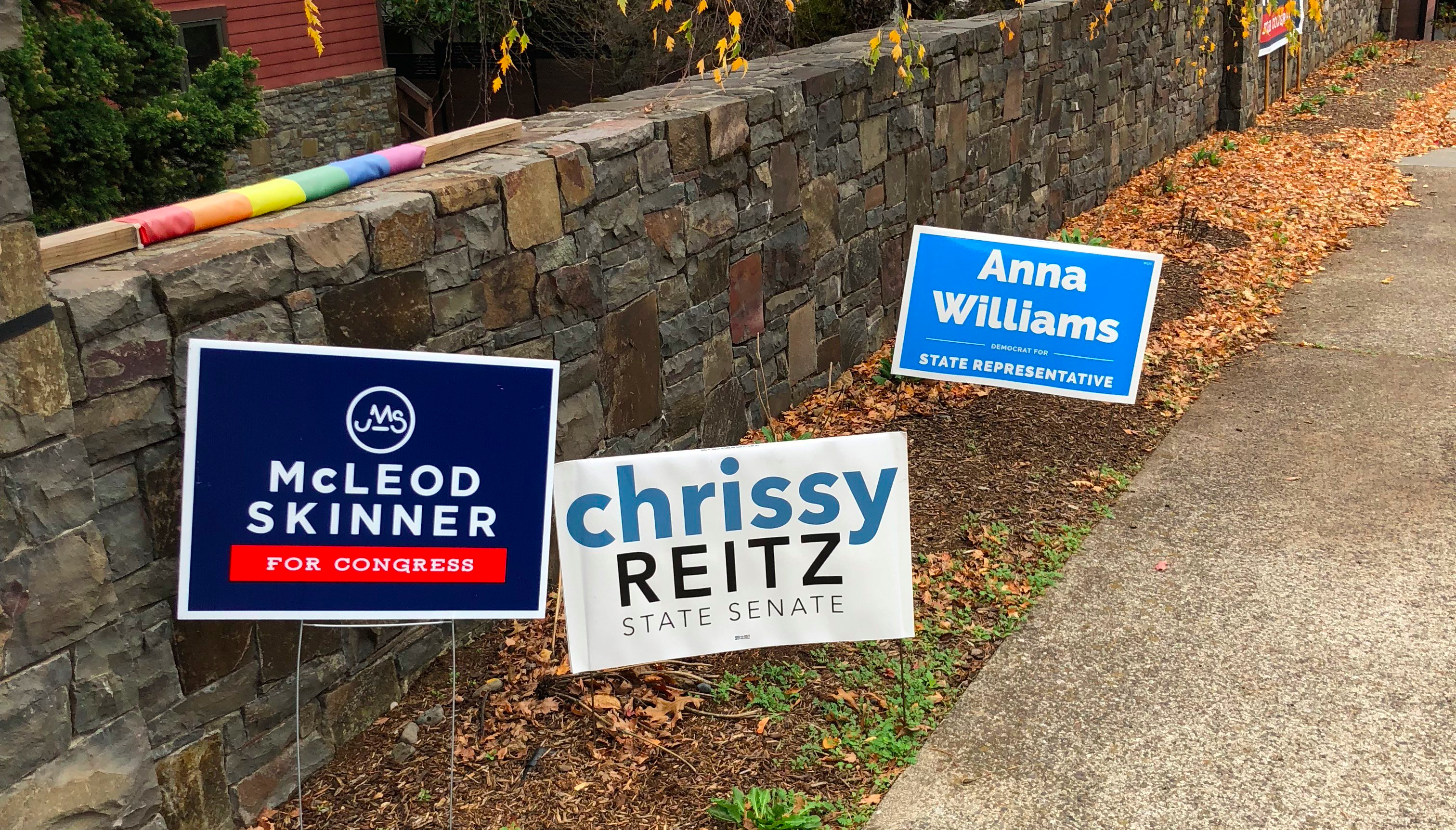
I’ve never canvassed before, and I was nervous about it. We showed up to the campaign office of the state representative we were knocking on doors for. The past two years have been a tremendous political education for the entire country, which is so far the most positive effect of the 2016 election, and hopefully one that lasts. People who never followed politics before cannot escape it, people who were not that engaged are learning about all kinds of mechanisms like the Supreme Court nomination process, gerrymandering, and census manipulation, other people who have always participated in the process are starting to actively think about ways to reform and change the rules to respond to the ways that conservative politicians have already changed them. For me, it’s moved me to donate and try out directly participating in a way that no other election has yet.

This is a pretty long winded way of saying that my schema for what a campaign office looks like was a little more Aaron Sorkiny than the strip mall office I arrived at.

A very earnest and handsome education lobbyist oriented me, and then we were off to door knock. After all of the building up I had done in my head, we mostly hung flyers on doorknobs, and only had about five or six conversations with people the whole afternoon. But those conversations felt great, and even though its very late in the election season, it gave me a real window into how approachable the whole process is, and what a powerful tool and channel for community building it can be.

I’m going to be watching the results on Tuesday night, and I 100% will be on edge until the results are in, not just here in Oregon, but also in Texas, in Kentucky, in Arizona, in Florida, in Georgia. But I feel really good about having taken a big step towards reclaiming power for myself, and I’m already excited to get involved earlier for a candidate I feel passionately about in 2020.

img_0945.jpg