To The Glory of God, Robin Lee McAllister

I am often in the First Baptist Church building in downtown Portland for work. It’s a grand old building dating to the 1890’s, and like many mainline denomination buildings, it has seen healthier times. It has a tremendous twice a week meal program for people who are sleeping rough, but also holds events which puts its staff in the deeply uncomfortable position of having to move along people on one day they are trying to bring comfort to on another. It has a grandeur to it, with a kidney shaped sanctuary that, in it’s fully open configuration, seats nearly a thousand people, but which must seem echoingly empty on a normal Sunday. It now hosts a Cambodian ministry that is lively and active, with families and elders and children all present.

I am deeply ambivalent to religion—Christianity in particular because that’s my tradition—but I am not hostile to it, and I understand a bit of the function that it provides to people in hard times. These are hard times. Religions are both survival strategies and philosophies for what comes after survival. Pandemic aside, there is so much hardship in our society right now and our civic lives have been hollowed out from churchgoing Sundays to bowling on Wednesdays to drinks at the Eagle Lodge on the weekends.

Millennials were sold a bill of goods. We were told that the best thing about us was that we were not attached to the old ways of doing things, that we were digital natives, post-social, and that those were good things. Instead, internet hypercapitalism Hoovered up all of the civic institutions that needed us to enter them as a generational transition* leaving us with nothing but a never-ending parade of headlines about such-and-such institution closing (until the newspapers themselves closed).

*Of course, many of the institutions sucked. They were racist, they were sexist, they made no room for youth. That’s a huge part of the story, I just wish they had closed for those reasons and not because they had bad websites or didn’t offer online checkout or easy social sharing or any of the thousand, sociopathic reasons we decided to patronize a shiny new online business instead of one with a presence in our actual lives.

One of my favorite places in the church is the doorway to the service entrance to the church, the pathway that goes past the garbage and recycling to the street and where the deliveries come in. That door has a simple stained glass window, dedicated to the memory of Robin McAllister. At their very very best (maybe a rare best), churches are a place where people can turn labor into care for a community through service. I don’t know their story, but I think Robin McAllister must have been a person who understood that.

Coronavirus Diary No. 3

Los Angeles Times: ‘Batman’ shut down after positive COVID case, reportedly Rob Pattinson. New York Times: Trump Vaccine Chief Casts Doubt on Vaccine by Election Day Fox News: Salon owner denies Pelosi’s ‘setup’ claims, says House Speaker ‘owes the entire country an apology’. Twitter: We Might See A Lot More Coronavirus Pandemics Ahead, Experts Warn.

I feel pretty hopeless right now.

It was muggy and hot this afternoon; Long August has not yet yielded to Wet Autumn. All I wanted to do was to go to a movie theater. Movie theaters are not open, they shouldn’t open, in fact they should stay closed for so long that I’m worried that they will disappear completely. I don’t spend all day thinking about how “coronavirus sucks” but the thought isn’t far from my mind, just like other sucky facts like **** being president or climate change or megafauna going extinct. It’s a train of thought that you can’t even let leave the station because it’s just car after car of awful realities and diffuse loss. I fucked up today, I started thinking about how I usually have so many things to do with the kind of mood I had this afternoon: go to a bar and get a cocktail, visit someone, go get a meal, try and make smalltalk with strangers at a gay bar, go to the mall.

At the beginning of this, during the period I wrote from in March, it looked like this was going to be a trial of individual endurance: how long can I stay in my house, what do I do with all of this time, what new hobbies am I going to pick up, what can I learn, how am I going to connect with people in new ways? I knew our response was going to be poor, but I thought that surely the huge constituencies of people that are taking deep deep wounds from an incompetent response were going to be enough to demand action. Businesses, anything hospitality, the mass unemployed, landlords and renters alike. Instead, every single fracture point in society seems to be crumbling. The injustices that were already worn as collars have become garrotes, tightening with no sign of stopping, cutting into flesh.

I was reading Plato’s Republic yesterday (when I was 20, a cute blond cello playing philosophy major named Paul told me that I would enjoy reading Artur Schopenhauer’s The World as Will and Representation and I’m still working my way through the necessary background reading to learn whether he was right. He was drunk, and it was almost certainly the last book he had read and didn’t have anything to do with me in particular, but 10 years later I still want to know whether he was flirting with me or not.) and was struck by this observation, given by Socrates and directed towards the city—mirroring Socrate’s ideal model city—which has paid for greater wealth and a more complex development with inequality, injustice, and the presence of corruption:

We will have to find agreater” title for the other because each of them is a great many cities, but not a city, as they say in the game. They contain two, at any rate, which are at war with one another: the city of the poor and that of the rich. And within each of these, there are a great many more. So if you treat them as one city, you will be making a big mistake… As long as your own city is [just and soundly governed], it will be the greatest one—not in reputation; I do not mean that; but the greatest in fact…

There’s so much captured here: the way that inequality and corruption go hand in hand, the way that displays of wealth and high levels of civic development often do too. There has always been a poor America, a rich America, a black America, a white America, a men’s America, a women’s America. Languages, countries of origin, who we love and how we worship. None of these divisions are new. What feels new right now is that it feels like we are all breaking down to the level of the pod. I feel constant anxiety about how many people are in my bubble. It makes me question my own values and good judgement. When I take down the barrier of the mask with someone new, I question their values and good judgement too, and this includes roommates and good friends and family and lovers alike. Don’t get me started on other people—everyone else gets my least compassion, my highest suspicion.

I have some ways that I am required to be in the world, and some ways that I choose to be in the world. Whether or not I engage with the outside world, events are taking place in it without me. If I choose to withdraw more, I become more dependent on people whose inability to make that choice is being exploited: retail and food workers, delivery drivers, service providers, healthcare professionals. We’re all suspicious of each other, we’re all unhappy that our way of life has been tremendously disrupted at best and obliterated at worst. I feel that friction all day, I don’t have very many opportunities to recover and rest from that friction, and I don’t have very much hope that the status quo will change for many months at the earliest, and years at worst.

One of the most shocking changes in real politics that has happened in my lifetime, the stuff underneath the bloated two party scrum, is the change in national mood between the open, assimilationist, culturally dominant, modern attitude of the United States towards the world (sometimes and somewhat reciprocated) and the closed, fearful, decaying attitude we all carry now. It’s been one of the most consistent social trendlines in my lifetime, connecting the end of “Made in USA” products at Wal-Mart to 9/11 to the shoe thrown at George W. Bush to ICE detention centers now and hundreds of thousands of corpses filled with Sackler family pharmecuticles.

(There’s a lot of erasure in this narrative. Throughout this period there have been people who have seen the ugly side, who did not participate in the civic religion. There was a girl I went to in high school who did her senior project on the Zapatistas and I sometimes think about her, and her vision of the world in relation to myself at my age. I didn’t know shit about this country or this world and when I’m honest with myself I admit that I don’t know shit about the future or what’s possible.)

One of my favorite pieces of media to revisit during the **** presidency has been Louis Malle’s 1986 documentary …And The Pursuit of Happiness (currently only available to watch through the Criterion Channel service). This documentary interviews many first generation immigrants, from a very diverse set of countries of origin and across the United States. One thing that pulses through the documentary like a pulse is the visible enthusiasm, excitement, that the interviewees have for the process of adapting to a new place.

There’s not much of that to be found right now. It’s like we’ve all woken up to the fact that we’re in a burning building, and nobody wants to evacuate without knowing who is going to be in control of who gets to come back in. It’s going to get worse before it gets better, but there’s no guarantee that it gets better.
Master/Chef

When you change a set of strings on an instrument, one of the things you have to be careful of is to maintain tension in the instrument. A guitar or violin or piano is not one solid thing, it is an assembly of wood and wire that only keeps its shape because it is under a perfectly balanced tension, each piece pushing strongly against its opposite. Take too much tension away from the system and pieces start to pull away from each other, parts warp and break, and eventually the instrument falls apart completely.

It seems like the independent restaurant industry may be going through such a moment right now, the sudden slack in demand from a public health crisis causing escalating tensions in very delicately balanced parts of the industry, including below living wages for kitchen workers, restaurant cash flow, and a cultural system in which non-white chefs are treated as automatons, mechanically reproducing their own ethnic food or a head chef’s food, and white chefs are elevated as artists. I was really fascinated by this article from The LAnd magazine on the LA brunch restaurant Sqirl. Sqirl had one very, very bad set of practices—preparing food in a secret uninspected kitchen and serving moldy jam— that couldn’t help but go viral on social media, but one thing the article explores is that there were a whole host of other bad set of practices that Sqirl engaged in that are pretty much standard in the restaurant industry. There is a striking quote from Sqirl’s owner, Jessica Koslow that speaks to this: “I can apologize for and fix my own mistakes, but I am not in a position, standing alone, to apologize for a business structure that is foundational to the entire service industry and the majority of American businesses.”

One of the principal business structures that Koslow is defending is the unwritten convention that chefs are entitled to all the rewards, financial and social, for excellent food that comes from their kitchens, whether or not they cook themselves or even develop recipes. This attitude doesn’t come out of nowhere. In fact, restaurant culture seems to be one of the last remaining places in the economy where medieval craft guild norms determine respect, standing, and rewards. In as few words as I can, a craft guild was an association of craftspeople that regulated the production and sale of a particular trade in a particular place. The joiners’ guild of Bonn regulated furniture-making in Bonn, while a thatcher’s guild in London regulated roofing. The guild regulated quality by designating skilled workers as masters, who could establish their own workshops and sell their goods for the highest prices. Skilled workers on their way to becoming masters were journeymen, and workers learning their trade were apprentices.

Here’s the key parallel with kitchens: only master works were able to be sold for their true value. If you were an apprentice or a journeyman in a workshop, your work was not your own. If the work was high enough quality, a master could mark it with his own seal and it would be sold under his name. This was a time in which the rewards were mostly economic. For the most part, craftspeople did not have high social status, and the notion of the individual artist expressing themselves (which was not broadly applied to restaurant chefs until the 1980’s) didn’t become popular until the 18th century. It’s important to note that some amount of exploitation was built into the guild model from the beginning. Apprentices were essentially indentured servants. Abuse by their masters was unlawful but commonplace, corporal punishment lawful and universal. The primary function of a guild was to keep skilled workers from being able to freely sell their own work and undercut the prices of master craftsmen.

It was a very successful model in Europe for hundreds of years. But eventually the greed of the masters and corruption in the system caused it to topple under its own weight—exactly as we are seeing now in restaurants. Over time, masters began to make it harder for apprentices to become journeymen and journeyman to become masters. Instead of journeymen making master and establishing their own workshops, workshops and the master rank became something that passed down from father to son. The relationship between a master and his workers evolved from a trainer-trainee, mentor-mentee relationship to an employer-employee relationship. Guilds became hostile to other forces that threatened the masters’ power: technological advances, new tools and working methods, and a slowly globalizing trade market. In the face of such forces, the guilds were sidelined into irrelevance.

What we’re seeing right now in restaurant of the fiction that a kitchen is a craft workshop. Masters were responsible for providing lodging, food, and education for their adolescent apprentices. US restaurants rely on subsistence wages for their dishwashers and back of house, and often these are jobs held by people for years. In a landscape of inequality, it has become nearly impossible for talented chefs to open their own independent restaurants without sharing ownership with an investor. I think that part of what is so offensive to the former Sqirl employees is that the owner is being showered with respect and attention as a chef, when they know that, just like with the late stage guild workshops, her success has more to do with her access to social and financial capital than her own skill. It makes the fundamental exploitation of the kitchen—the back of the house creates all of the value, the owner keeps all of the reward—too visible.

If you are going to treat your staff as employees, you have to treat their jobs like jobs. Right now, the restaurant asks crazy things from its workers, many of them already illegal like working with no breaks or working in unsafe conditions. As staff are increasingly able to talk back, I hope this becomes untenable. If a chef treats its staff like collaborators, as many of the most excellent chefs and kitchens do, credit and rewards must be shared, and the old guild master system has to go. It had a good run, it’s time has come, we are ready for new systems.   

Further Reading

History of the guild system.

Overview of middle ages commerce.

Apprentice childhoods.

Get Used to It

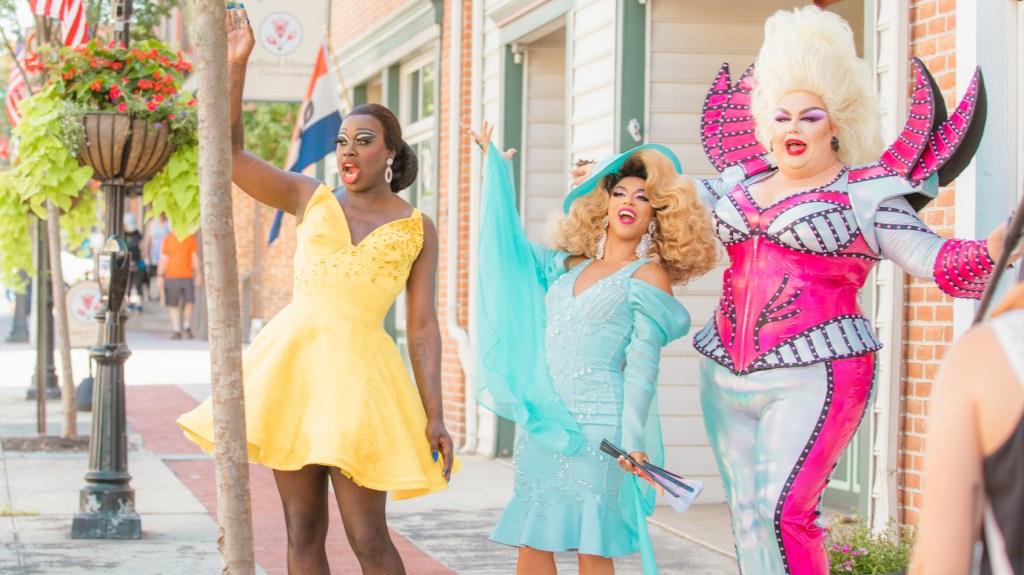
We’re Here [HBO]. Three drag queens not named RuPaul take a Priscilla/Too Wong Foo tour through small towns across America to stage drag shows and use their power to validate and heal local queer scenes.

I loved gay culture, like so many of us did, before I loved my gay self. I loved the sense of humor and the aesthetic and the love for the forgotten and the neglected. I learned to love myself eventually, and only now am I truly understanding what it means to love and to gather close to the most defiant and challenging of us: the sissies and the faggots, the bullied and abused.

There’s so much power in the experience of learning to love yourself. That’s something that Queer Eye taps into so deeply. The danger in Queer Eye is that it muddies the line between who you are and what you buy (although much much less than its original incarnation) and also in the sheer amount of space it occupies in queer representation. Some queer people, especially young people discovering themselves, may not have more access to queer adults than their Netflix account, and I worry that the aspirational devotion the show has towards its stars makes their confidence seem unattainable to younger queers.

I considered ditching We’re Here a few minutes into its first episode. I though its hosts, Shangela, Eureka, and Bob the Drag Queen, were doing a tired and derivative imitation of Queer Eye. I’m so glad that I gave the show a second chance, because once I figured out what it was doing it totally won me over.

The show has more or less a fixed format. Bob, Shangela, and Eureka roll into a small town (ranging from about 10k people to about 50k, from Pennsylvania to New Mexico). They explore downtown shops, locals don’t know what to make of them. They pick three locals to collaborate with to put on a free drag show: one is always a straight, cis guy. Another is a queer person who is trying with all of their might to be themself despite adverse conditions, like a wildflower in a thunderstorm. The third is a little loose, but the thread that connects them is that they are people who have chosen to stay in their home communities despite deep wounds, and who are in need of a little healing through community.

Bob the Drag Queen, Shangela and Eureka O’Hara/HBO’s We’re Here.

There is a little bit of “once in a lifetime experience”/“transformation” language—that’s what turned me off in the beginning—but the show is pretty straightforward about the fact that when the drag queens leave town, regular life will resume. “Your life is not going to change in one week” Shangela bluntly tells a young gay Latino man, José, in a Louisiana town. There’s a scene later in that episode where Shangela sits down with José’s mother so we can get the tearful scene where she tells him that she will always love him because he’s her son. What sets this show apart from the pack is the scene that comes afterward. “Moms always put on their best face for company,” Shangela says quietly. José’s face is guarded and ambivalent. He’s heard the love before. He’s also heard disappointment, disapproval, and scolding. It undercuts the drama of the moment, but it’s a thousand times more real than the staged scenes of reconciliation in Queer Eye, almost fraying in front of you at the edges of the frame.

This show would be so obnoxious and patronizing if it was about the big bad city queens showing small time yokels how it’s really done. What comes through so strongly is that, even though the locals are “crunchy,” according to an unusually shady Shangela in the episode in Twin Falls, Idaho, they have such respect for the people they are working with. The queers that stay in small towns are those who defy a whole host of voices—some loving, some hateful—that say that you are going to have a happier life if you don’t live it here. Queer people are delicate flowers. We flourish in environments where there is enough material abundance for beauty and grace to be valued, where self-expression is permitted, where difference is tolerated. Small town queer people are those flowers hanging on, fiercely, to life. The succulent rooted in sheer face of rock, the thistles growing on the side of the road, the tree that was uprooted by the storm but flowers anyway.

I was transfixed by the beauty of these people, the fierce way that they held on to their sense of themselves. A grandfather and a grandson, bonded so tight by love that there was no room for shame. Two gay men who have a beautiful friendship in which each is totally comfortable in the company of the other. The title carries a double meaning. It’s not just “we are now here” or “we’re here, we’re queer, get used to it,” it’s “look, we have always been here, right here, in your town. We’re your brother or cousin or granddaughter or boss or teacher.” The visiting drag queens are basically church planting. They are giving all of the local queer people a reason to gather together, a way for all of their allies to gather together by bringing this bubble of total queer acceptance and (almost) uncompromising queer aesthetic and letting everybody see each other and experience together what queer joy feels like. The shit that they stir up is the grit around which the pearl forms.

So in that way, it’s not like Queer Eye at all. It’s really the anti-Drag Race. (I think that Drag Race gets a lot of unfair hate. The critiques are totally valid, but they wouldn’t matter as much or sting when the show gets it wrong if there was a whole ecosystem of queer entertainment that was funded and promoted and critiqued and awarded like entertainment directed at straight audiences. That puts way more weight on Drag Race than it can support.) Drag Race is about gatekeeping, it’s about designating something as special, it’s about elevating regional talent into international spotlight. We’re Here is about recognizing that queer talent and beauty and joy is everywhere, and about the power of coming together and nurturing that in the places where you live.

This is for: queers who need a pick me up, people tired of LA/NY stories or having to pretend places like Houston, Chicago, or Atlanta are small towns because they are slightly smaller than those two cities, anyone really missing Pride this summer.

Not for: haters, cynics, the lactose intolerant.

Recommended. 🏳️‍🌈🏳️‍🌈🏳️‍🌈🏳️‍🌈/5

Black Lives Matter

Black Jesus from Egyptian American Coptic Christian's View, w ...
Image of Jesus and his followers from the Egyptian Coptic tradition.

“So the last will be first, and the first will be last.”…

Matthew 20:16

I’ve been thinking about this verse a lot. Reading the verse in context gives reveals a different meaning, but I’ve been thinking about what it means when we upend hierarchies and reverse the order, as in the words of Jesus.

When we apply an intersectional lens, we look at where the lines of hierarchy are in a situation, how they interact, and who is excluded based on them. In some situations, race is the most powerful operating hierarchy, in others gender or sexuality or national origin may be strongly operating. That being said, there are few contexts in which Blackness is placed at the bottom of a power hierarchy.

Sometimes when we talk about oppression, there is a temptation to direct focus towards the psychic wounds of the oppressor, to frame it as as a piece of collateral damage that the hierarchy inflicts on those at the top. This is often used as a piece of deflection, to argue that the hierarchy wounds those at the top just as it wounds those at the top. There is a grain of truth in this—I do believe that it inflicts wounds, just as toxic masculinity inflicts wounds on men and boys and heteronormativity inflicts wounds on straight people. The simple truth is, though—and here is the genius of that verse—that there is no way to bring justice and healing to the wounds of the last (poor, darker, feminine) without healing the wounds of all the others in the process. In other words, if your wounds are caused because you are the tool that administers injustice, you will stop being wounded when you stop administering the injustice.

If there is hope right now, that’s my hope. Black Trans Lives Matter. If you bring Black trans people racial justice, Asian and Latino people will live in a more just world too. If you bring Black trans women gender equality, cis women of all races will live in a more just world. If you bring Black trans women equality for their sexual choices, we all live in a more just world. Centering justice for white gay men can leave others behind. Centering justice for white women can leave others behind. Centering justice for cis straight Black men can leave others behind.

I am not brave, and I am not good. I have done some of this work already: I have accepted that I have been conditioned to be racist, I have been conditioned to premise value—social, cultural, economic—with Blackness at the bottom (what activists are referring to with the shorthand anti-Blackness). I feel tremendously liberated by that, though. Antiracism is a practice, and I don’t get knocked down into paralysis or shame when I discover some new way in which racism acts on my everyday life.

One of the tools that white supremacy uses to perpetuate itself is to control what knowledge is allowed to be known and treated as common knowledge. As heartening as it is to see so many white people (and non-Black people of color, as I am) turning out in wide numbers, particularly in suburban and rural places where there is not much of a tradition of protest, it is also extremely painful to hear white people acknowledging truths which are plain on their face to everyone and yet only now have moved into the category of “truths which are permitted for white people to acknowledge.”

We’ll see if there is a backlash of forgetting. Or of superficial reforms, followed by a pretense that it’s all been resolved. It really does seem like something has been opened that cannot be put back together.

That’s where I’m at, in this moment.

Postscript

I was browsing Wikipedia for some context about this parable, and I saw a navigation box at the foot of the page with links to each of Jesus’ parables. Somehow until this day, I never thought about the parables as analogous to koans, to other teaching stories in other religious traditions. It’s the old cliché; you have to go away from something to learn what’s been in front of you the whole time.