Google Wave “killer app”

I don’t want to come down too hard on Google Wave. It’s in alpha release, and the biggest problem with it is that people don’t have accounts. Nevertheless, I haven’t really been checking it because after a flurry of sandbox-like posts, there wasn’t much activity.

I decided to start a Wave with my LOST watching buddies, all of whom are all around the country, and it’s been working out so far. My plan is to set up a wave for every episode this season. My friends on the East coast can use it like a chat room while watching it live, and I can check it after I watch the episode and participate in the post-mortem, even if nobody is still online.

Book: His Majesty’s Dragon

I just got done with Naomi Novik’s His Majesty’s Dragon. I picked it up on Alyssa Rosenberg’s half-recommendation. It seemed like it would hit all of my buttons. I’m an unabashed lover of kitschy dragon fiction, and historical fiction makes me feel intelligent and stokes my ego (when it’s done well, because I understand the references. When it’s done poorly, because I feel superior to the author). A dragon-filled book of military historical fiction? I’m on board!

HMD is set in England during the Napoleonic Wars. We meet Will Laurence, captain in the Royal Navy, as he captures a French frigate with a valuable cargo: a dragon egg. In this alternate history, dragons function as the aerial arm of the military, complete with ground crews and different breeds suited to strafing, bombing and dog (dragon?) -fighting. Will harnesses (imprints) this mysterious dragon, which he names Temraire. This book (the first in a series) deals with the personal fallout of that action, and Will and Temraire’s training regimen in the Dragon Air Corps.

The book is slight, with lean plotting. I found it pretty entertaining and extremely easy to read. I also appreciated that Novik flirted with some of the conventions of the genre, while sidestepping most of them. The mere fact that our protagonist is in his late 20’s means that there is a whole host of adolescent-centric character arcs that we don’t have to read again.

The flip side of that ease and directness of plot is that it frequently feels like it’s underwritten. I don’t believe that longer is always better (although I am slogging through the Baroque Trilogy, so I must be some kind of masochist), but there are several sections that, had they been fleshed out a little more, would have served a more cohesive, satisfying, and substantial whole.

I also found the speculative/alternate history aspect of the book fairly superficial. The characters speak in an unobtrusive old timey formal style (as opposed to, say, Jonathan Strange & Mr. Norell, a novel in which everyone speaks like Joseph in Wuthering Heights), and Novik name-checks a handful of historical figures, but otherwise the characters and plot could have been set in any fictional world. Or Pern.

The most surprising thing to me was how disturbed I was by scenes of dragon aerial combat. The book sets them up as these sentient war beasts, and I couldn’t help but think of war elephants. The scenes aren’t particularly graphic, but the flippant cartoony descriptions almost made it worse for me.

I would probably recommend reading the book if you had it in your hand and were boarding a flight, otherwise I’d skip it. I’m a sucker for multi-volume sci-fi/fantasy stories, yet I don’t think I’ll continue with the series.

Organ Case File #1: St. Andrew’s Church

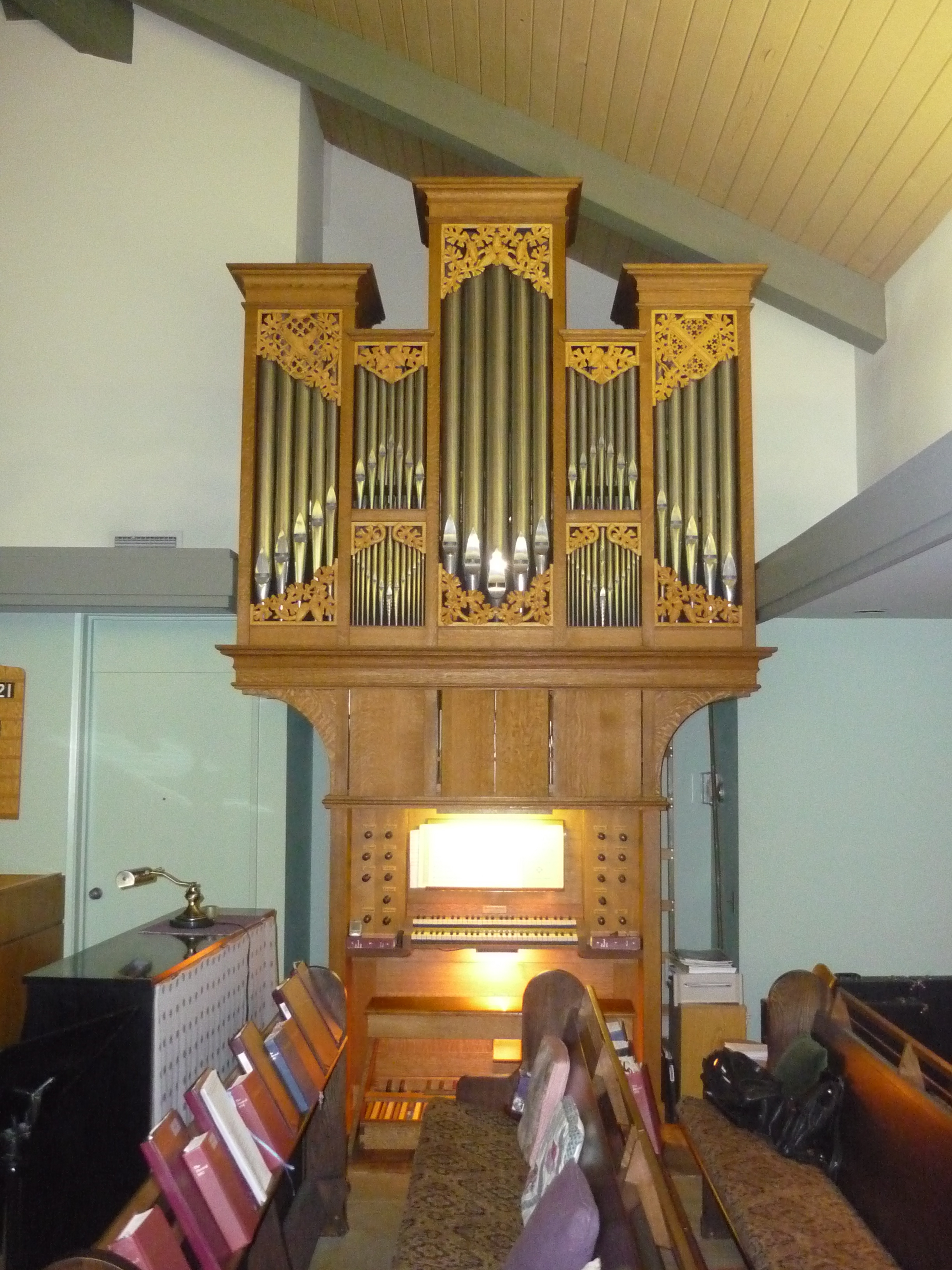
P1000566

I started taking organ lessons at the beginning of the semester. The organ, partially because of its liturgical use and partially because of its fundemental complexity, exists in its own hermetically sealed sphere; there is a tremendous amount to learn about every aspect of the instrument. One of the most useful things an organ student is to try and gain experience and perspective by visiting, playing and experimenting with many different instruments. Although these updates will not be regular, I hope to post about the different organs I visit in my own language to the extent of the education I have now.

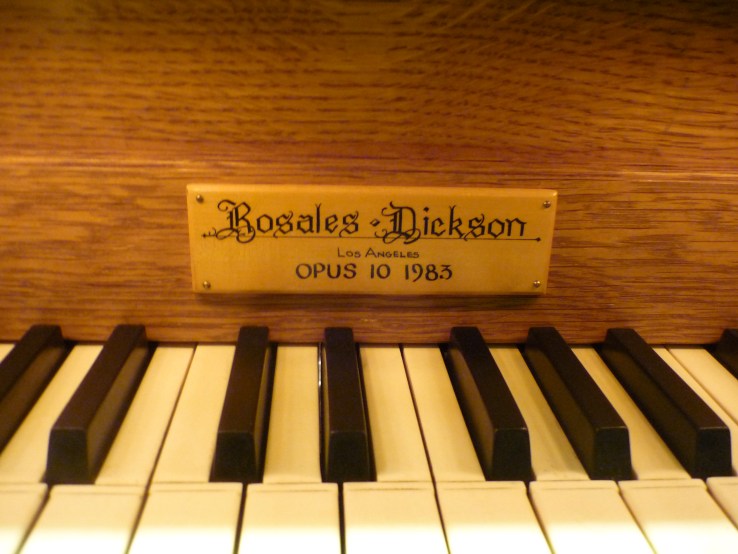
One of the most fun afternoons of my spring break was the brief time I had to visit the Rosales Op. 10 organ at St. Andrew’s Episcopal Church in Ojai, California. Manuel Rosales is a Los Angeles based organ builder who builds in a tonally postmodern style heavily influenced by French and Mexican organs. His magnum opus is the organ at the Walt Disney Concert Hall (Op. 24), however he first gained national attention with the organ at Trinity Cathedral in Portland, Oregon (the Trinity organ was build right after the instrument at St. Andrew’s).

The organ at St. Andrews is much more modest than those organs (15 stops and two manuals), however it has the same craftsmanship, sweet tone, and strong point of view that have come to characterize Rosales organs. There were some physical features that I noticed immediately. The pedalboard is flat, without the curved array ususal for American organs. The stops on the console are physically large (perhaps taking influence from Mexican organs). Because of the small size of the organ, the expression pedal controls small hinged doors on the case, not the usual louvres. This, and the facade prestant, gives the organ an incredible dynamic range; the chimney flute with the doors closed is nearly inaudible. Sara Edwards, resident organist, pointed out to me the decoration on the case; it incorporates local motifs like the oak leaves and acorns of the California live oaks that grow in abundance in Ojai, and the crossed fishes of St. Andrew.

P1000563

I’m still new at this, so I don’t have much of a palate to distinguish between different tonal palletes, however the organ did seem very sweet and mellow. As befits an organ of this size, the different stops seemed to be quite versatile. Almost all of them seemed like they could hold their own as a solo stop; I was particularly taken with the delicate 8′ chimney flute. Although I found the mechanics sluggish (it is a tracker [completely mechanical] organ), the 8′ trumpet sounded quite nice. I am generally suspicious of reed stops, but this one balanced boldness with richness. One thing that I found interesting when I first began to learn about organ building traditions is that, outside of a few basic stops, there is no standardized naming convention for organ pipes, they depend on the imagination and poetry of the builder. The stops at St. Andrews are named with traditional French labels, however the presense of the Dulciana in the choir division show Rosales’ Mexican influence (his Disney organ in particular has this in abundance with stops labeled Llamarada, Clarín armonico and Pajaritos*).

It was a real pleasure to play. I had heard the organ before, but didn’t know anything about them. It was interesting to find that there was such a treasure in my backyard.

*Pajaritos (little birds) is a stop that controls four birdolas, a kind of trick organ stop. Basically, before you play, you fill a small chamber with water, and the keys on the manuals control air burbling through it (almost like those plastic whistles you fill with water). One of my favorite things is all these trick stops on organs. They are most present on theater organs (like classic Wurlitzers) but they are also present in concert or liturgical organs. The St. Andrew’s organ has a Cymbal Star: basically air pressure spins a tine around which strikes a series of fixed cymbals.

Tuesday’s Top Tune – L’Horloge de Flore

Jean Françaix was a French (approprately enough) neoclassical composer that lived through almost the entire 20th Century. L’Horloge de Flore is a suite for oboe and chamber orchestra, almost an oboe concerto in a different form. A floral clock is either a lansdscaping feature with a subterranean mechanics below a flower bed in the shape of a clock, or (as Françaix was inspired by) a bed in the shape of a clock that tells time based on the different times of the day that a flower blooms. Each movement of the suite takes its inspiration from one of these flowers.

I heard this on the radio as I was driving to the airport on Sunday. It pushes my musical buttons in all the right way; I really like the neoclassical technique of preserving the form and structure of traditional music while incorporating what were forbidden or alienating harmonies. I think it’s perfectly lovely, especially this first movement:

I. Galant du Jour (Poisonberry)