I’m glad to see some political groundswell against these data centers.
In late July, I took a tour with my choir through Eastern Oregon. To get there, we drove along the Columbia River on I-84, and one of the shocking new features of that highway is the huge data centers built along the river next to the dams at Hood River, Cascade Locks, and The Dalles. They are enormous, out of human proportions, and blandly ugly. They are uglier than the wildest phantasm of Socialist brutalism dreamed by a 1980’s Cold Warrior. Their presence by the river is a third theft, not just water and electricity but beauty, too.
We need data centers. Locate them somewhere else, and the power is dirtier and the water more scarce. I worry, though, about the scale of these buildings. There have always been upper limits on the economies of scales. Build too large of a factory, and there will not be enough workers. These buildings, these massive industrial park blanknesses, do nothing that you can see with the naked eye except turn electricity into steam. They have few workers. Everything goes in and out through a wire or a pipe.
Do we need this many data centers? Even under the logic of capitalism, which I am more friendly to than most I know, price is the outcome of a vast behavioral computer. Prices aren’t working right now. There’s a thumb on every scale. Vast stores of work and value and resources are being fed into a fire underneath a cauldron that might never come to boil.
I can’t bring this to any more of a coherent conclusion other than we need a global emissions tax system.
Ezra Klein had Jonathan Haidt to talk about the influence The Anxious Generation has had on school no-phone policies. Haidt is mostly right in his societal diagnosis, but I wish his ideas had a different messenger. Haidt is a fool, a boor, and a coward.
He’s a coward because underneath his innuendo about children losing a ‘coherent moral order’ is old-fashioned Bill Bennett conservatism: young people are fucked up because they weren’t taught good values. It can’t engage with the reality that people weight moral values differently, or have different opinions about how to express them. Taken to the extreme, only conservative people are given the agency to have their own moral stances–socially liberal people are brainwashed or “only doing what feels good.”
He’s a boor because he cannot help himself from bringing weird gender essentialist, heteronormative asides into his argument. There is no sense that he talked to young people about his ideas. In his world view, they are all damaged, maybe permanently. Why bother finding out what they think?
He’s a fool because he thinks the solutions to the problems he diagnoses are simple. Totalitarian age-verification systems are not a viable answer. The collateral damage would be tremendous, especially to repressed groups. We’ve decimated IRL social spaces for kids & teens and better age verification policies wouldn’t do a thing to make alternatives more accessible.
As the argument that I first encountered in Johann Hari’s book about depression goes, when mammalian environments are stimulating and social, we are not as attracted to quick dopamine buttons. The argle-bargle about morality is necessary for Haidt’s to explain how this generation of kids is different. It’s easier for him to conjure the specter of a zombie army of braindead amoral iPad kids than to confront the unique material conditions of the moment: lower birthrate, two income families, loss of recreational spaces, changed norms around childhood independence.
And despite all that I do think he’s more right than he’s wrong! It’s OK to consider how we are raising children right now, to compare them against the ideas from many wisdom traditions about how to live a good life, and to find it alarming. There is endless room for scientific debate about what something is and how it became that way, but the question of why it matters is always a values question.
I’m thinking about this a lot because I am preparing for the arrival of a child. The way I am wrapping my head around it is to think about positive interaction loops.
The oldest and most important positive loop is the secure attachment between parent and child. There are others, like between audience and performer or pupil and teacher. There are even non-human interaction loops, like the way that a cup and ball toy builds fine motor coordination. The things I’m looking for are that they provide true feedback (so, not like a modern videogame that adjusts its skill level down if you suck) and that the more interaction you give to them the more you walk away with (so not like Instagram, which takes your time and leaves you with nothing). I can’t see the future or understand how every parenting choice is going to affect my child, but I can tell which interaction looks are providing positive training or just wasting time. That’s enough to get started.
At my high school, we were required to have regular meetings with the college counselor starting in junior year. They would get more intense as the clock ticked toward senior year college application season, but the first meeting was a get-to-know-you. Couselors would get a sense of your goals, and start to get the ground ready by making a connection between our current academic performance and the options that might be open to us next year.
My meeting was with a woman I’ll call Ms. Troy. Ms. Troy was a lovely, warm person. She was mixed race and Chicana, and an anchoring presence for many students of color. She had a funny—sometimes infuriating—ability to slip out of any social friction, unpleasantness, or conflict by giving a little laugh like you had said something funny.
I was meeting with her and sharing some of my goals for college. I have no idea where this came from, but at some point I mentioned something about exploring my Latino identity. Ms. Troy gave her little laugh and said, “Oh don’t worry about that right now. That’s what college is for!”
I understand now what she meant. The campus we were conversing in had a lot of pressure to socially conform, and there was only so much room to express an identity counter to the dominant culture. Colleges have resources that our school didn’t: access to international communities, academic circles, student activity funds. In just over a year, she was saying, you’re going to have so much more room to explore.
That’s not how I understood it at the time. What I took from her words was that there was going to be some mysical process of identity formation coming my way in college. I was asking some huge questions: Am I Latino enough? Enough for what? Why Latino, why not Chicano or Mexican-American? How important is it that I don’t speak Spanish very well? What stories am I at the center of? What stories am I on the periphery of? What is my relation to whiteness? How has whiteness advantaged me in my life?
These are questions I deeply wanted to know the answer to, and I really took to heart this short conversation. Those questions were unsettling. Exploring them led to places I didn’t enjoy thinking about. It was a nice thought, that they would resolve themselves in college all by themselves.
I am still living those questions. I no longer believe that there is someone out there that can give me the answers. I don’t believe my individual construction of identity has much of an impact one way or another.
One person who explores this territory, and specifically as a gay Latino (with bad Spanish!) is JP Brammer. I loved this recent piece of his on the funny position that Dia de los Muertos occupies in US culture right now. It’s both a unifying example of Mexican identity, and also filled with iconography that are surprisingly new:
It might surprise some to hear that the Día de Muertos parade [in Mexico City] stemmed from a single scene in a James Bond movie in 2015. Día de Muertos is, after all, a beloved tradition that many people hold close to their hearts. Indeed, the fact that it is a tradition, an heirloom of sorts, makes people protective, at times precious about it.
That it centers on the ancestors, a word that commands reverence, only adds to the idea that this holiday is an old, brittle thing that must be handled with great care. It’s understandable that some might view the parade through a cynical lens, as a tourist trap or as an inauthentic take on an ancient custom. “Fake,” others might say.
But I’m not one of those people. In fact, in the James-Bond-inspired Día de Muertos parade, I see something else entirely: a cypher for how culture is generated and, frankly, for how absurd it can be. I mean that in a good, fun way.
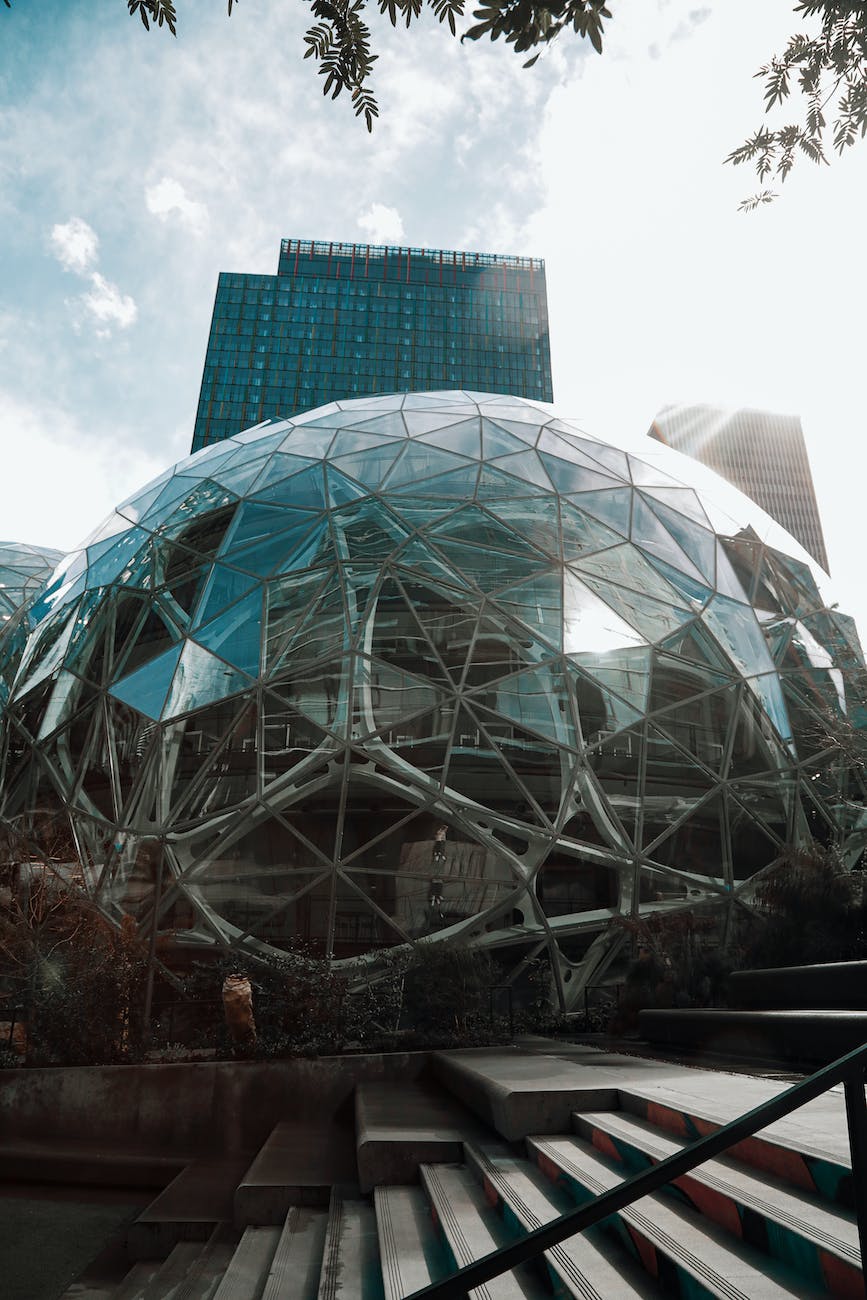
Last month I attended a one-day conference hosted at Amazon’s conference center in the South Lake Union area of Seattle. There’s a tech industry psychic hum in the streets there, just like the entertainment industry hum that runs through anonymous looking three-story office parks in northern LA or the legal hum that saturates certain blocks in downtown Portland. The office workers getting their morning coffee look focused and unencumbered by family or community commitments. They are men and women, and stylish. The pinup shirt wearing, punk rock programmer dude and the carebear gothic tenderqueer have both been disciplined by three tech recessions since the year 2000. The clothes are less formal and structured than the norm for, say, finance, but there is a look and bright colors are a risk.
Right across the street from the Amazon campus, a forest of huge rainbow glass-walled skyscrapers that hold the back office of the everything store, there is a humble red building. It’s a sex toy boutique with an old-school porn screening room. I find this delightful.
When a platform goes away, especially when it has just left, it is hard to preserve memory of what it looked like when it was healthy. Especially things that you might not think of as platforms. Take phone calls. When the platform was built (not with lines of code but with redwood and creosote and copper) it was too expensive to use as a social network. Later, with home phone service and party lines, it got closer, but it wasn’t private enough. Once digital switching and billing and private home service came into being, there was a glorious period in which phone calls were welcome. Infrastructure to support the network sprang up, like answering services and phone booths and cordless phones. Friendships and relationships were built, distances shrunk.
That golden age was long gone by the time I was a kid. The phone system was becoming overwhelmed by telemarketing. Small breakdowns in the system were everywhere. For example, when everyone screens their calls using an answering machine, getting someone on the phone could take a full minute, much slower than in the era where each call was too expensive to waste on a cold call. Phone booths were always vandalized and often didn’t work. By the time that cell phones came around and changed the paradigm again, the stereotype of the Millennial that hates talking on the phone was well ingrained.
That same arc plays out over and over, for as long as humans have or will exist. Letters through the postal service, the bulletin board at the laundromat, philosophers at the agora. There are situations where these media survive long past when the rest of the world has moved on from them. Letters and phone calls still maintain relationships in prison. Astronauts swap movies on thumb drives on the International Space Station.
The porn store represents a node on a very particular kind of retail platform. That platform is rapidly disappearing, in no small part due to the work of Amazon. On that platform, you exchanged cash for a physical good. The store knew nothing about you, or where your money came from. You didn’t know anything about where the good came from. Somewhere out there, you could buy almost anything.
That platform didn’t exist everywhere. In cities where the power of the city government was finite and the size was big enough that there was some undesirable area where a sleazy, taboo business could exist without neighbors complaining, there could be remarkable freedom. In most places, the power of the local government could keep them out. If the government couldn’t do anything, customers could be harassed.
You can’t really go back. As much as I miss the good parts of healthy local retail, and as much as I worry about what will happen if the right wing succeeds in enforcing repressive suburban values onto the internet, internet retail does work better for most people in more places than local retail did in the late 1990’s.
But I love that these powerful symbols, one the last of its kind, the other the worldkiller, face each other on Westlake Avenue.



 hammer & jack