
novel

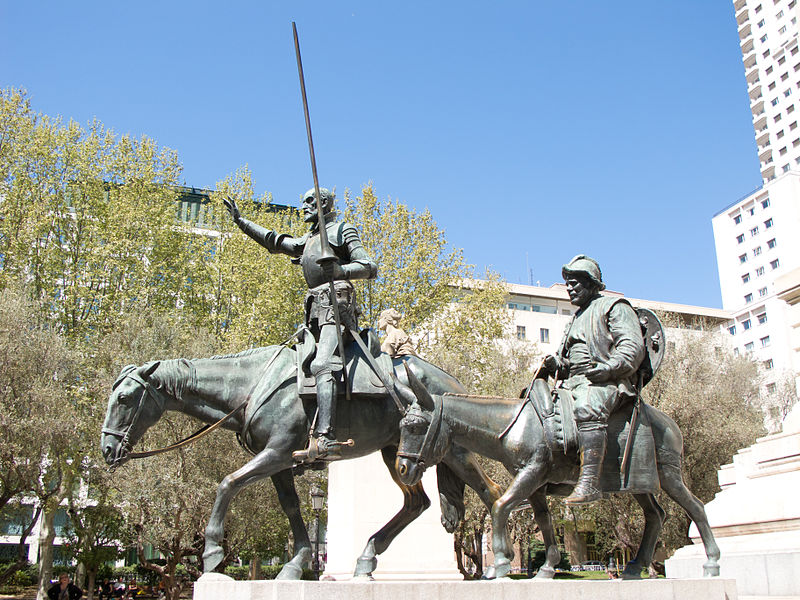
File:Monumento a Miguel de Cervantes – 05.jpg” by Carlos Delgado is licensed under CC BY-SA 3.0.

For almost 500 years the type of story most popular among literate Europeans was the chivalric romance. The Song of Roland, Troilus and Criseyde, the kind of stories that Monty Python and the Holy Grail makes fun of. In 1605, Miguel de Cervantes writes a bawdy little satire called Don Quixote. It takes all of the noble tropes of the romance and turns them upside down. In the place of a young noble undergoing a challenge of grave importance to earn the hand of a beautiful maiden, there is a destitute old crank and his wisecracking frenemy wasting their time shouting at windmills and fantasizing like incels about the feminine qualities of the beauties they’re totally going to find.

That’s how Cervantes accidentally invented the modern novel.

The novel embraced that it was a low, grubby kind of story. They didn’t have to be any more realistic than the romances. They just dealt with slightly more grounded people than Chosen Ones on a divine quest given to them by God. They made mistakes for petty, human reasons. That turned out to be relatable to people, and novels are still with us today.

I thought about the romance and the novel recently while watching TV, bored. I was watching It’s A Sin but it could have been any number of shows or movies. I realized that I wanted a drama but I was watching some new form of show that reminds me of school pageants.

Pageants present well-known stories about well-known people going through well-known situations. If the pageant is about George Washington, there will be a cherry tree and the Delaware will be crossed. About California history, expect Missions and Gold Rush and Silicon Valley. Any child actor is welcome to play their part artfully, if they so choose, but the form doesn’t demand it. A good pageant keeps the story moving along even when the people on stage aren’t behaving in ways that resemble any human let alone a particular character, or can’t remember their lines, forget how to speak, are having an out of body experience. It’s a funny art form!

Many shows and movies that get applause for being brave and diverse and bringing new stories are secretly pageants. It’s A Sin was about AIDS in the 1980’s, a rural, innocent looking twink moved to a big city and was taken under the wing of worldly club queens. There were tearful scenes of family betrayal and discrimination at work. Among a large cast of characters are stand-ins for straight allies, lesbians, older gay men, Black and Asian gay men.

Playing with pageantry can be great. Juno sends up the teen mom after school special by giving you a quirky, character-driven comedy. A lot of the pleasure of Ryan Murphy or Aaron Sorkin shows, Derek Jarman films, or Julie Taymor musicals are that they are pageants.

Pageants are blunt, though, and I don’t think they can ever introduce a new story as well as a drama. Work in Progress, The Bisexual, and Chewing Gum are all weird, flawed shows. But showing the messy ambivalence of the human, strange, lovable characters at the heart of those shows gave me a chance to fall in love with them. That’s what I need from TV.

interconnected

Photo by Fábio Lucas on Unsplash

There is no blog that makes me feel excitement to meet the future than Interconnected, the public journal of Matt Webb. Webb is a UK based managing director of investment funds and former head of a design group. He specializes in imagining the near future, supporting businesses at the intersection of tech and material design.

I love the way that he incorporates a very long view of history into his imagination of the almost-possible. In this fantastic post considering the use of birds to divine the future in the ancient world, he connects this taxonomy of magicians codified in Roman law:

A haruspex is one who prognosticates from sacrificed animals and their internal organs;

a mathematicus, one who reads the course of the stars;

a hariolus, a soothsayer, inhaling vapors, as at Delphi;

augurs, who read the future by the flight and sound of birds;

a vates, an inspired person – prophet;

chaldeans and magus are general names for magicians;

maleficus means an enchanter or poisoner.

to some of the mystical personalities that have become common in Silicon Valley and globalized manufacturing:

I happen to have spent my career in a number of fields that promise to have some kind of claim to supernatural powers: design, innovation, startups…

It’s not hard to run through a few archetypes of the people in those worlds, and map them onto types of ancient magician.

Those like Steve Jobs (with his famous Reality Distortion Field) who can convincingly tell a story of the future, and by doing so, bring it about by getting others to follow them – prophets.

Inhaling the vapours and pronouncing gnomic truths? You’ll find all the thought leaders you want in Delphi, sorry, on LinkedIn.

Those with a good intuition about the future who bring it to life with theatre, and putting people in a state of great excitement so they respond – ad planners. Haruspex.

Those who have the golden mane of charismaenchanters. Startup founders.

People with a great aptitude for systems and numbers, who can tell by intuition what will happen, from systems that stump the rest of us. We call them analysts now. MBAs. Perhaps the same aptitude drew them to read the stars before? Mathematicus.

Just today, I was lit up with imagination and fantasies of the wonders of the future—confidence in the future is hard to locate right now, on the brink of a nuclear world war that all of the small people of the world are hoping against—by a new post connecting the physics of bumblebees and fish:

Vortices in the water are generated by the skin, and the side-to-side movement of a trout is the fish slipping between the vortices, pinballing between them, propelled on them like a boat on wind. (Shown, says the article, by the fact a dead trout on a line in moving water will still exhibit the characteristic swimming action.)

All of which leads to this REMARKABLE line:

Fish don’t swim, they’re swum.

ARGH. Too good. Am dead now.

to new forms of locomotion enabled by the marriage of machine learning with precise, instant control of motors:

How can the tools for inventing new wheels end up in the hands of the people with the right imaginations?

[…]

All wired together. Handed out to designers and mechanical engineering students.

And, given this package, perhaps the future will look very different from our science fiction.

Pinhead drones dragging copper wires behind them, darting through the home bouncing on air currents, generating electricity and power by dragging their tails through ambient magnetic fields.

Directional packaging that is can’t slip out of your hands (but dislodges easily when you move your hands the other way).

Cars with fine filament-bristles covering on the base, shaping and sweeping the air at nanometer resolution to ride on a silent and almost friction-free air cushion of vortex turbulence.

All mechanical objects with halos of filaments, magnets, mist, so fine that the eye can’t identify clean edges, no hard plastics or iron but all our artefacts in soft focus, encased as they will be in a gentle haze of turbulent air sculpted by alien intelligence.

It’s just fantastic.

I have such an inborn and church-reinforced worldview that is highly attuned to loss, and I never assume that just because the present followed the past it is automatically better. When I think about the lifestyles of the 1930s, I don’t think about how they didn’t have TV and most of their movies sucked, I think about how there were professional musicians in every city and dance halls where people had fun. Embodied, active fun. And their bread tasted better.

But it’s also true that I don’t have a way to think about all of the hunger, all of the people who had no bread at all. Maybe the truest truth about the 30’s is that the early 30’s sucked for almost everyone, and romanticizing anything about it is ridiculous.

A more balanced view would be to appreciate the good qualities of any given time, and appreciate it separately from comparisons to the future. There are social factors that make it difficult to set up a 1930’s style dance hall today: no one knows how to dance, the economic model relied on huge volumes and it would be a niche activity today, and it’s more expensive to secure and insure event spaces today. Not to mention that partner dances rely on rigid gender roles! All that means is that we need new models to respond to the conditions today.

It takes faith in the belief that people want to dance.

Future thinkers like Matt Webb give me confidence that we can figure out new models to create spaces where that can happen.

rationality

Joshua Rothman writes about rationality in The New Yorker, and various recent bestsellers written about the concept. He makes reference to the Tyler Cowan/Less Wrong/Effective Altruism circles, surveys the way that different social science disciplines think about it, and explores the value a good rational friend can have on your decision making.

I often feel pulled toward these web communities. I love exploring ideas with people who get excited by ideas, and by people who share my attitude that many things are knowable, and the only reason to give up on curiosity is when you discover exactly what is still unknown. Unfortunately, these communities also frequently have blind spots around race and gender that end up pushing me away, and I was disappointed to not find anything in this article that touched on those issues.

One of the disciplines championed by these intellectual internet communities is spotting cognitive biases and putting our on ideas to the test. They struggle to recognize and respond to this pattern: the more an internet community values rational argument, debate, an “anything goes” intellectual freedom, and an appeal to “honor” to mediate interpersonal conflict, the more its social hierarchy looks like a white supremacist heteropatriarchy.

One could imagine that on the internet, considering its global reach and English’s status as a global lingua franca, if you create a community centered around the value of rational intellectual discourse, you would bring together the members of myriad groups of people that are most interested in that value. Earlier in the history of the internet, when access required computer equipment that cost hundreds or thousands of dollars, perhaps you could believe that the demographics skewed white and male because that’s who had access, and diversity would come as more people gained access to the network. That’s not an excuse any more, and it hasn’t been for a couple decades. 

Here’s my two cents: in my time on the internet, I’ve seen many communities fracture when some part of its membership brings a social inequality present in the community to light. There’s a little dance the defenders do, some mixture of these steps. The pushback goes like this:

  • There’s no inequality.
  • All right, here’s the unbiased, pragmatic reason why there’s inequality, it has nothing to do with prejudice.
  • OK, sure we have prejudice but who doesn’t? It doesn’t have anything to do with the core mission of this community.
  • So, it seems like this bias has always been deeply intertwined with the foundational history of this community, but isn’t this all a distraction?.
  • Why are you trying to destroy this community?

Anybody from a group that experiences discrimination is well familiar with this pattern, and if you are a highly educated knowledge worker from such a group you deal with this shit all the time and are not seeking it out for fun. There are spaces on the internet that have done social engineering to disempower the default to white straight male experience. I like the Metafilter comments sections and Learned League, and Andy Baio and the XOXO team developed a lot of good ideas for facing these dynamics head on and being willing to experiment with fundamental assumptions

I’m still looking for that great space, though. For every narrow, well moderated group I come across, there are many others that make room for social reactionaries. If you’ve found a community you like, I’d love to hear about it. 

limits

Five and a half hours into our drive from San Francisco to Portland, I got into an argument with A. about the return to mask mandates. I was wrong, but that didn’t stop me from digging in and getting increasingly frustrated. My rage at the situation, at the people choosing not to get the vaccine for political reasons, at my mother for being one of them, all bubbled up into white hot anger and contempt.

Since last March I have seen people get fired up by small inconveniences in daily life. Fear of reality gets sublimated into rage at the service being slow or an item being out of stock. It was my turn. I lost my hold on rational thought. Other countries with flawless pandemic responses are also seeing Delta variant surges. It’s not rational to blame the reappearance of distancing and masking on vaccination refusal. Wearing a mask indoors is the right thing for everyone to do right now, and that fact broke me.

One of the assumptions I held about climate change is that there would be some disaster so obviously terrible that the powerful—and the financially invested—would have to take action to save themselves. This year has taught me that there will be no such disaster. There will be death and destruction, the powerful will retain their hold on power, the invested will have the government pick up their losses then be paid to “rebuild.”

The kind of humility and international cooperation it will take to save our home is nowhere to be found. If the augur is true, I can expect an adulthood of social fracture, solutions slipping out of our grasp, and rapidly disintegrating ecosystems.

I worry that I won’t resist becoming uglier as our planet becomes uglier. With each passing day, the pressure grows to look at others as my competition for dwindling resources or problems to be solved. I will be pressured to learn how to dissociate from the feeling of distress that comes with noticing the increasingly loud warning signs the Earth is sending. Or tuning them out altogether. I don’t have much appetite for those kind of changes.

Why does the fact of human climate change hurt my heart and the fact that the earth will fall into the sun not hurt? Choice is the difference. Choice, and the unfulfilled dream that we could transcend our biology. What comes next is the same thing that happens to every other animal population that exceeds the carrying capacity of its habitat.

epiphany

In the last year, many of us have gotten weirder. I have become more religious.

I was raised in the church, and because I like books and ritual and community and art, it rooted deeply. When I went to boarding school, I was surrounded for the first time by people who were not raised in generally the Christian church. Some were non-religious and raised in families where religion was not present at all. Many were from other countries where the majority religions were other than Christianity.

I found myself surprised to have nothing to say to these people—all of my evangelizing concepts had been developed around what bringing Jesus Christ into your life, and they did not have much to say to why Christianity?

The church I was raised in had no respect for a pluralistic faith that saw the light in other religions, nor the value in faith that did not try to convert others. That became the tip of the wedge that drove religion out of my life. By the time I started discovering my sexuality and having to accept or reject the idea that my church offered me two paths: denial and heterosexual conformity or a lifetime of tortured marginalization, I decided that there was no room for me in the church.

I could never break from it completely. The art and music still moved me. The sensitivity to something other than this world, the place from which I could look at the world and see how contingent all of our circumstances are on social ideas and history, I also found in Plato’s realm of Forms, and E.T.A. Hoffman’s realm of art and music beyond language, and Jean Toomer’s vision of a future beyond race and sexuality.

Over time, my sense of myself began to settle into something that could not be blown around or bullied, and the church environment became less threatening. I miss the sense of cross-generational community, and the beauty of singing in a body of untrained voices. This is a tough world to maintain a sense of meaning if you are not making it.

Other artists trying to integrate faith into the life of an artist made their way to me. The incredible, literary quality and artistic integrity of Stephen Cone’s films floored me, particularly Princess Cyd. Discovering the drive of Dorothy Day to do good, and of the poet (I can no longer remember who) that would sit in the back of the church during Mass, never returning to the church but in some kind of relationship with it nevertheless.

It’s still hard for me to imagine attending church services regularly. I no longer have the expectation that things or people must be perfectly resolved and completely comprehensible in order for me to engage with them. Yet it’s hard for me to imagine attending church services regularly. Could I really be seen, be myself? Do I dare to dream that that aspect of myself, in all of its keen and sinister dimensions, can be experienced in loving community?

I suspect not, but I have less patience now for the sterile and monotonous loneliness of a life holding myself apart from others.