Die Unstillbare Gier

When you receive a gift from someone who was in your life for a brief time, your relationship to the gift will eventually eclipse your memories of the giver. A few summers ago, at party in an apartment above The Matador on West Burnside (before it closed), I met T. and M. They were a good-looking couple from Bend who would drive to Portland every weekend to go out to clubs and party. M. was a schoolteacher with a quick, jealous temper. He liked to punctuate every sentence with an Alyssa Edwards tongue pop. T. was his tall blonde German hunk of a husband. That’s not poetic license, he was literally German, like, from Germany. He seemed bored by Bend. I got into a flirty, drunken conversation with T. and said that I was a singer. He lit up and asked me to sing. I wanted to impress him, so I sang from the first song in Schumann’s Diechterliebe. I performed it in a college recital, and my singer’s German no longer flowed easily, but T. loved it. He started gushing about his favorite song ever: this song from a vampire opera. He made me swear to learn it and sing it for him, and with wholehearted drunken sincerity, I promised. That never happened because the next time I saw him, his boyfriend called me a racist slur and I was so pissed off that I never hung out with their crew again. But I am happy to report that “Die Unstillbare Gier,” the song from the vampire opera, wormed its way into my heart, and I have returned to it again and again and again as a piece of wonderful, glorious, bizarre theater.

The Fearless Vampire Killers (1967) Von Krolock (Ferdy Mayne) encounters Sarah (Sharon Tate) as she bathes.

The origin of this piece of music begins in a 1967 Roman Polanski movie called The Fearless Vampire Killers, or, Pardon Me, But Your Teeth Are in My Neck (no, seriously),starring Sharon Tate and Polanski before they were married. It was a swinging 60’s sexy, farcical sendup of vampire tropes, and apparently a real piece of shit. It was butchered by its USA theatrical distributors in original release. When its original cut was “rediscovered” in the 1980’s, critical opinion was revised from “one of the worst movies I’ve ever seen” to “quite bad.” Despite its TCM at 3:00 in the morning reputation, at least one person believed in the durability of the movie’s plot: in the early 1990’s, a German theater impresario recruited Michael Kunze, a successful director who was the go-to guy for adapting hit Broadway shows into German, to adapt the movie into a musical and write the book. Jim Steinman was recruited to compose. Steinman is best known as the songwriter behind Meat Loaf, he wrote all of Bat Out of Hell parts I, II, and III, as well as hits for other artists, most famously “Total Eclipse of the Heart” for Bonnie Tyler. The result was Tanz der Vampire (Dance of the Vampires). The basic plot of Tanz is: a young woman in a Jewish shtetl in the Carpathian Mountains draws the attention of the vampire Count von Krolock. He lures her to a vampire’s ball. Her young admirer and a vampire hunter go to the ball to rescue her, she escapes. Krolock pursues them into the woods, where he is torn apart by wolves.

Poster for Tanz der Vampire 20-year Anniversary production in Vienna, 2009.

Tanz is a maximalist, over-the-top, totally committed work of high Gothic camp. Roman Polanski directed and designed its opening production in Vienna in 1997. While some movies and TV shows in the 90’s like Buffy the Vampire Slayer and Interview with the Vampire were deconstructing vampire iconography and adding contemporary elements, Tanz is all-in on classic visual tropes: costumes have capes and codpieces. The graveyard set is lit in purple and green. Krolock sings in an archaic poetic register. If you don’t buy into its sensibility, the whole thing is incredibly mockable, especially since—this is incredibly unfair, I know— Germans expressing themselves passionately always has an edge of silliness (not my most cosmopolitan opinion, but don’t blame me! Blame the Romantic German poets that taught German men that the best way to demonstrate your desire to a girl was to commit suicide at her).  

Kevin Tarte as von Krolock singing “Die Unstillbare Gier”

“Die Unstillbare Gier” (The Insatiable Greed) is von Krolock’s big solo number before the climactic finale of the musical. It starts with a mournful oboe melody against ambiguous harmony. Von Krolock enters in a defeated whisper, the stillness and the darkness quieting everything but his agony. The strings enter, a piano ballad riff establishes a new key and a midtempo rock beat. Krolock sinks into reverie, telling the story of memorable past lovers. Every time he opens his heart, he wants to turn them so they can share in eternal life together, but they always die in his arms. He has accepted that this will never work for him—“I still believed I could win,” he remembers with bitterness, of the first time he tried—but he remains forever trapped between his twin desires for love and for blood. In the chorus, his voice soars louder and angrier as he asks for one of these masters to set him free: “I want to be an angel or a devil.” As he builds to a climactic shout of rage towards god, he turns his anger towards the audience, challenging that everything that humans put meaning into—religion, science, art, heroism, virtue—is a delusion to distract us from the ultimate power that guides us: our greed for whatever we can’t have.  

Tanz der Vampire, Vienna 1997. Graveyard scene.

The reason that I return time and again to this song is that I believe Krolock. There’s a level of authenticity in song when the voice carries the emotion directly. It’s in music about joy that’s joyful, or music about anger that’s angry, or music about sorrow that’s sorrowful. This is a song about desire that wants. I am not a vampire aristocrat (although I would love to own property and a better wardrobe, so consider this an official expression of interest), but in my moments of deepest despair, I too wish that I wasn’t burdened by my own wants. I fear that I invite disaster by getting too close (“…when I reached for life, nothing remained in my grasp/I want to turn to flame and ashes, but I cannot be burned”). There is a fantasy version of myself that is better looking, richer, more charismatic, more powerful. When I let myself sink into feelings of jealousy and an angry entitlement at the world that this is it? This is all I was given?, my bitterness sounds like this song.

Songwriter Jim Steinman

Even if your tolerance for camp is lower than mine, the song itself has had a fascinating journey towards becoming itself. Jim Steinman has a method of recycling the same material over and over (others might call it creative exhaustion), and Tanz was assembled out of pieces of music used in other songs for other projects (“Total Eclipse of the Heart” has charmingly bizarre lyrics anyway, but it got much, much weirder when it was recycled into a horny vampire duet. “Die Unstillbarre Gier” had two lives before Tanz, as “Surf’s Up” on Steinman’s 1981 solo album Bad for Good, and as “Objects in the Rearview Mirror May Appear Closer Than They Are” on Meat Loaf’s Bat Out of Hell II: Back Into Hell.

Jim Steinman, “Surf’s Up”

“Surf’s Up” is a terrible song. I have a bias: it comes from my least favorite era of rock and roll, when pretentious male songwriters seemed to confuse priapism with a mystical experience. The central nature metaphor is that the singer wants to give you a pounding like waves on the shore. “Surf’s up, so am I” he cries erectly. Steinman has a perfectly serviceable voice, but it’s not quite up to his music in range and power. Only a small amount of musical material survived from “Surf” to “Gier,” it’s a piano ballad with a similar build and shape, but only a fragment of the first melody phrase in the verses and some of the verse chord progression are recognizable in “Gier,” the bridge and chorus are completely unconnected. The most interesting thing about the I-vi-IV-V verse chord progression is how conventional it is. What is interesting and memorable in “Objects” and “Gier” is just one or two chords away from being foursquare and forgettable. Present from the very beginning, though, is the unexpected vi chord that delays resolution to the dominant (on “never be like this again”). That surprising suspension, over the two revisions, will expand into the dramatic climax of “Gier” (“the real power that rules is/is the shameful, infinite, consuming, destructive/insatiable greed”).

Meat Loaf, “Objects in the Rearview Mirror May Appear Closer Than They Are” live in Orlando Florida, 1993.

“Objects in the Rearview Mirror May Appear Closer Than They Are” is a messy failure for a different set of reasons. The verse melody and chords have been heavily rewritten; they appear more or less intact in “Gier.” Steinman upgraded the voice by giving it to Meat Loaf who has more power in his upper range and enough energy to sell the soaring climaxes. It’s not quite right, however, “Objects” fails musically and, more importantly, in emotional tone. The musical failure is in the chorus. The entire chorus is the title line repeated in two symmetrical melodies. As if the repetition wasn’t enough, it drops in volume and energy, stopping the momentum of the song cold. A bigger failure is its emotional incoherence. The central metaphor is that “if life is just a highway, then the soul is just a car;” the singer reflects on three people that haunt his past like cars in the rearview mirror. The lyrics are both lurid and superficial, about the death of a boyhood friend, abuse at the hands of his father, and, with trademark Steinman horniness, bangin’ a girl named Julie in the back of a car (this is, presumably, a different car). Despite the singer’s different attitudes toward these ghosts of the past—affection and grief for Kenny, anger at his father, nostalgia for good times with Julie—the tone doesn’t change, and none of them fits the music convincingly. If my criticism wasn’t enough to make you hate the song, listen to Steinman’s praise:

It’s a very passionate song. It’s really, I think maybe, the most passionate one on the record. I mean, I’m really proud of it because that’s really one that goes over-the-top in the sense that it’s got images – it has religious imagery of resurrection, it’s got images of fertility and rebirth, it has really very good sexual images, images of cars – which I always like.  

Which brings us to “Die Unstillbare Gier.” The biggest improvement from “Objects” is that the lyrics are not written by Steinman. They are hilariously dense, but match the mournful, nostalgic, angry tone of the music perfectly. Surprisingly, one piece of syntax appears in all three versions of the song: “The grain was golden and the sky was clear” echoes “The sky is trembling and the moon is pale” in “Surf’s Up” and “The skies were pure and the fields were green” in “Objects.” Steinman made three notable musical improvements: the first is the addition of a slow, quiet introduction, which turns the entrance of the piano verse theme into a musical scene change as Krolock sinks into memory. Steinman also recognized that the two-part verse in “Objects” actually works as a verse and chorus, and cuts out the “Objects” chorus completely, which fixes the pacing. Finally, by adding a whispered, cabaret-like introduction and throwing some more hot sauce on the climax, it restructured into a much better overall shape and turned into a real showpiece for the voice. “Surfs Up” has been left far back in the rearview mirror.

Michael Crawford sings “The Insatiable Appetite” in Dance of the Vampires, original Broadway production, 2001

There is a fourth revision for this song that never quite was. You could write a book about everything went wrong with the disastrous attempt to bring Tanz to Broadway. Warring creative visions, an inexperienced director, a past-his-prime star that was preoccupied by his public image and didn’t like the campy sensibility of the show, clunky English translations, a cast that couldn’t stand each other. As if that weren’t enough, Dance of the Vampires opened the first week of September 2001. It played for three months before closing, a cast album was never even recorded. It lost $12m, one of the biggest Broadway flops ever. Tanz has been revived in Germany and Austria many times, but as far as I can tell the English adaptation has never been resurrected. There is one video of “The Insatiable Appetite” available online, you can see Michael Crawford lumber through the song, all the poetry gone from the lyrics, in a Count Chocula-esque accent.

I think that may be the final chapter in this journey. Tanz will return every now then, Dance of the Vampires will remain radioactive. Every now and then, I’ll play the video for a friend, introducing it as “a song from a German vampire opera,” and enjoy watching them put together what it is they’re watching. I can see the questions going through their heads. They are the same questions that have fueled my own obsession: This musical looks crazy, what the fuck is he wearing? Why is he so serious? Is that a boner or a part of his costume? Am I liking this? Wait, is this good? Oh my god, am I having actual feelings about this? They’re questions that one can contemplate for a lifetime, or more.

Extras

Forgetting Sarah Marshall

Jason Segal performs Dracula’s song in Forgetting Sarah Marshall (2007)

There’s a cute shout out to Tanz Der Vampire in the movie Forgetting Sarah Marshall. The brief selections we get from Peter’s puppet vampire opera lovingly spoofs the tone of Tanz, and the song “Die, I Can’t” pushes the same buttons as “Gier:” dead sincerity, total commitment to the performance, and a very silly setting.

Bisexual Vampires
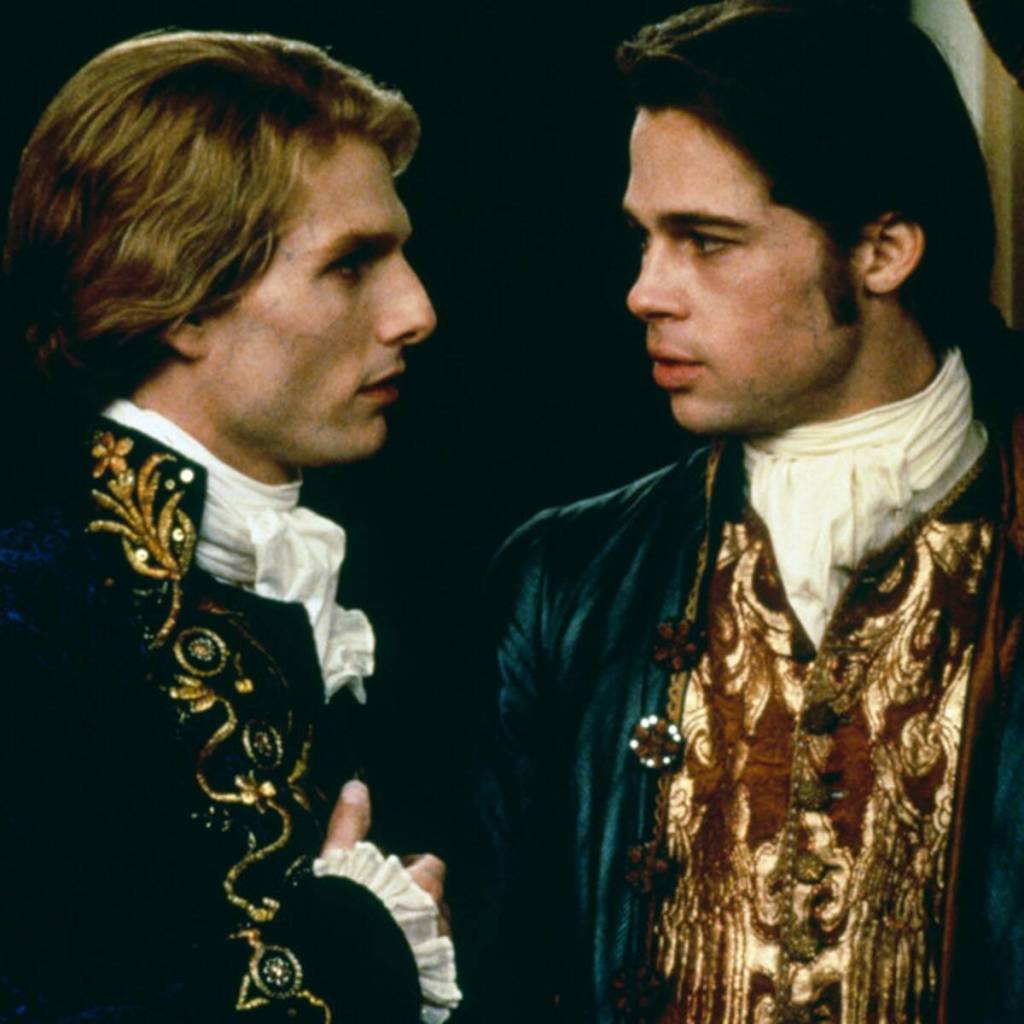
Tom Cruise and Brad Pitt in Interview with the Vampire (1994)

The late 80’s and early 90’s were the high water mark for the sexy bisexual villain and sexy bisexual vampire tropes. I have an ambiguous relationship to this trope. It is undeniably rooted in homophobia, treating the villain’s perverted attraction to the hero as an extra danger, with rape being the underlying threat. On the other hand, these characters are often the most charismatic and stylish characters in the movie. Tanz nods to this trope; while Krolock mostly revisits memories of lust for virginal women, he also mentions a page in Napoleon’s entourage: “I can’t forgive myself for his grief not breaking my heart.”

Notable Performances on YouTube

Jan Ammann performs “Die Unstillbare Gier”

The definitive performance on YouTube is the video I embedded at the top, featuring American tenor Kevin Tarte. Tarte has an opera background; his performance is very polished and he does a good job bringing the melody out. Kevin Barton originated the role, his performance has more of a brassy musical theater tone. Jonas Hein interprets it with more conversational line readings. Flippo Strocchi seems a little miscast, his pretty and youthful voice work at odds with the heavy, regret-filled affect of the song. Rio Uehara sings it in Japanese with a deep stentorian tone. My second favorite performance is this cabaret performance by Jan Amman, who needs costumes and a set when you can emote with your face like this?

Translation Issues

I mentioned that the German lyrics are dense, here’s an example of what that means. In the very first line of narration, the singer has to sing the word “ein­tausend­sechs­hundert­zehn” (sixteen-ten) in two beats. German is a difficult language to translate because, although its syntax and grammar are cousins to English, it has the ability to encode a lot of information in its nouns. A noun that takes a whole sentence to describe in English (“a face you’d like to slap”) can be rendered in a single word in German (“das Backpfeifengesicht”). This is a real challenge for song translators.
Coronavirus Diaries No. 2

Twitter: “IOC considers postponing 2020 Tokyo Olympics.” Fox News: “Aid talks at standstill as McConnell, Dems argue over sticking points in stalled spending bill.” New York Times: “Partisan divide threatens deal on rescue bill.” Oregonian: “Veteran with coronavirus dies a Lebanon nursing home, bringing Oregon death toll to 5.”]

The Wedding

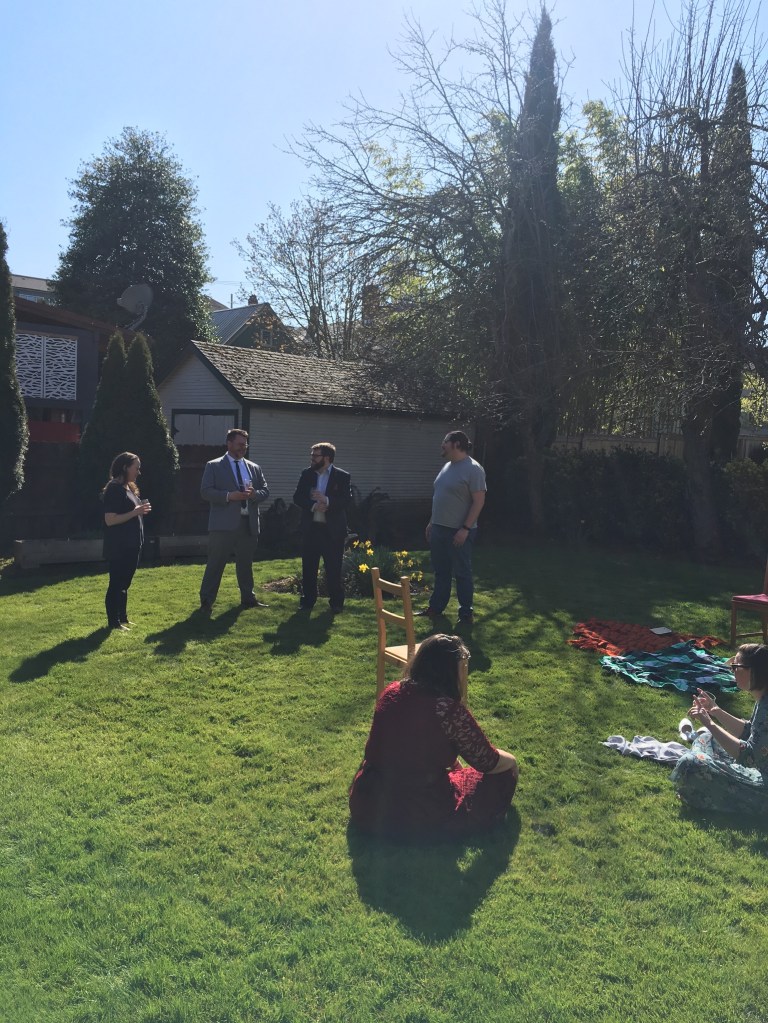
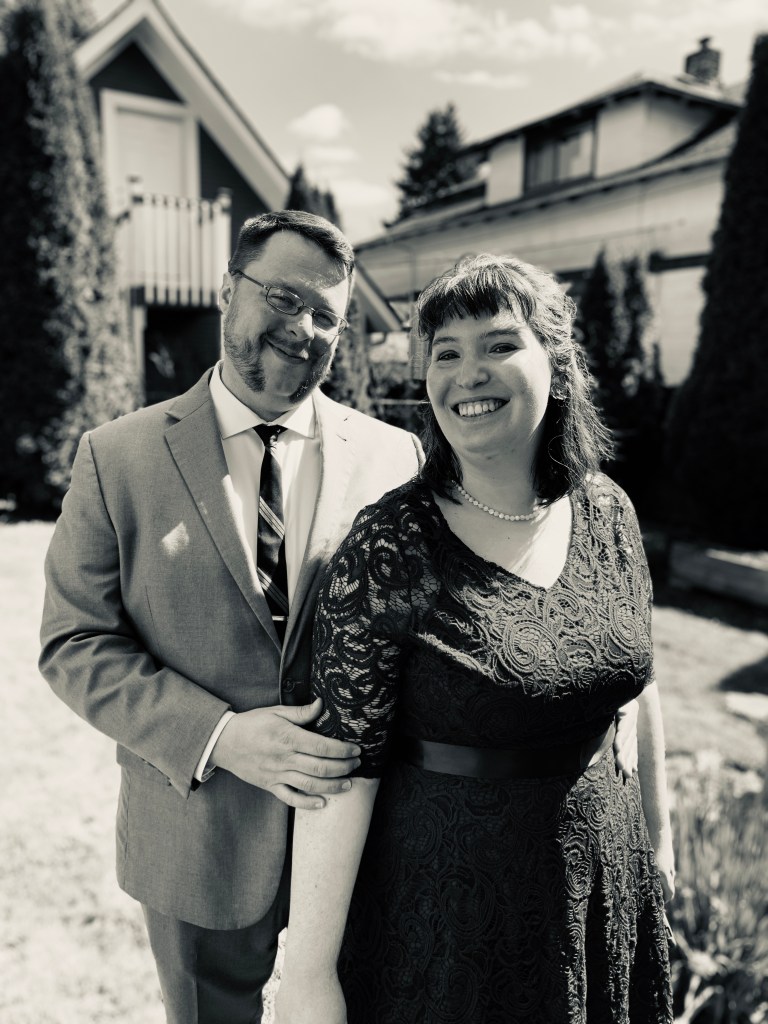
Yesterday, two of my best friends got married to each other. Congratulations, Nick and Celia! It was a totally lovely wedding: seven people present, in plain fresh air on a totally gorgeous day, as beautiful a day as you could dream of in Oregon in March. The grass was grass-green, the sky was sky-blue, and the cherry blossoms were white as wedding dresses.

I love ritual and ceremony. They allow us—“us” being a flexible unit that scales as large as the group observing the ritual or ceremony—to express ourselves through theme-and-variation. Theme-and-variation is one of the basest building blocks of artistic creation, and it exists in every art form. Weddings are a ceremony that have certain very popular elements: a couple, an officiant, vows, rings, a kiss, a party. Every couple decides what to incorporate into their ceremony and what form they take.

For this couple, perfect simplicity: a 10-minute ceremony, photos taken on a cell phone, a handmade cake, a dress ordered online. Each element chosen carefully, but lightly, with no comparison to anything outside its own rightness. Vows written sincerely, spoken in clear strong voice. One witness to laugh, one witness to cry. May you have such authorship and freedom from interference for all of your time together.

Postscript

I love the poet’s ability to say things so much more clearly and stylishly than I can. Here’s a poem from Lynn Ungar that captures a lot of what I was trying to say in the last one of these, but much better:

How are you doing? What is keeping your spirits up? If you’ve read this far, please leave a comment.

Coronavirus Diaries No. 1

I have been working from home for the last week and cutting down on socializing (due to an unrelated cold and asthma flare up) for a couple weeks. I have a million ideas of how to use my time, but the unstructured openness of the day makes it hard to focus on any one thing. Working from home feels like neither working nor being home

I’m trying to manage my worry. Entire industries are collapsing, and there is a tsunami of unemployment claims coming. The west coast might be ahead of the country on these measures, but viruses don’t respect state borders and every state that delays responding is going to be hit harder by it in 2-3 weeks. I think it’s possible that we will witness Great Depression-level destruction of the economy.

Oregon has been a half step behind California and Washington in covid cases and public health response, but this week is when the anticipation has become visible. Restaurants and bars have shut down (a big deal here—between coffee, beer, and cocktails it feels like 2/3 of the Portland economy involves pouring liquids). I live on a busy street that usually has two hours of rush hour traffic in the evenings, and it’s been empty.  I have a job, for now, but arts organizations are very vulnerable to recession. My office has felt tense since it became clear that we would need to cancel almost half of our concert season.

I’m doing my best to keep functioning. I make breakfast in the morning. In the absence of free office coffee, I bought beans for the first time in several months and brought my beloved tiny, one-and-a-quarter-mug French press out of storage. In the middle of the day, when I’m feeling bored and antsy after being in my computer chair for too long, I use a jump rope I bought on an impulse. I play video games, I read, I write, I play music. Yesterday I got a tremendous gift from a friend who let me take a long soaking bath in his oversize tub.

I’m not trying to say that everything is so cozy! or wow, isn’t this quarantine kind of like a staycation! I am deeply unsettled right now. When the part of my brain that wants to find the bright side of everything starts to speak up, I have to remind it that we haven’t seen the worst yet, we are still living through the very beginning of this story. What I’m thinking about is how we are navigating a perfect natural experiment in the practice of self-care cut off from the commercial appropriation of the idea.

The writer Tara Brach has a concept she calls “the trance of unworthiness”—a default state of busyness, distraction, dissatisfaction, disassociation, and self-loathing* that defines much of our time, if we let it. Although time goes by quickly without intention, it’s the opposite of a creative flow state. It’s the emotional induced by a society oriented towards trade and; we yield to jobs and technologies that take our time and attention, we work hard for rewards that do not make us feel better or contribute to our growth, and we blame ourselves and the people around us for the eternal discomforts that go along with being alive.

*what are their antonyms? Steadiness, focus, satisfaction, being present, and self-love—­what a great list of virtues to cultivate!

It is not worth the cost that many people are going to pay, but in this brief moment, it seems like the trance is not working. Every daily action, from going to the grocery store to texting your parents to going to work is invested with meaning, danger, and a true understanding of its value to our lives.

Self-care has become a cliché because it has been so successfully coopted by advertising. At the root of the concept is political and economic resistance, though. If the world around you is trying to destroy or oppress you, every act of care that you give to yourself is an act of resistance. It turns out that that’s a big “if” though—big enough to drive an advertising campaign through. Our culture teaches us its most important lesson from a very young age: spending money makes you happy. It establishes a lifelong relationship of cause and effect: when I’m feeling bad, I spend money, then I feel better. Once that lesson and relationship are established, all every company from soap to soda-pop has to do is pull that lever.

But look at where we are! It feels like the world is trying to destroy us. We are being called upon to do something difficult and counter-cultural: stay home, stop spending money, stop socializing in person, be with yourself. We have suspended one of the most powerful parts of our economy: paying other people to distract us from ourselves and make us feel better.

When we develop an understanding of how we can meet our own needs, that relationship to the self is so strong that no commercial interest can exploit it. Feeling good in our own bodies, feeling fulfilled by our work, feeling connected to our relationships, these are all so particular to our individual selves that no product can perfectly fill that need. The satisfaction and strength that we feel when we fill our own needs have so much integrity that we can’t be lured into dissatisfaction.

I think that we are at the beginning of a very difficult few months or years. There is a lot of death coming. We will need to adapt to the need for extended distancing until effective vaccines or medical treatments come into use. There is a possibility that our political institutions are too broken to meet this moment, and if that is the case we may be in for an extended economic depression. Finding ways to meet our own needs and the needs of our close kin and friend communities is going to be a survival skill.

I want to hear about what needs you are discovering and what ways you are discovering to fill them. I’m OK, and I hope that you are OK too.

2020 Oscars

It was the Oscars tonight! I watched the full telecast for the first time in several years tonight, and thought it was a surprisingly inspiring and life-affirming broadcast. Here’s my picks of winners and losers this year.

Winners

Parasite. The winner that everybody is going to be talking about tomorrow is Parasite. The best case scenario is that this becomes an early episode in a process of the American film ecosystem becoming more curious about international films and less chauvinistic about Hollywood movies. There’s a lot to consider here: the politics of the movie, production nominations vs. acting nominations, the relationship of South Korean culture to US culture. I’m not informed enough to have an opinion on all that, what I do know is that the movie was very good and deserved every award it won tonight.

Olivia Coleman. She is glorious, and one of the sharpest, most witty people in entertainment right now. Her wit allows her to get away with saying things that push the envelope of taste with this regal dominance that is a joy to watch. There are few people who can take a stage like that and be so secure in their ownership of it that they can be playful. Every time she is on stage as “Olivia Colman,” it’s down to earth, warm, and with a hilarious angle that nobody else would take. This guy fucks.

Quality movies. One of the reasons that this Oscar year felt good was that there were relatively few victory lap/middlebrow consensus winners. There was a little more Ford vs. Ferrari and 1917 presence than I would like, but otherwise it seemed like all the winners were rewarded for outstanding work, rather than because of popularity

Corniness. Janelle Monaé opened the broadcast with “Come Alive” from The ArchAndroid. It’s not my favorite song, but the feel of the song is like this strange mixture of B-52’s/Violent Femmes novelty rock and Cab Calloway big band schmaltz. It (mostly) worked, and it was very corny. Also corny was Maya Rudolph and Kristin Wiig’s a capella songs-about-clothing melody that was both incredible and completely embarrassing. Very skit-from-your-theater-camp-counselor vibes.

Workers of the world. Julia Reichert is a documentarian who co-directed American Factory, which won Best Documentary. She has terminal cancer. In her speech, she recognized working people: ““Working people have it harder and harder these days — and we believe that things will get better when workers of the world unite.” I truly cannot imagine the emotions she must be experiencing, this wonderful validation and career highlight, in a time when she must be aware of every moment that she has left to live.

Frozen 2. I just loved everything about this performance. I love Idina Menzel (she was great in just a few minutes in Uncut Gems); I love when these kind of events can share the spotlight with performers that don’t always get this kind of reach and platform; I loved hearing the song in all of the different languages; I loved the haunting vocals (and very strange choice of staging) of the delightfully elfin Aurora; and I love the operatic power of many solo voices coming together and singing in harmony. Loved it.

The human quality of grace. Not everybody that won an award was able to accept it gracefully. That’s no knock on them, it’s a big event. Even Taika Waititi, who has a trickster energy and seems to be able to create a vaudevillian routine for every public appearance started to lose his hold on his composure when accepting his screenwriting award. But some others seemed to understand the power of the public platform that they were given, not feel rushed, and said what they felt like needed saying. It’s a wonderful human quality, grace. There is a physical sense of the word, graceful movements, graceful lines, etc. But the root of the word (Latin: “praising” “welcoming”) has to do with social interactions, the physical definition is the metaphor. It is being present in the moment and retaining your composure at the same time as you are aware of the different levels of context that are in operation. It’s like respect: if I am to be welcoming to you, I must not only choose to be welcoming, but be paying enough attention to you to understand how you will receive my gestures. The best speeches of the evening—Hildur Guðnadóttir for the Joker score, Carol Dysinger for Learning to Skate in a War Zone (If You’re a Girl), and Bong Joon Ho all evening—had this kind of grace.

Losers

Shia LeBeouf. Shia had a few years of psychotically bad behavior, but over the last few years has built up a portfolio of interesting performances. I have no insider knowledge, but my guess is that he is either incapable of making himself play nice with the media or he is still radioactive to publicists because his public image never really adjusted to where is is today. He presented a category with Zack Gottsagen, his costar of The Peanut Butter Falcon who has Down’s syndrome. Out of context, he had a moment where he seemed to get angry with and roll his eyes at Zack, but I believe was an expression of secondhand anxiety for Zack, who was struggling with stage fright. But for people who concluded that he was a dick and wrote him off in 2013, that seemed really dickish.

The Best Actor and the Best Actress. Both Joaquin Phoenix and Renée Zellweiger gave terrible acceptance speeches. Phoenix gave an emotional, rambling speech about human exploitation of nature and each other. You can’t talk about racism and animal rights and environmental rights in the same thought like that, you just can’t. There are ways to live in balance with nature while taking from nature what we need to survive. There is a range of opinions about whether there is a moral balance like that possible with animal protein and materials. There is no good, balanced way to exploit other human beings.

Zellweiger either winged it or thought that memorizing names would be enough because she read the entire production credits of Judy before getting to a personal message about rallying around “our heroes” with all of the coherence of Miss Teen South Carolina talking about maps in 2007.

Little Women. What a great movie. It should have been nominated for Best Director, it would have been a fine choice for Best Picture, and Florence Pugh was absolutely robbed by Laura Dern’s showy-performance-in-a-mediocre-movie for Best Supporting Actress. The only award it won was Best Costume, which was the only award it should not have won (all of the clothes in that movie were too clean).

Normal-sized women. There was an embarrassing amount of hollow “Girl Power” messaging that just underlined how shut out women were from directing and most of the technical categories. You don’t need any of that if people are getting jobs. That’s what people want, they just want their projects funded and to have a fair shot at getting hired.

Old men. There were moments of tension, where it seemed like the status quo of all-white and all-male categories cannot hold much longer. One guy who won an editing award thanked his wife for giving up her career to raise their kids, and it just clunked in the room. Chris Rock and Steve Martin had a couple of opening jokes, and they just seemed like dinosaurs. There’s enough momentum in the system that men who came up in it will be able to keep staying at the top, but the folks that are coming up now are—I am hopeful—bringing a different world with them, and there’s going to be a moment when that balance tips. This year felt like a step back, in terms of women and black nominees. But I don’t think the old boy’s world is coming back. These older, white artists have a challenge ahead of them, if they choose to engage with it. They have the opportunity to re-imagine a position in the industry that is not automatically on top. Some are going to choose to evolve, some are going to choose to hold onto the past with all of their strength.

Building a cathedral

This article on cathedrals, particularly John the Divine in New York is the best thing I’ve read all year (so far): https://theprepared.org/features/2019/4/28/building-a-cathedral