For the past few years, Utopia (2019) by the Danish instrumental duo Bremer/McCoy has been my go-to album when I’m spending some alone time and I don’t know what I’m feeling. It’s calm, positive music, with slow, sparkling keyboard melodies dancing around bouncy acoustic bass lines. It’s not going to be a downer, and equally at home when I’m staring into the dark night and trying to wake up during a morning shower.
This delightful tweet from Linda Holmes sent me down the rabbit hole this afternoon exploring “Sit Down, You’re Rocking the Boat” and learning a little more about its composer, Frank Loesser.
“Sit Down” is a showstopper from the musical Guys & Dolls: the gambler Nicely-Nicely bullshits a temperance congregation into buying that he has been reformed after a religious epiphany in a dream. A context that isn’t as visible to today’s audiences, as both the early 1930’s in which the musical is set and the early 50’s in which it was staged blur together in the rear-view mirror, is that Dolls was a loving tribute to the outsize characters of a time past; it is a similar project to the 80’s movies/musicals that pay tribute to 50’s and 60’s styles, like Grease, Dirty Dancing, Footloose, American Graffiti, and Little Shop of Horrors. Most of Dolls is written in a sophisticated pastiche of Big Band and Swing-era jazz, and it’s a mark of success that so many songs from the musical have become standards. For story reasons, “Sit Down” also draws upon the densely chromatic close harmony choral style that you might be familiar with from Disney animated musicals like Alice in Wonderland,Peter Pan, or Dumbo, and the white gospel/tent revival style from a song like “In That Great Gettin’ Up Mornin’.”
Frank Loesser was a truly fascinating American character. His father was a pianist and made his living teaching, but for whatever reason—reading between the lines here, some tough personality clashes—his father never formally taught Loesser. He was self-taught on several instruments on the incredible strength of his ear, but seemed never to develop his musical reading or writing skills. Still, I think all of that dense European classical harmony is shot through his music.
The first song of his that really came to my attention is “Inchworm,” from the movie musical Hans Christian Andersen. It has a beautiful childlike melody, and wrings so much sensuality from small and deceptively simple harmonic movements. [In addition to the many jazz and pop artists that covered it, it was a special favorite of David Bowie, who wrote, “Ashes To Ashes wouldn’t have happened if it hadn’t have been for Inchworm. There’s a nursery rhyme element in it, and there’s something so sad and mournful and poignant about it. It kept bringing me back to the feelings of those pure thoughts of sadness that you have as a child, and how they’re so identifiable even when you’re an adult.“]
Loesser was always connected to music but had to make his way in the world from a young age and made his living as a young man in various creative fields like advertising and business. His first entrance into show business was writing jokes for Borscht Belt comedians, then started writing lyrics for other composers. It is astounding to me, given how fresh and unique his musical style was, that he was well into mid-career and his forties before he was able to compose and write lyrics for his own musicals.
The lyrics are great! Steven Sondheim singled out Loesser as having virtually perfect lyric writing technique, marveling at his ability to sound both conversational and stylishly playful in verse. Just look at that line I quoted in the title: “by the sharp lapel of your checkered coat”—those marvelous assonant plosive p’s in sharp and lapel and c’s in chekered and coat (by assonant, I mean the same consonant sound is repeated, and by plosive I mean that the consonant sound is made by a sudden burst of air). Those are the kind of words that demand to be sung, even if they weren’t also funny and charming and told a story.
But it’s the music that has been stuck in my ears all day. I love the way that the sopranos in the chorus keep going up the pentatonic scale to hit the high note at 1:16 in the first video, and the way the chorus builds a chord in the phrase after at 1:23. I love the surprising cadences that lead into the verse, the chordal motion echoing church hymns. For such a big company number, the verses are surprisingly slow and its an incredible role for somebody who has the energy to ham it up.
Other notable videos…
Walter Bobbie at the 1993 (94?) Tony’s
Just a murderer’s row of early 90’s talent, including J.K. Simmons, who is dead center and looking totally committed (this was even before his breakout role on Oz as a sadistic gay neo-Nazi), Nathan Lane, and Ernie Sambella (who would voice Timon and Pumbaa a few years after this performance).
Titus Burgess at the 2009 Tony’s
This was before Burgess’ breakout performance as Titus Andromedon on Unbreakable Kimmy Schmidt, and really shows off his incredible upper range. Worth it to watch the moment when he had to roll with switching the mics due to a technical malfunction on live TV!
Justin Keyes at the Guthrie Theater
I have a secret to admit—I’m not actually much of a musicals or theater person, very much an interested casual fan—, so I didn’t know what the Guthrie Theater was. If this is representative of the average quality of productions out there in Minnesota, though, I think I need to make a visit to Minneapolis. Fantastic singing, incredible costuming and choreography.
Clive Rowe on Great Performances
Rowe has a wonderful voice for this character (he does an incredible vocal trick at 2:02 that made my jaw drop). The tempo here is a little sleepy and takes a lot of energy out of the number, imho, but the orchestration is a little less swing-band and a little more Dixieland/hot jazz, which I thought was cool.
The Cast of Glee
Given the influence of Glee on theater kids, gay boys, and future Broadway cast members of my generation, I thought it was interesting that “Sit Down” was featured on the very fist episode of the show, showing how central it is to the American songbook.
Ashton Harris & The Hillsboro High School Players
This was far and away the best high school performance I found on YouTube. Ashton Harris did a great job here. If you look through other high school performances, you can see where the trouble spots for less-trained voices are: In the narration verses, a lot of the long belted notes are high in the range, so if the young singer does not have strong pitch control it is very easy to go sharp. The choruses are very lyric-dense for the soloist, the words come fast, the tempo is fast, adrenaline is cranking your heart rate up and throwing your internal clock off, everyone around you is singing at full volume so you can’t hear the pit very well, and the line is syncopated. Almost all of the high school soloists rush through “And the devil will drag you under” and end up a full beat ahead by the end of the choruses.
Frank Loesser with Frank Loesser
Here’s the man himself. He had a perfectly serviceable voice, and it’s interesting to hear this simplified solo piano reduction by the man who wrote it, it shows what he thought was the essence of the song, and which lines he liked to mug with.
…and one orthogonal connection.
Loesser’s other big Broadway hit was How to Succeed in Business Without Really Trying, which also has a faux-revival big production number, “Brotherhood of Man.” NBC inexplicably chose this number for their network promo in 2012, which I was introduced to by this tweet. It feels insane to see this chosen, given NBC’s institutional problems with sexism in leadership and the no less than 4 sexual predators featured in the casts here. Every segment has something hilarious to look at. [Also it’s catchy as fuck and I will pay you $10 to tell me what that insane dance move that Ken Jeong does is.]
St. Gregory the Great fresco detail, Church of St. Rupert, Weißpriach, Austria. Photographed at the church by Richard Stracke, shared under Attribution-NonCommercial-ShareAlike license.
Yesterday, I just started reading in earnest the titanic, 5-volume, 3,856-page Oxford History of Western Music by Richard Taruskin. So far, I’m finding it fascinating because I am an arch-dork about music. One tidbit I’m particularly tickled by was this account of the origin of the idiom “a little bird told me:”
[A book of plainchant] could not have existed in St. Gregory’s day, because there would have been no way of putting music into it. […] By the ninth century, however, the legend of Pope Gregory as composer of what has been known ever since as “Gregorian chant” was firmly in place. It was propagated not only in literary accounts like that of John the Deacon but also in an iconographic or pictorial tradition that adapted a motif already established in Roman illuminated manuscripts containing Gregory’s famous Homilies, or sermons, on the biblical books of Job and Ezekiel. According to this tradition, the pope, while dictating his commentary, often paused for a long time. His silences puzzled the scribe, who was separated from Gregory by a screen. Peeping through, the scribe beheld the dove of the Holy Spirit hovering at the head of St. Gregory, who resumed his dictation only when the dove removed its beak from his mouth. (It is from such representations of divine inspiration that we get our expression, “A little bird told me.”)
Taruskin, Richard. Oxford History of Western Music. Oxford University Press.
Some other little tidbits I’ve enjoyed from this first section:
The word noon comes from the monastical service held at 3pm called “none,” from the word for nine (the ninth hour since waking at 6am). On why the 3pm service became our name for the 12pm hour? Taruskin: “[it’s] just one of those things.”
For the very first time I actually understood what the Holy Roman Empire was.
Notated plainchant (which everyone but historians just think of as “Gregorian chant”) was adapted from monastic/ascetic practices, so despite what pop culture and our own filling in the blanks might suggest, all around the church there was instrumental music, ensembles/orchestras, choirs, bands, and music with many harmonies and parts. Plainchant for church use was designed to sound ancient and primitive. If you’ve ever been to a church service with chant and felt a shiver of something primal and magical down your spine, that’s exactly what the church hierarchy hoped might happen… in the 7th century.
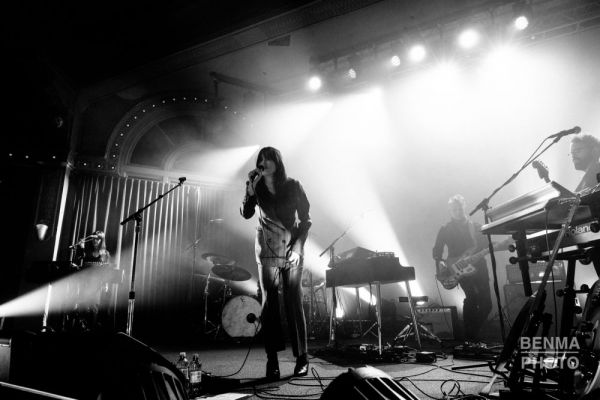
Last night I went to see Sharon Van Etten at the Crystal. Seeing music there is a little dicey because the proportions of the room make me uncomfortable, and as much as I want to enjoy myself, a full 1/3 of my brain is tied up tamping down my claustrophobia.
I went with somebody with an extra ticket, and I wasn’t very familiar with her music beyond some cramming on my drive home from work. There’s something nice about coming fresh to someone in concert. I may have not had the sweet anticipation of her super-fans, the ones who had been waiting five years for new music and were losing their minds, but I think that is balanced by an openness to the new material.
She came out in a gray trouser suit, double breasted and with pinstripes that echoed wartime fashion to me. During the first song, the thin material shook with nerves for just a second. Her voice was swooping, somewhere in the neighborhood of Florence Welch and Stevie Nicks. At first, she hid behind long black bangs, mumbling and moaning into the microphone, stomping chunky black heels and feeling the beat by slapping her legs. Over the course of the set, she loosened up. During “Seventeen,” a track on her new album–so many great songs about that age: “Edge of Seventeen”, “Anthems for a Seventeen Year Old Girl” “Dancing Queen”, “It Was a Very Good Year”–there is this climactic line, I know what you’re gonna be, where all of the sudden she dropped into a new gear of energy and rage and betrayal and power and screamed, and the crowd screamed back because the song speaks to the part of us that is hurt that we all thought we would be different, and we really weren’t, or at least not in the way our seventeen year-old selves thought we would be, those idiots.
(My seventeen year old self would have hated me forever for calling him an idiot, and he’s not wrong, one day one of us will finally kill the other.)
How cool are bands? People that get together to play music. That’s what I was thinking. I was close enough to the stage to see their faces, to see when patches were switched, when folks tuned in breaks, furtive hand signals to the sound guy. It seemed like they were having a great time.
This night… we went to the Opera, which are Comedies & other plays represented in Recitative Music by the most excellent Musitians vocal & Instrumental, together with variety of Seeanes painted & contrived with no lesse art of Perpective, and Machines, for flying in the aire, & other wonderfull motions. So taken together it is doubtlesse one of the most magnificent & expensfull diversions the Wit of Men can invent: The historie was Hercules in Lydia, the Seanes chang’d 13 times, The famous Voices Anna Rencia, a Roman, & reputed the best treble of Women; but there was an Eunuch, that in my opinion surpass’d her, and a Genoveze that sung an incomparable Base: This held us by the Eyes and Eares til two in the Morning…
-John Evelyn, Venice, 1645.
With all of the chatter about Comic Con going on right now, it’s a good time to take a moment to reflect on the fact that young men nerding out about new types of spectacles is not a new phenomenon. John Evelyn (1620-1706) would have been 25 at the time that he wrote this entry, having completed his education at Oxford College and basically taking the grand tour of continental Europe to dodge the first English Civil War.
If you’re interested, after the jump I’ve reposted the entry with hyperlinks to information about the things mentioned by Evelyn:



 hammer & jack