
a bit of irresponsible commentary

Haruki Murakami

I’m working through Haruki Murakami’s  Wind Up Bird Chronicles for the first time. Strike that. Let’s not oversell it; I’m a few pages into WUBC. Flipping past the numerous reviews of the recent 1Q84 impressed upon me two things: 1. Murakami is a genius, etc. 2 1Q84 was probably not a great introduction to his work*.

*On the other hand, I sometimes perversely wonder whether the best way to be introduced to a great master is through their least-regarded work. There’s always the chance that the experience will be so bad it will turn you off forever, but if it doesn’t then every new work is better than the last.

And really, it’s far too early for me to be giving any sort of opinions on the work. I’m literally like 10 pages in. One thing I can say is that I’m enjoying the similarities between Murakami’s work and that of one of my current favorite writers, David Mitchell (Cloud Atlas, The Thousand Autumns of Jacob De Zoet)*.

*Murakami’s such a well known and beloved figure that it’s probably meaningless to say that any writer is “familiar” with his work, but I would put money down on the fact that Mitchell–who has set several of his works in Japan–has consciously modeled his style on him.

One of the thing that I’m sensing about Murakami is that he, like Mitchell, likes to play with the idea of characters that are both completely specific and completely symbolic. These characters are just slightly larger than life, but not so much as to disrupt a sense of reality. This frees the writer to write in a style that’s a little more plot-centric while remaining in the realm of literary fiction without becoming banal. It’s the strategy that ties Murakami’s pop-culture references and hints at magic realism, and Mitchell’s polyvocality and postmodernism together. Characters that are complete archetypes, that in a less ambitious work would be stock, are given weight by the knowledge that all of their actions carry subtext, and that for all the emphasis on narrative and plot there is another story also being explored.
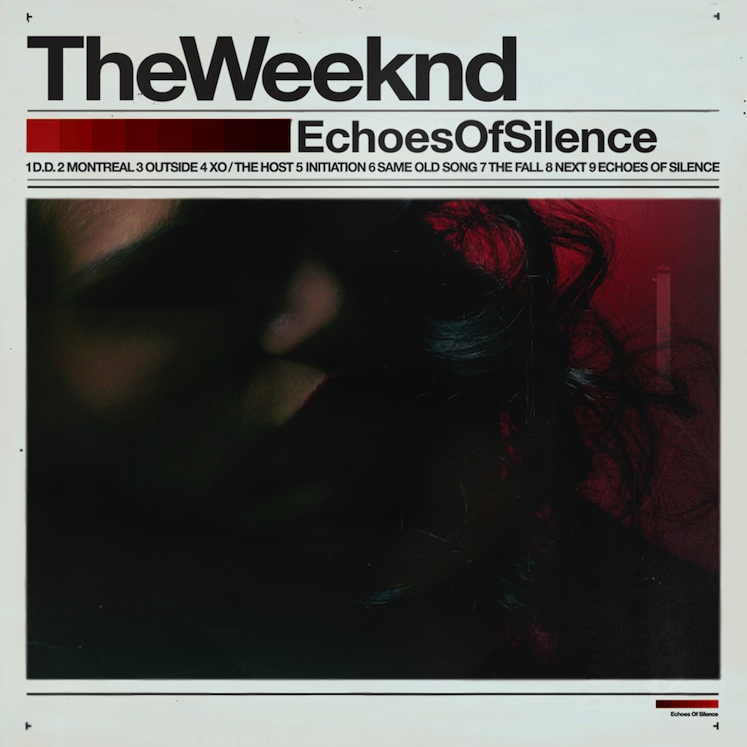
The Weeknd – Echoes of Silence

Hopping on the bandwagon here, but I have a few thoughts on the last Weeknd EP of 2011, Echoes of Silence.

One of the real highlights of my 2011 was listening to the first Weeknd EP, House of Balloons. There’s an amazing feeling, one that music lovers chase all the time, of hearing something new, hearing a different take on material that you know well, a different path through well-traveled territory. And that’s something that I heard on that EP. A chillingness, a remoteness, sexy fucking music. Processed as fuck yet as intimate as someone singing softly in your ear. Soft and ethereal, hard and sleazy. 

And it’s a great format. Splitting up the material allows the strongest tracks to shine on their own and take up their own space. Releasing an EP every couple of months allows crazy amounts of anticipation to build up while still feeling like it’s a part of a cohesive whole. The Weeknd became one of the few artists in 2011 that I kept tabs on to check for new albums, and the only albums that I made sure that I obtained the day they were released. I try deliberately to not look at biographical information about the musicians that I listen to, yet I found myself Googling compulsively.

Just like Robyn’s Body Talk EPs last year, the last entry in this three EP series is the strongest, and the most vital. As I said, House of Balloons blew my fucking ears off. It wasn’t only because of the chilled, murky production or the mechanically smooth vocals, it was the interesting way that The Weeknd integrates musical elements that exist outside that closed sound world into the songs. My favorite tracks from House of Balloons are “The Party & the After Party” with that great hook (“You always come to the party/To pluck the feathers off all the birds…”) and “House of Balloons” which integrates a Siouxie and the Banshees sample, a great nod to a predecessor*.

*By the way, the sprechstimme on the line “And no closed doors” is probably my favorite line in The Weeknd’s oeuvre. It manages to be sexy and deeply, deeply sad–and real.

The reason that Thursday remains the EP that I’ve listened to the least is that it retreated back into that sound world. I appreciate the new take that they bring to slow fucking music, but even on the first album, I thought that once there were no external elements to bounce that sound off of, it became formulaic and monotonous. That said, it’s possible that given a little more time, I’ll completely reverse that opinion (see Theif, Hail to the).

Echoes of Silence kicks that door down. Every track is solid. Every track has that mixture of interior, exterior; hard and soft. I’m still working through the Gotterdammerung-epic quality of an album as big as this, but I love the interplay between different sounds on this album, and the ambition. “D.D.” takes a song by the biggest pop star ever and manages to blow it up even bigger. And I love the winking quality of the title; it acknowledges that it’s a cover while staking out a new identity.

Great EP.

Lady Gaga & Tony Bennett

Singing The Lady is a Tramp:


I was surprised and impressed by Gaga’s chops. I’m sure it’s massaged and produced like anything else, but I finally have a clear sense of what her voice sounds like.
I wish I could say the same about her face. She’s amazing to me because images of her are everywhere and yet I wouldn’t recognize her if she was walking down the street in front of me.

Lady Gaga & Tony Bennett

Singing The Lady is a Tramp:

I was surprised and impressed by Gaga’s chops. I’m sure it’s massaged and produced like anything else, but I finally have a clear sense of what her voice sounds like.

I wish I could say the same about her face. She’s amazing to me because images of her are everywhere and yet I wouldn’t recognize her if she was walking down the street in front of me.