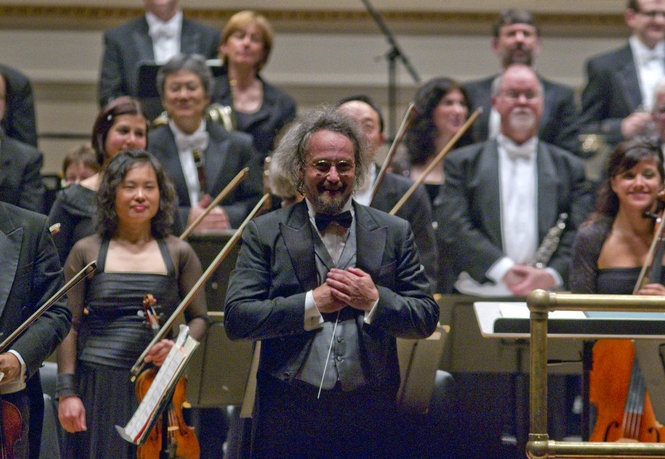
Congratulations to all of the musicians of the Oregon Symphony, who have just finished their very first Carnegie Hall concert. Early word has it that the concert was a great success; Alex Ross tweeted “Triumphant Carnegie debut for the Oregon Symphony — best of Spring for Music so far. Eloquent Sylvan, explosive Vaughan Williams.”
“Will o’ the Wisp” from Sketches of Spain was the track that most piqued my interest the first time I listened to the album. Like the rest of the album, it’s strongly driven by clipped Spanish rhythms, but there is something about the combination of catchy, modal melody and the slightly demonic harmonies in the verses that is just arresting.
After trolling YouTube, I finally realized that, like most of the tracks on the album, it is an arrangement of a piece of Spanish classical music, “Canción del fuego fátuo” from El Amor Brujo by Manuel de Falla (1876-1946).
4. a defense of ‘sketches of spain’
Sketches of Spain is one of Miles Davis’ best-known and best-selling albums, so in that respect it needs no defense. I think its accessibility means that it’s undeservedly treated differently. One album database site I visited categorized it as “easy listening!” What fascinates me about this album is the layers of subtext involved in the very creation of the album, a collection of jazz covers of Spanish classical music pieces.
Spain occupies a very strange place in the classical music economy. Although the country has a classical tradition as old as any other country in Western European, the “Spanish” sound in classical music has mostly been defined by French composers. Think Bolero by Ravel, or Iberia by Debussy, or the opera Carmen by Bizet. Part and parcel of this fascination with Spanish rhythms and folk sounds is the idea that Spain represents a liberated, and therefore savage, shadow of France. It’s the Spain of the Basque, of the Roma. It’s the Spain of Resident Evil 4. It’s the exoticized Mediterranean in the heart of Europe, and with the exotic there are always connotations of danger.
So it’s in this context that you get the music of the great 19th/20th Spanish composers, de Falla, Albéniz, Granados. Their music was nationalistic, but in a different way than is usually described by music historians. It was not an attempt to create a national identity against the forces of shifting borders, as Chopin, nor was it an attempt to establish a new musical tradition and sound where there had been none before, as Sibelius. Instead, it was an attempt to reclaim an authentic musical tradition from the realm of caricature, and to translate that tradition into the language, classical music, of the elites.
Jazz is also a musical project that gave a voice to a population that had previously only been represented in the elite culture by caricature. If you look at the language that was used to describe black musical culture and Spanish musical culture, it’s amazing how many of the same clichés surface: the music is more rhythmically obsessed, it’s more passionate, it’s vulgar. And in both cases, there was the fear that there was something corrupting in the music.
5. will o’ the wisp
Miles Davis engages directly with this web of associations on Sketches of Spain. There’s something a little…off about the arrangements. Remote. Tense. Far from easy listening. There’s plenty of idiomatic Spanish melodic and rhythmic content, and nothing of the easy caricature of French composers. I think this reflects some of Davis’ own engagement with the European classical establishment; one should never forget that he attended Juliard and there’s an alternate world where he was America’s greatest 20th century composer. There’s something about the web of oppositions that permeate the album that consistently fascinates me. It’s a mixture of two musical cultures, one white, one black, but both defined in opposition to the European classical tradition. At the same time, both the Spanish composers and Miles Davis in adapting their music decided to speak in the language of the elites.
I don’t have any answers to these apparent contradictions, however I do know that this album deserves a lot more thoughtful engagement than just dismissing it as an easy listening album of Miles Davis covering classical music.
It looks like one of my summer projects will be trying to complete last summer’s failed read-through of David Foster Wallace’s Infinite Jest. The book represents one of my most personally embarrassing acts of hubris. I had heard that there were bloggers a few summers ago that read through the book in a group. I read that there was a lot of attrition in the group, and like a fool, assumed it was because professional bloggers lacked the mental energy and sustained focus to read the 1000+ page book.
I made it to page 66.
To be fair, that number does not include the copious endnotes that pepper the book. In fact, it was one such section–a catalog of the fictional films of James O. Incandenza, Jr.–that led me to give up. I knew that I wanted to read the book well (ex. reading every word/every page) but it reminded me of the (and here I’m showing that I’m a Reed College student) catalog of ships from The Iliad.
I’m reading the book mostly on my phone, and it struck me how perfect e-reader technology is for Wallace’s fiction. The endnotes become much less annoying when they’re hyperlinked across the document. Wallace’s fairly catholic vocabulary can quickly be decoded with the built in dictionary and Wikipedia functions.
I’ll be up late writing a paper on the significance of the compositional chronology of the last section of J.S. Bach’s Mass in B minor,* but I wanted to link to a release of the premiere performance of On Sacred Ground, The Bad Plus’ reworking of Stravinsky’s The Rite of Spring. Pianist Ethan Iverson is a beast on the recording, and his blog post on his creative process is a must-read. I’m also grateful to him for pointing to pianist Serhiy Salov’s album The Sacred Spring of Slavs. The album contains Salov’s own transcription of the Rite for solo piano as well as a suite of character pieces by the Ukrainian composer Igor Shamo. The transcription is rough and edgy, while at the same time showing off near-superhuman piano technique (there were several times where I had to repeat a section to try and figure out how he was producing these sounds with only two hands), and the Shamo pieces are strong in their own right, a combination of the folk melodies of Stravinsky/Bartók and the atmospheric washes of color of Debussy.



 hammer & jack