hey there mister bisexual

Processed with VSCO with c1 preset

It is bi visibility day. One lovely thing about bisexuals is that—because it’s a tricky identity to wrap your head around—although folks come out as gay and lesbian according to a more or less microwave popcorn distribution centered around late high school and young adulthood, folks seem to steadily come out as bi as they assimilate that self-knowledge into the life and relationships they have.

I identified in high school as bisexual, but in college that didn’t last very long. I got really in my head about whether I was adopting the label because I was afraid to identify as gay, something that felt more taboo in the religious context I was raised in (more on that in a bit). In college I decided that because my attraction leaned heavily towards men, I might as well identify as gay and at the time it brought me a lot of satisfaction.

If the process of creating myself has been imperfect and absurd, coming to terms with my sense of desire has been downright chaotic. Boxes, labels… when we are looking for words to tell us who we are, they can be extremely helpful. Being named can help us feel less alone and make us feel like others who are like us have lived and have had meaningful lives. They are only ever shortcuts to self-understanding, though, and in the best case scenario, where they help you grow, one eventually grows out of them.

Once I put away some of my issues around body shame and being outside of the beauty ideal—a fucked up hierarchy that has so much power invested in it, particularly by gay men—I was able to rediscover my sense of play and exploration in regards to sexuality. It’s painful to think about how grim and serious my mental models for sex were 10 years ago. It was a hunger that could only be satisfied by metaphorically feeding off of, taking away from, someone else and (at best!) letting them feed off of you. Each the only one to see the true face of hunger. It was not a popular offer! Once I was able to trust others a little better and believe more in my own capacity to give pleasure, a whole different attitude that was light and playful and improvisatory and spontaneous and experimental opened up, and with that came better sex.

And an interest in exploring bodies other than cis men.

I think that I would have been fine with the (imperfect, contradictory) identity of “gay man who sometimes has sex with women sometimes and is pretty indifferent to the continuing decoupling of sex and gender,” but reading through Shiri Eisner’s Bi: Notes for a Bisexual Revolution. In addition to going through some of the negative stereotypes of bisexuals in media—the vampire/serial killer/sociopathic/hedonist, the bi-until-graduation, I Kissed A Girl And I Liked It—Eisner points out that bisexuals are particularly destabilizing to patriarchal values because every deviation from its rules is a choice. It’s true that there are not very many visible bi male icons, and there is nowhere near the level of definition about what their (our) role is in society, much less than the roles of straight man or gay man.

I’m still figuring out what it means to be bi in practice. I’m happy to be visible, to be counted, to surprise anybody that has known me for a long time and people who form expectations instantly when they meet me alike. If I can open up the idea that the world around you is messier and more complicated than it looks on the surface, that’s a good day’s work done.
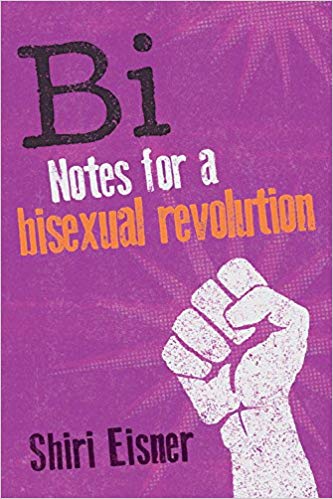
Bi: Notes for a Bisexual Revolution | Shiri Eisner

There is a shelf on the third floor of Central Library in downtown Portland. It contains all of the nonfiction books specifically about bring queer: books about raising your gay teenager, coming out in later life, how to support your partner who is transitioning, and about four books on bisexuality. I have never done anything in my life without reading a book about it first, so I picked out the most relevant of those four books, which was Bi: Notes for a Bisexual Revolution.

It turns out that Bi has everything to do with why there are only four books on that shelf. Shiri Eisner has put together a book that discusses the particular political, economic, and social marginalization experienced by bisexual people—distinguished from the experience of gay, lesbian, and straight people (“monosexuals,” in her terminology). Eisner starts by describing how bisexual can be a radically inclusive term for all sorts of people that experience attraction to more than one gender, then goes through the myths, stereotypes, and stigmas attached to bisexual people. Next, Eisner examines how bisexual identity intersects with sexist and racist axes of oppression, then proposes this vision of a radical bisexuality that inherently destabilizes patriarchy and gender based oppression.

Whew!

There is a lot of material in this book, and because of the jargon-bordering-academic language it uses, the tedious and repetitious disclaimers of privilege, and activist-y eye rolls at global capitalism and the police state, I would say that it’s more of a reference than a book to read front to back. I did appreciate the thoroughness of the work, and I have to admit to a certain bias against radical and activist thinking that sometimes provokes me into greater critical thinking and sometimes makes me churlishly dismissive.

Unfortunately, I was also turned off by some methodological loosey-goosey and an inconsistent analytical lens that made it seem like polemic. For example, a lot of Eisner’s evidence for the argument that bisexuals experience worse health economic etc. outcomes is based on a single set of demographic data. That’s certainly not Eisner’s fault—she argues persuasively that bisexuals are an understudied group of people. But in another part of the book, she points out that because this data set is based on self-reported categories, it dramatically under-represents the group within bisexuals that would have the best outcomes due to other kinds of privilege, namely cis bisexual men.

Whatever gripes I might have with the rigor of some of her evidence, I also have to admit that despite coming in with a lot of skepticism, Eisner ended up convincing me that there is a unique stigma attached to bisexual people, and I came to understand why she considered bisexuals and their relationships as a battlefield of patriarchy and queer liberation.

And yet, I did end up walking away a little disappointed. I was still looking for some idea of what the specific bisexual experience of the world is. My gay identity was built not only from crushes and eyes averted and inconvenient erections and hot shame, but also from books and poetry and movies and narratives and testimony and role models. And a lot of that just isn’t out there for bisexual men—or at least I might have to keep working to find it.

Bi: Notes for a Bisexual Revolution | Shiri Eisner

There is a shelf on the third floor of Central Library in downtown Portland. It contains all of the nonfiction books specifically about bring queer: books about raising your gay teenager, coming out in later life, how to support your partner who is transitioning, and about four books on bisexuality. I have never done anything in my life without reading a book about it first, so I picked out the most relevant of those four books, which was Bi: Notes for a Bisexual Revolution.

It turns out that Bi has everything to do with why there are only four books on that shelf. Shiri Eisner has put together a book that discusses the particular political, economic, and social marginalization experienced by bisexual people—distinguished from the experience of gay, lesbian, and straight people (“monosexuals,” in her terminology). Eisner starts by describing how bisexual can be a radically inclusive term for all sorts of people that experience attraction to more than one gender, then goes through the myths, stereotypes, and stigmas attached to bisexual people. Next, Eisner examines how bisexual identity intersects with sexist and racist axes of oppression, then proposes this vision of a radical bisexuality that inherently destabilizes patriarchy and gender based oppression.

Whew!

There is a lot of material in this book, and because of the jargon-bordering-academic language it uses, the tedious and repetitious disclaimers of privilege, and activist-y eye rolls at global capitalism and the police state, I would say that it’s more of a reference than a book to read front to back. I did appreciate the thoroughness of the work, and I have to admit to a certain bias against radical and activist thinking that sometimes provokes me into greater critical thinking and sometimes makes me churlishly dismissive.

Unfortunately, I was also turned off by some methodological loosey-goosey and an inconsistent analytical lens that made it seem like polemic. For example, a lot of Eisner’s evidence for the argument that bisexuals experience worse health economic etc. outcomes is based on a single set of demographic data. That’s certainly not Eisner’s fault—she argues persuasively that bisexuals are an understudied group of people. But in another part of the book, she points out that because this data set is based on self-reported categories, it dramatically under-represents the group within bisexuals that would have the best outcomes due to other kinds of privilege, namely cis bisexual men.

Whatever gripes I might have with the rigor of some of her evidence, I also have to admit that despite coming in with a lot of skepticism, Eisner ended up convincing me that there is a unique stigma attached to bisexual people, and I came to understand why she considered bisexuals and their relationships as a battlefield of patriarchy and queer liberation.

And yet, I did end up walking away a little disappointed. I was still looking for some idea of what the specific bisexual experience of the world is. My gay identity was built not only from crushes and eyes averted and inconvenient erections and hot shame, but also from books and poetry and movies and narratives and testimony and role models. And a lot of that just isn’t out there for bisexual men—or at least I might have to keep working to find it.