The Open Goldberg Variations project is complete. You can download the recording in various formats free from this website.
Kimiko Ishizaka performing the first variation of the Goldberg Variations.
This project was funded via Kickstarter, and I really like the way that it seems to be opening the door to other projects like this; democratically funded monuments of culture, free to distribute to all.
It’s a beautiful idea.
Please download yourself a copy. I’ll never not believe that the Goldberg Variations are self-evident pieces of genius.
For many, teenagers playing tinny music to each other on public transport on their mobile phones can be intensely irritating. Why do they do it?
With mobile phones in many a teenager’s pocket, the rise of sodcasting – best described as playing music through a phone in public – has created a noisy problem for a lot of commuters.
First, stop using the term “sodcasting.” No matter how many times you repeat it in the article, it’s not going to take. Continuing,
“I don’t think it is intrinsically anti-social, what I would say is that it is a fascinating human phenomenon of marking social territory,” says Dr Harry Witchel, author of You Are What You Hear.
“With young people, usually loud music corresponds very strongly to owning the space.
“They are creating a social environment which is suitable for them and their social peers. But for those not in this group – a 50-year-old woman for example – instead of confidence, she’ll feel weakness and maybe even impotence as there’s nothing that she can do about it.”
I guess there’s some truth in that. The British legal use of the term “anti-social” has always struck me as really creepy, and it’s downright Orwellian in this instance. As with cameras, the best speaker is the one you have on you, and if that means that the only way you can listen to music with your friends is through a shitty phone speaker, that’s what you do. What could be a more social activity than that?
Bruce Haynes creates “new” Bach concertos by arranging cantata movements.
These so-called Brandenburgs are actually instrumentalized groupings of Bach cantata movements. The original idea was Haynes’s, a Bach expert who had already used Bach cantata movements to score a concerto for oboe and harpsichord obbligato in 1982, almost thirty years before starting this new Brandenburg project last year. Tragically, Haynes passed away on May 17, just over a month before the premiere of what will be the last of his projects.
Why would somebody do this, you ask?
Why new instrumental concertos, instead of vocal or solo pieces? Because the small number of chamber pieces by Bach that have survived has always frustrated musicologists and musicians. Bach gave his chamber music to Wilhelm Freidemann Bach, his favourite child. Unfortunately, W.F. was also a drunkard and lost most of the music. Compare this to the cantatas, which were bequeathed to another son, Carl Philipp Emanuel. Those were carefully preserved and indexed. Today, we know of six Brandenburg concertos and a few other Bach concerti. There were probably many more.
It was also a very well known practice in the baroque era to re-score cantatas without singers. “Several composers and writers mention this,” said Napper. She added while laughing, “No singer, no problem!”
No problem! Hahaha. Seriously. Fuck you.
I’m sorry that you love Bach’s music so much that you feel like you need to take those terrible vocal parts out. Oh no, definitely, the music is much better without them. Yes, it’s totally a good idea to rearrange 18th Century music to fit contemporary aesthetics. No, nobody has ever done that before. Okay, some people have tried that before. But we totally respect them for their efforts and play their “improved” arrangements all the time.
Right?
Right?
Sarcasm aside, the point that we probably hold too tightly to Bach’s scores and that he reused and rearranged his music all of the time is a valid and important one. But that’s not where the trail of breadcrumbs ends. The fact is, we know little about Bach’s personal attitude toward his music. We don’t know if he viewed the cantatas as artistic works or only as things he composed for his day job. There are remarkably few Bach compositions that seem to be deliberately intended for posterity or as an artistic demonstrations (these include, off the top of my head, the Mass in B Minor, the Art of the Fugue, and his French and Italian keyboard suites). Almost every aspect of Bach performance includes some speculation or artistic decisions, many based on aesthetic preference alone. Still, sticking to what actually survives on the page seems to me to be a perfectly reasonable line in the sand.
Alfred Brendel playing Schubert’s Piano Sonata in B-flat, D. 960.
Over the past few months, I’ve been going through a little bit of a gloomy period, and I think a big part of the reason why I was feeling melancholic was that I wasn’t playing or making as much music as I had been, and not nearly as much as I’d like. One of my summer resolutions to change that is to start tackling a piano sonata that I’ve really fallen in love with, Schubert’s Piano Sonata in B-flat.
One consequence of not getting into classical music in a serious and studious way until I started college is that there are still large gaps in my knowledge of the canonical works and composers of the past, even as I try and nurture all of my interests in music. One of those gaps is Schubert. Outside of a couple of lied, I really don’t have much exposure to his music (as it turns out, however, my sister (also a pianist) has been working on an Impromptu that she presented in recital a week ago). I was introduced to this piano sonata through a school assignment, and discovered that Schubert’s piano writing calls to me deeply, both as a pianist and as a listener.
I’m not a great pianist. I took some time away from serious keyboard study in high school, which could have been a very productive and fruitful time of study. I have a very strong ear that I have to work to control, and so learning piano and learning to improvise have always gone hand in hand. I’ve also always had a great love for chords; if I had had different teachers or different exposure when I was younger I might have had a lot of fun playing jazz. I don’t want to equate myself and Schubert, but I can imagine that we might mess around at the piano in the same way, albeit at different levels of skill. Schubert’s piano music is almost entirely chords and chord voicings. There are long stretches of the sonata that are composed of nothing but melody embedded in chord voicings and arpeggios.
But how good are those voicings? It goes so far beyond chord inversions, or what the bass note of the chord is. To play his music is to realize that he had control of everything: what the root and bass note of the chord is, how much space needs to be around the melody for it to be heard within the texture, how much repetition can be used without becoming monotonous, how to arrange the intervals within a chord. And he does it with standard chord progressions and very controlled amounts of dissonance.
Schubert presents completely different problems for a pianist than, say, Bach or Beethoven. It’s much easier, in a sense. There’s little to none of the counterpoint that makes Bach difficult, and he doesn’t (in this piece) call for the virtuosic tricks that Beethoven might have wrote. In fact, I’m sure that there are many child prodigies that have the technique to conquer this piece. What they might not have is the hand span to do so. Six- and eight-note chords are common in this piece, and it requires a tremendous amount of control to play them evenly. It’s even harder to play them softly, as Schubert calls for. His practice of embedding the melody in large chords also means that the performer has to switch smoothly and often between wide hand positions, and I can see that this is going to be a big difficulty for me. Another difficult point of classical technique are his smooth, sweeping broken chords. They carry the melody as well, so there’s nowhere for bad technique to hide.
I’m pretty confident in my ability to get this under my belt, and I’m excited to dig into the piece.
Posting has been scarce of late due to my normal post-semester crash. Hopefully my brain will be up and running soon. I plan on tackling Jonathan Franzen’s Freedom and Edward Abbey’s Monkey-Wrench Gang this week. In lieu of in-depth thoughts, here’s a potpourri of impressions:
1. Modernism, Music, and Politics
Krzysztof Penderecki’s Threnody for the Victims of Hiroshima, one of the most powerful, political pieces of modern music. Interestingly, especially in the context of the essays below, the piece was fully composed before the title was added.
Martin Bresnick’s fascinating account of a very special musical exhibition in Prague, 1970 has been going around the classical internet. It’s a remarkable piece of writing, powerful even to those who don’t know the musical names invoked:
On March 6, 1970, at the close of the Second International Free Composers Tribune in Prague, the final composer to be represented at the conference, Luigi Nono, spoke for more than 10 minutes before a large audience of mostly Czech musicians, vigorously criticizing my score for the short film “Pour,” which preceded his presentation. Although the protocol of the tribune permitted each composer only 10 minutes to speak about his or her own music, Nono took those 10 minutes to speak about mine, concluding with a scathing condemnation of my use of vernacular music.
Nono then went on for another 10 minutes about the making of his own work, especially pointing out the theoretically correct choice of the pre-recorded sounds he had employed. He then played a tape of his composition “Non Consumiamo Marx.” When the piece was over there were three people left in the hall at the Janacek Composers’ Club at 3 Besedni Street: Luigi Nono, Mr. Okurka (the technician who operated the tape recorder and sound system) and me.
I won’t spoil the punchline to the piece, save to observe that the goal of infusing music with political meaning is perpetually one of the greatest challenges a composer can undertake. It’s interesting to read Bresnick’s piece as counterpoint to David T. Little’s piece on contemporary music:
Historically, political composers believed that, since politics was going to concern itself with the arts — (as rulers like Hitler and Stalin proved) — art had better concern itself with politics. It was as if this was the artists’ preemptive duty. During the 1930s, the revolutionary tide reached the ivory towers, and composers began to see themselves as standing in solidarity with the worker. “Whether composers know it, admit it or not … they most of them belong to the proletariat,” wrote Charles Seeger in a 1934 essay.
But my reasons, approach and techniques are different, because this historical moment is different. We are no longer amidst a social(ist) revolution in the United States (despite what the Tea Party says) and as such music with a strong ideological or revolutionary message can often feel out of place and out of touch. As a result, political composers are no longer the revolutionaries we once were. Instead, we function as critics.
Perhaps because of my age, the demise of film production only merits a shrug. I would, of course, be very sad if film was altogether unavailable in the future, or if production standards were likewise diminished. But other once popular media, like woodblock printing, lithographs, etchings, are still alive and well and their traditions maintained by artists and craftsmen that love the tradition. I would imagine that the same will hold for film.
What I think is truly gross, however, is the rise of fake vintage camera effects, à la Hipstamatic. They hold all of the false charm and tackiness as stock Photoshop “impressionistic” or “fresco” effects. By appropriating the visual signatures of the past, we further unstick ourselves in time.
3. Musical Public Domain
Marc Parry writes in the Chronicle of Higher Education (behind paywall, sorry) of conductor Lawrence Golan’s David-and-Goliath fight against Big Media’s effort to keep 20th century artworks out of the public domain ad infinitum:
For 10 years, the music professor has been quietly waging a legal campaign to overturn the statute, which makes it impossibly expensive for smaller orchestras to play certain pieces of music.
Now the case is heading to the U.S. Supreme Court. The high-stakes copyright showdown affects far more than sheet music. The outcome will touch a broad swath of academe for years to come, dictating what materials scholars can use in books and courses without jumping through legal hoops. The law Mr. Golan is trying to overturn has also hobbled libraries’ efforts to digitize and share books, films, and music.
The conductor’s fight centers on the concept of the public domain, which scholars depend on for teaching and research. When a work enters the public domain, anyone can quote from it, copy it, share it, or republish it without seeking permission or paying royalties.
The dispute that led to Golan v. Holder dates to 1994, when Congress passed a law that moved vast amounts of material from the public domain back behind the firewall of copyright protection. For conductors like Mr. Golan, that step limited access to canonical 20th-century Russian pieces that had been freely played for years.
“It was a shocking change,” Mr. Golan says over dinner at a tacos-and-margaritas dive near the University of Denver’s mountain-framed campus. “You used to be able to buy Prokofiev, Shostakovich, Stravinsky. All of a sudden, on one day, you couldn’t anymore.”
I think the ethics of copyright are very much up in the air right now (and the ethical issues are much more complicated than both the “rights protect artists” and the “information wants to be free” camps seem to acknowledge) but I think one thing that’s clear is that efforts like these–and big music publisher’s draconian crackdown on live performers–are creating an environment that is toxic for future performers and composers, or at the very least, turning them into rulebreakers.
4. Portland’s New Bud Clark Commons
The great Portland arts blog PORT has a great feature on the design elements incorporated into a new no-income housing/homeless shelter project in Portland’s Pearl District.
I’ve seen some critical posts elsewhere in the blogosphere (I’m not going to dignify them by linking) that have focused on the high-value design and stylish materials to attack the project. As with some other publicly funded services, especially prisons and public housing, any element of comfort seems to be a waste of taxpayer dollars, or “too good” for the target population.
That’s probably just an ugly side of human nature, but it’s always amazing to me how much resistance there is to public projects that are, you know, effective.
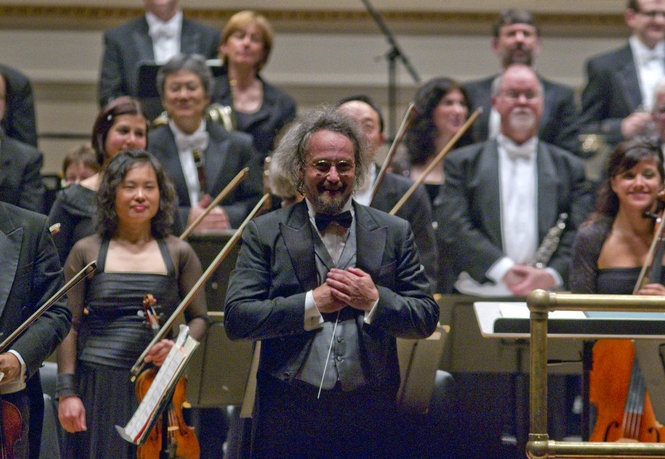
Congratulations to all of the musicians of the Oregon Symphony, who have just finished their very first Carnegie Hall concert. Early word has it that the concert was a great success; Alex Ross tweeted “Triumphant Carnegie debut for the Oregon Symphony — best of Spring for Music so far. Eloquent Sylvan, explosive Vaughan Williams.”


 hammer & jack