The wind rises, we must try to live

I have spent the last week laid low by the extreme air pollution caused by multiple wildfires across northern California, Oregon, and Washington. Physical symptoms include burning eyes, nausea, migranes, nosebleeds, cough, wheeze, and dryness. Emotional symptoms include despair, helplessness, inability to focus, insomnia, and anhedonia. For several days in the middle of the week, the air in Oregon was the worst in the entire world.

The wildfires here are different than in California. Forest fires are a natural part of the life cycle in California, and the large fires we are seeing in the last 20 years are the result of catastrophically bad management. Forest managers and/or the politicians that supervise them decided to cut down the number of managed burns to almost nothing, leading up to a huge amount of fuel in the forests over large areas without managed fire breaks. In Oregon, forest fires happen but are once in a few generation events.

When British colonists arrived here, they found an abundance of large white oak trees, perfect for shipbuilding, which they—true to their nature as disastrous incompetents that ruined every ecosystem they came into contact with—cut down in great numbers. White oaks are hardier against fire than their faster-growing neighbors that they compete with, the Douglas fir. The pre-colonial landscape of Oregon contained a slow dance between the white oak and the Douglas fir: the firs would light-smother young oak trees, building up a dense stand, which would then burn down to the advantage of a lucky white oak that resisted the fire, earning enough light to get established and remain alive for several hundred years. It’s a beautiful dance, one that colonists put a stop to when they logged the white oak to near extinction, then stopped the wildfires, then started clearcutting the remaining monoculture leaving nothing but sterile mountainsides full of decay.

The forest are the land’s lungs, and they are burning.

For my entire lifetime, the forests of Oregon and Washington have been dangerous traps that look like enchanted landscapes. These traps are everywhere, and they are starting to knock into each other and go off: overfished oceans, pumped out aquifers leading to ground collapse, disruption of the water cycle, destruction of the atmosphere, mass extinction of animal species. They are all connected by one phenomenon: the capitalist market system assumes that the earth’s natural resources are infinite.

It’s comforting to think of the market as a circulatory system where money flows through exchanges of value, but if you zoom out far enough it looks like a giant system of roots, and at the tip of every root is someone extracting something out of the earth and not putting it back: mining, harvesting, slaughtering, fishing, felling. For all our talk of progress, there has never been a year since the Industrial Revolution where we have restored more than we have destroyed, planted more than we have harvested, or rested more than we have disrupted. The resources of the earth are not infinite, however, and we are starting to experience that collapse.

It has been difficult to accept that the slow disaster of ecological collapse is going to be the entire story of my lifetime, and nothing that I do professionally, artistically, or socially, will be more important than that story. Teenagers and folks in their early to mid-20’s got there a lot faster than I did. I had a childhood where environmentalism was a niche political issue instead of the loudest story forever, and that has opened a big generational divide between me and those just a little younger than me.

Despite the large challenges of climate change—and the more that I learn about the different policy choices that led to the world being as it is right now and the more that I learn about economics and the more that I learn about our scientific research system, the more truly convinced I am that we have all of the tools and resources, right now, to decarbonize the global economy—the fact that we don’t have a full consensus about the existence and scale of the problem is what makes me despair the most. I wish I could scapegoat uneducated white people as the roadblock, but I’ve seen ignorance about this problem from wealthy, educated white East Coast cousins and working class, high-school educated Southwest cousins both white and latino.

Individual actions are not going to be enough to fix this problem, and I set myself apart from a lot of my anticapitalist liberal friends because I don’t think that nationalizing industry or banning categories of businesses are going to do it either. It can be solved with a combination of aggressive taxes for the wealthy and taxes and regulation for industry and manufacturing that are polluting or have a negative effect on the ecosystem. This idea seems to make older folks nervous, but I don’t see why the status quo isn’t making them more nervous. It may seem like confiscating wealth to highly tax the wealthiest 50 people in the country, but it’s also confiscating wealth to set the conditions for unstable weather events, make property uninsurable, then do nothing as people lose their homes.

Voting isn’t going to be enough. There’s no question that **** has to be dismissed, but the center-left party is too reliant on the status quo to meet this challenge. I’ve used a lot of words to get here, but this is what I want to say: we have reached a tipping point of rolling, painful natural disasters. There is no longer a choice between change and no-change. The choice is between managed change and violent change.

I am a peace loving person, I love growth and building for the future and cycles. I am trying to find acceptance with the fact that those will not be the conditions under which I get to build my life.
Coronavirus Diary No. 3

Los Angeles Times: ‘Batman’ shut down after positive COVID case, reportedly Rob Pattinson. New York Times: Trump Vaccine Chief Casts Doubt on Vaccine by Election Day Fox News: Salon owner denies Pelosi’s ‘setup’ claims, says House Speaker ‘owes the entire country an apology’. Twitter: We Might See A Lot More Coronavirus Pandemics Ahead, Experts Warn.

I feel pretty hopeless right now.

It was muggy and hot this afternoon; Long August has not yet yielded to Wet Autumn. All I wanted to do was to go to a movie theater. Movie theaters are not open, they shouldn’t open, in fact they should stay closed for so long that I’m worried that they will disappear completely. I don’t spend all day thinking about how “coronavirus sucks” but the thought isn’t far from my mind, just like other sucky facts like **** being president or climate change or megafauna going extinct. It’s a train of thought that you can’t even let leave the station because it’s just car after car of awful realities and diffuse loss. I fucked up today, I started thinking about how I usually have so many things to do with the kind of mood I had this afternoon: go to a bar and get a cocktail, visit someone, go get a meal, try and make smalltalk with strangers at a gay bar, go to the mall.

At the beginning of this, during the period I wrote from in March, it looked like this was going to be a trial of individual endurance: how long can I stay in my house, what do I do with all of this time, what new hobbies am I going to pick up, what can I learn, how am I going to connect with people in new ways? I knew our response was going to be poor, but I thought that surely the huge constituencies of people that are taking deep deep wounds from an incompetent response were going to be enough to demand action. Businesses, anything hospitality, the mass unemployed, landlords and renters alike. Instead, every single fracture point in society seems to be crumbling. The injustices that were already worn as collars have become garrotes, tightening with no sign of stopping, cutting into flesh.

I was reading Plato’s Republic yesterday (when I was 20, a cute blond cello playing philosophy major named Paul told me that I would enjoy reading Artur Schopenhauer’s The World as Will and Representation and I’m still working my way through the necessary background reading to learn whether he was right. He was drunk, and it was almost certainly the last book he had read and didn’t have anything to do with me in particular, but 10 years later I still want to know whether he was flirting with me or not.) and was struck by this observation, given by Socrates and directed towards the city—mirroring Socrate’s ideal model city—which has paid for greater wealth and a more complex development with inequality, injustice, and the presence of corruption:

We will have to find agreater” title for the other because each of them is a great many cities, but not a city, as they say in the game. They contain two, at any rate, which are at war with one another: the city of the poor and that of the rich. And within each of these, there are a great many more. So if you treat them as one city, you will be making a big mistake… As long as your own city is [just and soundly governed], it will be the greatest one—not in reputation; I do not mean that; but the greatest in fact…

There’s so much captured here: the way that inequality and corruption go hand in hand, the way that displays of wealth and high levels of civic development often do too. There has always been a poor America, a rich America, a black America, a white America, a men’s America, a women’s America. Languages, countries of origin, who we love and how we worship. None of these divisions are new. What feels new right now is that it feels like we are all breaking down to the level of the pod. I feel constant anxiety about how many people are in my bubble. It makes me question my own values and good judgement. When I take down the barrier of the mask with someone new, I question their values and good judgement too, and this includes roommates and good friends and family and lovers alike. Don’t get me started on other people—everyone else gets my least compassion, my highest suspicion.

I have some ways that I am required to be in the world, and some ways that I choose to be in the world. Whether or not I engage with the outside world, events are taking place in it without me. If I choose to withdraw more, I become more dependent on people whose inability to make that choice is being exploited: retail and food workers, delivery drivers, service providers, healthcare professionals. We’re all suspicious of each other, we’re all unhappy that our way of life has been tremendously disrupted at best and obliterated at worst. I feel that friction all day, I don’t have very many opportunities to recover and rest from that friction, and I don’t have very much hope that the status quo will change for many months at the earliest, and years at worst.

One of the most shocking changes in real politics that has happened in my lifetime, the stuff underneath the bloated two party scrum, is the change in national mood between the open, assimilationist, culturally dominant, modern attitude of the United States towards the world (sometimes and somewhat reciprocated) and the closed, fearful, decaying attitude we all carry now. It’s been one of the most consistent social trendlines in my lifetime, connecting the end of “Made in USA” products at Wal-Mart to 9/11 to the shoe thrown at George W. Bush to ICE detention centers now and hundreds of thousands of corpses filled with Sackler family pharmecuticles.

(There’s a lot of erasure in this narrative. Throughout this period there have been people who have seen the ugly side, who did not participate in the civic religion. There was a girl I went to in high school who did her senior project on the Zapatistas and I sometimes think about her, and her vision of the world in relation to myself at my age. I didn’t know shit about this country or this world and when I’m honest with myself I admit that I don’t know shit about the future or what’s possible.)

One of my favorite pieces of media to revisit during the **** presidency has been Louis Malle’s 1986 documentary …And The Pursuit of Happiness (currently only available to watch through the Criterion Channel service). This documentary interviews many first generation immigrants, from a very diverse set of countries of origin and across the United States. One thing that pulses through the documentary like a pulse is the visible enthusiasm, excitement, that the interviewees have for the process of adapting to a new place.

There’s not much of that to be found right now. It’s like we’ve all woken up to the fact that we’re in a burning building, and nobody wants to evacuate without knowing who is going to be in control of who gets to come back in. It’s going to get worse before it gets better, but there’s no guarantee that it gets better.

Coronavirus Diaries No. 2

Twitter: “IOC considers postponing 2020 Tokyo Olympics.” Fox News: “Aid talks at standstill as McConnell, Dems argue over sticking points in stalled spending bill.” New York Times: “Partisan divide threatens deal on rescue bill.” Oregonian: “Veteran with coronavirus dies a Lebanon nursing home, bringing Oregon death toll to 5.”]

The Wedding

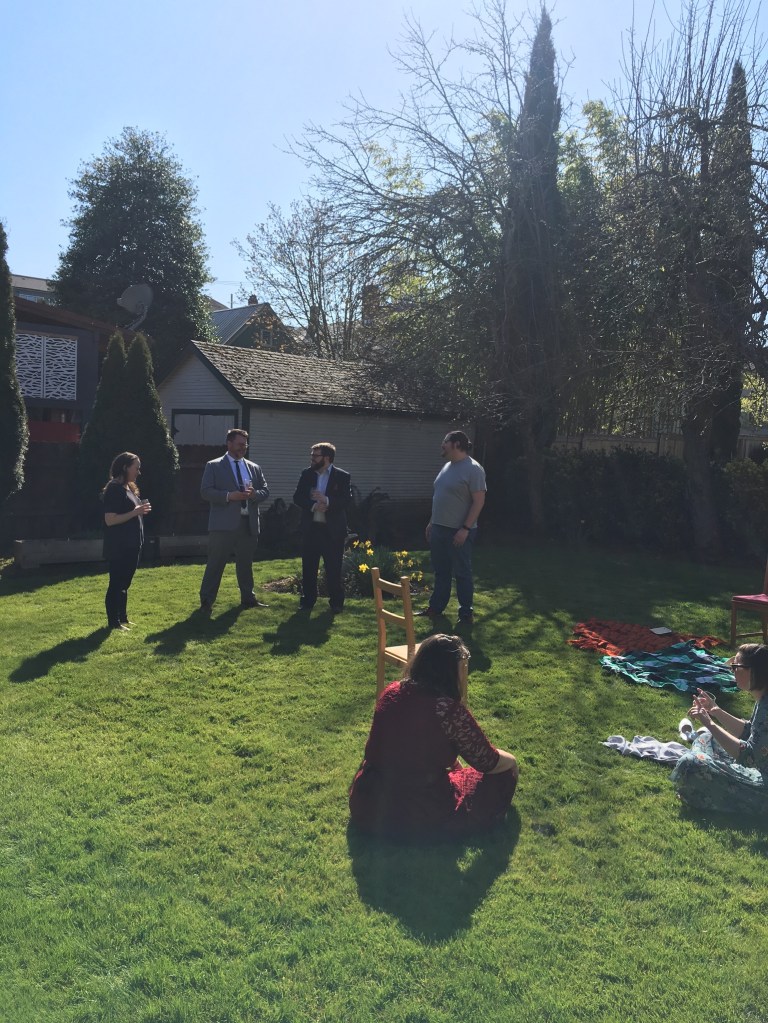
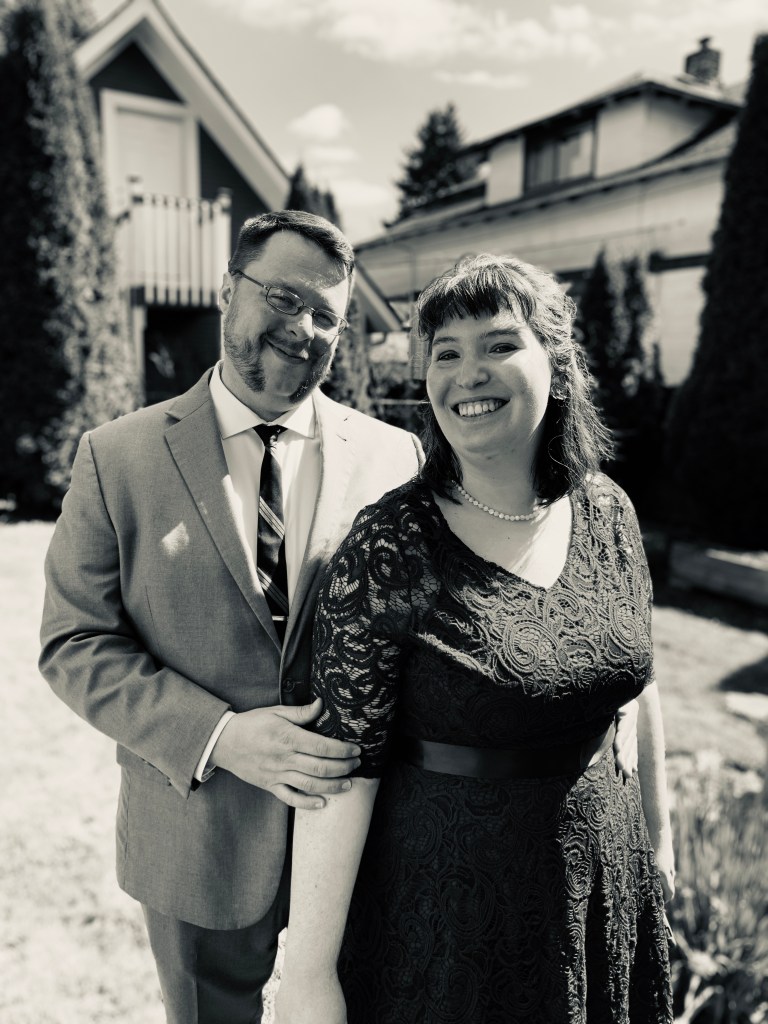
Yesterday, two of my best friends got married to each other. Congratulations, Nick and Celia! It was a totally lovely wedding: seven people present, in plain fresh air on a totally gorgeous day, as beautiful a day as you could dream of in Oregon in March. The grass was grass-green, the sky was sky-blue, and the cherry blossoms were white as wedding dresses.

I love ritual and ceremony. They allow us—“us” being a flexible unit that scales as large as the group observing the ritual or ceremony—to express ourselves through theme-and-variation. Theme-and-variation is one of the basest building blocks of artistic creation, and it exists in every art form. Weddings are a ceremony that have certain very popular elements: a couple, an officiant, vows, rings, a kiss, a party. Every couple decides what to incorporate into their ceremony and what form they take.

For this couple, perfect simplicity: a 10-minute ceremony, photos taken on a cell phone, a handmade cake, a dress ordered online. Each element chosen carefully, but lightly, with no comparison to anything outside its own rightness. Vows written sincerely, spoken in clear strong voice. One witness to laugh, one witness to cry. May you have such authorship and freedom from interference for all of your time together.

Postscript

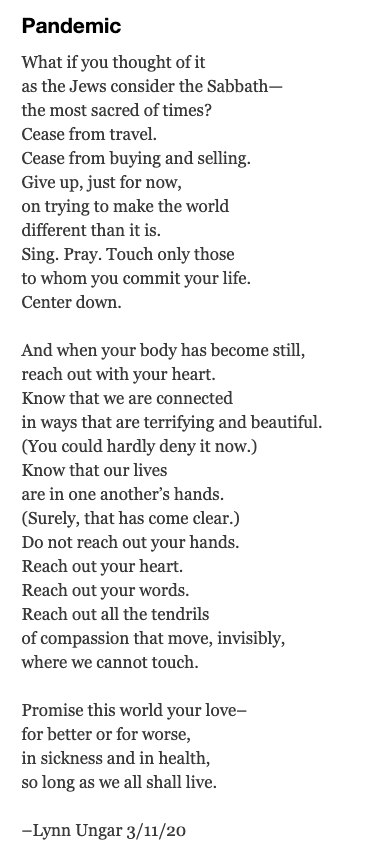
I love the poet’s ability to say things so much more clearly and stylishly than I can. Here’s a poem from Lynn Ungar that captures a lot of what I was trying to say in the last one of these, but much better:

How are you doing? What is keeping your spirits up? If you’ve read this far, please leave a comment.

Coronavirus Diaries No. 1

I have been working from home for the last week and cutting down on socializing (due to an unrelated cold and asthma flare up) for a couple weeks. I have a million ideas of how to use my time, but the unstructured openness of the day makes it hard to focus on any one thing. Working from home feels like neither working nor being home

I’m trying to manage my worry. Entire industries are collapsing, and there is a tsunami of unemployment claims coming. The west coast might be ahead of the country on these measures, but viruses don’t respect state borders and every state that delays responding is going to be hit harder by it in 2-3 weeks. I think it’s possible that we will witness Great Depression-level destruction of the economy.

Oregon has been a half step behind California and Washington in covid cases and public health response, but this week is when the anticipation has become visible. Restaurants and bars have shut down (a big deal here—between coffee, beer, and cocktails it feels like 2/3 of the Portland economy involves pouring liquids). I live on a busy street that usually has two hours of rush hour traffic in the evenings, and it’s been empty.  I have a job, for now, but arts organizations are very vulnerable to recession. My office has felt tense since it became clear that we would need to cancel almost half of our concert season.

I’m doing my best to keep functioning. I make breakfast in the morning. In the absence of free office coffee, I bought beans for the first time in several months and brought my beloved tiny, one-and-a-quarter-mug French press out of storage. In the middle of the day, when I’m feeling bored and antsy after being in my computer chair for too long, I use a jump rope I bought on an impulse. I play video games, I read, I write, I play music. Yesterday I got a tremendous gift from a friend who let me take a long soaking bath in his oversize tub.

I’m not trying to say that everything is so cozy! or wow, isn’t this quarantine kind of like a staycation! I am deeply unsettled right now. When the part of my brain that wants to find the bright side of everything starts to speak up, I have to remind it that we haven’t seen the worst yet, we are still living through the very beginning of this story. What I’m thinking about is how we are navigating a perfect natural experiment in the practice of self-care cut off from the commercial appropriation of the idea.

The writer Tara Brach has a concept she calls “the trance of unworthiness”—a default state of busyness, distraction, dissatisfaction, disassociation, and self-loathing* that defines much of our time, if we let it. Although time goes by quickly without intention, it’s the opposite of a creative flow state. It’s the emotional induced by a society oriented towards trade and; we yield to jobs and technologies that take our time and attention, we work hard for rewards that do not make us feel better or contribute to our growth, and we blame ourselves and the people around us for the eternal discomforts that go along with being alive.

*what are their antonyms? Steadiness, focus, satisfaction, being present, and self-love—­what a great list of virtues to cultivate!

It is not worth the cost that many people are going to pay, but in this brief moment, it seems like the trance is not working. Every daily action, from going to the grocery store to texting your parents to going to work is invested with meaning, danger, and a true understanding of its value to our lives.

Self-care has become a cliché because it has been so successfully coopted by advertising. At the root of the concept is political and economic resistance, though. If the world around you is trying to destroy or oppress you, every act of care that you give to yourself is an act of resistance. It turns out that that’s a big “if” though—big enough to drive an advertising campaign through. Our culture teaches us its most important lesson from a very young age: spending money makes you happy. It establishes a lifelong relationship of cause and effect: when I’m feeling bad, I spend money, then I feel better. Once that lesson and relationship are established, all every company from soap to soda-pop has to do is pull that lever.

But look at where we are! It feels like the world is trying to destroy us. We are being called upon to do something difficult and counter-cultural: stay home, stop spending money, stop socializing in person, be with yourself. We have suspended one of the most powerful parts of our economy: paying other people to distract us from ourselves and make us feel better.

When we develop an understanding of how we can meet our own needs, that relationship to the self is so strong that no commercial interest can exploit it. Feeling good in our own bodies, feeling fulfilled by our work, feeling connected to our relationships, these are all so particular to our individual selves that no product can perfectly fill that need. The satisfaction and strength that we feel when we fill our own needs have so much integrity that we can’t be lured into dissatisfaction.

I think that we are at the beginning of a very difficult few months or years. There is a lot of death coming. We will need to adapt to the need for extended distancing until effective vaccines or medical treatments come into use. There is a possibility that our political institutions are too broken to meet this moment, and if that is the case we may be in for an extended economic depression. Finding ways to meet our own needs and the needs of our close kin and friend communities is going to be a survival skill.

I want to hear about what needs you are discovering and what ways you are discovering to fill them. I’m OK, and I hope that you are OK too.