I almost impulse bought a piano


I don’t have any money. I don’t have any room for it. I have easy access to pianos elsewhere. But I almost bought a piano a couple of days ago.

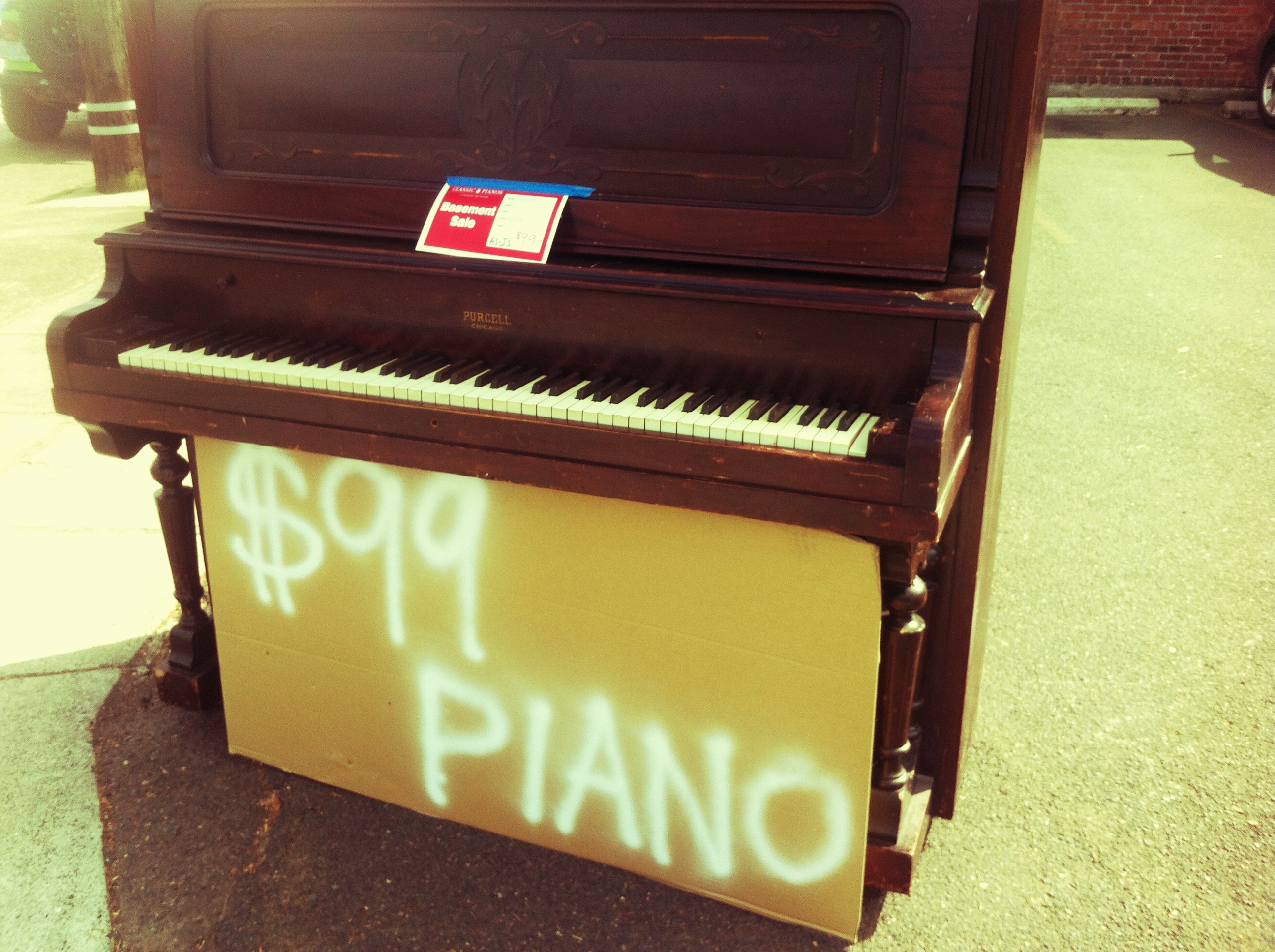
Classic Pianos, on Milwaukie and Powell here in Portland, has been having a basement sale to clear out inventory. As I was riding a bus into Downtown, that sign above, $99 piano, caught my eye. I don’t care what the piano sounds like, or how it’s been taken care of. If it plays and is capable of holding tune, 99 dollars is a ludicrously low price for a piano. I had an appointment with my therapist, but the whole time I was in session, a small part of my brain was arguing: “Dude, you have no money.” “Yeah, but, come on, I have $99. And you’re never going to see that price again.” “But you’re starting school next week, you’re going to need money.” “But it’s a piano.”

By the time the appointment was over, common sense had returned. It’s a hundred dollars, but that’s not the only cost associated with owning a piano. Plus, there was no was I was going to get my roommates to go for it. I decided that there was no way that it was going to happen, and I should head home after the appointment.

When my bus stopped at Milwaukie and Powell, there was a person in a wheelchair getting off, so we were stopped a little longer than usual. And in that brief extra time, my heart really wanted to touch the piano on the street, and my brain gave its OK. There was an upright, the one in the picture, as well as a charming spinet. The spinet was more in tune, as well as having a clearer tone, but as soon as I went over to check to make sure all the keys were working, a salesman came outside and invited me to check out the showroom and the basement pianos.

I walked into the store, and was immediately assaulted by the memories of wild pianos I have known. There was a black Bösendorfer, the same size as the one in the Reed College practice rooms. A gaudy white Yamaha baby grand that my 11 year old self would have drooled over. A classic shiny black upright, the piano that I always imagined I would have in my sophisticated apartment, or cloistered away in my home studio. A blonde parlor grand, like that owned by my music teacher. When I went downstairs to the basement, I was even able to find a couple of Baldwin Acrosonic spinets, like the one in my childhood home, though none of them was exactly the same model. Good thing, too. I might have lost it.

I was overtaken with some mixture of happiness, sadness, and a kind of deep excitement. Part of it was the nostalgia of recognizing the different pianos that I’ve formed an attachement to. Part of it was the simple regret that I don’t have a spare $3,000 or $5,000 to throw around right now to do it right. But the best part was a little of the childlike enthusiasm that used to be inseparable from the experience of playing and listening to music for me.

Once I had decided that I really wasn’t in a place to buy a piano, I just spent some time playing. I sat down at a beautiful Yamaha grand, and launched into my memorized five or six minutes of the Schubert Piano Sonata in B-flat Major, D.960. I haven’t made the progress with it that I’ve wanted, but for that amount of time, I can fake some level of virtuosity. There was a feeling of security and confidence that came to me, that this world is not a mystery, that these are things that I know, that this arrangement of black and white levers is neither foreign nor mysterious nor intimidating. These are my tools.

That was such a rush. That feeling of play and excitement often feels like something I misplaced. And retracing my steps these last couple of years can feel like being an amnesiac recovering lost memory. It’s frustrating, because at this point in my life, time feels like this ever accelerating force, like the frontiers of an expanding universe, but unless I have that sense of play, I will always be fighting myself musically. It was good to sit down in that room and play. It reassured me that, you know what, I’ve been doing this a while. I’m not the best, but I know some things. And I can do even better, even greater, if I get out of my own way.


Losing Touch With The Young Folk

I was pretty gobsmacked by this story out of Portland, Maine*:

Over the next two weeks, Portland’s school district will install filtering software on laptops issued to high school students, in order to block access to pornography, social networking sites and video streaming sites when the laptops are at home.

Access to those sites is blocked now only at school, through the school network. The current filter doesn’t work when laptops are off school property.

The district will install filtering software made by Sophos, an Internet security company based in Boston. The software will be downloaded automatically when the students boot up their computers at school. Only when students get home will they discover that their lives have changed in a big way.

No longer will they have access to social networking sites like Facebook and video-streaming sites like Hulu and YouTube. Also blocked will be forums and news groups, games, dating sites, gambling sites and chat rooms.

Fortunately, the Kennebec Journal didn’t shy from the implications of this decision:

[School board Chairwoman Kate] Snyder said the school district shouldn’t give students equipment that makes it harder for parents to do their job, which is to help children stay focused on academics. She said the district has the right to filter the Internet.

“It’s a school-issued laptop,” she said. “If that’s something that the student wants to do on their own time and on a family computer, that’s OK.”

The change’s impact on students will depend on whether they have access to other computers at home. For many poor families, the school-issued laptop is the only computer in the house.

In interviews with Portland High students last week, those from middle-class families expressed various degrees of annoyance when told of the new filtering measures. A group of immigrant students reacted with anger.

“When we are at home, we need to have something else to look at besides homework,” said Fatush Jama, a senior.

“Where can we go to share if we don’t have Facebook?” asked Nateho Ahmen, a 17-year-old junior. “Who came up with this idea? We are going to have a long talk.”

This is not a legal question. Of course the school district has every right to install whatever software it wants on the computers it owns. But it’s hard for me to see this decision as anything but smallminded and passive aggressive.

First of all, I think it’s pretty uncontroversial to state that internet filters are nothing but odious joy killing vectors of hate. We’ve all had that experience of being interrupted at school, or at work in our quest for the answer to a question by an overzealous filter. Using the internet behind a filter is like browsing with a doddering uncle on your shoulder. He’s not entirely sure what’s going on, but he’s pretty sure that he disapproves. Not being able to leave him behind at the end of the school day sounds hellish.

Second, I think it’s pretty galling that a small group of parents pushed this through and made parenting decisions for the entire school district (that’s conjecture–there’s nothing mentioned about it in the article–but given that the school board member was the one dishing out the quote about giving control to parents, I think it’s pretty solid). I’m pretty sure the low income parents that use the computer as part time family computer are not the ones complaining. Sure, it’s primarily intended as a tool for school, but giving computer access to these families is a pretty valuable secondary social function. There’s something frankly ugly about denying access to families that don’t have other options.

But third, and most important, this decision shows a real failure of empathy on the part of the parent groups for the students they are responsible. Becoming out of touch with the culture is somthing I’ve been thinking about a lot, as I’ve reconsidered my relationship to pop culture and what’s popular. As I grow older, and my tastes more specialized, I’ve had to think about what responsibility I have to keep up with the culture at large. Another mental milestone passed by when I was reading a review for the new YA novel Fear, by Michael Grant, which posits a world in which everyone over the age of 15 mysteriously vanishes, and I realized that I had joined the masses of the dead. They told me to never trust anybody over the age of 25, and now that doesn’t seem very far away at all.  

But being out of touch with the chatter of the world happens, and I don’t really worry about it. There’s so much much in the world, and I don’t think anybody cares that much when a sheep drops out of the herd. What I really worry about is this exact kind of losing touch, where new technologies, new ideas, new social dynamics cut you off from your own experiences and your own former selves. Empathy is a plastic thing; I’ve met people in high school that will never be able to see themselves in people that did not grow up like them, and I’ve met older people that have stayed young, despite growing up in a world that may not exist anymore. Facebook is a new thing. But wanting to talk to your friends, gossiping about your enemies, developing a personality apart from your parents, even avoiding homework, these are very old things. And the smallmindedness of banning Facebook from school computers is the same smallmindedness of banning conversation during lunch, or restricting recess.

And we’ll all become old things too, whether that means over 15, or over 25, or over 55; age is a moving target. The boundaries of us and them will change whether we listen to top 40 or read the news or go to the movies. But we can resist forgetting what it means to be young.

*Which is, as regional allegiances require me to point out, the worst Portland.

Web Roundup

Posting has been scarce of late due to my normal post-semester crash. Hopefully my brain will be up and running soon. I plan on tackling Jonathan Franzen’s Freedom and Edward Abbey’s Monkey-Wrench Gang this week. In lieu of in-depth thoughts, here’s a potpourri of impressions:

1. Modernism, Music, and Politics

Krzysztof Penderecki’s Threnody for the Victims of Hiroshima, one of the most powerful, political pieces of modern music. Interestingly, especially in the context of the essays below, the piece was fully composed before the title was added.

Martin Bresnick’s fascinating account of a very special musical exhibition in Prague, 1970 has been going around the classical internet. It’s a remarkable piece of writing, powerful even to those who don’t know the musical names invoked:

On March 6, 1970, at the close of the Second International Free Composers Tribune in Prague, the final composer to be represented at the conference, Luigi Nono, spoke for more than 10 minutes before a large audience of mostly Czech musicians, vigorously criticizing my score for the short film “Pour,” which preceded his presentation.  Although the protocol of the tribune permitted each composer only 10 minutes to speak about his or her own music, Nono took those 10 minutes to speak about mine, concluding with a scathing condemnation of my use of vernacular music.

Nono then went on for another 10 minutes about the making of his own work, especially pointing out the theoretically correct choice of the pre-recorded sounds he had employed. He then played a tape of his composition “Non Consumiamo Marx.” When the piece was over there were three people left in the hall at the Janacek Composers’ Club at 3 Besedni Street: Luigi Nono, Mr. Okurka (the technician who operated the tape recorder and sound system) and me.

I won’t spoil the punchline to the piece, save to observe that the goal of infusing music with political meaning is perpetually one of the greatest challenges a composer can undertake. It’s interesting to read Bresnick’s piece as counterpoint to David T. Little’s piece on contemporary music:

Historically, political composers believed that, since politics was going to concern itself with the arts — (as rulers like Hitler and Stalin proved) — art had better concern itself with politics. It was as if this was the artists’ preemptive duty.  During the 1930s, the revolutionary tide reached the ivory towers, and composers began to see themselves as standing in solidarity with the worker. “Whether composers know it, admit it or not … they most of them belong to the proletariat,” wrote Charles Seeger in a 1934 essay.

But my reasons, approach and techniques are different, because this historical moment is different.  We are no longer amidst a social(ist) revolution in the United States (despite what the Tea Party says) and as such music with a strong ideological or revolutionary message can often feel out of place and out of touch.  As a result, political composers are no longer the revolutionaries we once were.  Instead, we function as critics.

For that matter, the entirety of the New York Times column “The Score”–from which these pieces are taken–is great.

2. The End of Film?

Roger Ebert reprints Ben Dobbins’ article on the dwindling production of film.

Perhaps because of my age, the demise of film production only merits a shrug. I would, of course, be very sad if film was altogether unavailable in the future, or if production standards were likewise diminished. But other once popular media, like woodblock printing, lithographs, etchings, are still alive and well and their traditions maintained by artists and craftsmen that love the tradition. I would imagine that the same will hold for film.

What I think is truly gross, however, is the rise of fake vintage camera effects, à la Hipstamatic. They hold all of the false charm and tackiness as stock Photoshop “impressionistic” or “fresco” effects. By appropriating the visual signatures of the past, we further unstick ourselves in time.

3. Musical Public Domain

Marc Parry writes in the Chronicle of Higher Education (behind paywall, sorry) of conductor Lawrence Golan’s David-and-Goliath fight against Big Media’s effort to keep 20th century artworks out of the public domain ad infinitum:

For 10 years, the music professor has been quietly waging a legal campaign to overturn the statute, which makes it impossibly expensive for smaller orchestras to play certain pieces of music.

Now the case is heading to the U.S. Supreme Court. The high-stakes copyright showdown affects far more than sheet music. The outcome will touch a broad swath of academe for years to come, dictating what materials scholars can use in books and courses without jumping through legal hoops. The law Mr. Golan is trying to overturn has also hobbled libraries’ efforts to digitize and share books, films, and music.

The conductor’s fight centers on the concept of the public domain, which scholars depend on for teaching and research. When a work enters the public domain, anyone can quote from it, copy it, share it, or republish it without seeking permission or paying royalties.

The dispute that led to Golan v. Holder dates to 1994, when Congress passed a law that moved vast amounts of material from the public domain back behind the firewall of copyright protection. For conductors like Mr. Golan, that step limited access to canonical 20th-century Russian pieces that had been freely played for years.

“It was a shocking change,” Mr. Golan says over dinner at a tacos-and-margaritas dive near the University of Denver’s mountain-framed campus. “You used to be able to buy Prokofiev, Shostakovich, Stravinsky. All of a sudden, on one day, you couldn’t anymore.”

I think the ethics of copyright are very much up in the air right now (and the ethical issues are much more complicated than both the “rights protect artists” and the “information wants to be free” camps seem to acknowledge) but I think one thing that’s clear is that efforts like these–and big music publisher’s draconian crackdown on live performers–are creating an environment that is toxic for future performers and composers, or at the very least, turning them into rulebreakers.

4. Portland’s New Bud Clark Commons

The great Portland arts blog PORT has a great feature on the design elements incorporated into a new no-income housing/homeless shelter project in Portland’s Pearl District.

I’ve seen some critical posts elsewhere in the blogosphere (I’m not going to dignify them by linking) that have focused on the high-value design and stylish materials to attack the project. As with some other publicly funded services, especially prisons and public housing, any element of comfort seems to be a waste of taxpayer dollars, or “too good” for the target population.

That’s probably just an ugly side of human nature, but it’s always amazing to me how much resistance there is to public projects that are, you know, effective.


Oregon Represent

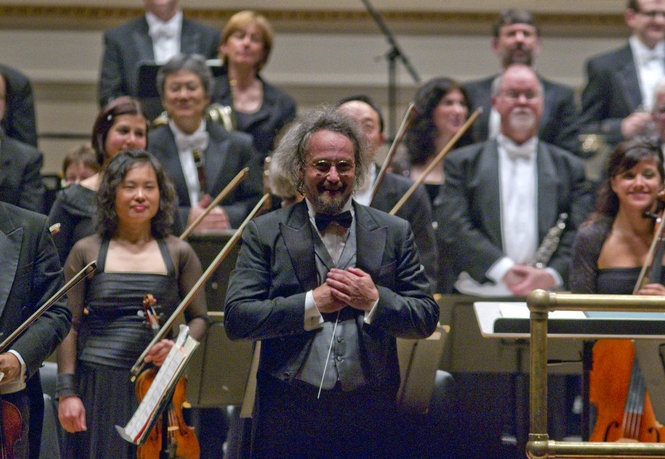
Congratulations to all of the musicians of the Oregon Symphony, who have just finished their very first Carnegie Hall concert. Early word has it that the concert was a great success; Alex Ross tweeted “Triumphant Carnegie debut for the Oregon Symphony — best of Spring for Music so far. Eloquent Sylvan, explosive Vaughan Williams.”

David Stabler of The Oregonian has been covering the tour in exhaustive detail: preview of the concert program, departure of orchestra personnel and instruments, arrival in New York, first rehearsal on the Carnegie stage, pre-concert thoughts from music director Carlos Kalmar, concert post-mortem.

Violist Charles Noble writes about what it’s like to rehearse at Carnegie at his blog, NobleViola.

Audio of the concert will be available through NPR after 9pm PST on Thursday.

Olivier Messiaen

Alex Ross has a new post about the centennial of Olivier Messiaen. I had the privelage of seeing pianist Jeff Payne perform Messiaen’s masterpiece, Vingt regards sur l’enfant-Jésus in a (I’m told) rare complete performance.

I found the experience completely disorienting. I found the lack of melody hard to deal with, and reminded me of what a terrible Philistine I am. I also had a huge moment of low self esteem when I was talking over the concert the day after with a friend of mine. He had heard and played many of Messiaen’s organ works, and heard much more harmonically in the piece than I did.

It has become another one of my Moby Dicks… there will be one day when I will hear more than a dense swirling of disjoined chords in that work.