After stalling out halfway through, I finished the second season of The Bear last week. Aside from some bright moments, I was disappointed. The first season caught a zeitgeist. I don’t think that the creative team found a way to develop the story elements that made the first season so fresh.
I loved that the first season was not about fine dining. It made room to explore more working class characters and settings. The Original Beef of Chicagoland was a restaurant out of Diners, Drive-Ins and Dives, not Chef’s Table. The visual language of Carmy’s fine dining flashbacks (the crisp white linens, flatware at perfect angles, chef’s brigade of intense young men) comes from fine dining documentaries. It’s supposed to be a contrast to the earthy, low-margin, traditional, welcoming environment of the Original Beef. Part of the democratic ethos of the show was the idea that there is a way to find excellence here, too. It’s disappointing to slip back to fine dining and it’s attendant connection to wealth and class.
That promise and disappointment are found in secondary characters as well. Like Orange is the New Black and Lost, the first season was an ensemble show. It had generosity and attention for secondary characters. Anyone could anchor an episode. The focus is slowly shifting to a smaller number of main characters. You cannot ignore the racial aspect of this dynamic. Ebraheim, Tina, and Marcus are being left behind to give more time and story to Carmy and Richie. In the final episode of the season there’s a throwaway line that Ebraheim will be serving the old menu out of the back of the restaurant. As if you could fit the whole world of the first season through a Quikserv window.
This is all connected. In the first season, Tina and Ebraheim knew the business of the Original Beef better than Carmy did. He knew the business of fine dining, but he didn’t know this business. That balanced the story and made an interesting power dynamic. While it’s great that the Original Beef crew gets new training, their expertise is no longer needed. Carmy was always able to tap out and go back to fine dining. In the first season, we’re always wondering why he doesn’t. He doesn’t seem to know why. In the second season, that source of tension is gone. Cliched beats about whether he can commit to a relationship don’t reheat well.
It wasn’t all bad. There’s so much talent on this show. Jeremy Allen White, Ayo Edebiri, Ebon Moss-Bacharach and Oliver Platt are so much fun to watch. Richie and Marcus get solo episodes that are fantastic. “Forks” was my favorite episode the show has ever done, and what a magnificent cameo by Olivia Colman. I didn’t like “Fishes” very much, but Jon Bernthal and Bob Odenkirk butting heads at the dinner table was electric.
Veneno is a bio-drama miniseries from Spain about La Veneno—a trans hooker who was “discovered” by a TV tabloid show in the mid 1990’s and who became a hypersexualized, circus figure on talk shows. For a younger generation of trans women, she was a representational icon at a time where there was no room for anything but ridicule for them in Spanish society. Veneno dramatizes both La Veneno’s life, and the coming out and transition of a young teen fan that idolizes her and with whom La Veneno publishes a memoir, bringing her back to media attention in the weeks before her untimely and mysterious death.
Marcos Sotkovszki as a young Veneno in Veneno on HBO Max
Veneno takes several strains of queer TV/film aesthetics and turns up the volume and executes them very well. Operatic set pieces, bright and postmodern set designs and surreal storytelling devices from gay auteurs like Russel T. Davies, Pedro Almodóvar, and Ryan Murphy mark emotionally important moments in Veneno’s life. There is a commitment to queer actors playing queer parts and incorporating members of the communities depicted on screen, as in queer shows like Vida and Work in Progress. There’s some exploration of how queerness moves around in families across generations from Transparent, and the beautiful rush and heartbreaking pain that comes with depicting mental illness from close up and on the inside from Eurphoria and I May Destroy You. These are my points of reference, all excellent.
Isabel Torres as La Veneno and Paca la Piraña as herself in Veneno on HBO Max
Veneno is often beautiful—you can see the set design budget stretched when sets are reused one too many times, but everyone looks great—and there are several moments where costuming choices took my breath away, like when we first see teenage Veneno’s outfit to wear to a village festival. The writing is strong too, although there’s only so much I can say about that given that I am watching in a subtitled translation. Some emotional notes are hit a little too often for me, particularly in montages of the young trans writer, Valeria, gazing adoringly at Veneno, but any bum notes are saved by the incredible talent on screen. Highlights in the cast include Marcos Sotkovszki, Jedet, and Isabel Torres, who all play La Veneno at different ages, Paca la Piraña, Veneno’s longest friend and appearing as herself, Lola Rodriguez playing Veneno’s young disciple Valeria, and Lola Dueñas who plays the amoral TV producer that first finds La Veneno.
Lola Rodríguez as Valeria, Isabel Torres as La Veneno, and Paca la Piraña as herself in Veneno on HBO Max
Veneno was a charismatic monster to Spanish TV audiences in the 90’s, and she’s a bit of one now. Her understanding of queerness and sexuality, her love of commoditizing and sharing her body, her hunger to be objectified, these are all uncomfortable traits for queer heroes as we round into 2021. We are not supposed to so nakedly hang our self esteem on how we are desired by men. It has taken a whole apparatus of corporate gay organizations to send the message that being queer is not synonymous with risky sex, sex for money, sexual violence, mental illness and drug addiction, but these were all important parts of La Veneno’s story. At the end of her life, all of her friends that loved her wished that she had a different life. We get a sense of the arc of her whole life, how she hungered for safety and love in every chapter of her life. She didn’t often get it, and we have a chance to give her some of that love in death. She made for great television, and it appears that she still does, and we as viewers have to sit with that knowledge too.
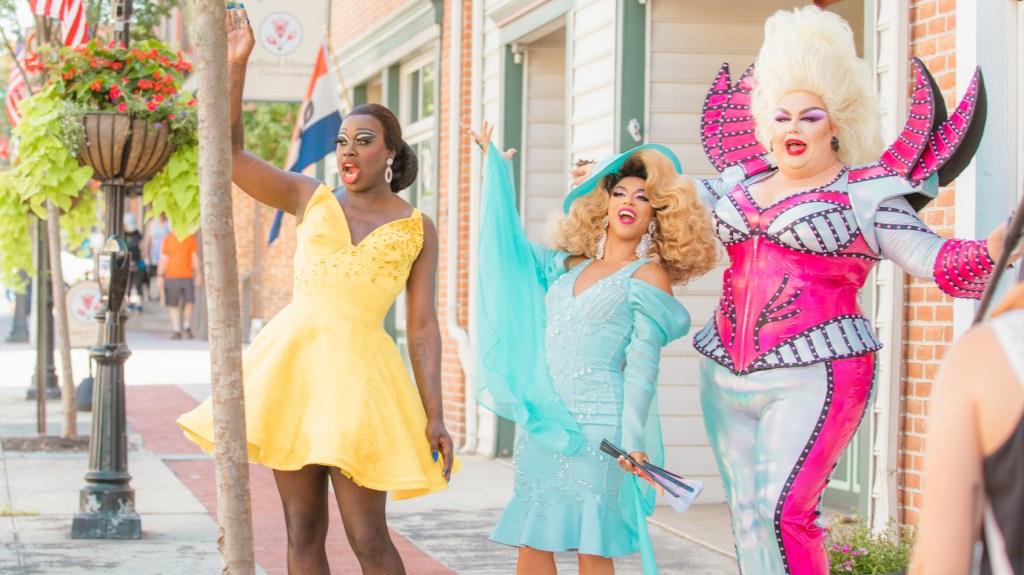
We’re Here [HBO]. Three drag queens not named RuPaul take a Priscilla/Too Wong Foo tour through small towns across America to stage drag shows and use their power to validate and heal local queer scenes.
I loved gay culture, like so many of us did, before I loved my gay self. I loved the sense of humor and the aesthetic and the love for the forgotten and the neglected. I learned to love myself eventually, and only now am I truly understanding what it means to love and to gather close to the most defiant and challenging of us: the sissies and the faggots, the bullied and abused.
There’s so much power in the experience of learning to love yourself. That’s something that Queer Eye taps into so deeply. The danger in Queer Eye is that it muddies the line between who you are and what you buy (although much much less than its original incarnation) and also in the sheer amount of space it occupies in queer representation. Some queer people, especially young people discovering themselves, may not have more access to queer adults than their Netflix account, and I worry that the aspirational devotion the show has towards its stars makes their confidence seem unattainable to younger queers.
I considered ditching We’re Here a few minutes into its first episode. I though its hosts, Shangela, Eureka, and Bob the Drag Queen, were doing a tired and derivative imitation of Queer Eye. I’m so glad that I gave the show a second chance, because once I figured out what it was doing it totally won me over.
The show has more or less a fixed format. Bob, Shangela, and Eureka roll into a small town (ranging from about 10k people to about 50k, from Pennsylvania to New Mexico). They explore downtown shops, locals don’t know what to make of them. They pick three locals to collaborate with to put on a free drag show: one is always a straight, cis guy. Another is a queer person who is trying with all of their might to be themself despite adverse conditions, like a wildflower in a thunderstorm. The third is a little loose, but the thread that connects them is that they are people who have chosen to stay in their home communities despite deep wounds, and who are in need of a little healing through community.
Bob the Drag Queen, Shangela and Eureka O’Hara/HBO’s We’re Here.
There is a little bit of “once in a lifetime experience”/“transformation” language—that’s what turned me off in the beginning—but the show is pretty straightforward about the fact that when the drag queens leave town, regular life will resume. “Your life is not going to change in one week” Shangela bluntly tells a young gay Latino man, José, in a Louisiana town. There’s a scene later in that episode where Shangela sits down with José’s mother so we can get the tearful scene where she tells him that she will always love him because he’s her son. What sets this show apart from the pack is the scene that comes afterward. “Moms always put on their best face for company,” Shangela says quietly. José’s face is guarded and ambivalent. He’s heard the love before. He’s also heard disappointment, disapproval, and scolding. It undercuts the drama of the moment, but it’s a thousand times more real than the staged scenes of reconciliation in Queer Eye, almost fraying in front of you at the edges of the frame.
This show would be so obnoxious and patronizing if it was about the big bad city queens showing small time yokels how it’s really done. What comes through so strongly is that, even though the locals are “crunchy,” according to an unusually shady Shangela in the episode in Twin Falls, Idaho, they have such respect for the people they are working with. The queers that stay in small towns are those who defy a whole host of voices—some loving, some hateful—that say that you are going to have a happier life if you don’t live it here. Queer people are delicate flowers. We flourish in environments where there is enough material abundance for beauty and grace to be valued, where self-expression is permitted, where difference is tolerated. Small town queer people are those flowers hanging on, fiercely, to life. The succulent rooted in sheer face of rock, the thistles growing on the side of the road, the tree that was uprooted by the storm but flowers anyway.
I was transfixed by the beauty of these people, the fierce way that they held on to their sense of themselves. A grandfather and a grandson, bonded so tight by love that there was no room for shame. Two gay men who have a beautiful friendship in which each is totally comfortable in the company of the other. The title carries a double meaning. It’s not just “we are now here” or “we’re here, we’re queer, get used to it,” it’s “look, we have always been here, right here, in your town. We’re your brother or cousin or granddaughter or boss or teacher.” The visiting drag queens are basically church planting. They are giving all of the local queer people a reason to gather together, a way for all of their allies to gather together by bringing this bubble of total queer acceptance and (almost) uncompromising queer aesthetic and letting everybody see each other and experience together what queer joy feels like. The shit that they stir up is the grit around which the pearl forms.
So in that way, it’s not like Queer Eye at all. It’s really the anti-Drag Race. (I think that Drag Race gets a lot of unfair hate. The critiques are totally valid, but they wouldn’t matter as much or sting when the show gets it wrong if there was a whole ecosystem of queer entertainment that was funded and promoted and critiqued and awarded like entertainment directed at straight audiences. That puts way more weight on Drag Race than it can support.) Drag Race is about gatekeeping, it’s about designating something as special, it’s about elevating regional talent into international spotlight. We’re Here is about recognizing that queer talent and beauty and joy is everywhere, and about the power of coming together and nurturing that in the places where you live.
This is for: queers who need a pick me up, people tired of LA/NY stories or having to pretend places like Houston, Chicago, or Atlanta are small towns because they are slightly smaller than those two cities, anyone really missing Pride this summer.
New Amsterdam is a mediocre vodka, New Amsterdam is a bad TV show. I can’t stop watching it.
I made a conscious decision in college to stop hate-watching things because I was spending a lot of time with a friend, let’s call him Trip, that only seemed to hate-watch things that he thought was bad and it made me feel like I was only ever choosing to watch things I didn’t like. This is five or seven years later and I feel good about the movies I’ve watched since then.
In Trip’s defense, there were some common themes to the bad movies that he liked to watch. He loved movies where filmmakers were un-self-aware in various ways: uncool movies that unconvincingly treat uncool things as cool, movies where the screenwriter thinks they’re a god and too good for an editor and the actors are always a little confused, movies from other countries trying to introduce a new genre, movies with jarring and inexplicable shifts toward adolescent-boy lecherous tone. He loved what came when a creative team team was in a little over its head, like the faces you make when reaching for a dish on a shelf just out of your reach.
When I hate watch, I look for something different. I love to hate-watch movies and TV shows that are trying to copy something else but don’t seem to understand what made the original good. Sometimes formulas are copied and the copy is pretty good, or better than the original. If it works, I don’t care that it’s a copy. There’s an clunky uncanny valley that I find frustrating when part of the formula is right and part of it is wrong (here’s looking at you, Netflix originals and the entire Greg Berlanti TV universe). And then there are the copies that miss it completely. Complexity is simplified, the specific becomes generic, and characters are flattened like a pancake. Any part of the show that provokes the viewer to consider something differently is repurposed to cut a deeper groove into our preconceptions.
Which is what draws me to New Amsterdam. It’s a really, really bad copy of a copy of ER.
Hospital dramas are TV staples and will never go away because the setting lends itself so well to episodic stories. The stakes are inherently life and death, there are a lot of different things that motivate doctors, medical care touches people from all strata of society, and medicine is always at the center of our political and moral battleground. Patients come in and out, and doctors and nurses make new relationships with them in every episode.
ER premiered in 1994 and made a huge leap forward for hospital shows because of two special advantages. First, Michael Crichton, the series creator, was a doctor who had been a resident and was a perceptive enough observer of emergency rooms to get the emotional tone right. Second, Jurassic Park-era Steven Spielberg was the first executive producer, and it seems that his production choices led to better medical special effects than had ever been on TV. ER invested deeply in its cast, too. Certain characters got most of the attention, however background characters played by regular guest stars got to be real too. Different characters worked day shifts and night shifts. Malik, Jerry and Heleah all managed the intake stations and answered phones differently. Most importantly, ER understood what was dramatic about a TV show and (at least in the early seasons) did not underestimate its audience. We always got glimpses into character’s lives outside the hospital, but that was never the most interesting part of the show. What we knew about the rest of their lives allowed viewers to decode the emotions underneath the surface as characters went about their work.
New Amsterdam gets this hilariously wrong. It’s based on the fairly sober seeming and workmanlike memoir Twelve Patients: Life and Death at Bellevue Hospital by Eric Mannheimer, but its hard to imagine him recognizing his work in the show. Doctors almost never practice any medicine. Background characters get no lines so even though the show is shot on a giant set with lots of extras, we only ever interact with about six doctors. Instead of exploring any number of inherently dramatic scenarios that happen in hospitals, all the drama is interpersonal and involves two characters conflicting then slowly telling the other four characters what is going on while ignoring the patients in front of them. Maybe the writers knew they were working with a turkey because the main character is (and I’m not joking): taking over the largest public hospital in New York, while mourning the death of his sister at the very same hospital, while his wife is having complications from a pregnancy, and also he has brain cancer.
But the worst thing of all, and the car crash that I can’t turn away from, is that it is the most blatantly cynical or un-self-aware (or both) White Savior story I have ever seen. I am surprised, and also not, that this got made in 2018. The implicit message of the show is that all of the ills of modern medicine: high medical bills, impersonal care, corporatization, lack of mental health care; all could be solved by a white man with unlimited authority. It’s Trump, M.D., and if you think that I’m overstating, the very first act of this incoming medical director is to fire all tenured doctors. [This is after an excruciating scene where the hospital’s janitors are gossiping in Spanish and the medical director responds in Spanish because he’s Down Like That™️ and Not That Kind of White™️]. His plan to turn the hospital around? I don’t know and neither does he because his only instruction to his doctors is to give a shit. This is meant to be inspiring.
It’s racist and cynical, but the reason I can’t look away is that it so deluded about what the challenges of the day are. Climate change, economic collapse, infrastructure deterioration, these are all big problems that are going to require big thinkers. But this show is so nakedly wishing for a simpler time when someone powerful like a doctor at the top of the pyramid could just order the reality he wanted and all the people in the jobs that don’t get lines on this show: the nurses, the janitors, orderlies, billing techs, patients; they all have to fall in line and make that reality. Through that lens, this show may be a part of white America coming to grips with the failure of the Trump presidency. New Amsterdam believes that the system we had in the past was pretty good, as long as you had someone goodhearted running it.
Compassion for self and compassion for others grow together and are connected; this means that men finding and recuperating the lost parts of themselves will heal everyone. – Nora Samaran
We don’t get to choose the Grand Themes that move us, and for better and (without question) for worse, the dark cycle of pain, abuse and dysfunction and its light counterpart of growth, healing, and transformation is one of mine. Fullmetal Alchemist is a dear favorite of mine for this reason, and particularly one character, the sad, sweet, and immensely strong Alphonse Elric.
Edward Elric is the Fullmetal Alchemist, the youngest certified State Alchemist in history, and the show is his and follows his adventures. Edward is brilliant, heroic, egotistic, idealistic, quick to anger, loyal, and a perfectionist. Alphonse is gentle, cautious, kind, and equally brilliant. I’m sure there are fans out there who watch because they admire Edward, but I believe sincerely, if pigheadedly, that those of us who Really Get The Show may have compassion for Edward, but could only love Alphonse.
For those who haven’t watched the show, here’s a brief set-up: Alphonse and Edward were alchemical prodigies that tried to bring their mother back to life with magic. They failed, and in the process Edward (the elder brother) lost an arm and a leg, and Alphonse lost his body. Alphonse’s soul was bonded to a suit of armor, and now the brothers wander from town to town developing their skill as alchemists in order to bring Alphonse’s body back to him.
There’s meaningful recurring joke in FMA: whenever the Elric brothers come to a new town, everybody assumes that Alphonse is the elder brother, the Fullmetal Alchemist. Edward is very sensitive, and erupts into rage. I find the interaction telling, and tragic, because despite Edward’s offense that his younger brother is perceived as being older than he is, Alphonse has become more mature than he is. Alphonse’s loss is simply greater, and whereas Edward maintains fanatical focus on mastering the arts of human transfiguration, Alphonse maintains an ambivalent attitude towards the idea of getting his body back, and the price for the knowledge to be able to do so.
Alphonse clearly feels the absence of his body. He is uncomfortable being so large. He is uncomfortable being hollow. Whenever his body is violated, even innocently as by a cat, he reacts with panic. And yet the irony of his appearance and of his relationship to the experiment that maimed him is that he has done his healing, and he lives with his armor down. His brother has never been able to forgive himself, and he lives with his armor up, always.
Edward still believes that his mistake was a technical one, that if he had succeeded in bringing their mother back to life, that there would be no tragedy in their life. Alphonse knows differently, and his awareness, which he is never quite able to communicate with his brother, that there are ruptures too large for magic to undo, makes him the moral center of the show, and in the end, the Elric brother worth watching.





 hammer & jack