
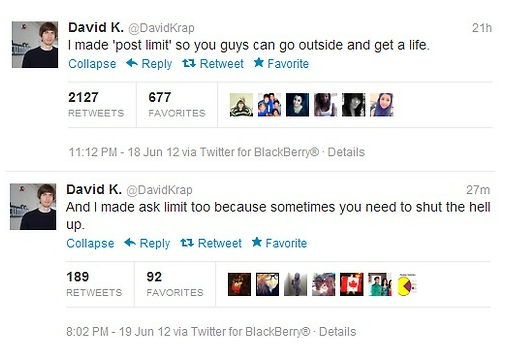
There is absolutely nowhere in the world for righteous anger than Tumblr. That tweet up there? That ignited the Tumblr equivalent of a firestorm. My dash was filled by reblogs of this post by thisiswhiteprivilege.tumblr:
To David Karp [creator and CEO of Tumblr] and all of those who work under the Support Staff:
You are all misogynist, racist, homophobic trash—every single one of you. And David? Yeah, you, David Karp. You need to make some changes.
The post continues with a mixed list of grievances ranging from legitimate disagreements about how the site is moderated (requiring users to block other users that they find abusive vs. proactively censuring user) to a pretty thin misreading of a two year old blog post (it may be stupid, but David Karp asking “Can I use the word “nigga” if I’m quoting a song?” is in no way the same as:
“3.) After all of this, you, a white man have the nerve to ask, “It’s okay if I say the n word, right?” (Spoiler alert: NO IT ISN’T, because it’s a fucking racial slur, you racist fuckface.)
Let’s take a minute to think about that one. David Karp thinks people using racial slurs at people of color is acceptable, thinks people of color responding with justified anger is hate speech, and then has the nerve to ask if he can use one of said slurs himself.”
to taking offense at a couple of statements made not by David Karp, but by a parody account (identified as such in the bio section), @DavidKrap (source of the screenshot above). So basically the “open letter” post is conservatively 80% bullshit, and works against whatever changes thisiswhiteprivilege wants to bring to the platform.
It’s also just pure Tumblr.
It goes almost without saying that the restraints created by the design of a social platform shape the way that its users interact. Facebook has traditionally been very good at semi-private, horizontal interactions between users, not so much for broadcasting or keeping in touch with those outside the walled garden. Twitter’s 140 character limit. Traditional blogs’ comment sections. And Tumblr’s design choices have made it a platform that anybody can access but is extremely limited in user interaction.
Tumblogs are like a parody of Web 2.0, WordPress or Blogger or Typepad-powered blogs (although WordPress has made huge changes in the last year to bring it closer to the Tumblr model). Every user has a URL that can be used to navigate to a public-facing page. Every user can set their own design. But spend any time on the site, and you can see how different a beast it is.
There is no way to comment on a post, except by “reblogging*” and appending your own text. Actually, “liking” (which adds a comment: “____ liked this” to the bottom of the post) and reblogging are the only ways that users can interact at all (this becomes very annoying. My dashboard (90% of any user’s time on Tumblr will be at http://www.tumblr.com/dashboard; nobody sees that custom theme you spent a couple hours deciding on) is constantly filled with the same posts, reblogged to add a comment). Thus reblogging becomes the social focus of the site. This is summed up well by a Quora user answering the question, “How do teenagers waste hours upon hours consuming Tumblr? My 15-year old daughter wastes hours upon hours everyday mindlessly scrolling rapidly through her “endless” tumblr stream. She also brags about her own blog on tumblr and how much love it gets, but it doesn’t contain any original content (only reblogs). I don’t understand.”:
Reblogging is a great and made-easy way to define my newly-established online self. It is how I quickly pass along the things that I care about and keep my followers interested in my blog. Despite it not consisting of all-original content, my blog is the equivalent of making a portfolio to sum myself up. I spend much time and care making my blog unique and look good.
My followers rely on me for discovery, as I rely on the people I follow. So, I feel responsible for doing just this; not doing so would run the risk of me losing followers, which will impact the amount of users who see my original content when I choose to write something myself or post a photo of mine or a video I found. So as I am browsing my feed for hours and hours, I am also looking for things that I think my followers would be interested in, like to see, or content that would go nicely given the other stuff on my blog. And, yeah, it is endless, which only increases the amount of time I spend on the site (the scrolling is set up so that as I near the bottom, more content loads). And I see it as crucial that I search through everything in my feed since my last visit to Tumblr, as I wouldn’t want to miss anything potentially interesting (that may make good blogging material or just suits my own interests).
What this means in practice is that Tumblr functions as a parody of conspicuous consumption: where everything costs nothing and goes on infinitely. Images and reblogs become the ways to signal your education, or your hipness, or your personality. And ultimately it shows everything but you.
But its greatest sins are in obscuring the chain of information. Whenever you reblog, you have the option of removing attribution to a previous user. This can mean that it’s very confusing to find the original post that another user might be quoting. Because reblogging is the only way to make a comment, there’s no linear order to comments & users can fork a conversation at any point**. Furthermore, while there are tools to embed URLS and captions to images, most tumblr users are very bad about attributing images. I’m not even talking about getting permission from artists, simply crediting them by name. While traditional blogs may be less sharey/social (if you want to discuss this article, you have to make a comment on this page and keep checking back to follow the discussion***), there is more interactivity with the information. All of the links I’ve embedded in the post allow you to go back and disagree with my interpretations. And I think it makes this a more durable platform.
If it seems like I’m dumping on the platform: don’t worry. I’m completely addicted to Tumblr.
The signal to noise ratio is crazy low, don’t get me wrong. But what I find irresistible about the platform is that when people do actually write original posts, when they write about their own feelings or opinions, users of Tumblr have absolutely no filter. And so more than any other place on the internet, if you want to hear how people feel about being mixed race, or people who have scoliosis, or people who were raised fundamentalists, there is no better place to look then on those Tumblr tags. When users give themselves permission to be themselves, they’re completely themselves.
And that’s why I keep coming back.
My tumblr can be found at sauntodo.tumblr.com
*a phrase which I find–frankly–a contradiction in terms.
**In a hilarious, “This is supposed to be Web 3.0?” twist, these comments are displayed with c. 1998-chain-letter carats >>>.
***and, by the way, please do.
 hammer & jack