
A fantastic offering from the LOST writers.

web log (late 20th c. – early 21st c.)
Now that it’s only a couple of days away, I am really excited for the release of Watchmen. Last night, my brethren and I (the men and women of the Mediaphilia dorm) had a great time picking apart various early reviews, including this stinker from Anthony Lane of the New Yorker. Now, I haven’t seen the movie and it’s entirely possible that the movie is merely ok or even bad, but a review that lambasts the movie for being pseudo-intellectual and pretentious is really ironic coming from the New Yorker.
Lane manages to load the review with comic book reader stereotypes (“leering 19-year olds” “whose deepest fear [is]… meeting a woman who requests intelligent conversation”) that are so tired they’re laughable, all while missing the point of the comic and movie so completely that it led a fellow Mediaphiliac to smirk, “It’s so much fun to see a New Yorker writer completely outsmarted by a comic book.” Lane claims that, “Whether [the] Watchmen have true superpowers, as opposed to a pathological bent for fisticuffs, I never quite worked out” and that “The problem is that Snyder, following Moore, is so insanely aroused by the look of vengeance, and by the stylized application of physical power, that the film ends up twice as fascistic as the forces it wishes to lampoon.” No shit. Congratulations, you recognized the two things about the comic book that made it stand out from the genre when it was published and for which it is beloved, and yet completely failed to understand them.
All of that was a long preamble to this discussion about the soundtrack to the film.
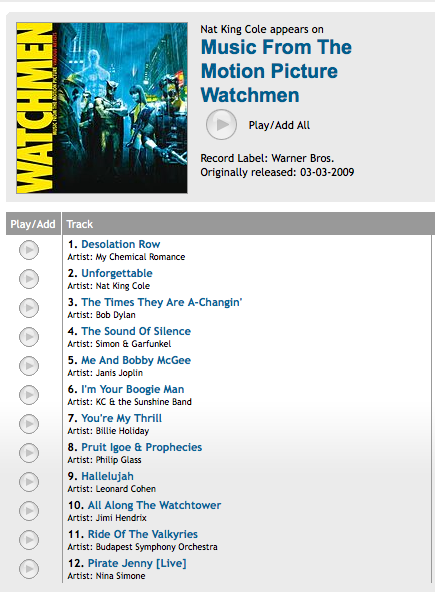 I think it’s an incredibly interesting, bordering on weird, selection of songs. I’m going to guess that “Ride of the Valkyries” is going to be used in a Comedian Vietnam flashback, considering how that usage in Apocalypse Now is so firmly ingrained in the popular culture. The Philip Glass track from Koyyanisqatsi was used in a trailer and I can see it being used in the film. Because its a cover of a classic Dylan track and that its from the only artist of the 21st century, I think “Desolation Row” will be playing over the credits. As you can see from the lyrics here, “Pirate Jenny” is the Kurt Weill song that narrates the story of the Black Freighter (which we have been promised will appear on the DVD).
Taking those songs out of consideration, we are left with a collection of songs from classic 20th century songwriters. I am a little concerned that some of these songs will be used a little too heavy-handedly. I am already imagining a wince from the line “freedom’s just another word for nothing left to lose” in “Me and Bobby McGee.” But, in keeping with the original goal of this series, all are top tunes.
———————————————————–
Now, the contest. In Anthony Lane’s review, he uses the phrase “cod mythology,” a Google search of which brings up only references to literal cod mythology and message boards trying to figure out what cod mythology means in reference to the review. I will give a digital blue ribbon, and a place on my new contests page, to the person who comes up with the definition of cod mythology or the most entertaining attempt. Here’s the original context:
The world of the graphic novel is a curious one. For every masterwork, such as “Persepolis” or “Maus,” there seem to be shelves of cod mythology and rainy dystopias, patrolled by rock-jawed heroes and their melon-breasted sidekicks.
Now that it’s only a couple of days away, I am really excited for the release of Watchmen. Last night, my brethren and I (the men and women of the Mediaphilia dorm) had a great time picking apart various early reviews, including this stinker from Anthony Lane of the New Yorker. Now, I haven’t seen the movie and it’s entirely possible that the movie is merely ok or even bad, but a review that lambasts the movie for being pseudo-intellectual and pretentious is really ironic coming from the New Yorker.
Lane manages to load the review with comic book reader stereotypes (“leering 19-year olds” “whose deepest fear [is]… meeting a woman who requests intelligent conversation”) that are so tired they’re laughable, all while missing the point of the comic and movie so completely that it led a fellow Mediaphiliac to smirk, “It’s so much fun to see a New Yorker writer completely outsmarted by a comic book.” Lane claims that, “Whether [the] Watchmen have true superpowers, as opposed to a pathological bent for fisticuffs, I never quite worked out” and that “The problem is that Snyder, following Moore, is so insanely aroused by the look of vengeance, and by the stylized application of physical power, that the film ends up twice as fascistic as the forces it wishes to lampoon.” No shit. Congratulations, you recognized the two things about the comic book that made it stand out from the genre when it was published and for which it is beloved, and yet completely failed to understand them.
All of that was a long preamble to this discussion about the soundtrack to the film.
 I think it’s an incredibly interesting, bordering on weird, selection of songs. I’m going to guess that “Ride of the Valkyries” is going to be used in a Comedian Vietnam flashback, considering how that usage in Apocalypse Now is so firmly ingrained in the popular culture. The Philip Glass track from Koyyanisqatsi was used in a trailer and I can see it being used in the film. Because its a cover of a classic Dylan track and that its from the only artist of the 21st century, I think “Desolation Row” will be playing over the credits. As you can see from the lyrics here, “Pirate Jenny” is the Kurt Weill song that narrates the story of the Black Freighter (which we have been promised will appear on the DVD).
Taking those songs out of consideration, we are left with a collection of songs from classic 20th century songwriters. I am a little concerned that some of these songs will be used a little too heavy-handedly. I am already imagining a wince from the line “freedom’s just another word for nothing left to lose” in “Me and Bobby McGee.” But, in keeping with the original goal of this series, all are top tunes.
———————————————————–
Now, the contest. In Anthony Lane’s review, he uses the phrase “cod mythology,” a Google search of which brings up only references to literal cod mythology and message boards trying to figure out what cod mythology means in reference to the review. I will give a digital blue ribbon, and a place on my new contests page, to the person who comes up with the definition of cod mythology or the most entertaining attempt. Here’s the original context:
The world of the graphic novel is a curious one. For every masterwork, such as “Persepolis” or “Maus,” there seem to be shelves of cod mythology and rainy dystopias, patrolled by rock-jawed heroes and their melon-breasted sidekicks.
This week has been so meh, I have ‘meh’rly been able to keep up with things. I spent all of Sunday working on a odiously difficult counterpoint assignment, which is in its way a blessing because I never have to do it again. This is going to end up being one of the more emo MWE… ever. This week I have spent a lot of time being depressed about the state of culture in America and the world, and anxious about finding my place in it. This is not so bad really. It’s a nice break from being depressed about being fat and alone.
1. The Angela Merkel Barbie

2. “We’re All Gonna Die – 100 Meters of Existence”
This is a really interesting photo project. It is a 100 meter long image made up of portraits taken from the same point on a bridge over 20 days. The effect it creates is kind of eerie. The sterile white background, as well as the people all walking toward the camera does seem to suggest something sinister. It’s probably fair to say that the title of the project is a little pretentious, but taken with the image, it does not seem out of place.
3. Karl Paulnack
This speech by Karl Paulnack, a lecturer at the Boston Conservatory, sums up a lot about what I have been feeling lately about the value of music in my life and in the world. I have lately begun to wrestle with the idea that I have no cognitive tools available to me to evaluate art’s value. I think that I have been trained to see value in things as a function of their usefulness. Things that can be quantized, things that can be measured, things that can be broken down into discrete components, these are the things that have value in our society.
I think that this is most easily seen in the greatest intersection of art and commerce ever: the movie industry. There is no question that some movies are driven by their star power (I’m thinking Pirates of the Caribbean). But think how lame it is when studios try and sell movies with clearly nothing going for them except their lead actors. Same thing with “soul” or “heart.” I recently saw Rachel Getting Married, a movie with drama and pain, and yet was completely grounded in a human goodness that was completely genuine. On the other end, you get a movie like The Reader, a movie that replaces genuine emotion and human conflict with emotional pandering through the Holocaust and uncomfortable sexuality.
What I’m trying to say is that there is no way while making a movie to say, “Let’s make this 20% more soulful,” let alone “20% more scary” or “%20 more thrilling.” By the time you are thinking in those terms, reducing the masterpiece to a widget, you have already lost. I think it’s telling that the most consistently successful studio in Hollywood right now is Pixar. Pixar has never had a movie gross less than $460 million dollars. Their average gross is $500 million dollars. Half a billion dollars. And yet the Pixar philosophy is simple: provide the artists with tools, and let them make something that they are satisfied with. I understand that this model will not work everywhere, and that different markets are completely, well, different. I will even give you that Pixar is an outlier. And yet I think that people can see what is genuine, and people can recognize quality.
4. Or maybe not.
This is a super interesting article that came out about this time last year in the Washington Post magazine. Their team asked Joshua Bell, the virtuoso violinist, to play at the entrance to a Metro station to see if anybody would recognize a musician of his caliber.
In the three-quarters of an hour that Joshua Bell played, seven people stopped what they were doing to hang around and take in the performance, at least for a minute. Twenty-seven gave money, most of them on the run — for a total of $32 and change. That leaves the 1,070 people who hurried by, oblivious, many only three feet away, few even turning to look.
No, Mr. Slatkin, there was never a crowd, not even for a second.
It was all videotaped by a hidden camera. You can play the recording once or 15 times, and it never gets any easier to watch. Try speeding it up, and it becomes one of those herky-jerky World War I-era silent newsreels. The people scurry by in comical little hops and starts, cups of coffee in their hands, cellphones at their ears, ID tags slapping at their bellies, a grim danse macabre to indifference, inertia and the dingy, gray rush of modernity.
Even at this accelerated pace, though, the fiddler’s movements remain fluid and graceful; he seems so apart from his audience — unseen, unheard, otherworldly — that you find yourself thinking that he’s not really there. A ghost.
Only then do you see it: He is the one who is real. They are the ghosts.
Well worth reading.
5. Walter Martin & Paloma Muñoz
Martin and Muñoz create occasionally whimsical, occasionally disturbing artworks, such as this:
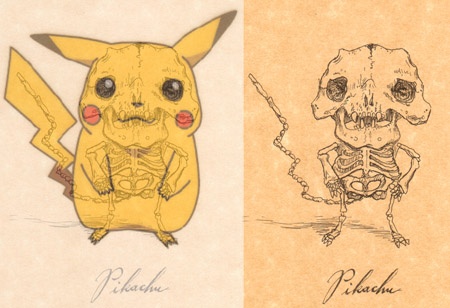
 It’ll take you like three seconds to click the link, some of the stuff there is really cool. I found it via Street Anatomy, a very cool anatomy themed blog with things like this:


6. Right America Feeling Wronged
This is a documentary by Alexandra Pelosi that aired on HBO showing footage of McCain/Palin supporters during the rallies. I found some of it a little scary, some of it a little familiar (see my earlier post about Alan Keyes), but I mostly felt a little overwhelmed that these people live in the same country that I do. All five parts are up on Youtube, worth it if you have a spare 40 minutes.
This week has been so meh, I have ‘meh’rly been able to keep up with things. I spent all of Sunday working on a odiously difficult counterpoint assignment, which is in its way a blessing because I never have to do it again. This is going to end up being one of the more emo MWE… ever. This week I have spent a lot of time being depressed about the state of culture in America and the world, and anxious about finding my place in it. This is not so bad really. It’s a nice break from being depressed about being fat and alone.

2. “We’re All Gonna Die – 100 Meters of Existence”
This is a really interesting photo project. It is a 100 meter long image made up of portraits taken from the same point on a bridge over 20 days. The effect it creates is kind of eerie. The sterile white background, as well as the people all walking toward the camera does seem to suggest something sinister. It’s probably fair to say that the title of the project is a little pretentious, but taken with the image, it does not seem out of place.
This speech by Karl Paulnack, a lecturer at the Boston Conservatory, sums up a lot about what I have been feeling lately about the value of music in my life and in the world. I have lately begun to wrestle with the idea that I have no cognitive tools available to me to evaluate art’s value. I think that I have been trained to see value in things as a function of their usefulness. Things that can be quantized, things that can be measured, things that can be broken down into discrete components, these are the things that have value in our society.
I think that this is most easily seen in the greatest intersection of art and commerce ever: the movie industry. There is no question that some movies are driven by their star power (I’m thinking Pirates of the Caribbean). But think how lame it is when studios try and sell movies with clearly nothing going for them except their lead actors. Same thing with “soul” or “heart.” I recently saw Rachel Getting Married, a movie with drama and pain, and yet was completely grounded in a human goodness that was completely genuine. On the other end, you get a movie like The Reader, a movie that replaces genuine emotion and human conflict with emotional pandering through the Holocaust and uncomfortable sexuality.
What I’m trying to say is that there is no way while making a movie to say, “Let’s make this 20% more soulful,” let alone “20% more scary” or “%20 more thrilling.” By the time you are thinking in those terms, reducing the masterpiece to a widget, you have already lost. I think it’s telling that the most consistently successful studio in Hollywood right now is Pixar. Pixar has never had a movie gross less than $460 million dollars. Their average gross is $500 million dollars. Half a billion dollars. And yet the Pixar philosophy is simple: provide the artists with tools, and let them make something that they are satisfied with. I understand that this model will not work everywhere, and that different markets are completely, well, different. I will even give you that Pixar is an outlier. And yet I think that people can see what is genuine, and people can recognize quality.
This is a super interesting article that came out about this time last year in the Washington Post magazine. Their team asked Joshua Bell, the virtuoso violinist, to play at the entrance to a Metro station to see if anybody would recognize a musician of his caliber.
In the three-quarters of an hour that Joshua Bell played, seven people stopped what they were doing to hang around and take in the performance, at least for a minute. Twenty-seven gave money, most of them on the run — for a total of $32 and change. That leaves the 1,070 people who hurried by, oblivious, many only three feet away, few even turning to look.
No, Mr. Slatkin, there was never a crowd, not even for a second.
It was all videotaped by a hidden camera. You can play the recording once or 15 times, and it never gets any easier to watch. Try speeding it up, and it becomes one of those herky-jerky World War I-era silent newsreels. The people scurry by in comical little hops and starts, cups of coffee in their hands, cellphones at their ears, ID tags slapping at their bellies, a grim danse macabre to indifference, inertia and the dingy, gray rush of modernity.
Even at this accelerated pace, though, the fiddler’s movements remain fluid and graceful; he seems so apart from his audience — unseen, unheard, otherworldly — that you find yourself thinking that he’s not really there. A ghost.
Only then do you see it: He is the one who is real. They are the ghosts.
Well worth reading.
5. Walter Martin & Paloma Muñoz
Martin and Muñoz create occasionally whimsical, occasionally disturbing artworks, such as this:
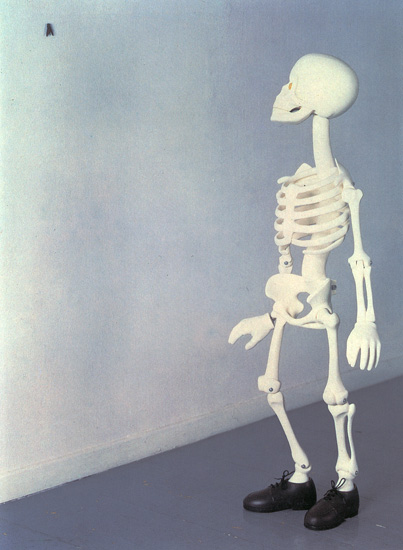 It’ll take you like three seconds to click the link, some of the stuff there is really cool. I found it via Street Anatomy, a very cool anatomy themed blog with things like this:

6. Right America Feeling Wronged
This is a documentary by Alexandra Pelosi that aired on HBO showing footage of McCain/Palin supporters during the rallies. I found some of it a little scary, some of it a little familiar (see my earlier post about Alan Keyes), but I mostly felt a little overwhelmed that these people live in the same country that I do. All five parts are up on Youtube, worth it if you have a spare 40 minutes.

