…but I’ll leave you with this link to a large scale optical illusion that was constructed in a Swiss town in the alps.


web log (late 20th c. – early 21st c.)
…but I’ll leave you with this link to a large scale optical illusion that was constructed in a Swiss town in the alps.
The main chord progression from Radiohead’s “Everything in it’s Right Place”…
…is the same as the string riff in Marlena Shaw’s “California Soul.”
On November 20th, Warner Brothers will release The Blind Side, a biopic based on Michael Lewis’ book The Blind Side: Evolution of a Game, about the high school years of Baltimore Raven’s offensive tackle Michael Oher. An excerpt of the book was published in the New York Times Magazine in 2006 as “The Ballad of Big Mike.” There are several things that make me uncomfortable about both the journalistic account and the movie project. Oher, his foster family, the professional football establishment, and the journalistic coverage of the situation bring up many complicated issues of class, race and attitudes toward the developmentally delayed. To be clear, I have not read the book; I regard it as a separate entity and will critique it as such.
Most of the race-based controversy surrounding this film that I have encountered online deals with the motivations of Leigh Ann and Sean Tuohy, the white couple who foster parented Oher through his high school years. I think this is a distraction from the real issues. Detractors point to the couples involvement with the Ole Miss football team, and charge them with adopting Oher for the purpose of grooming him to play college ball. Sean Tuohy (before the arrival of Oher) had a track record of financially supporting black students at Briarcrest Christian School (BCS), and from all accounts has been proactively racially progressive. Furthermore, Tuohy was not the person that brought Oher to BCS (although his influence with the school kept him there) and there is no indication that he would have abandoned Oher had he not proven to be successful at football. One could point to the enormous difference in Oher’s quality of life before and after the Tuohy’s involvement as motivation to stay in the program, but he is a presumably adult professional football player now; if he can’t decide independently now, then when? (I’ll write a little more later about this later). On the other hand, I do think that boosterism played a part in the Tuohy’s motivation, however I don’t find it wrong, simply a complicating factor. The Tuohys were trying to help Oher reach his full potential, and that meant both providing the home and cognitive foundation that Oher never got in his childhood and get his grades high enough to participate in high school and college football. It’s obvious that if their goal was to focus on academics their plan would have been different, but today Oher is independent, wealthy, successful, and shows no outward signs of his absent childhood. I think actions matter more than hidden motivations and that Oher’s journey has been a success.

On the other hand, I do think there are some racial problems with this story, and they all come from the telling of it. I don’t want to unfairly malign Michael Lewis; I understand that you have to alter your narrative arc to cut down a book into a 3,000 word Sunday magazine article and some subtlety gets lost. Still, the language used to describe the teenaged Oher is astounding to me: “an awesome physical specimen,” “not any ordinary giant.” When Lewis talks about offensive linemen in general, the comparison to animals is even more explicit, calling them “rare beasts.” There is no question that a description of an athlete will include physical form and condition, or that defensive linemen are not all black. Still, the comparisons between Oher and animals (or at least something not human), the constant reference through the story to his size, and, worst of all, the complete silence of Oher and his point of view on the situation paint a picture of Oher the other.
That absence of what I consider an essential point of view, Oher’s, is what makes me most uncomfortable about the magazine article. In the article, everything happens TO Oher. His journey is described as Oher being handed off from one interested parent-substitute to another. We never get his perspective on his high school years. We never get the sense that he is in any way independent of the Tuohy’s plans for him. It creates a false and demeaning distance between Oher and his own story; it puts the focus completely on the Tuohys while pretending that Oher is the subject. Even the title casts Oher as a mythical archetype rather than a real person with agency. Lewis must have interviewed Oher for the book. To not include him in the article strikes me as callous and disrespectful to his subject.
This distance is found in media about mental illness and developmental disabilities from Radio to Rain Man. Too often, the “abnormal” person acts as a foil for the character development that happens to the “normal” people. This is independent of the acting or the depictions of the symptoms and behaviors involved. The reason why Shine (to name a film that handles mental illness well) works isn’t Geoffery Rush or (the underappreciated) Noah Taylor, it is that the film treats David as an independent person, even in sequences where he abruptly enters other character’s lives. Oher is an independent adult, and for his voice to be absent in a story about the most personal details of his life is shameful.
The movie trailer, on the other hand, just made me nauseous. To start with, the movie makes the common “based on a true story” mistake of confusing the end intangible result with the journey to get there. I’m sure Oher and the Tuohys are happy with how far he has come, but there were huge emotional sacrifices, sometimes ugly sacrifices, involved in getting there, and no movie can portray those accurately while remaining “feel good.”
The politics involved with the changes made to the story are even more disgusting. The film would have it that Leigh Ann “rescued” Oher out of the random kindness of her heart (even worse, using the “the unprejudiced naivite of a child breaks down adult’s racial attitudes” trope) and, worse, completely ignores the role that his football potential played in her, and other’s, decisions. The fact is that everyone (except perhaps, ironically, Big Tony, the “inner city character” that sheltered Oher at the beginning of his time at BCS) had one eye on Oher and one eye on the field. I don’t think this makes the Tuohys bad people, but it does not make them saints.
The most cringe inducing line was the “If you insult my son, you insult me” sequence. Leaving aside that twee sentiment, it misrepresents the challenges of homelessness that Oher faced. Nobody was going to mess with him. Protecting himself is easy. Finding shelter, heat and clothes is much more difficult.
Finally, the movie looks like it will repeat all of the mistakes found in the movies I mentioned earlier. The puppy dog expression on Quinton Aaron’s face and the trailer’s focus on Sandra Bullock reinforce the shallow depiction of Oher as a project, a problem for a bored housewife to fix.

I started taking organ lessons at the beginning of the semester. The organ, partially because of its liturgical use and partially because of its fundemental complexity, exists in its own hermetically sealed sphere; there is a tremendous amount to learn about every aspect of the instrument. One of the most useful things an organ student is to try and gain experience and perspective by visiting, playing and experimenting with many different instruments. Although these updates will not be regular, I hope to post about the different organs I visit in my own language to the extent of the education I have now.
One of the most fun afternoons of my spring break was the brief time I had to visit the Rosales Op. 10 organ at St. Andrew’s Episcopal Church in Ojai, California. Manuel Rosales is a Los Angeles based organ builder who builds in a tonally postmodern style heavily influenced by French and Mexican organs. His magnum opus is the organ at the Walt Disney Concert Hall (Op. 24), however he first gained national attention with the organ at Trinity Cathedral in Portland, Oregon (the Trinity organ was build right after the instrument at St. Andrew’s).
The organ at St. Andrews is much more modest than those organs (15 stops and two manuals), however it has the same craftsmanship, sweet tone, and strong point of view that have come to characterize Rosales organs. There were some physical features that I noticed immediately. The pedalboard is flat, without the curved array ususal for American organs. The stops on the console are physically large (perhaps taking influence from Mexican organs). Because of the small size of the organ, the expression pedal controls small hinged doors on the case, not the usual louvres. This, and the facade prestant, gives the organ an incredible dynamic range; the chimney flute with the doors closed is nearly inaudible. Sara Edwards, resident organist, pointed out to me the decoration on the case; it incorporates local motifs like the oak leaves and acorns of the California live oaks that grow in abundance in Ojai, and the crossed fishes of St. Andrew.
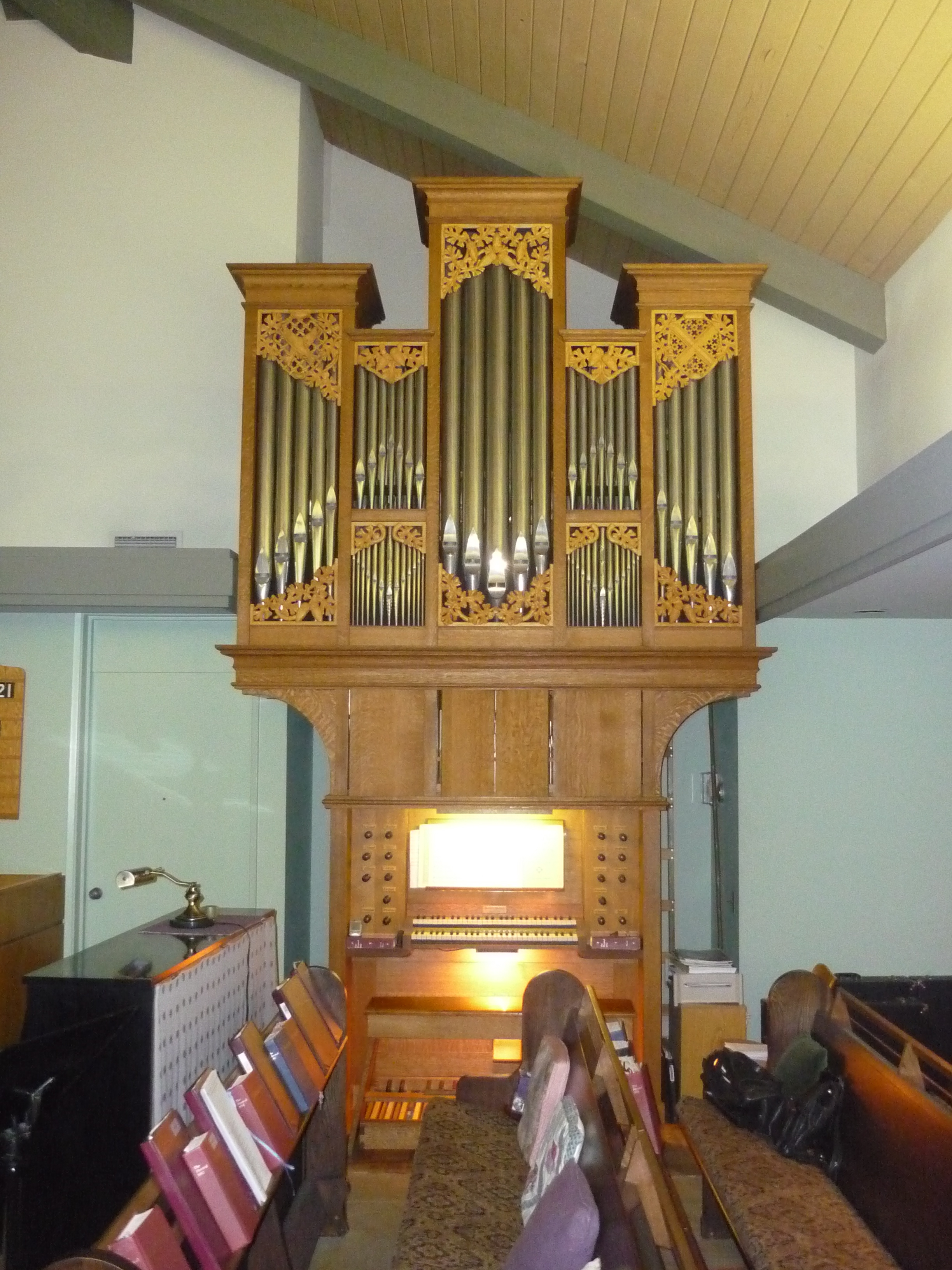
I’m still new at this, so I don’t have much of a palate to distinguish between different tonal palletes, however the organ did seem very sweet and mellow. As befits an organ of this size, the different stops seemed to be quite versatile. Almost all of them seemed like they could hold their own as a solo stop; I was particularly taken with the delicate 8′ chimney flute. Although I found the mechanics sluggish (it is a tracker [completely mechanical] organ), the 8′ trumpet sounded quite nice. I am generally suspicious of reed stops, but this one balanced boldness with richness. One thing that I found interesting when I first began to learn about organ building traditions is that, outside of a few basic stops, there is no standardized naming convention for organ pipes, they depend on the imagination and poetry of the builder. The stops at St. Andrews are named with traditional French labels, however the presense of the Dulciana in the choir division show Rosales’ Mexican influence (his Disney organ in particular has this in abundance with stops labeled Llamarada, Clarín armonico and Pajaritos*).
It was a real pleasure to play. I had heard the organ before, but didn’t know anything about them. It was interesting to find that there was such a treasure in my backyard.
*Pajaritos (little birds) is a stop that controls four birdolas, a kind of trick organ stop. Basically, before you play, you fill a small chamber with water, and the keys on the manuals control air burbling through it (almost like those plastic whistles you fill with water). One of my favorite things is all these trick stops on organs. They are most present on theater organs (like classic Wurlitzers) but they are also present in concert or liturgical organs. The St. Andrew’s organ has a Cymbal Star: basically air pressure spins a tine around which strikes a series of fixed cymbals.

I started taking organ lessons at the beginning of the semester. The organ, partially because of its liturgical use and partially because of its fundemental complexity, exists in its own hermetically sealed sphere; there is a tremendous amount to learn about every aspect of the instrument. One of the most useful things an organ student is to try and gain experience and perspective by visiting, playing and experimenting with many different instruments. Although these updates will not be regular, I hope to post about the different organs I visit in my own language to the extent of the education I have now.
One of the most fun afternoons of my spring break was the brief time I had to visit the Rosales Op. 10 organ at St. Andrew’s Episcopal Church in Ojai, California. Manuel Rosales is a Los Angeles based organ builder who builds in a tonally postmodern style heavily influenced by French and Mexican organs. His magnum opus is the organ at the Walt Disney Concert Hall (Op. 24), however he first gained national attention with the organ at Trinity Cathedral in Portland, Oregon (the Trinity organ was build right after the instrument at St. Andrew’s).
The organ at St. Andrews is much more modest than those organs (15 stops and two manuals), however it has the same craftsmanship, sweet tone, and strong point of view that have come to characterize Rosales organs. There were some physical features that I noticed immediately. The pedalboard is flat, without the curved array ususal for American organs. The stops on the console are physically large (perhaps taking influence from Mexican organs). Because of the small size of the organ, the expression pedal controls small hinged doors on the case, not the usual louvres. This, and the facade prestant, gives the organ an incredible dynamic range; the chimney flute with the doors closed is nearly inaudible. Sara Edwards, resident organist, pointed out to me the decoration on the case; it incorporates local motifs like the oak leaves and acorns of the California live oaks that grow in abundance in Ojai, and the crossed fishes of St. Andrew.
I’m still new at this, so I don’t have much of a palate to distinguish between different tonal palletes, however the organ did seem very sweet and mellow. As befits an organ of this size, the different stops seemed to be quite versatile. Almost all of them seemed like they could hold their own as a solo stop; I was particularly taken with the delicate 8′ chimney flute. Although I found the mechanics sluggish (it is a tracker [completely mechanical] organ), the 8′ trumpet sounded quite nice. I am generally suspicious of reed stops, but this one balanced boldness with richness. One thing that I found interesting when I first began to learn about organ building traditions is that, outside of a few basic stops, there is no standardized naming convention for organ pipes, they depend on the imagination and poetry of the builder. The stops at St. Andrews are named with traditional French labels, however the presense of the Dulciana in the choir division show Rosales’ Mexican influence (his Disney organ in particular has this in abundance with stops labeled Llamarada, Clarín armonico and Pajaritos*).
It was a real pleasure to play. I had heard the organ before, but didn’t know anything about them. It was interesting to find that there was such a treasure in my backyard.
*Pajaritos (little birds) is a stop that controls four birdolas, a kind of trick organ stop. Basically, before you play, you fill a small chamber with water, and the keys on the manuals control air burbling through it (almost like those plastic whistles you fill with water). One of my favorite things is all these trick stops on organs. They are most present on theater organs (like classic Wurlitzers) but they are also present in concert or liturgical organs. The St. Andrew’s organ has a Cymbal Star: basically air pressure spins a tine around which strikes a series of fixed cymbals.

