Circe ፧ Madeline Miller

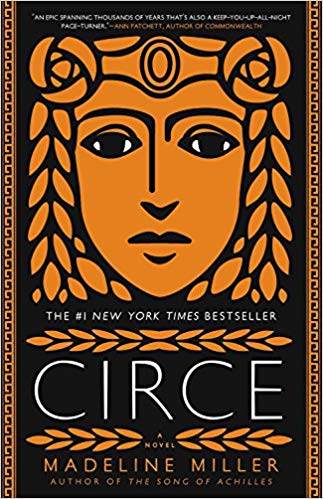
Circe, by Madeline Miller. Buy it from Powells.

The highest praise I can give to Circe is to simply describe, simply and without exaggeration, how I felt when I finished the book. It felt like a heavy weight on my chest, and like every feeling of loneliness and powerlessness and fear had been dug up from the deep places I had tried to bury them in. I put the book down and immediately headed out into the rain to walk to a bar to be around people and to connect to my own worry-worn rosary made up of clichés like we met and talked all night and I took one look and knew they were the one.

That’s what happened.

Circe, whose “official story” as a sexually tempting sea-witch is contained in a brief interlude in The Odyssey, is born as one of the least powerful immortals. Her family is not kind to her, and although she has a powerful father, this does not give her protection. Instead, it makes her a particularly vulnerable (easy to use) pawn in a game in which she has no place and cannot win. Things happen to her, she learns lessons. Ultimately, she has to choose between listening to what everyone around her tells her is her place, or, taking the lonely road of learning to listen and trust herself, and therefore discover her own power.

I saw a lot of myself in Circe’s story. Although it turns out that, seen with hindsight and self-confidence, there was less to fear than I believed, I too felt different and removed from my family. But there is only so much kinship with Circe I can claim, because a lot of the emotional dynamics explored in this book involve family abuse and the violence that men enact on women. Madeline Miller writes in this wonderful, poetic register that is often punctuated by beautiful aphorisms, and they resonate, of course, not because Circe’s experience is so extraordinary but because it’s so common.

As a confused high-schooler, I took Latin classes, and as a confused young adult I chose a college that put a big emphasis on studying “the Classics.” Homer’s world of wars and gods and glory and vengeance never came alive to me for two reasons: I was not a good student and spent no time completing reading assignments, and because the whole toxic-masculinity template, this foundational ethos that fueled scores of empires great and small seemed so stupid. Who can kill the most people is a question like who can run the fastest or who can lift the heaviest thing: useful to know in limited contexts but not very useful to most parts of life and definitely a poor indicator of divine favor or ruling authority. What Miller does so well is take the same stories (dominant, masculine, exterior focused), and retell them through the eyes of the other, who is usually left out of the tale (inferior, feminine, interior focused). It’s a wonderful way of queering the text: reading Homer with the values that his culture tried their best to suppress. I may or may not return to the Iliad or Odyssey, but even if I do I imagine it will be Miller’s Circe, Miller’s Achilles, Miller’s Agamemnon, that will be the “real” versions of the character to me, not Homer’s. I hope that is the sweetest victory of all.
Tangerine

See the source image
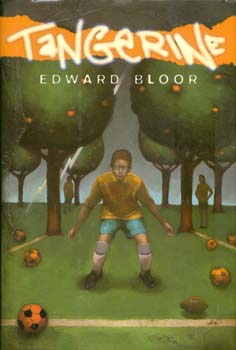
Tangerine, by Edward Bloor. San Diego, Calif. : Harcourt Brace, 1997. Tangerine, by Edward Bloor. San Diego, Calif. : Harcourt Brace, 1997.

A delightful discovery I made while starting to write this re-review was a blog post I wrote 10 years ago about the books that made a deep impression on me. Tangerine was one of those books. I’m tempted to rattle off things that my home town had in common with Tangerine/Lake Windsor Downs—a citrus growing industry, strange segregation between white and Hispanic neighborhoods and people, groves with fans and heaters for cold nights (I think I remember the orange glow of smudge pots on winter nights, but perhaps that is a memory incepted by this very book, as they were banned in California decades before I was born). The truth is that there were as many things completely outside of my experience in Paul Fisher’s life as there were in it. My parents were not image-conscious people. We were not a sports family, and I did not have any physical characteristics that made me different other than being fat. I did not have a tormenting older brother; to my eternal shame, I was that older brother.

What Paul Fisher and I had in common, however, was the fear.

After Paul joins the War Eagles and the team comes together, they start winning:

“The War Eagles have set out on a bloody rampage through the county. We have destroyed every enemy. We have laid waste to their fields and their fans. There is fear in their eyes when we come charging off our bus, whooping our war cry. They are beaten by their own fear before the game even begins. This is a feeling that I have never known before. Anyway, I have never known it from this side of the fear. Maybe I am just a [substitute], maybe I am just along for the ride, but this is the greatest thing that has ever happened to me.”

Paul feels the catharsis of stepping out of the fear that he experiences all of the time through soccer, a healthy channel for that need. As a teenager, I tried to escape that fear in ways that were unhealthy just as often as they were healthy. I spent a lot of time alone with music, creating a zone of safety around me, but I also was mean to people and made fun of others because while I was directing the target of mockery, it could never be me. Maybe it’s because his fear is so focused on an actual threat, but Paul can see the fear and shame in those around him:

“Mom took me into the kitchen and got me a glass of water. She ran her finger under the strap of my goggles and slipped them off. Then she said, “Honey you know how it is with your eyesight. You know you can’t see very well.’ And that was that. But I can see. I can see everything. I can see things that Mom and Dad can’t. Or won’t.”

Paul can see the fear that his parents and the adults in the subdivision have that their home investments will become worthless, that their projected image will crumble. He sees the chips on his classmates’ shoulders and the callous way that his brother takes advantage of the adults around him, who are so overly concerned about threats from the outside that they don’t pay attention to monsters closer to home.

You spend some time with Paul and you see it too. This is not an overtly political book, but reading it made me also think of the wildly weird Bush years. You can view this book through the lens of the culture of that time, or maybe the other way around, but so many flashpoints: hypocrisy of prosperity gospel religious bullshitters, rampant gentrification, everyday racism, toxic relationship to the earth, creepy messaging about keeping the home/homeland safe, even lax oversight by government officials to promote development, they’re all here in Tangerine.

I forgot how abruptly it ends, and I’m afraid that the next few years were probably tough for Paul. His brother was a monster, but he also needed a lot of intervention to have a hope of making it through his teen years. We don’t get any real reason to believe that his parents will grow into better ones. But today Paul would be around 35. I hope he’s had some time to grow and heal, and some time to be really angry at his parents, and maybe some therapy. Revisiting Tangerine, I often just appreciated how good-hearted Paul is. I hope he’s found his way to step out of the fear without needing to be on the other side of it.

gr(eat)

I never get tired of the highbrow/lowbrow debate. There’s a long article in the Chronicle of Higher Education on (according to the writer, Michael Clune) a reluctance for humanities scholars to engage in critical evaluation (as opposed to interpretation).

This eschewal of hierarchy appears eminently progressive. Who am I to say that one book is better than another? Why should I tell you what you should read? Everyone’s taste is equal. No one’s judgment is any better or worse than anyone else’s. […] The abdication of professional judgment throws all questions of value into the marketplace. The free market is where consumers, whose preferences are all accorded equal status, exercise their cultural choices.

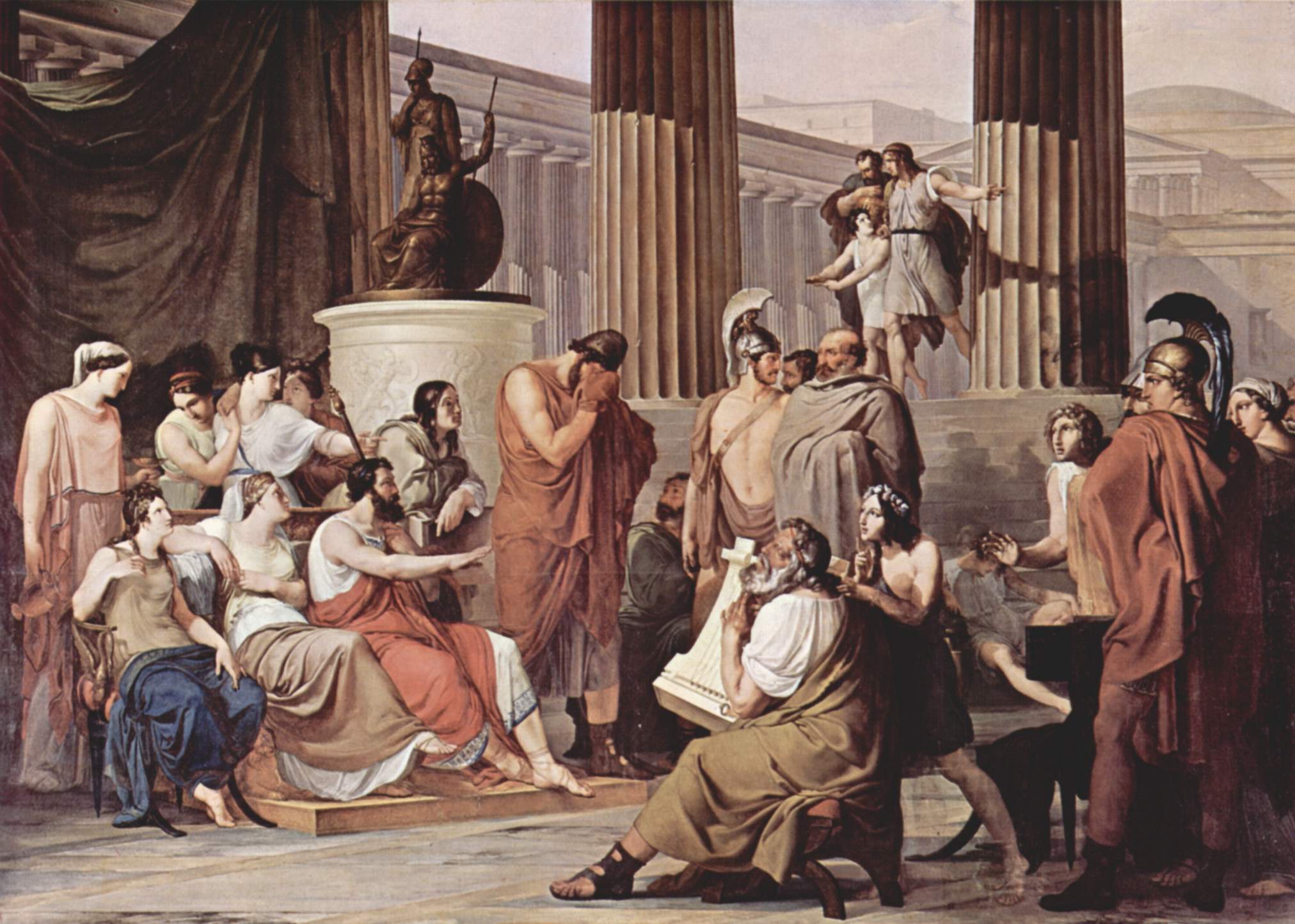
Ulysses at the court of Alcinous by Francesco Hayez. In other words, poetry in the literal marketplace.

Is making a hierarchical ranking the same thing as making an aesthetic judgement? Clune performs this little misdirection throughout the essay. Ranking things in lists seems like an insane way to engage with any art form to me. Art criticism must start with what’s on the page or on the canvas, but it’s no longer tenable to ignore the other axes of power and cultural capital that lead to one thing being considered a masterpiece and another forgotten. Clune tries to head off this argument: “Criticizing the limits of equality doesn’t mean ignoring the pathologies of expertise. Many expert judgments of the past bear the ugly marks of racism and sexism. Probably many of our own judgments will seem similarly distorted in the future.” Clune seems unwilling to entertain the idea that the cultural hierarchy he’s defending is simply a mirror of social hierarchy.

The deadliest trap in art is the circular logic trap that comes about when “Is this the best?” leads to “To whom?” which is then answered by “Us!” The exclusivity of the connoisseur becomes evidence the greatness of the work, and the greatness of the work becomes evidence of the enlightened nature of the connoisseur. This is something I am very passionate about: I think that the whole world of art and literature and culture opens up when you get away from that question.

I do think Clune is coming from a good place, he writes sentimentally about a vivid reading experience he had as a teenager, exploring the Japanese poet Bashō. This is a great example of the questions that go unexplored when you’re just looking at hierarchy: why is Bashō a part of your poetry canon, when he would not have been if you were reading poetry at Oxford 100 years ago? How does a poem move in and out of “greatness?”

“a little bird told me…”

St. Gregory the Great fresco detail, Church of St. Rupert, Weißpriach, Austria. Photographed at the church by Richard Stracke, shared under Attribution-NonCommercial-ShareAlike license.

Yesterday, I just started reading in earnest the titanic, 5-volume, 3,856-page Oxford History of Western Music by Richard Taruskin. So far, I’m finding it fascinating because I am an arch-dork about music. One tidbit I’m particularly tickled by was this account of the origin of the idiom “a little bird told me:”

[A book of plainchant] could not have existed in St. Gregory’s day, because there would have been no way of putting music into it. […] By the ninth century, however, the legend of Pope Gregory as composer of what has been known ever since as “Gregorian chant” was firmly in place. It was propagated not only in literary accounts like that of John the Deacon but also in an iconographic or pictorial tradition that adapted a motif already established in Roman illuminated manuscripts containing Gregory’s famous Homilies, or sermons, on the biblical books of Job and Ezekiel. According to this tradition, the pope, while dictating his commentary, often paused for a long time. His silences puzzled the scribe, who was separated from Gregory by a screen. Peeping through, the scribe beheld the dove of the Holy Spirit hovering at the head of St. Gregory, who resumed his dictation only when the dove removed its beak from his mouth. (It is from such representations of divine inspiration that we get our expression, “A little bird told me.”)

Taruskin, Richard. Oxford History of Western Music. Oxford University Press.

Some other little tidbits I’ve enjoyed from this first section:

  • The word noon comes from the monastical service held at 3pm called “none,” from the word for nine (the ninth hour since waking at 6am). On why the 3pm service became our name for the 12pm hour? Taruskin: “[it’s] just one of those things.”
  • For the very first time I actually understood what the Holy Roman Empire was.
  • Notated plainchant (which everyone but historians just think of as “Gregorian chant”) was adapted from monastic/ascetic practices, so despite what pop culture and our own filling in the blanks might suggest, all around the church there was instrumental music, ensembles/orchestras, choirs, bands, and music with many harmonies and parts. Plainchant for church use was designed to sound ancient and primitive. If you’ve ever been to a church service with chant and felt a shiver of something primal and magical down your spine, that’s exactly what the church hierarchy hoped might happen… in the 7th century.

Further reading, for the interested: https://robertgreenbergmusic.com/a-most-successful-campaign-of-misinformation-or-listen-to-the-birdie/

"a little bird told me…"

St. Gregory the Great fresco detail, Church of St. Rupert, Weißpriach, Austria. Photographed at the church by Richard Stracke, shared under Attribution-NonCommercial-ShareAlike license.

Yesterday, I just started reading in earnest the titanic, 5-volume, 3,856-page Oxford History of Western Music by Richard Taruskin. So far, I’m finding it fascinating because I am an arch-dork about music. One tidbit I’m particularly tickled by was this account of the origin of the idiom “a little bird told me:”

[A book of plainchant] could not have existed in St. Gregory’s day, because there would have been no way of putting music into it. […] By the ninth century, however, the legend of Pope Gregory as composer of what has been known ever since as “Gregorian chant” was firmly in place. It was propagated not only in literary accounts like that of John the Deacon but also in an iconographic or pictorial tradition that adapted a motif already established in Roman illuminated manuscripts containing Gregory’s famous Homilies, or sermons, on the biblical books of Job and Ezekiel. According to this tradition, the pope, while dictating his commentary, often paused for a long time. His silences puzzled the scribe, who was separated from Gregory by a screen. Peeping through, the scribe beheld the dove of the Holy Spirit hovering at the head of St. Gregory, who resumed his dictation only when the dove removed its beak from his mouth. (It is from such representations of divine inspiration that we get our expression, “A little bird told me.”)

Taruskin, Richard. Oxford History of Western Music. Oxford University Press.

Some other little tidbits I’ve enjoyed from this first section:

  • The word noon comes from the monastical service held at 3pm called “none,” from the word for nine (the ninth hour since waking at 6am). On why the 3pm service became our name for the 12pm hour? Taruskin: “[it’s] just one of those things.”
  • For the very first time I actually understood what the Holy Roman Empire was.
  • Notated plainchant (which everyone but historians just think of as “Gregorian chant”) was adapted from monastic/ascetic practices, so despite what pop culture and our own filling in the blanks might suggest, all around the church there was instrumental music, ensembles/orchestras, choirs, bands, and music with many harmonies and parts. Plainchant for church use was designed to sound ancient and primitive. If you’ve ever been to a church service with chant and felt a shiver of something primal and magical down your spine, that’s exactly what the church hierarchy hoped might happen… in the 7th century.

Further reading, for the interested: https://robertgreenbergmusic.com/a-most-successful-campaign-of-misinformation-or-listen-to-the-birdie/