The Handmaid’s Tale

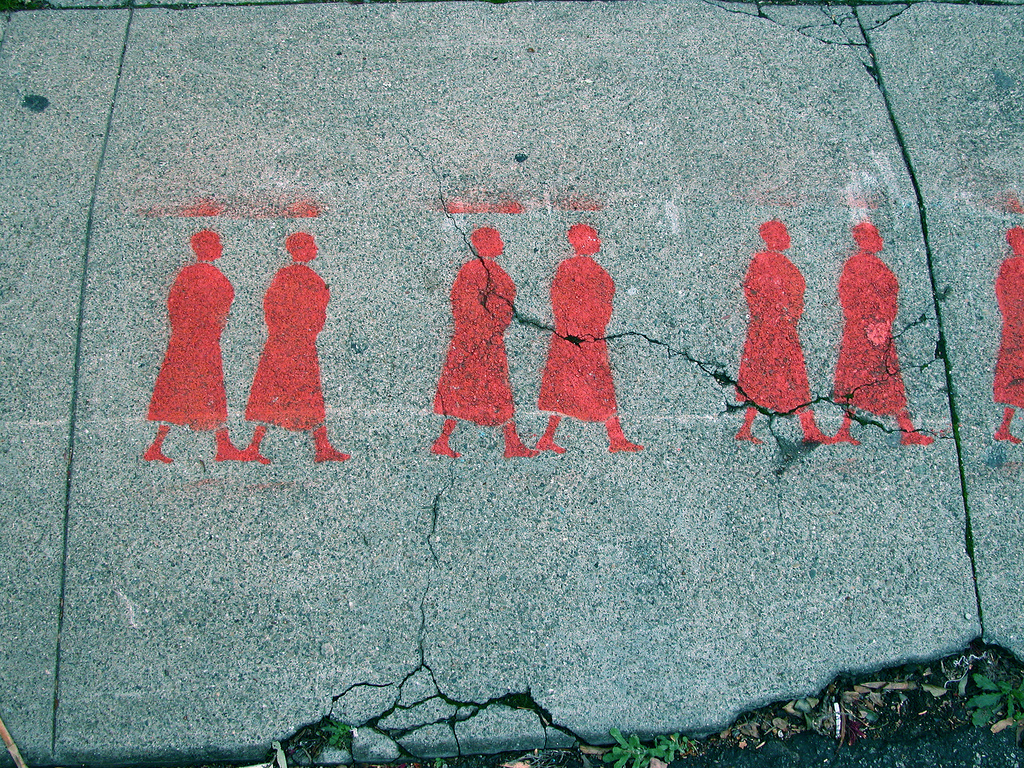
red stencil walkers

Many people that I know read The Handmaid’s Tale in high school. I didn’t. Because so many people come to it when they are younger, when they are developing their consciousnesses, I thought the book would be more polemical, more manifesto. The book makes a clear statement, and has the anger and righteousness of a manifesto, but I was surprised to discover that Offred’s voice was an ambivalent, human voice. I thought it was an extremely brave thing of Atwood to do to have so much of Offred’s internal monologues, especially her regrets, to focus on the loss of her child and husband. It would be less complicated to have a character that only has hate for men, only resents her own ability to create children, but by embracing that complication, the book seems more truthful to me. It’s incredible to think how much time has passed since the publication of the book, and how nothing so substantial has changed that it seems to invalidate the premise of the story.

I’m thinking of this story in Fortune about women in the tech industry. One way of saying that “Everyone was the same, and no one was like me.” is that these jobs are not designed to be filled by people who have a family. Sometimes that means no women, but even their male workers are expected to have a “traditional” family structure simply because these men cannot contribute in that way to the household. There’s a scene in the Tale where all women workers are summarily fired and their financial accounts frozen. We despise the men in that story for saying nothing. Maybe that wouldn’t happen in reality today, but if there was suddenly a new law that meant that maternity leave was more inconvenient/more expensive for employers and women workers suddenly found their careers stalled or themselves forced out, how many workplaces are there in which men would stand up? Would we say anything if it didn’t happen all in one day? Would I notice?

I’m also thinking of an episode of The Dick Cavett Show  I watched once while I was fucked up. Carole Burnett was the guest.I thought it was the craziest thing I had ever seen, because she was so comfortable, relaxed, bantery, funny. And also because she seemed to have the cool/funny girl schtick that I associate with entertainers like Mindy Kaling, Tina Fey or Lena Dunham. The pose that says that Sexism is bullshit and totally happens to me but I can joke about it and I’m not going to let it stop me because eh, what are you going to do? But then again, there’s something aggressive about a male interviewer opening his segment by grilling her about her sexual history. And we look at that as both banter and also as something uncomfortable, something that probably wouldn’t happen today. But if it did, it would seem “edgy” and “honest” and we would all get a thrill out of breaking the same taboo that Burnett and Cavett were breaking. Especially now as Lena Dunham becomes the center, again, of whether she is or is not a Feminist Icon of Our Times, I can’t help but look back and forth between Dunham and Burnett and the context of their times and think This will never be enough. And then I think about how lonely Margaret Atwood must get sometimes if she’s spent her entire life thinking that all of it will never be enough.

This Reader’s Digest, July 2013

Big reading month for me. Here’s the good, the bad, and the ugly, with some commentary. I get apathetic about rewriting what is easily Googleable, so no plot summaries. Unreservèd recommendations are marked with a star.

*The Little Way of Ruthie Leming Rod Dreher

The Little Way of Ruthie Leming – Rod Dreher

A truly unique project. Dreher’s book rarely strays beyond the borders of the small Louisiana hamlet in which he was raised and his sister lived, but it manages to be at once a small book about the complex relationships between siblings and a large book, a synecdoche of America’s relationship to the rest of the world. Dreher made me stop often to consider the way that the dynamics and attitudes he describes have played out in my own life. It was also consistently frustrating to me, as some of the insights that Dreher captures are so right, and others betray the same lack of flexible thinking and imagination that he sees as missing in his sister and father. Go forth and read this book.

Devices and Desires K.J. Parker

Right on the border between sci-fi and fantasy. If you look at a plot summary and think you might be interested, you’ll probably like it. If it sounds like it’s not for you, you’re probably right.

The War for Late Night Bill Carter

Bill Carter’s 1994 account of the Carson-Leno-Letterman Tonight Show saga, The Late Shift has become one of the canonical pieces of television writing and reportage. I haven’t read it, but I thought I would have more interest in this second book, because I remember the media nuttiness surrounding Conan O’Brien at NBC. Reading the book, I became aware of two things. First, I just care less about everybody involved in this story than I thought. Second, disciplined academic writing has spoiled me for easy narratives, characterizations, and explainations. After yet another TV executive’s negotiating style explained by their hardscrabble Brooklyn roots, I said fuck it and dropped the book.

*We The Animals Justin Torres

We The Animals – Justin Torres

One of the most intriguing debuts I’ve read. I hated this book when I finished it. I thought the ending was so cheap, so out of keeping with the rest of the novel. It was like watching somebody construct something amazing, then seeing them turn on the project and burn it down. Once I calmed down from that initial emotional reaction, I was able to consider that, no, it’s not the same thing as burning it down. The first three-quarters of the book are still great. Torres’ prose (prose poetry?) shows either stylistic precocity or stylistic vapidity. This is one of the few books these days that I wish would have a better constructed plot. The structure of the book is very loose, either a novel, novella, short story cycle, fictional memoir, or vignettes, depending on how you feel about it. I personally think its a fantastically successful short story cycle, and a poor novel. I eagerly await either Torres’ first volume of poetry or his third novel.

You Can Say You Knew Me When K. M. Soehnlein

I was excited to read this book because Soehnlien’s The World of Normal Boys, which I read a couple of years ago, is a true masterwork. While not breaking from the model established by Edmund White’s A Boy’s Own Story, Soehnlein’s specificity of character and setting elevates it above the many realization and coming out stories that are staples of gay lit. You Can Say You Knew Me When, about a self-destructive 30something gay in San Francisco discovering himself and shit, is not nearly as good. It was fine. If you’re like me, and will read any half-decent piece of trash if there are gay people in it, go ahead and pick it up. Otherwise, there’s only about three pieces of real interest. 1. The main character’s encounter with a rough-around-the-edges 19 year-old perfectly captures the appeal of rough trade. 2. The description of pre-90’s tech bubble craziness has come back around and become relevant again in this day of billion dollar aquisitions. 3. The main character’s father is compassionately portrayed, and is interesting and plausible as a person who had a bohemian youth and became more conservative in later life.   

Role Models John Waters

Reading this book is like listening to the filthy gay uncle you never had hold court. So there are bound to be great stories here (my favorite involved a one eyed, alcoholic, lesbian stripper named Zorro) and some sections that put you to sleep.

Gulliver Travels [since renamed Gulliver Takes Manhattan] Justin Luke Zirilli

Absurd book written by a gay club promoter that proves that endless fucking in New York is not, in itself, engaging absent any other point of interest.

*Far From the Tree Andrew Solomon 

Far From The Tree – Andrew Solomon

To me, Andrew Solomon’s project, which you can learn about in compressed form in this TED talk, boils down to this: what does the “normal” parent-child relationship look like when defined as the opposite of its variants? To that end, Solomon looks at situations where children best thrive by developing identity through peer relationships and opposed to familial relationships (deafness, dwarfism, homosexuality); where emotional relationships cannot be reciprocated (autism, multiple disabilities); where meaning of the child to the world shouts down meaning of the child to its parents (prodigies, criminals). The miracle of this book is that Solomon manages to balance on the knife’s edge between detachment and compassion towards his subjects, and has created one of the few recent pieces of writing that I might call wise. His prose has a razor sharpness to his conservatism of meaning and precision of language, and the through-line of his logic is consistent, and strong. He presents factual information straightforwardly, both communicating the best of what we know about these conditions while acknowledging that the science is in its infancy. At the same time, he is respectful of his subjects and their constructed identities, while refraining from adopting their communities’ jargon unless it edifies. This is not an easy read. The prose is dense, and because it is so carefully written it reads slow. And in focusing on this cohort of families, a major secondary theme that runs through the book are the profound bioethical questions that are going to come, with fury and anger and disruption and casualties, to our world.

The Elusive Embrace Daniel Mendelssohn

Could not surmount the twinned barriers of the solipsism of the writer and the indifference to classical studies of this reader. Abandoned.

A Cage of Bones Jeffrey Round

Yet another gay romance about an ennui filled gay man. Sexy location, competently written.

From Paris to the Moon Adam Gopnik

American in Paris memoir. I was expecting a little more. Tone was a little too Erma Bombeck/Sedarisy, his insights about the differences in American and French national culture were interesting, but a little too few and far between.

Wild Cheryl Strayed

Not only has this memoir been a breakout hit in the last two years, but Strayed is a hometown hero here in Portland. I thought the book was pretty good, mostly because Strayed has a distinctive voice, and is good company. After finishing the book, I began to explore some of her Dear Sugar columns, and I can see how this book would be of interest for those who are interested in how she cultivated her unique, and uniquely precious, moral sense. While I am mostly positive about the book, the material in it is half nature writing about the settings Strayed encountered on the Pacific Coast Trail, and half grief memoir about the loss of Strayed’s mother, and I thought both suffered for the attention given to the other. I found myself contradictorily wishing Strayed had given more time to the aftermath of the grief process, and more closely described her process of leveling out, while at the same time wanting her to take a little more time with the wildnerness locales she passed through rather than just talking about her condition on the trail.

Eleanor and Park Rainbow Rowell

Another straight teen romance in the vein of John Green’s Looking for Alaska. My pet theory about books like this is that it is an unintended consequence of the discovery of the gay YA market. Every one of Park’s (male protagonist) character notes—his love for new wave and punk, distance from authoritarian father, picked on at school—seem swiped from an Alex Sanchez or David Levithan book from ten years ago. Straight is the new gay. 

*CivilWarLand in Bad Decline George Saunders

Like one of my other favorite living writers, David Mitchell, Saunders is a profoundly moral writer that never moralizes. Though a couple of stories in this collection did not affect me profoundly, those that did kept me both at complete physiological attention to discover where the plot would go, and with a incessant lump in my throat as Saunders captures just how cruel we can be to each other, and how improbably kind.

Mysterious Skin Scott Heim

A better than average book that made a worse than average movie. Heim, with subtlety and empathy, explores the complicated role that sexual abuse plays in the formation of one gay man’s identity. Very dangerous subject to tackle.

On yesterday’s gay marriage rulings

My mom called yesterday morning, greeting me with a Good morning. I groaned something back.

 Oh, are you asleep? she asked.

 No, I lied, I was up to read the Supreme Court decision. That wasn’t a lie. I had woken up to read the papers, so dulled by sleep that I just stared at my phone in confusion for thirty seconds before realizing that there were about ten apps that would have the news and I just had to pick one.

 What was the decision about?

 Perry vs. Schwarzenegger, you know, the Prop 8 case. Basically DOMA is gone and gay marriage is legal in California again. She said something in response and we agreed to talk later. As I drifted back asleep, I was struck with how different things were now, nearly five years after the Prop 8 election results disrupted my complacency about the tolerance of my state and my country.

–––––––––––––––––––––––––––– ∆ –––––––––––––––––––––––––

In the summer of 2008, I was 18 years old, and excited to be voting in my first election. I was—and am—the type of person to be excited by an election. Like many, I was surprised that May when the California Supreme Court first legalized gay marriage in the state. In the year and a half since I had first come out to a close friend, I engaged in a dedicated program of independent study of how to be gay. That study, however, mostly consisted of a ravenous consumption of the past fifty years of gay cultural artifacts, and I was uninformed  about contemporary gay politics. The Court decision seemed a boon, and when the injunction against marriages followed and Prop 8 was put on the ballot, I barely noticed it. I assumed that the defeat of Prop 8 would be a formality, and California would assume its place as the great power of Western and liberal values and civil rights. That we had ceded such a place to the lesser states of Massachusetts and Iowa was an affront to state pride.

I was unforgivably complacent about that election. I vividly recall a long telephone conversation I had about the election with one of my high school teachers. I often talked about current events and politics with this teacher and, for a time, after leaving for college maintained the habit of calling him to shoot the breeze a couple of times a year. He was also, as I had come to understand, a deeply closeted gay man from three or four gay cultural generations previous to mine own (His present to me at my high school graduation—a DVD copy of the Merchant and Ivory adaptation of E.M. Forster’s Maurice—was an introduction to a lettered and more rarefied strain of gay culture than the Dan Savage columns and Queer as Folk episodes I had been pouring over). He kept insisting that the proposition would pass soundly. Even as opinion polls were showing a near even split in the state, he believed that people were afraid to express their prejudice to pollsters, but would behave differently in the voting booth. I insisted that it was impossible that such an initiative would pass in California—California!—of all places. I truly believed that while anti-gay prejudice was a significant force in other parts of the country, my state had, taken as a whole, grown out of that phase. I saw my teacher as a man scarred by the political fights of yesteryear, his memories blinding him to the new social reality. You’ll see in November, he said at the end of our conversation.

I saw.

It would take me a couple of years to read Randy Shilt’s And the Band Played On to learn that bureaucratic inaction can be the cruelest form of action, and that mass silence can equal mass death. It would take me a couple of years to read Eric Foner’s A Short History of Reconstruction to learn that civil liberties and the social protections of government can and have been taken away in this country. And it would take me a couple years of experiences of hearing the word faggot and becoming uncomfortable in and hyperaware of my surroundings, or hearing it shouted at me in the street, to learn that—like death in Arcadia—here, too, in one of the most liberal areas of the country, is prejudice.

––––––––––––––––––––––– ∆ –––––––––––––––––––––––––

I don’t know how many people have election rituals with their parents, but I have one with my mother. Every election, she fills out my absentee ballot for me while I’m on the phone, and we’ll usually talk through the ballot initiatives and candidates. She usually has more knowledge about local offices than I have, and I’m more willing to jump on the computer to research the statewide issues, and usually we vote the same way and for the same people. Sometimes, as with Prop 8 we differ. I don’t remember the specific content of my discussion with my mother. I do remember tiptoeing up to coming out to her and explaining that I had something of a personal stake in this issue, but never finding enough courage to say the words. Plus, the worst that could happen was that we would cancel each other’s votes out in an initiative fight that wasn’t going to pass anyway.

By the time the last California polls that night in November, the networks had all ready called the election for Obama and the atmosphere on campus was electric. An impromptu group of students were gleefully parading around campus playing will.i.am’s “Yes We Can” anthem with an unknowable admixture of irony and sincerity—or, if not sincerity, at least counter-irony. The memory I remember in most detail—noted for its subsequent entry into my personal Dorkiest Moments Hall of Shame—was inviting one of my friends to join me for a celebratory drink, just like a Big Man, leading both of us to uncomfortably sip straight citrus vodka from a plastic cup because I didn’t yet understand how alcohol worked. I also remember staying up into the early hours of Wednesday waiting for the full results for Prop 8 to come in. It was a couple hours after the networks and papers announced that it had passed when I finally accepted that the results of a few more precincts from Los Angeles County were not going to be enough to change the outcome.

Prop 8’s passage filled me with a deep sense of betrayal by my state and its voters, and also shame for myself and what I had not done. I knew that coming out to my mother would not have been a panacea. One vote wasn’t going to change the outcome of that election. But I knew that I didn’t just not come out to my mother, I didn’t post anything on Facebook, I didn’t make sure that people I knew voted, I didn’t email my relatives to come out to them and explain my position either. And it might be true that if I and everyone in my position had, maybe things would have been different.

I also understood immediately that I would be in for a long wait. As Ted Olsen and David Boies announced that they would be collaborating to bring a constitutional challenge to Prop 8, I waited. As, a few months later, Perry vs. Schwarzenegger was filed in California, I waited. As attorneys Olsen, Boies, Charles Cooper and Judge Vaughan Walker conducted what history will recognize as the trial of the century, I waited. As the 9th Circuit Court of Appeals upheld Walker’s decision, I waited. As the Supreme Court granted cert, I waited. As the Court conducted oral arguments last fall, I waited. Yesterday, that wait ended.

––––––––––––––––––– ∆ ––––––––––––––––––––

Prop 8 is dead. DOMA is dead. Code phrases like “not the marrying kind” or “confirmed bachelor” will lose their power, until some point in the future where those phrases will be identified with an note explaining their roots in pre-21st century prejudice against homosexual commitment ceremonies. And yet my joy in the political victory of my constituency and happiness for the people that this ruling will directly benefit is tempered by some feeling of ambivalence.

Some of my hesitation comes from a bad reason. This ruling is not very concrete for me yet. I don’t have a boyfriend, let alone one I would consider marrying. While this ruling has everything to do with the way that gays and lesbians are treated by civil society, marriage is a relationship entered in between one member of our community to another. Seen through that lens, this victory can seem like weak tea in the face of problems like employer and housing discrimination in the legal sphere, or simple prejudice in the social sphere in which we are directly asking those who disapprove of us for more tolerance—asking them to actively back down from their positions instead of leaving us alone while we marry each other. My hesitation also stems from a more nuanced understanding of how gay relationships have functioned outside of marriage, and the danger in trying obscure difference through shared conformities.

In this there is something unseemly: wedding boutiques expanding their offerings to cover same-sex weddings. Stores updating their gift registries. Jewelers advertising for his and his, and hers and hers. Articles about Washington, New York, and Los Angeles power couples consolidating their political and economic capital together. The faces of gay marriage, often wealthy white men, less often the not-wealthy, the nonwhite, the nonmen. Never all three. In all of this there is something unseemly. Gay men and women are being quickly assimilated into the iconography of this institution, and I cannot shake the sense that the community is trading something it doesn’t know the true value of for something it doesn’t need.

When I was first coming out to my friends, I kept the paranoia I developed in the closet about appearing “flaming,” or showing my interest in things that were “too gay.” Whenever I was confronted with any confrontational gay in news or media or life, be it the sissy, the queen, the activist, the sexual aggressor, I felt like I had to reassure my friends—but mostly myself—that I wasn’t going to be one of “those” gays. I was drawing a Chris Rock-like distinction between gay and faggot, and I didn’t want to be a faggot. In my mind’s eye, pictured my life as just like Straight Me’s life, just with shadowy figures of men instead of women. It took me longer to accept that Straight Me never existed, and therefore my life was going to look different from his. I recently came across Essex Hemphill’s poem “American Wedding,” written twenty-one years ago, which concludes:

 I vow to you.

I give you my heart,

a safe house.

I give you promises other than

milk, honey, liberty.

I assume you will always

be a free man with a dream.

In america,

place your ring

on my cock

where it belongs.

Long may we live

to free this dream.

Past me would have been threatened by the eroticism of the poem, with the radical subversion of ritual. Present me thinks fuck yeah.

I am reminded of the first act of The Godfather, Part II, where drunken paisano Frank Pentangeli makes a scene at little Anthony Corleone’s confirmation party on the shores of Lake Tahoe by demanding that the whitebread bandleader play some Sicilian songs. Frank’s outburst punctures the event’s veneer of Anglo gentility. Certainly not Michael Corleone, probably not Anthony either, but Anthony’s children will look at the Tahoe party not as a symbol of the family’s social achievement, but as a demeaning reminder of the extent toward which the family was required to change itself simply to keep the economic and social standing it already possessed. Or maybe they won’t even miss the songs they’ve never heard. Conditional acceptance is being permitted to enter the mainstream. True acceptance is changing the definition of mainstream.

–––––––––––––––––––––––  ∆ ––––––––––––––––––––––––––––––

I don’t want my reservations to obscure that I am very happy about yesterday’s rulings. Marriage is an invaluable institution to have access to, especially for couples with children. Even though I am nowhere near a marriage-level relationship—indeed, even if I never marry—this is a victory for me. DOMA was a sign of disrespect towards those gay couples who are married. Disrespect to those marriages is disrespect to the relationship the marriages encompassed. Disrespect to those to those relationships is disrespect to the type of relationship those couples have. Disrespect to the type of relationship is disrespect to those who want that type of relationship. Thus yesterday’s ruling was not just a victory for those in marriages a sign of respect for all of us who love like they love.

I’ve come to see the law as the shem in the mouth of the golem, both giving it power and power’s limits. Or as the lines in a pentagram, constraining the powerful demon within, the refinement of its shape reducing the possibility of escape or unintended action. Though I am always aware of the possibility of liberties being rolled back, I do also believe in the laws power, through precedent and time, to place certain incursions of liberty off the table. Yesterday’s ruling was one such precedent. It might be an incremental change, but in this small respect, the law has placed a part of my human dignity beyond debate. The hypocrite, the huckster, the two-bit fuckster, the douchebag, the crackpot, the fundie whackjob, all the bad actors that will someday take power, are forced to respect me in this small way. This is what makes me happy.

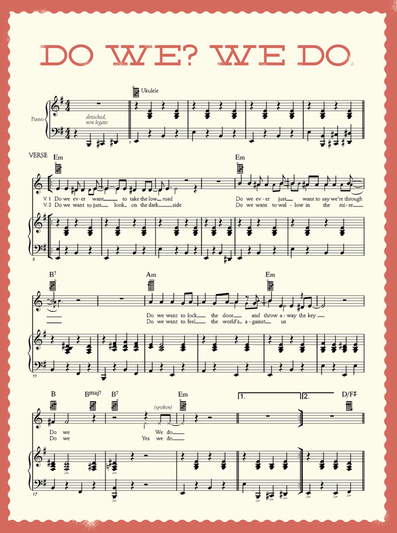
Beck’s Song Reader

Man, do I love this project. 

In December 2012, Beck is set to release an “album” of sheet music. From the project page at publisher McSweeney’s:

In the wake of Modern Guilt and The Information, Beck’s latest album comes in an almost-forgotten form—twenty songs existing only as individual pieces of sheet music, never before released or recorded. Complete with full-color, heyday-of-home-play-inspired art for each song and a lavishly produced hardcover carrying case (and, when necessary, ukelele notation), Song Reader is an experiment in what an album can be at the end of 2012—an alternative that enlists the listener in the tone of every track, and that’s as visually absorbing as a dozen gatefold LPs put together. The songs here are as unfailingly exciting as you’d expect from their author, but if you want to hear “Do We? We Do,” or “Don’t Act Like Your Heart Isn’t Hard,” bringing them to life depends on you.


This project is pushing every one of my music-nerd buttons. Of course it’s a gimmick, of course it’s a little precious. But we are going through a revolutionary time in music history, and this project is folding that history back on itself to bring back another time where the economic math of music was being recalculated.

Commercial music publishing is not a very important facet of the music business today. You can walk into any music store and see sheet music singles for Top 40 hits, but it’s also true that it’s easier to make a piano/vocal reduction of The Carpenter’s “We’ve Only Just Begun” than Ke$ha’s “TiK ToK.*” It’s hard to imagine from today’s perspective how disruptive a technology popular song sheet music was.

*Sheetmusicplus.com did have one hit for Ke$ha, surprisingly.

Notation (which is a kind of recording) introduced two important concept to music: the idea of a definitive version of a musical piece, and the idea of authorship of a musical piece. That first idea is inherent to the project of notation; just like speech, somebody might say things many different ways, or vary the way that they say it, but when you write something down, you’re only writing one thing down. The concept of authorship evolved over time. At first, as in Gregorian chant, a piece of music might be tied to the church or court that used it, the composer being anonymous. But as the composer evolved to become a separate artistic entity, there became only one Beethoven’s Fifth, and it was in one form and it was written by Beethoven.

But even through the invention of notation, even through the elevation of the composer, there was still no fixed concept of ownership of melody. Classical music constantly borrowed, stole, or arranged popular music or folk tunes; words were added to catchy classical melodies; people wrote new lyrics to popular tunes, dances and melodies disseminated and combined with each other. But when the commercial printing press combined with printed music, and the legions of newly middle-class women (usually) for whom a piano in the home and piano training were the markers of gentle society, you have a situation where independent songwriters can make a living by filling the void of new music. Remember, no record players. If you wanted music in the house, you made it yourself. And just as today, everybody wants new.

It’s impossible to overstate how influential these songs and songwriters were. Many of their compositions survive today, mistaken for folk songs: “Oh, Susanna” “Camptown Races” “Beautiful Dreamer” (Stephen Foster); “My Grandfather’s Clock” (Henry Clay Work); “The Daring Young Man on the Flying Trapeze” (Gaston Lyle); all of these were songs written and distributed as sheet music before the avent of recordings. Early recordings, in fact, were promotional material to sell sheet music! And even as revenue from the sale of recordings overtook that of sheet music, the dynamics of that era survive today through the power of the professional association for songwriters (ASCAP) and the large royalty payment that goes to the songwriter with every recording sold or licensed, often larger than that to the performer, largely because the songwriter holds copyright.

So let’s bring it back to Beck, and his song collection, and what it says about today.

First, I see it as a reminder that the economics of the music business are not set in stone, not given by God. The idea that I hand someone money for a physical object that contains a recording of a particular song by a particular artist is fairly new. Before that, I would pay money for a piece of sheet music that represented a particular song, but I was the performer. And before that I paid musicians, but there was no such thing as the definitive version of a song or a melody. Once, recordings were promotions for sheet music. Now, recordings may just be promotions for live shows. Of course this is going to change the quantity and the quality of the music we produce, but we’ll figure out how to make it work. Until something else comes along.

Second, I think this project is interesting in light of the conversations we’re having about remix culture and “audience” participation in works of culture. Think about it as a three-way tug-of-war between songwriter (or composer), performer, and audience. For all the talk of sampling, remixes, mash ups, YouTube covers, etc., we have to remember that the recording era had less audience participation than the sheet music era that preceded it. Beck is bringing music back to an era in which the act of consuming music was also an act of creation. It’s a nice reminder that, in an era where musicians are experimenting with interactive apps, or releasing workfiles to facilitate remixing, or even creating new music through fan videos, that the thing that hath been, it is that which shall be; and that which is done is that which shall be done: and there is no new thing under the sun.

Either this is amazing or I’m dumb

I stumbled upon this Wikipedia page for the Triangle of U, which as far as I understand is a phenomenon whereby three different genomes, in different combinations, create different crops, including: turnips, kale, different mustard species, cauliflower and rapeseed (canola).  I’m terrible at even basic biology, but this seems so amazing to me. I’d love to get some feedback in the comments if anybody knows if this is more common than I think.