last postcard of 2014

Staycation

I’ve been on a staycation for the last week and a half, combining some vacation time with the paid holidays. For the first couple of days, I felt a little bit guilty about just staying home, like I was squandering a valuable resource. One thing that I’ve realized is really important to me in a vacation is not feeling like I’m rushed, and that there’s some kind of sense of abundance. So I’m glad I didn’t spend to go somewhere and then had to pinch pennies while I was there.

I wasn’t quite prepared to fall apart completely right after my last day of work, though. I’ve been trying to push myself out of my comfort zone and minimize alone time, the thought of trying to fill two weeks of free time caused me to dissolve and turn into a giant needy piece of shit. I sent out a series of poorly-thought-out OKCupid messages that dialed up the impatience and neediness by at least 300%. Over the next couple of days I was hit by a swift and severe case of the Christmas Special, Everyone-Is-Leaving-Me Blues. Once that passed though, I’ve been super content and chill and happily introverted. 

Christmas

I spent Christmas Eve at Trinity Episcopal Cathedral. Episcopalians know how to do a beautiful service. I misread the time that the service would start, and so decided to duck into a bar for a drink (I know, I know—what a rebel). It was kind of a shithole sportsbar that I would have hated anyway, but it was also a little bit too sad. I felt pretty uncomfortable and finished my drink quickly and just walked around the neighborhood listening to podcasts. Beautiful organ program, decent selection of carols, really nice choir program and performance. I saw that one of the apprentice musicians was somebody that I met when we studied with the same organ teacher. I had a huge crush on him back then, but I didn’t actually see him anywhere there to say hi.

I spent Christmas day and dinner with my best friend’s boyfriend’s family. It was really nice to observe family dynamics without having any skin in the game. I could sit back and watch questions go to him like “How serious is this girl?” and “So when are you having kids?” with both safety and the gleeful and perverse interest of the Best Friend that [He Has] to Keep Happy.

Cigarettes

I finally had a “this is it” moment a couple weeks ago and decided to prioritize quitting smoking. This past weekend was really tough because I was drinking with people that I usually smoke with and there were plenty of cigarettes and smoke around. I can’t wait until my lungs come back and the cough goes away, I’m a little discouraged by how long that part of the process is taking, and there have been other side effects to the nicotine replacement that I’ve been taking that has me feeling a little bit worse off for all the effort right now.

I’ve also started walking every day—that’s a little more recent. I’m just trying to cultivate a new habit. Right now my mood is really good and filled with a real sense of possibility. Even as recently as a few weeks ago, certainly last month, I was really overwhelmed with this dissatisfaction at the thought that I was stuck in a cycle of mitigating the consequences of decisions I had made in the past when I didn’t understand what was at stake. What’s taken its place is a really nice optimistic mood, a feeling like right now I am at the beginning of my story, not at the end of a story or in the middle of one that’s in progress.

Some Bad News

One piece of upsetting news is that my therapist is closing his practice. I’m glad that this didn’t come at a more life-and-death time, but I’m really not looking forward to starting from the beginning with somebody new. I’m worried that I won’t be strong enough to be as honest with the next person as I have with my current therapist, who has really seen me at my worst and messiest.

Tires

I bought some tires yesterday. They were way past due, and it reminded me of the way that anybody who works at a job that interacts with the public (like I do) inevitably begins to judge people based on the way that they behave as customers. Please, Mr. Les Schwab, know that I am better than my bald tires.

Goodbye to 2014

It’s been a big year for me. I don’t have some big thesis about what it all meant, but as I look back, there have been a lot of highlights:

79 pages journaled • moved to a new job • got a raise • got to meet and work with some really special kids and families • finished some poems, and showed them to another human • Grand Budapest HotelBoyhood • moved to a new house, gained a new roommate • Portrait of the Artist as a Young Man • started therapy again to work on becoming the person that I want to be, not just out of a sense of crisis • reawakening my creative self • playing music socially • renegotiated and changed patterns with almost all of the friends that I have • made some new friends • cooked some ramen from scratch • Mindset • really attacked some of my issues of self-confidence and self-worth • walked in my first pride parade • became more comfortable flying solo and going to bars and social spaces by myself • saw Bombay Bicycle Club live • got a beautiful summer tan • went on a couple dates with boys • I had the confidence to dramatically change up my personal appearance • I partied hard a couple nights • I quit smoking.

I feel like resolutions are the easiest way to get angry at yourself in mid-January, so I don’t do them, but I’m hoping that 2015 will come with even more forward momentum.

Happy New Year

Pioneers in the Graveyard

I went for a walk through a historic graveyard. Most of the people seemed to be dead before the 1940’s, although there were some random 00’s scattered amongst the pioneers. The graveyard in my hometown is beautiful, though it has a little bit of a sterile, David Hockney quality, all flat lawns and sunlight and palm trees. The dead find their rest and, like the living, are rarely bothered by the weather. 

The Oregon graveyard is scarred by the weather. Grave markers sink quietly into the uneven ground, while more ostentatious markers are overtaken by moss. 

The most interesting feature of the cemetery were large rococo stelae in the shape of trunks, complete with gnarled bark and forest creatures. It reminded me of the pioneer identity that must have been so important to previous generations of Oregonians–I am the worst kind of outsider, a Californian–, an identity that I don’t really see in the culture here, except in museums and school names. I was struck by its tackiness and its idiosyncrasy: I didn’t imagine that the person who could afford to be buried in the city and have a person-height memorial was the coonskin hat wearing type, and at the same time, it’s hard to imagine anything like it anyplace else.

My mind wandered to the tension between the local and the universal. I’m one of those high culture types. I believe, sincerely, that great culture can come from anywhere and be an asset to the world. Japanese film. Tequila. Gumbo. Whatever. One of the things that eats at me, though, is that it is exactly my type of person that is the most threatening to folk cultures, to local variation, to art forms not yet recognized as such. 

There seems to be a life cycle: a culture forms as a response to change. That culture challenges baseline assumptions of existing cultural forms. Those existing forms have already achieved legitimacy, so culture defenders (again, I think of myself as one of them) form ranks to protect them. The new form hangs on. The new form becomes popular because of its newness. The new form becomes old, but has built up a body of practitioners and ideas about itself. The culture defenders recognize the wealth of culture that has built up, and incorporate it into existing patterns of cultural presentation/prestige. This hybrid form becomes part of the world culture. 

For that life cycle to complete itself requires that I have a shadow twin. Somebody that believes the local/new/yet-unrecognized culture is legitimate in and of itself. That rejects the influence of the wider culture as intrusion. One of the things that most difficult for me to accept is that perhaps the perfect outcome is that we both be in balance, that neither one achieves dominance over the other. Too much high culture, and the idiosyncrasies of the local culture become ironed out, homogenized. Too much of the local culture, and it dies with its last practitioner, or never evolves in complexity in response to the mixture of other cultures. 

Portland is going through a bit of a high culture moment. Its aspirations, in its restaurants, art scene, music culture, is to be a “world class” city. But where does that leave the pioneers? Are they present with us, in mason jars of bourbon drinks, in the fresh local produce and heritage breeds featured in its restaurants, in the genderfuckery and tolerance for experiment in its art scene? Or are they dormant, preserved in the cold earth, waiting to take their place as grandparents of the future city? 

10 Pancakes I Have Known

Fluffiest Pancakes

1. My grandparents lived in a 40’s ranch-style house in the hills of LA County. Spending the weekend at their house meant blueberry pancakes during Sunday morning breakfast. My grandfather was a research chemist. He loved electric ranges because they had a scale, and a 7 was always a 7 and a 5 was always a 5. My dad swears that he kept a lab notebook in the kitchen and flipped his pancakes when cued by a timer. I don’t remember any of that, or very many of my own memories of my grandfather, but I do remember the frozen blueberries he would add to the batter. I remember their taste of burnt fruit sugar.

2a. In the summers, we would take vacations in Mammoth Lakes, where my dad had lived in his twenties. There’s a country cafe there called The Stove, the kind of restaurant where things come in skillets and has a gift shop. One day, I wanted to order buckwheat pancakes, something I had heard about from Literature, probably one of the Little House books. I felt very grownup, ordering such a sophisticated pancake. It was the first time I remember being aware that different flours, different grains, could have different tastes. They tasted like pancakes with a new dimension.

2b. Later, as an adult, I noticed that there was a buckwheat pancake mix on the shelf and put it into my cart. I learned to add extra water to the batter to create the thin, flat cake that I love, and to sweeten the batter with thick, black molasses. They still make me feel grownup.

3. I was eleven years old and we were traveling through Idaho on the way back from a trip to the great National Parks. We stopped at a beautiful rambling rural house, all screened porches and garden plots and plaster walls. Produce was in high summer season, and we ate from the garden. My job was to make sure that my brother and sister bothered me first about being bored, and to look like kids you would want to have to my dad’s old friends, they that owned the house. Everything went wrong. The tent–adventure!–my siblings and I slept in had a hole in it, and we were consumed by mosquitos and other summer bugs. My brother got a spiderbite that caused his whole hand to swell up and ooze clear pus from the bite marks. In the morning, they made us pancakes from expensive, organic pancake mix of various flours and nuts. The oils in the mix were rancid, and the cakes tasted awful. My sister and I were confused, because maybe they were supposed to taste like that? My brother has always been pickier, and he threw pleading eyes at me. My stomach turned at the thought of insulting a host. I was the oldest, and I knew that it was my job to say something, so I said something. And of course the hosts tasted the pancakes, realized that the flour had spoiled, and then felt even worse that my sister and I had tried to eat them anyway. Later, when I am asked to think of an example of when I was vulnerable, I think of this memory. When I think about a time when I was a leader, I think of this memory.

4. Once in Mrs. Kwazny’s 3rd grade classroom we all made pancakes. I loved using the flour sifter. O proud me brought back the paper handout with the recipe, so that we could make it at home. We never did, but it’s there in my mother’s recipe binder 16 years later because someone loves us all.

5. Pancakes and fried eggs taught me how to cook at the stove. The mistakes I would make! Pancakes with uncooked Bisquick in the middle. Burned black on one side, carbon dioxide holes like pockmarks on the other. My mom would never have anyone over to the house without having twenty people over to the house, and would never cook a meal without cooking three meals, in portion and number of dishes. I learned to cook by helping her entertain. I haven’t yet learned how to fill my house like she fills hers, but I think that when I have a single dish to cook, I’m just as good as her. She doesn’t know I think this. Please, gentle reader, don’t tell her.

6a. There would be buses to town on the weekends, and the rich kids that could afford to eat at restaurants would get breakfast on Sunday mornings. One of the restaurants was French, and had delicious crepes. These are technically pancakes I haven’t known, because I never ate there. My friend John would talk about how much he liked them, and I would say that I didn’t like them, and call him pretentious. One day, the dining hall made apple blintzes. I thought that they were very gross, and that they were what crepes tasted like, so I never wanted to try them again.

6b. Later, in Portland, a friend makes me try her lemon and sugar crepe from the carts on 11th and Hawthorne. When I feel myself getting too attached to a position, getting too entrenched in a dislike, I think of how much I like crepes now.

7. “Banana Pancakes” by Jack Johnson is the best pop song about pancakes, by default.

8. We went to Albuquerque to scatter my grandmother’s ashes on the mountain that overshadows the junior high school where she met my grandfather. We stayed at a hotel that had a pancake machine with a tank of batter and integrated, hot plate-like griddle so that you could press a button and it would make a fresh pancake. I watched people make pancake and felt the joy of human enterprise & the earthy optimism of mechanical invention.

9. I have never been in love, but I would like to someday. My best friend and I talk often of first pancakes, pancakes that are meant to be thrown away. When I meet men I try not to think of their cakeyness, because when I make pancakes now I don’t need to throw the first one away. When I worry, I worry about batter, not burning.

10. My roommate Lauren made pancakes this morning. I never turn down pancakes, and I was right. They were delicious.


The Handmaid's Tale

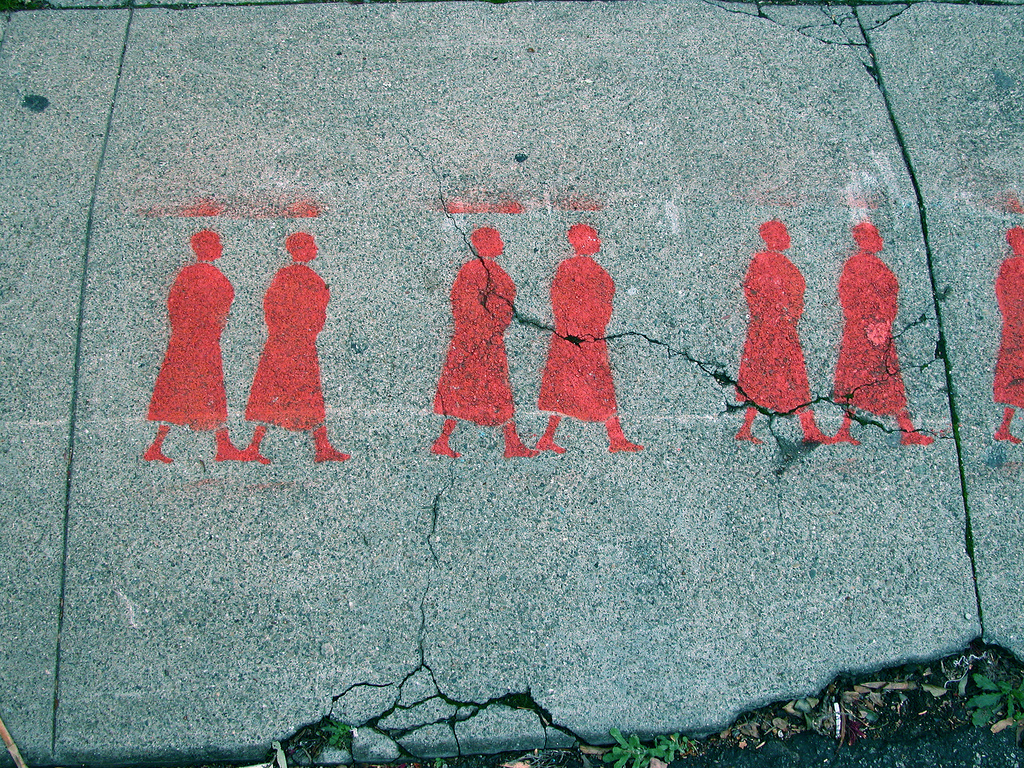
red stencil walkers
Many people that I know read The Handmaid’s Tale in high school. I didn’t. Because so many people come to it when they are younger, when they are developing their consciousnesses, I thought the book would be more polemical, more manifesto. The book makes a clear statement, and has the anger and righteousness of a manifesto, but I was surprised to discover that Offred’s voice was an ambivalent, human voice. I thought it was an extremely brave thing of Atwood to do to have so much of Offred’s internal monologues, especially her regrets, to focus on the loss of her child and husband. It would be less complicated to have a character that only has hate for men, only resents her own ability to create children, but by embracing that complication, the book seems more truthful to me. It’s incredible to think how much time has passed since the publication of the book, and how nothing so substantial has changed that it seems to invalidate the premise of the story.
I’m thinking of this story in Fortune about women in the tech industry. One way of saying that “Everyone was the same, and no one was like me.” is that these jobs are not designed to be filled by people who have a family. Sometimes that means no women, but even their male workers are expected to have a “traditional” family structure simply because these men cannot contribute in that way to the household. There’s a scene in the Tale where all women workers are summarily fired and their financial accounts frozen. We despise the men in that story for saying nothing. Maybe that wouldn’t happen in reality today, but if there was suddenly a new law that meant that maternity leave was more inconvenient/more expensive for employers and women workers suddenly found their careers stalled or themselves forced out, how many workplaces are there in which men would stand up? Would we say anything if it didn’t happen all in one day? Would I notice?

I’m also thinking of an episode of The Dick Cavett Show  I watched once while I was fucked up. Carole Burnett was the guest.I thought it was the craziest thing I had ever seen, because she was so comfortable, relaxed, bantery, funny. And also because she seemed to have the cool/funny girl schtick that I associate with entertainers like Mindy Kaling, Tina Fey or Lena Dunham. The pose that says that Sexism is bullshit and totally happens to me but I can joke about it and I’m not going to let it stop me because eh, what are you going to do? But then again, there’s something aggressive about a male interviewer opening his segment by grilling her about her sexual history. And we look at that as both banter and also as something uncomfortable, something that probably wouldn’t happen today. But if it did, it would seem “edgy” and “honest” and we would all get a thrill out of breaking the same taboo that Burnett and Cavett were breaking. Especially now as Lena Dunham becomes the center, again, of whether she is or is not a Feminist Icon of Our Times, I can’t help but look back and forth between Dunham and Burnett and the context of their times and think This will never be enough. And then I think about how lonely Margaret Atwood must get sometimes if she’s spent her entire life thinking that all of it will never be enough.

The Handmaid’s Tale

red stencil walkers

Many people that I know read The Handmaid’s Tale in high school. I didn’t. Because so many people come to it when they are younger, when they are developing their consciousnesses, I thought the book would be more polemical, more manifesto. The book makes a clear statement, and has the anger and righteousness of a manifesto, but I was surprised to discover that Offred’s voice was an ambivalent, human voice. I thought it was an extremely brave thing of Atwood to do to have so much of Offred’s internal monologues, especially her regrets, to focus on the loss of her child and husband. It would be less complicated to have a character that only has hate for men, only resents her own ability to create children, but by embracing that complication, the book seems more truthful to me. It’s incredible to think how much time has passed since the publication of the book, and how nothing so substantial has changed that it seems to invalidate the premise of the story.

I’m thinking of this story in Fortune about women in the tech industry. One way of saying that “Everyone was the same, and no one was like me.” is that these jobs are not designed to be filled by people who have a family. Sometimes that means no women, but even their male workers are expected to have a “traditional” family structure simply because these men cannot contribute in that way to the household. There’s a scene in the Tale where all women workers are summarily fired and their financial accounts frozen. We despise the men in that story for saying nothing. Maybe that wouldn’t happen in reality today, but if there was suddenly a new law that meant that maternity leave was more inconvenient/more expensive for employers and women workers suddenly found their careers stalled or themselves forced out, how many workplaces are there in which men would stand up? Would we say anything if it didn’t happen all in one day? Would I notice?

I’m also thinking of an episode of The Dick Cavett Show  I watched once while I was fucked up. Carole Burnett was the guest.I thought it was the craziest thing I had ever seen, because she was so comfortable, relaxed, bantery, funny. And also because she seemed to have the cool/funny girl schtick that I associate with entertainers like Mindy Kaling, Tina Fey or Lena Dunham. The pose that says that Sexism is bullshit and totally happens to me but I can joke about it and I’m not going to let it stop me because eh, what are you going to do? But then again, there’s something aggressive about a male interviewer opening his segment by grilling her about her sexual history. And we look at that as both banter and also as something uncomfortable, something that probably wouldn’t happen today. But if it did, it would seem “edgy” and “honest” and we would all get a thrill out of breaking the same taboo that Burnett and Cavett were breaking. Especially now as Lena Dunham becomes the center, again, of whether she is or is not a Feminist Icon of Our Times, I can’t help but look back and forth between Dunham and Burnett and the context of their times and think This will never be enough. And then I think about how lonely Margaret Atwood must get sometimes if she’s spent her entire life thinking that all of it will never be enough.