
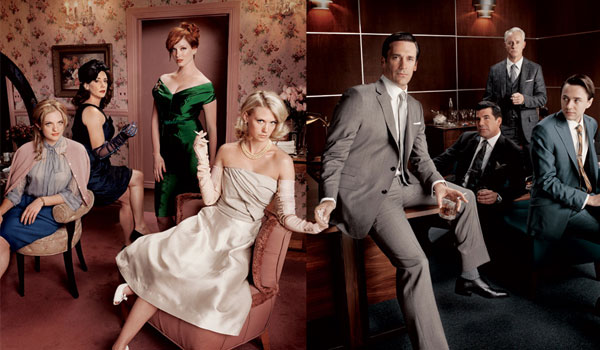
Mad Men & The Beatles


Readers who legitimately do not give a shit about Mad Men may still be interested in my comments on the Beatles album Revolver after the embedded YouTube video.
I have no interest whatsoever to blog seasons of television or do recaps or anything that needs to be timely or consistent, but I do want to say that I’m enjoying Mad Men so much this season; it may be my favorite season so far. I’m sure that almost everyone has decided at this point whether they’re into the show or not, so writing or talking about the show can feel a little circlejerky, but the show has changed so much over time that I feel like evangelizing the show all over again.
I feel like Mad Men‘s dramatic juice has always come from this combination of elements (and disregarding, for the moment, other concerns like marketing, costume design, cast etc.):

  1. The charisma and mystery and glamour of the character of Don Draper.
  2. The art and science of advertising, and
  3. The knowledge that the next decade, and the judgment of history, are going to hit this class of people like a bus.

Mad Men’s M.O. has generally been to foreground 1 & 2, while letting 3 work quietly in the background, visible only to the viewers. This formula has shifted over time. For one, Don Draper is just less mysterious. We may still be captivated by the way that he behaves and his responses to situations, but there’s no more puzzle to his history, and we’ve come a long way from watching him navigate between his wife and his piece on the side. For the last couple of seasons, even as the show stays anchored in the workplace, there is less emphasis on the advertising business. In the first season, it seemed like the show was going to establish a product-of-the-week format. This season, there have still been some high profile clients that contribute a C- or D-plot (Howard Johnson’s, Miracle Whip), but there’s less pontificating on the nature of advertising, fewer Draper pitches, fewer observations about what people want.
But where this season has been really shining is with that third element. Change has come to the foreground. Changes in music, in morés, style and class, there hasn’t been an episode this season where our characters haven’t been confronted by the culture moving to another place, or disrupted by a person that’s already there. One of my roommates is watching the show for the first time, and one huge contrast between the first season and the current season is the first season, both in both its style and its narrative, is about deeply controlled people. Their suits are fitted. Their lives, even as they are falling apart behind closed doors, are carefully compartmentalized. The most shocking moment of the pilot is Don Draper, who we’ve come to know in the context of his workplace, open his door and step into his role as father and husband. In comparison, this season is very messy. Characters are divorcing, shacking up; colors are loud, patterns clash; and the braintrust of Sterling Cooper Draper Pryce is increasingly buffeted by changes in mass taste and an increasingly politicized culture.
Some of the fun of this season is watching unexpected reactions to those changes–the same Roger Sterling who performed in blackface has seemingly skipped a generation and become an LSD-dropping nihilist, while the same Pete Campbell who was batted away from pursuing black-targeted accounts has begun to act out with all the propriety of a drunken salaryman at a karaoke bar–but none has been more interesting to watch than Don Draper. Because this is supposed to be the time where the culture catches up to Don Draper. In earlier seasons, Don is shown to be operating ten years ahead of his clients by producing ads that focus on the lives and desires of consumers rather than on products. At times, particularly in his preference for and interactions with strong, independent women, and his apparent dislike for the rules prescribed for men in gray suits, he has seemed like the audience-insertion character. Don’s pitches used to promise the future. But now we’re in the future, and it’s a new world of Beatles and beatniks, of civil rights and antiwar left, a world that Don is increasingly reluctant to embrace.


Last episode featured the Beatles song “Tomorrow Never Knows” in an extremely effective manner. This season has featured many “the 60’s are here” moments, but few have been as powerful as Ringo’s snare knocking on Don Draper’s door to introduce sounds that have become deeply integrated into contemporary pop culture’s DNA. And so I have found myself completely, and admittedly sheepishly, obsessed with Revolver.
It is because of the centrality of the Beatles catalogue to popular music that it has been hard for me to listen to their music as music, or listen to their albums like any other band. It was only a few months ago that I decided to try and listen to the albums through to get a sense of them as albums, instead of units containing some of the hits that I knew. I began with Sgt. Pepper’s, then slowly through  Rubber Soul  and Abbey Road. Somehow, I had not yet gotten to Revolver. I had heard from music people that Revolver was the best Beatles album, but I never appreciated the extent to which it–and Sgt. Pepper’s–are simply in a league of their own*. Rubber Soul is too indebted to their earlier pop rock sound, Abbey Road has a signal to noise ratio that’s too low, and Let It Be is moribund. In these two albums, they managed to do everything they do well right, and produce an astonishing amount of perfect songs on each. My the worst track on Revolver is either “Doctor Robert” or “Taxman,” and both of them are extraordinarily good songs.
*I’m going to break in with a couple of caveats here: One, a general disclaimer that I haven’t heard all of the albums yet. So I’ll admit the possibility that one of the other albums might just be that much better (though somehow I don’t think Magical Mystery Tour will be it). Two, it’s relevant that I really hate most of the early-Beatles, teen idol-y songs. I imagine that there is still some cohort that dislikes all of their albums after they went to India. But for me, almost all of those early albums are going to be disqualified.
Listening through Revolver also provided me with one of those cherished opportunities to check in with my own evolving tastes. I remember having a conversation with my piano teacher’s husband about whether we liked the Beatles by John Lennon or the Beatles by Paul McCartney better. I declared myself a McCartney man. My piano teacher told me to “give that time.” And that’s proven to be completely true. I can see where I was coming from; I played piano, and all of the best Beatles songs to play on the piano are Paul’s ballads (“Let It Be,””Yesterday”)**. Lennon’s songs tended to be more guitar-riff driven and  production-heavy.*** Scanning a tracklist of Revolver reveals that all of the songs that have been rocking my shit are Lennon songs.
**It took me time to discover that the best McCartney songs are the quasi-art songs: “She’s Leaving Home,” “Penny Lane” “The Long and Winding Road” etc. 
***Though, of course, those taxonomies can be deceptive. “Helter Skelter,” for example, is a McCartney song and is about as aggro as the Beatles get, while “Something” was written by George Harrison and is (with the exception of an extra-prominent guitar solo) almost a quintessential Paul song.
And now just a few thoughts on individual tracks:

  • “I’m Only Sleeping” and “Here, There and Everywhere” are weirdly mirror images of each other; the root of the chord progressions in their choruses are extremely similar, 1-2-3-4 (Here, There and Everywhere) and 1-2-3-2 (I’m Only Sleeping), yet I can’t stand HTE, and can’t get enough of IOS. IOS contains maybe my favorite use of sweet oohing harmonies, and the backtracked guitar solo is still just the greatest.
  • For all that the 90’s Britpop genre (Oasis, etc.) is pretty much defined by an indebtedness to the Beatles, “She Said, She Said” is maybe the only song in their catalog that I think could just be a 90’s song, if John Lennon didn’t have one of the most distinctive voices in rock. For that matter, the guitar intro could kick off a Pavement song. The drumming on this track is sublime; the only time that I have been completely impressed with Ringo Starr.
  • “For No One” is almost a perfect song, but the dotted rhythm at the end of “no sign of love behind the tears” is like jamming an icepick into my ears, I hate it that much.
  • “Tomorrow Never Knows” is still the greatest: epic tape loops and distortion; Lennon’s incantation-like delivery; anti-guitar solos; mystical nonsense that smells like profundity; a killer drum and bass ostinato; a maximalist masterpiece.
Mad Men & The Beatles

Readers who legitimately do not give a shit about Mad Men may still be interested in my comments on the Beatles album Revolver after the embedded YouTube video.

I have no interest whatsoever to blog seasons of television or do recaps or anything that needs to be timely or consistent, but I do want to say that I’m enjoying Mad Men so much this season; it may be my favorite season so far. I’m sure that almost everyone has decided at this point whether they’re into the show or not, so writing or talking about the show can feel a little circlejerky, but the show has changed so much over time that I feel like evangelizing the show all over again.

I feel like Mad Men‘s dramatic juice has always come from this combination of elements (and disregarding, for the moment, other concerns like marketing, costume design, cast etc.):

  1. The charisma and mystery and glamour of the character of Don Draper.
  2. The art and science of advertising, and
  3. The knowledge that the next decade, and the judgment of history, are going to hit this class of people like a bus.

Mad Men’s M.O. has generally been to foreground 1 & 2, while letting 3 work quietly in the background, visible only to the viewers. This formula has shifted over time. For one, Don Draper is just less mysterious. We may still be captivated by the way that he behaves and his responses to situations, but there’s no more puzzle to his history, and we’ve come a long way from watching him navigate between his wife and his piece on the side. For the last couple of seasons, even as the show stays anchored in the workplace, there is less emphasis on the advertising business. In the first season, it seemed like the show was going to establish a product-of-the-week format. This season, there have still been some high profile clients that contribute a C- or D-plot (Howard Johnson’s, Miracle Whip), but there’s less pontificating on the nature of advertising, fewer Draper pitches, fewer observations about what people want.

But where this season has been really shining is with that third element. Change has come to the foreground. Changes in music, in morés, style and class, there hasn’t been an episode this season where our characters haven’t been confronted by the culture moving to another place, or disrupted by a person that’s already there. One of my roommates is watching the show for the first time, and one huge contrast between the first season and the current season is the first season, both in both its style and its narrative, is about deeply controlled people. Their suits are fitted. Their lives, even as they are falling apart behind closed doors, are carefully compartmentalized. The most shocking moment of the pilot is Don Draper, who we’ve come to know in the context of his workplace, open his door and step into his role as father and husband. In comparison, this season is very messy. Characters are divorcing, shacking up; colors are loud, patterns clash; and the braintrust of Sterling Cooper Draper Pryce is increasingly buffeted by changes in mass taste and an increasingly politicized culture.

Some of the fun of this season is watching unexpected reactions to those changes–the same Roger Sterling who performed in blackface has seemingly skipped a generation and become an LSD-dropping nihilist, while the same Pete Campbell who was batted away from pursuing black-targeted accounts has begun to act out with all the propriety of a drunken salaryman at a karaoke bar–but none has been more interesting to watch than Don Draper. Because this is supposed to be the time where the culture catches up to Don Draper. In earlier seasons, Don is shown to be operating ten years ahead of his clients by producing ads that focus on the lives and desires of consumers rather than on products. At times, particularly in his preference for and interactions with strong, independent women, and his apparent dislike for the rules prescribed for men in gray suits, he has seemed like the audience-insertion character. Don’s pitches used to promise the future. But now we’re in the future, and it’s a new world of Beatles and beatniks, of civil rights and antiwar left, a world that Don is increasingly reluctant to embrace.

Last episode featured the Beatles song “Tomorrow Never Knows” in an extremely effective manner. This season has featured many “the 60’s are here” moments, but few have been as powerful as Ringo’s snare knocking on Don Draper’s door to introduce sounds that have become deeply integrated into contemporary pop culture’s DNA. And so I have found myself completely, and admittedly sheepishly, obsessed with Revolver.

It is because of the centrality of the Beatles catalogue to popular music that it has been hard for me to listen to their music as music, or listen to their albums like any other band. It was only a few months ago that I decided to try and listen to the albums through to get a sense of them as albums, instead of units containing some of the hits that I knew. I began with Sgt. Pepper’s, then slowly through  Rubber Soul  and Abbey Road. Somehow, I had not yet gotten to Revolver. I had heard from music people that Revolver was the best Beatles album, but I never appreciated the extent to which it–and Sgt. Pepper’s–are simply in a league of their own*. Rubber Soul is too indebted to their earlier pop rock sound, Abbey Road has a signal to noise ratio that’s too low, and Let It Be is moribund. In these two albums, they managed to do everything they do well right, and produce an astonishing amount of perfect songs on each. My the worst track on Revolver is either “Doctor Robert” or “Taxman,” and both of them are extraordinarily good songs.

*I’m going to break in with a couple of caveats here: One, a general disclaimer that I haven’t heard all of the albums yet. So I’ll admit the possibility that one of the other albums might just be that much better (though somehow I don’t think Magical Mystery Tour will be it). Two, it’s relevant that I really hate most of the early-Beatles, teen idol-y songs. I imagine that there is still some cohort that dislikes all of their albums after they went to India. But for me, almost all of those early albums are going to be disqualified.

Listening through Revolver also provided me with one of those cherished opportunities to check in with my own evolving tastes. I remember having a conversation with my piano teacher’s husband about whether we liked the Beatles by John Lennon or the Beatles by Paul McCartney better. I declared myself a McCartney man. My piano teacher told me to “give that time.” And that’s proven to be completely true. I can see where I was coming from; I played piano, and all of the best Beatles songs to play on the piano are Paul’s ballads (“Let It Be,””Yesterday”)**. Lennon’s songs tended to be more guitar-riff driven and  production-heavy.*** Scanning a tracklist of Revolver reveals that all of the songs that have been rocking my shit are Lennon songs.

**It took me time to discover that the best McCartney songs are the quasi-art songs: “She’s Leaving Home,” “Penny Lane” “The Long and Winding Road” etc. 

***Though, of course, those taxonomies can be deceptive. “Helter Skelter,” for example, is a McCartney song and is about as aggro as the Beatles get, while “Something” was written by George Harrison and is (with the exception of an extra-prominent guitar solo) almost a quintessential Paul song.

And now just a few thoughts on individual tracks:

  • “I’m Only Sleeping” and “Here, There and Everywhere” are weirdly mirror images of each other; the root of the chord progressions in their choruses are extremely similar, 1-2-3-4 (Here, There and Everywhere) and 1-2-3-2 (I’m Only Sleeping), yet I can’t stand HTE, and can’t get enough of IOS. IOS contains maybe my favorite use of sweet oohing harmonies, and the backtracked guitar solo is still just the greatest.
  • For all that the 90’s Britpop genre (Oasis, etc.) is pretty much defined by an indebtedness to the Beatles, “She Said, She Said” is maybe the only song in their catalog that I think could just be a 90’s song, if John Lennon didn’t have one of the most distinctive voices in rock. For that matter, the guitar intro could kick off a Pavement song. The drumming on this track is sublime; the only time that I have been completely impressed with Ringo Starr.
  • “For No One” is almost a perfect song, but the dotted rhythm at the end of “no sign of love behind the tears” is like jamming an icepick into my ears, I hate it that much.
  • “Tomorrow Never Knows” is still the greatest: epic tape loops and distortion; Lennon’s incantation-like delivery; anti-guitar solos; mystical nonsense that smells like profundity; a killer drum and bass ostinato; a maximalist masterpiece.
eyePhone

Blind iPhone users, via stuff.co.nz.

I was fascinated by this story from The Atlantic, describing how accessibility features of the iPhone are rapidly changing blind users’ daily lives. A description of some of the features:

Tatum is what Edmead calls “a techie.” She had a previous, failed experience with the Android, which almost made her give up the touch technology. Luckily, she kept her mind open enough to see how those around her are adapting to the iPhone. “I started ‘Info share’ five years ago, where a group for visually impaired people can share information.

A young lady, Eliza, got an iPhone, and she was entranced.” The sales representatives at the Verizon store, she says, were very nice and helped her set up her email account and sync her contacts. They didn’t know much besides that, and she had to teach them how accessibility is turned on (through Settings.) “They all went ‘Whoa!’,” she says.

Tatum and Rios happily volunteer to show off all their iPhone can do. “See, I tap it,” says Tatum, her iPhone stretched in front of her, “and it started reading out what is on the screen.”

Blind people use their iPhones slightly different than the sighted because, well, they can’t see what they’re tapping on. So instead of pressing down and opening up an app, they can press anywhere on the screen and hear where their finger is. If it’s where they want to be, they can double-tap to enter. If it isn’t, they’ll flick their finger to the right, to the left, towards the top or the bottom, to navigate themselves. The same for the simple “slide to unlock” command.

The article goes on to describe the way that apps developed specially for the blind, including navigational apps, color identifiers, and paper money identifiers, have started to replace single-use machines and even open up new sensory experiences. Austin Seraphin describes on his blog some of his first impressions in his first week of using an iPhone. Here, he describes being able to explore and share the world of color with the aid of an app:

The other night, however, a very amazing thing happened. I downloaded an app called Color Identifier. It uses the iPhone’s camera, and speaks names of colors. It must use a table, because each color has an identifier made up of 6 hexadecimal digits. This puts the total at 16777216 colors, and I believe it. Some of them have very surreal names, such as Atomic Orange, Cosmic, Hippie Green, Opium, and Black-White. These names in combination with what feels like a rise in serotonin levels makes for a very psychedelic experience.

I have never experienced this before in my life. I can see some light and color, but just in blurs, and objects don’t really have a color, just light sources. When I first tried it at three o’clock in the morning, I couldn’t figure out why it just reported black. After realizing that the screen curtain also disables the camera, I turned it off, but it still have very dark colors. Then I remembered that you actually need light to see, and it probably couldn’t see much at night. I thought about light sources, and my interview I did for Get Lamp. First, I saw one of my beautiful salt lamps in its various shades of orange, another with its pink and rose colors, and the third kind in glowing pink and red.. I felt stunned.

The next day, I went outside. I looked at the sky. I heard colors such as “Horizon,” “Outer Space,” and many shades of blue and gray. I used color cues to find my pumpkin plants, by looking for the green among the brown and stone. I spent ten minutes looking at my pumpkin plants, with their leaves of green and lemon-ginger. I then roamed my yard, and saw a blue flower. I then found the brown shed, and returned to the gray house. My mind felt blown. I watched the sun set, listening to the colors change as the sky darkened. The next night, I had a conversation with Mom about how the sky looked bluer tonight. Since I can see some light and color, I think hearing the color names can help nudge my perception, and enhance my visual experience. Amazing!

Some other interesting links: AppAdvice has a list of apps targeted toward blind users, or with thoughtful support for accessibility functions, as well as a list of games that blind users may enjoy.  MacWorld has a rundown of where these settings are located, and what each means. One feature not on the list, but mentioned by Seraphin in the post linked above, is that blind users have the option of disabling the screen and camera, which strikes me as pretty badass in the same way that when I was a kid I thought it was awesome that people who could read Braille could read in the dark. Finally, in a different realm of accessibility, David Pogue of the New York Times describes Apple’s implementation of custom gestures and options for users that don’t have the physical mobility to use multitouch gestures. Comments on the post from users are very interesting. Here’s one sample:

My 11 year old nephew has cerebral palsy. The iPad has opened up a whole world for him. Before the iPad, Nick needed help to surf the web, type, etc., with a regular computer. He lacks the strength and accuracy to press down on a physical keyboard. In addition to motor control problems, Nick’s speech can be difficult to understand. He has used and benefitted from two different AAC devices (assistive and augmentative communication) but they never became something he used in his daily life, only at/for school.

But Nick can use the iPad 100% independently, even without Assistive Touch, because he can tap, swipe and type on the large on screen keyboard, which is much larger than any smartphone. He can do everything on it and with it that any other kid can. He WANTS to use it because it’s cool and because it’s NOT for the disabled. He’s not different when he uses his iPad, he’s just like any other kid. Only luckier, cuz most of his friends don’t have one!

I am a speech-language therapist and I use Android text to speech apps with my adult patients with aphasia, but only has a demonstration of what’s possible because the keyboards are too small for them to use. I was already thinking of switching to an iPhone, and this is another reason to do so. I know that there is a risk of simply giving people with disabilities, especially kids, iPads and expecting them to develop communication skills. It doesn’t work that way, and over using iPads for therapy and education does more harm than good. But in the hands of capable teachers, iPads, iPhones and iOS can change lives.

All of this is super cool and super interesting, but the thing that I was really tickled by in the Atlantic story was this comment from one of the blind advocates:

Yet for all that technology has helped achieve, many in the blind community fear it might result in illiteracy in the generations to come.  “I think the technology that’s coming out right now is wonderful,” says Chalkias,”but I also think it’s dumbing us down because it’s making everything so easy. I have a lot of teens who have speech technology and they don’t know how to spell, and it’s horrifying to see that.”

Rios has encountered the same problem. She is an administrative assistant at the music school of Lighthouse International “an organization dedicated to overcoming vision impairment,” based in Manhattan, and a tutor at CCVIP who helps Maria with teenagers. “Even now I come in contact with kids who can’t spell,” she says. “Young adults don’t read Braille because they have screen readers who read for them.”

“I definitely think there’s benefits to this technology” Chalkias says. ”But if it keeps getting easier we’re just going to be a society of idiots that can’t do anything except tell our computers what to do for us.”

Among all populations, the more things change, the more things stay the same.

Losing Touch With The Young Folk

I was pretty gobsmacked by this story out of Portland, Maine*:

Over the next two weeks, Portland’s school district will install filtering software on laptops issued to high school students, in order to block access to pornography, social networking sites and video streaming sites when the laptops are at home.

Access to those sites is blocked now only at school, through the school network. The current filter doesn’t work when laptops are off school property.

The district will install filtering software made by Sophos, an Internet security company based in Boston. The software will be downloaded automatically when the students boot up their computers at school. Only when students get home will they discover that their lives have changed in a big way.

No longer will they have access to social networking sites like Facebook and video-streaming sites like Hulu and YouTube. Also blocked will be forums and news groups, games, dating sites, gambling sites and chat rooms.

Fortunately, the Kennebec Journal didn’t shy from the implications of this decision:

[School board Chairwoman Kate] Snyder said the school district shouldn’t give students equipment that makes it harder for parents to do their job, which is to help children stay focused on academics. She said the district has the right to filter the Internet.

“It’s a school-issued laptop,” she said. “If that’s something that the student wants to do on their own time and on a family computer, that’s OK.”

The change’s impact on students will depend on whether they have access to other computers at home. For many poor families, the school-issued laptop is the only computer in the house.

In interviews with Portland High students last week, those from middle-class families expressed various degrees of annoyance when told of the new filtering measures. A group of immigrant students reacted with anger.

“When we are at home, we need to have something else to look at besides homework,” said Fatush Jama, a senior.

“Where can we go to share if we don’t have Facebook?” asked Nateho Ahmen, a 17-year-old junior. “Who came up with this idea? We are going to have a long talk.”

This is not a legal question. Of course the school district has every right to install whatever software it wants on the computers it owns. But it’s hard for me to see this decision as anything but smallminded and passive aggressive.

First of all, I think it’s pretty uncontroversial to state that internet filters are nothing but odious joy killing vectors of hate. We’ve all had that experience of being interrupted at school, or at work in our quest for the answer to a question by an overzealous filter. Using the internet behind a filter is like browsing with a doddering uncle on your shoulder. He’s not entirely sure what’s going on, but he’s pretty sure that he disapproves. Not being able to leave him behind at the end of the school day sounds hellish.

Second, I think it’s pretty galling that a small group of parents pushed this through and made parenting decisions for the entire school district (that’s conjecture–there’s nothing mentioned about it in the article–but given that the school board member was the one dishing out the quote about giving control to parents, I think it’s pretty solid). I’m pretty sure the low income parents that use the computer as part time family computer are not the ones complaining. Sure, it’s primarily intended as a tool for school, but giving computer access to these families is a pretty valuable secondary social function. There’s something frankly ugly about denying access to families that don’t have other options.

But third, and most important, this decision shows a real failure of empathy on the part of the parent groups for the students they are responsible. Becoming out of touch with the culture is somthing I’ve been thinking about a lot, as I’ve reconsidered my relationship to pop culture and what’s popular. As I grow older, and my tastes more specialized, I’ve had to think about what responsibility I have to keep up with the culture at large. Another mental milestone passed by when I was reading a review for the new YA novel Fear, by Michael Grant, which posits a world in which everyone over the age of 15 mysteriously vanishes, and I realized that I had joined the masses of the dead. They told me to never trust anybody over the age of 25, and now that doesn’t seem very far away at all.  

But being out of touch with the chatter of the world happens, and I don’t really worry about it. There’s so much much in the world, and I don’t think anybody cares that much when a sheep drops out of the herd. What I really worry about is this exact kind of losing touch, where new technologies, new ideas, new social dynamics cut you off from your own experiences and your own former selves. Empathy is a plastic thing; I’ve met people in high school that will never be able to see themselves in people that did not grow up like them, and I’ve met older people that have stayed young, despite growing up in a world that may not exist anymore. Facebook is a new thing. But wanting to talk to your friends, gossiping about your enemies, developing a personality apart from your parents, even avoiding homework, these are very old things. And the smallmindedness of banning Facebook from school computers is the same smallmindedness of banning conversation during lunch, or restricting recess.

And we’ll all become old things too, whether that means over 15, or over 25, or over 55; age is a moving target. The boundaries of us and them will change whether we listen to top 40 or read the news or go to the movies. But we can resist forgetting what it means to be young.

*Which is, as regional allegiances require me to point out, the worst Portland.

Worlds Collide

I was fascinated by this profile, in The Smart Set of Henry Steel Olcott, the American leader of a Buddhist revival in Sri Lanka in the late 19th century. It would be hard to find a better example of an extraordinary person doing extraordinary things than Olcott’s life, spanning from antebellum United States:

Henry Steel Olcott began life in 1832 on a farm in Orange, New Jersey, the eldest of six children. His parents were devout Presbyterians who traced their lineage to the Puritans. Olcott would study agricultural science at what is now New York University, and then work in experimental agriculture, publishing several influential studies that gave him international renown. Olcott was a confident man and a modern man, unconventional and independent, excelling at whatever he did, an embodiment of the American ethic. He allied himself with the liberal causes of mid-19th century America: the abolition movement, the women’s movement, the temperance movement, the cremation movement. There is some evidence that a young Olcott dabbled in Spiritualism, a fad at the time. Everyone who knew Olcott thought of him as a man of principle, and also a kook, and maybe a visionary, too. When he tired of agriculture, Olcott decided he would be a journalist, writing for the New York Tribune and a few other papers. Around this time, Olcott married the pious daughter of an Episcopalian minister who bore Olcott two sons. But husband and wife were destined to grow apart, and eventually they divorced, leaving Olcott to explore his more experimental side.

At the onset of the American Civil War, Olcott joined the Union Army and served as the special commissioner of the War Department investigating fraud, corruption, and graft at the New York Mustering and Disbursement Office. By the time he was through, Olcott had achieved the rank of colonel. He became so well respected as a man who could get to the bottom of any injustice, the secretary of war appointed him to investigate the conspiracy behind the Lincoln assassination, which was accomplished in two weeks’ time. At the war’s end, Olcott decided he would leave government service and become a private lawyer specializing in insurance, revenue, and fraud.

and ending as a leader of men:

By the time Olcott died in 1907, it was clear he had played a crucial role as just such a leader. In Sri Lanka, Henry Steel Olcott would create scores of Buddhist schools, and many more would be built in his name. It was Henry Steel Olcott who initiated the design of the international Buddhist flag, and you see it everywhere in Sri Lanka, from temples to trishaws. His Buddhist Catechism has been translated into more than 20 languages and is still used in Buddhist education all over the world. And Olcott has been honored in kind. There are Henry Steel Olcott statues in Sri Lanka, and Henry Steel Olcott streets. There is a Henry Steel Olcott Memorial Cricket Tournament (perhaps the greatest honor Sri Lanka could bestow upon a man) held across the country each year.

In 1967, at a ceremony for the commemorative stamp issued in Sri Lanka to celebrate the 60th anniversary of Olcott’s death, then-Prime Minister Dudley Senanayake summed up Olcott thus: “At a time when Buddhism was on the wane in Ceylon, Colonel Henry Steel Olcott…awakened its people to fight to regain their Buddhist heritage. Colonel Olcott was one of the heroes in the struggle of Lankan independence…. Colonel Olcott’s visit to Ceylon was a landmark in the history of Buddhism.”

On a more personal level, I was intrigued by this tidbit: “At his funeral in India in 1907, his successor as resident of the Theosophical Society, Annie Besant, told the gathering of mourners that they were not to say goodbye to Colonel Henry Steel Olcott but merely to the cast-off garment that once held his spirit.” It turns out that this woman, Dr. Annie Besant, was one of the founders of Besant Hill School, a competing boarding school located in the town that I attended school in, Ojai, California. Ojai has a long history of strange religious establishment; the school that I attended is located next to a compound run by the followers of Jiddu Krishnamurti.