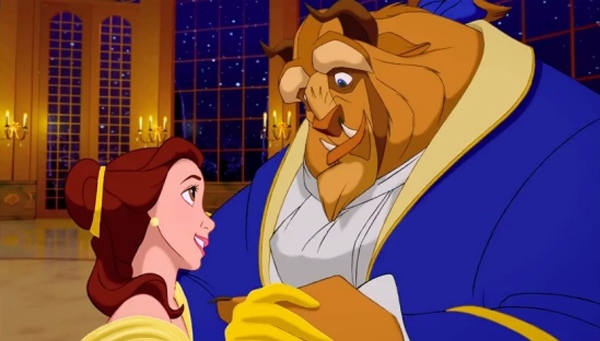
Saw the new Beauty and the Beast 3D rerelease tonight. I don’t have any special thoughts about the movie, as it has always been one of my favorites. I was a little too young to see it in theaters, however, and it did remind me that even now with high definition televisions and movie players the theater experience is something special.
It also made me think about Howard Ashman, the composer of Little Shop of Horrors, The Little Mermaid and Beauty and the Beast and a beautiful soul. His tragic young death of AIDS on the eve of Beauty’s release is covered in the excellent 2009 documentary, Waking Sleeping Beauty. We can never know what movies we’re missing if the dream team of Howard Ashman, Alan Menken, and the Disney Animation team were able to continue.
There’s video up at the Disney Parks blog of a scoring session for one of their new live shows at California Adventure in Anaheim. It’s a reworked version of “Night on the Bare Mountain” by Modest Mussorgsky, which was used for one of the segments in Fantasia. That piece has always fascinated me because of the dramatic difference between the circumstances in which it was written and the place it occupies now in our culture. The piece was reworked over and over again by Mussorgsky, and it was never played during his lifetime (in fact, the arrangement that is usually played in concert and in Fantasia was orchestrated by Rimsky-Korsakov). He is remembered only for “Night…” and Pictures at an Exhibition, and yet the music of this fairly minor and obscure Russian composer is heavily promoted by the Walt Disney Corporation, and people who have never gone to a classical music concert can hum its theme. It’s deeply tragic that the composer of one of the most widely recognized piece of classical music never heard it performed.
There are other examples of this. “A Lover’s Concerto” was a hit in 1965 for the girl group The Toys (it was later recorded by The Supremes); it’s a fairly literal translation of the Minuet in G Major from the Notebook for Anna Magdelena Bach. I was playing some Brahms, and one of my friends recognized the Violin Concerto from There Will Be Blood. I guess the strongest example is Also Sprach Zarathustra, used in 2001:A Space Odyssey.
I hadn’t seen the Muppet’s “Bohemian Rhapsody” until I read this article in the New York Times about it. I wasn’t disappointed. I especially appreciated the meta-humor of the (now) vintage characters, some of which are references to just-past-their-sell-by-date popular culture trends (Dr. Teeth and the Electric Mayhem referencing psychedelic rock), performing a song that is almost exactly contemporaneous with the original run of the show (The Muppet Show premiered 1976, “Bohemian Rhapsody” 1975); not to mention the sly wink at the end to contemporary technology.
I was even more pleased, however, to see another confirmation of one of my closest held beliefs: quality is not dependent on audience, medium or style. Since everybody’s in the mood for sweeping generalizations about this decade, I’ll throw one out there: this decade has been terrible for children’s movies. I understand that Pixar has put out a run of films this decade that stand up with the greatest family films of all time, but they are the exceptions that prove the rule.
Children’s entertainment is subject to the same economic forces as all other facets of the industry, but they also have to live with executives’ belief that children will like anything (and they’re not entirely wrong). That’s why cheap production values, bad writing, and alternative distribution schemes are so much more prevalent in this sector. Another idea that studio executives can’t seem to let go of is that children are more attracted to media over content. The commercial success of the Pixar films, as well as the surprising popularity of Shrek in 2001, ensured that any project that wasn’t computer animated got axed or had its budget cut. When you consider how new computer animation was to the Disney machine (Toy Story opened in 1995), their 2004 decision to close their traditional animation department is astounding.
So it’s nice to see 30 year old characters being put to good use with high quality production value. I don’t know if there was any commercial purpose to that video, but I imagine its place as the most watched video of the week with over 7 million views in its first week has to send some kind of message to the suits. Another good example is the Goofy short How to Hook Up Your Home Theater, released in theaters with National Treasure: Book of Secrets. It’s a conscious effort (check out Steamboat Willie in the logo) to tie current entertainment with the institutional legacy of Disney Studios, and it’s a form and medium that’s been a part of the company since the 1920’s. Popular culture has moved on from the days when Disney theatrical shorts were the only mass form of children’s cinema, but if you execute the formula well enough, children will choose it anyway.
Now that I’ve suceeded in driving away what little traffic I had to the blog, I can continue posting whatever comes to me at whatever time in as many words as possible.
Wednesdays have been rough. No Lost to sustain me through the week. But I have stumbled across a couple of things to keep my brain satisfied:
Unfortunately, it will be in Florida, but I think it will be well executed. I trust the WED Imagineers with this sort of stuff, and it’s not that hard to imagine a walkthrough diorama Dharma Station. The Ears, anyone?


 hammer & jack