
Beck's Song Reader


Man, do I love this project. 
In December 2012, Beck is set to release an “album” of sheet music. From the project page at publisher McSweeney’s:

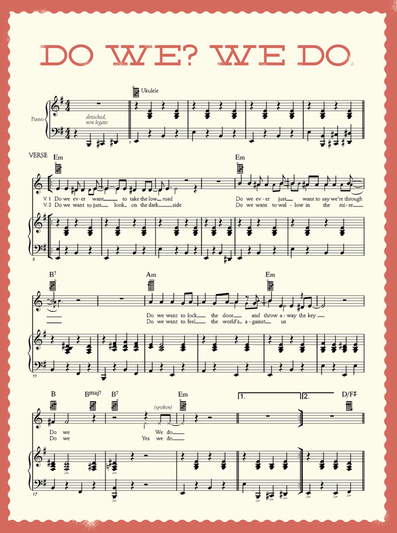
In the wake of Modern Guilt and The Information, Beck’s latest album comes in an almost-forgotten form—twenty songs existing only as individual pieces of sheet music, never before released or recorded. Complete with full-color, heyday-of-home-play-inspired art for each song and a lavishly produced hardcover carrying case (and, when necessary, ukelele notation), Song Reader is an experiment in what an album can be at the end of 2012—an alternative that enlists the listener in the tone of every track, and that’s as visually absorbing as a dozen gatefold LPs put together. The songs here are as unfailingly exciting as you’d expect from their author, but if you want to hear “Do We? We Do,” or “Don’t Act Like Your Heart Isn’t Hard,” bringing them to life depends on you.
 

This project is pushing every one of my music-nerd buttons. Of course it’s a gimmick, of course it’s a little precious. But we are going through a revolutionary time in music history, and this project is folding that history back on itself to bring back another time where the economic math of music was being recalculated.
Commercial music publishing is not a very important facet of the music business today. You can walk into any music store and see sheet music singles for Top 40 hits, but it’s also true that it’s easier to make a piano/vocal reduction of The Carpenter’s “We’ve Only Just Begun” than Ke$ha’s “TiK ToK.*” It’s hard to imagine from today’s perspective how disruptive a technology popular song sheet music was.
*Sheetmusicplus.com did have one hit for Ke$ha, surprisingly.
Notation (which is a kind of recording) introduced two important concept to music: the idea of a definitive version of a musical piece, and the idea of authorship of a musical piece. That first idea is inherent to the project of notation; just like speech, somebody might say things many different ways, or vary the way that they say it, but when you write something down, you’re only writing one thing down. The concept of authorship evolved over time. At first, as in Gregorian chant, a piece of music might be tied to the church or court that used it, the composer being anonymous. But as the composer evolved to become a separate artistic entity, there became only one Beethoven’s Fifth, and it was in one form and it was written by Beethoven.
But even through the invention of notation, even through the elevation of the composer, there was still no fixed concept of ownership of melody. Classical music constantly borrowed, stole, or arranged popular music or folk tunes; words were added to catchy classical melodies; people wrote new lyrics to popular tunes, dances and melodies disseminated and combined with each other. But when the commercial printing press combined with printed music, and the legions of newly middle-class women (usually) for whom a piano in the home and piano training were the markers of gentle society, you have a situation where independent songwriters can make a living by filling the void of new music. Remember, no record players. If you wanted music in the house, you made it yourself. And just as today, everybody wants new.
It’s impossible to overstate how influential these songs and songwriters were. Many of their compositions survive today, mistaken for folk songs: “Oh, Susanna” “Camptown Races” “Beautiful Dreamer” (Stephen Foster); “My Grandfather’s Clock” (Henry Clay Work); “The Daring Young Man on the Flying Trapeze” (Gaston Lyle); all of these were songs written and distributed as sheet music before the avent of recordings. Early recordings, in fact, were promotional material to sell sheet music! And even as revenue from the sale of recordings overtook that of sheet music, the dynamics of that era survive today through the power of the professional association for songwriters (ASCAP) and the large royalty payment that goes to the songwriter with every recording sold or licensed, often larger than that to the performer, largely because the songwriter holds copyright.
So let’s bring it back to Beck, and his song collection, and what it says about today.
First, I see it as a reminder that the economics of the music business are not set in stone, not given by God. The idea that I hand someone money for a physical object that contains a recording of a particular song by a particular artist is fairly new. Before that, I would pay money for a piece of sheet music that represented a particular song, but I was the performer. And before that I paid musicians, but there was no such thing as the definitive version of a song or a melody. Once, recordings were promotions for sheet music. Now, recordings may just be promotions for live shows. Of course this is going to change the quantity and the quality of the music we produce, but we’ll figure out how to make it work. Until something else comes along.
Second, I think this project is interesting in light of the conversations we’re having about remix culture and “audience” participation in works of culture. Think about it as a three-way tug-of-war between songwriter (or composer), performer, and audience. For all the talk of sampling, remixes, mash ups, YouTube covers, etc., we have to remember that the recording era had less audience participation than the sheet music era that preceded it. Beck is bringing music back to an era in which the act of consuming music was also an act of creation. It’s a nice reminder that, in an era where musicians are experimenting with interactive apps, or releasing workfiles to facilitate remixing, or even creating new music through fan videos, that the thing that hath been, it is that which shall be; and that which is done is that which shall be done: and there is no new thing under the sun.
Beck’s Song Reader

Man, do I love this project. 

In December 2012, Beck is set to release an “album” of sheet music. From the project page at publisher McSweeney’s:

In the wake of Modern Guilt and The Information, Beck’s latest album comes in an almost-forgotten form—twenty songs existing only as individual pieces of sheet music, never before released or recorded. Complete with full-color, heyday-of-home-play-inspired art for each song and a lavishly produced hardcover carrying case (and, when necessary, ukelele notation), Song Reader is an experiment in what an album can be at the end of 2012—an alternative that enlists the listener in the tone of every track, and that’s as visually absorbing as a dozen gatefold LPs put together. The songs here are as unfailingly exciting as you’d expect from their author, but if you want to hear “Do We? We Do,” or “Don’t Act Like Your Heart Isn’t Hard,” bringing them to life depends on you.


This project is pushing every one of my music-nerd buttons. Of course it’s a gimmick, of course it’s a little precious. But we are going through a revolutionary time in music history, and this project is folding that history back on itself to bring back another time where the economic math of music was being recalculated.

Commercial music publishing is not a very important facet of the music business today. You can walk into any music store and see sheet music singles for Top 40 hits, but it’s also true that it’s easier to make a piano/vocal reduction of The Carpenter’s “We’ve Only Just Begun” than Ke$ha’s “TiK ToK.*” It’s hard to imagine from today’s perspective how disruptive a technology popular song sheet music was.

*Sheetmusicplus.com did have one hit for Ke$ha, surprisingly.

Notation (which is a kind of recording) introduced two important concept to music: the idea of a definitive version of a musical piece, and the idea of authorship of a musical piece. That first idea is inherent to the project of notation; just like speech, somebody might say things many different ways, or vary the way that they say it, but when you write something down, you’re only writing one thing down. The concept of authorship evolved over time. At first, as in Gregorian chant, a piece of music might be tied to the church or court that used it, the composer being anonymous. But as the composer evolved to become a separate artistic entity, there became only one Beethoven’s Fifth, and it was in one form and it was written by Beethoven.

But even through the invention of notation, even through the elevation of the composer, there was still no fixed concept of ownership of melody. Classical music constantly borrowed, stole, or arranged popular music or folk tunes; words were added to catchy classical melodies; people wrote new lyrics to popular tunes, dances and melodies disseminated and combined with each other. But when the commercial printing press combined with printed music, and the legions of newly middle-class women (usually) for whom a piano in the home and piano training were the markers of gentle society, you have a situation where independent songwriters can make a living by filling the void of new music. Remember, no record players. If you wanted music in the house, you made it yourself. And just as today, everybody wants new.

It’s impossible to overstate how influential these songs and songwriters were. Many of their compositions survive today, mistaken for folk songs: “Oh, Susanna” “Camptown Races” “Beautiful Dreamer” (Stephen Foster); “My Grandfather’s Clock” (Henry Clay Work); “The Daring Young Man on the Flying Trapeze” (Gaston Lyle); all of these were songs written and distributed as sheet music before the avent of recordings. Early recordings, in fact, were promotional material to sell sheet music! And even as revenue from the sale of recordings overtook that of sheet music, the dynamics of that era survive today through the power of the professional association for songwriters (ASCAP) and the large royalty payment that goes to the songwriter with every recording sold or licensed, often larger than that to the performer, largely because the songwriter holds copyright.

So let’s bring it back to Beck, and his song collection, and what it says about today.

First, I see it as a reminder that the economics of the music business are not set in stone, not given by God. The idea that I hand someone money for a physical object that contains a recording of a particular song by a particular artist is fairly new. Before that, I would pay money for a piece of sheet music that represented a particular song, but I was the performer. And before that I paid musicians, but there was no such thing as the definitive version of a song or a melody. Once, recordings were promotions for sheet music. Now, recordings may just be promotions for live shows. Of course this is going to change the quantity and the quality of the music we produce, but we’ll figure out how to make it work. Until something else comes along.

Second, I think this project is interesting in light of the conversations we’re having about remix culture and “audience” participation in works of culture. Think about it as a three-way tug-of-war between songwriter (or composer), performer, and audience. For all the talk of sampling, remixes, mash ups, YouTube covers, etc., we have to remember that the recording era had less audience participation than the sheet music era that preceded it. Beck is bringing music back to an era in which the act of consuming music was also an act of creation. It’s a nice reminder that, in an era where musicians are experimenting with interactive apps, or releasing workfiles to facilitate remixing, or even creating new music through fan videos, that the thing that hath been, it is that which shall be; and that which is done is that which shall be done: and there is no new thing under the sun.
Mad Men & The Beatles


Readers who legitimately do not give a shit about Mad Men may still be interested in my comments on the Beatles album Revolver after the embedded YouTube video.
I have no interest whatsoever to blog seasons of television or do recaps or anything that needs to be timely or consistent, but I do want to say that I’m enjoying Mad Men so much this season; it may be my favorite season so far. I’m sure that almost everyone has decided at this point whether they’re into the show or not, so writing or talking about the show can feel a little circlejerky, but the show has changed so much over time that I feel like evangelizing the show all over again.
I feel like Mad Men‘s dramatic juice has always come from this combination of elements (and disregarding, for the moment, other concerns like marketing, costume design, cast etc.):

  1. The charisma and mystery and glamour of the character of Don Draper.
  2. The art and science of advertising, and
  3. The knowledge that the next decade, and the judgment of history, are going to hit this class of people like a bus.

Mad Men’s M.O. has generally been to foreground 1 & 2, while letting 3 work quietly in the background, visible only to the viewers. This formula has shifted over time. For one, Don Draper is just less mysterious. We may still be captivated by the way that he behaves and his responses to situations, but there’s no more puzzle to his history, and we’ve come a long way from watching him navigate between his wife and his piece on the side. For the last couple of seasons, even as the show stays anchored in the workplace, there is less emphasis on the advertising business. In the first season, it seemed like the show was going to establish a product-of-the-week format. This season, there have still been some high profile clients that contribute a C- or D-plot (Howard Johnson’s, Miracle Whip), but there’s less pontificating on the nature of advertising, fewer Draper pitches, fewer observations about what people want.
But where this season has been really shining is with that third element. Change has come to the foreground. Changes in music, in morés, style and class, there hasn’t been an episode this season where our characters haven’t been confronted by the culture moving to another place, or disrupted by a person that’s already there. One of my roommates is watching the show for the first time, and one huge contrast between the first season and the current season is the first season, both in both its style and its narrative, is about deeply controlled people. Their suits are fitted. Their lives, even as they are falling apart behind closed doors, are carefully compartmentalized. The most shocking moment of the pilot is Don Draper, who we’ve come to know in the context of his workplace, open his door and step into his role as father and husband. In comparison, this season is very messy. Characters are divorcing, shacking up; colors are loud, patterns clash; and the braintrust of Sterling Cooper Draper Pryce is increasingly buffeted by changes in mass taste and an increasingly politicized culture.
Some of the fun of this season is watching unexpected reactions to those changes–the same Roger Sterling who performed in blackface has seemingly skipped a generation and become an LSD-dropping nihilist, while the same Pete Campbell who was batted away from pursuing black-targeted accounts has begun to act out with all the propriety of a drunken salaryman at a karaoke bar–but none has been more interesting to watch than Don Draper. Because this is supposed to be the time where the culture catches up to Don Draper. In earlier seasons, Don is shown to be operating ten years ahead of his clients by producing ads that focus on the lives and desires of consumers rather than on products. At times, particularly in his preference for and interactions with strong, independent women, and his apparent dislike for the rules prescribed for men in gray suits, he has seemed like the audience-insertion character. Don’s pitches used to promise the future. But now we’re in the future, and it’s a new world of Beatles and beatniks, of civil rights and antiwar left, a world that Don is increasingly reluctant to embrace.


Last episode featured the Beatles song “Tomorrow Never Knows” in an extremely effective manner. This season has featured many “the 60’s are here” moments, but few have been as powerful as Ringo’s snare knocking on Don Draper’s door to introduce sounds that have become deeply integrated into contemporary pop culture’s DNA. And so I have found myself completely, and admittedly sheepishly, obsessed with Revolver.
It is because of the centrality of the Beatles catalogue to popular music that it has been hard for me to listen to their music as music, or listen to their albums like any other band. It was only a few months ago that I decided to try and listen to the albums through to get a sense of them as albums, instead of units containing some of the hits that I knew. I began with Sgt. Pepper’s, then slowly through  Rubber Soul  and Abbey Road. Somehow, I had not yet gotten to Revolver. I had heard from music people that Revolver was the best Beatles album, but I never appreciated the extent to which it–and Sgt. Pepper’s–are simply in a league of their own*. Rubber Soul is too indebted to their earlier pop rock sound, Abbey Road has a signal to noise ratio that’s too low, and Let It Be is moribund. In these two albums, they managed to do everything they do well right, and produce an astonishing amount of perfect songs on each. My the worst track on Revolver is either “Doctor Robert” or “Taxman,” and both of them are extraordinarily good songs.
*I’m going to break in with a couple of caveats here: One, a general disclaimer that I haven’t heard all of the albums yet. So I’ll admit the possibility that one of the other albums might just be that much better (though somehow I don’t think Magical Mystery Tour will be it). Two, it’s relevant that I really hate most of the early-Beatles, teen idol-y songs. I imagine that there is still some cohort that dislikes all of their albums after they went to India. But for me, almost all of those early albums are going to be disqualified.
Listening through Revolver also provided me with one of those cherished opportunities to check in with my own evolving tastes. I remember having a conversation with my piano teacher’s husband about whether we liked the Beatles by John Lennon or the Beatles by Paul McCartney better. I declared myself a McCartney man. My piano teacher told me to “give that time.” And that’s proven to be completely true. I can see where I was coming from; I played piano, and all of the best Beatles songs to play on the piano are Paul’s ballads (“Let It Be,””Yesterday”)**. Lennon’s songs tended to be more guitar-riff driven and  production-heavy.*** Scanning a tracklist of Revolver reveals that all of the songs that have been rocking my shit are Lennon songs.
**It took me time to discover that the best McCartney songs are the quasi-art songs: “She’s Leaving Home,” “Penny Lane” “The Long and Winding Road” etc. 
***Though, of course, those taxonomies can be deceptive. “Helter Skelter,” for example, is a McCartney song and is about as aggro as the Beatles get, while “Something” was written by George Harrison and is (with the exception of an extra-prominent guitar solo) almost a quintessential Paul song.
And now just a few thoughts on individual tracks:

  • “I’m Only Sleeping” and “Here, There and Everywhere” are weirdly mirror images of each other; the root of the chord progressions in their choruses are extremely similar, 1-2-3-4 (Here, There and Everywhere) and 1-2-3-2 (I’m Only Sleeping), yet I can’t stand HTE, and can’t get enough of IOS. IOS contains maybe my favorite use of sweet oohing harmonies, and the backtracked guitar solo is still just the greatest.
  • For all that the 90’s Britpop genre (Oasis, etc.) is pretty much defined by an indebtedness to the Beatles, “She Said, She Said” is maybe the only song in their catalog that I think could just be a 90’s song, if John Lennon didn’t have one of the most distinctive voices in rock. For that matter, the guitar intro could kick off a Pavement song. The drumming on this track is sublime; the only time that I have been completely impressed with Ringo Starr.
  • “For No One” is almost a perfect song, but the dotted rhythm at the end of “no sign of love behind the tears” is like jamming an icepick into my ears, I hate it that much.
  • “Tomorrow Never Knows” is still the greatest: epic tape loops and distortion; Lennon’s incantation-like delivery; anti-guitar solos; mystical nonsense that smells like profundity; a killer drum and bass ostinato; a maximalist masterpiece.

Mad Men & The Beatles

Readers who legitimately do not give a shit about Mad Men may still be interested in my comments on the Beatles album Revolver after the embedded YouTube video.

I have no interest whatsoever to blog seasons of television or do recaps or anything that needs to be timely or consistent, but I do want to say that I’m enjoying Mad Men so much this season; it may be my favorite season so far. I’m sure that almost everyone has decided at this point whether they’re into the show or not, so writing or talking about the show can feel a little circlejerky, but the show has changed so much over time that I feel like evangelizing the show all over again.

I feel like Mad Men‘s dramatic juice has always come from this combination of elements (and disregarding, for the moment, other concerns like marketing, costume design, cast etc.):

  1. The charisma and mystery and glamour of the character of Don Draper.
  2. The art and science of advertising, and
  3. The knowledge that the next decade, and the judgment of history, are going to hit this class of people like a bus.

Mad Men’s M.O. has generally been to foreground 1 & 2, while letting 3 work quietly in the background, visible only to the viewers. This formula has shifted over time. For one, Don Draper is just less mysterious. We may still be captivated by the way that he behaves and his responses to situations, but there’s no more puzzle to his history, and we’ve come a long way from watching him navigate between his wife and his piece on the side. For the last couple of seasons, even as the show stays anchored in the workplace, there is less emphasis on the advertising business. In the first season, it seemed like the show was going to establish a product-of-the-week format. This season, there have still been some high profile clients that contribute a C- or D-plot (Howard Johnson’s, Miracle Whip), but there’s less pontificating on the nature of advertising, fewer Draper pitches, fewer observations about what people want.

But where this season has been really shining is with that third element. Change has come to the foreground. Changes in music, in morés, style and class, there hasn’t been an episode this season where our characters haven’t been confronted by the culture moving to another place, or disrupted by a person that’s already there. One of my roommates is watching the show for the first time, and one huge contrast between the first season and the current season is the first season, both in both its style and its narrative, is about deeply controlled people. Their suits are fitted. Their lives, even as they are falling apart behind closed doors, are carefully compartmentalized. The most shocking moment of the pilot is Don Draper, who we’ve come to know in the context of his workplace, open his door and step into his role as father and husband. In comparison, this season is very messy. Characters are divorcing, shacking up; colors are loud, patterns clash; and the braintrust of Sterling Cooper Draper Pryce is increasingly buffeted by changes in mass taste and an increasingly politicized culture.

Some of the fun of this season is watching unexpected reactions to those changes–the same Roger Sterling who performed in blackface has seemingly skipped a generation and become an LSD-dropping nihilist, while the same Pete Campbell who was batted away from pursuing black-targeted accounts has begun to act out with all the propriety of a drunken salaryman at a karaoke bar–but none has been more interesting to watch than Don Draper. Because this is supposed to be the time where the culture catches up to Don Draper. In earlier seasons, Don is shown to be operating ten years ahead of his clients by producing ads that focus on the lives and desires of consumers rather than on products. At times, particularly in his preference for and interactions with strong, independent women, and his apparent dislike for the rules prescribed for men in gray suits, he has seemed like the audience-insertion character. Don’s pitches used to promise the future. But now we’re in the future, and it’s a new world of Beatles and beatniks, of civil rights and antiwar left, a world that Don is increasingly reluctant to embrace.

Last episode featured the Beatles song “Tomorrow Never Knows” in an extremely effective manner. This season has featured many “the 60’s are here” moments, but few have been as powerful as Ringo’s snare knocking on Don Draper’s door to introduce sounds that have become deeply integrated into contemporary pop culture’s DNA. And so I have found myself completely, and admittedly sheepishly, obsessed with Revolver.

It is because of the centrality of the Beatles catalogue to popular music that it has been hard for me to listen to their music as music, or listen to their albums like any other band. It was only a few months ago that I decided to try and listen to the albums through to get a sense of them as albums, instead of units containing some of the hits that I knew. I began with Sgt. Pepper’s, then slowly through  Rubber Soul  and Abbey Road. Somehow, I had not yet gotten to Revolver. I had heard from music people that Revolver was the best Beatles album, but I never appreciated the extent to which it–and Sgt. Pepper’s–are simply in a league of their own*. Rubber Soul is too indebted to their earlier pop rock sound, Abbey Road has a signal to noise ratio that’s too low, and Let It Be is moribund. In these two albums, they managed to do everything they do well right, and produce an astonishing amount of perfect songs on each. My the worst track on Revolver is either “Doctor Robert” or “Taxman,” and both of them are extraordinarily good songs.

*I’m going to break in with a couple of caveats here: One, a general disclaimer that I haven’t heard all of the albums yet. So I’ll admit the possibility that one of the other albums might just be that much better (though somehow I don’t think Magical Mystery Tour will be it). Two, it’s relevant that I really hate most of the early-Beatles, teen idol-y songs. I imagine that there is still some cohort that dislikes all of their albums after they went to India. But for me, almost all of those early albums are going to be disqualified.

Listening through Revolver also provided me with one of those cherished opportunities to check in with my own evolving tastes. I remember having a conversation with my piano teacher’s husband about whether we liked the Beatles by John Lennon or the Beatles by Paul McCartney better. I declared myself a McCartney man. My piano teacher told me to “give that time.” And that’s proven to be completely true. I can see where I was coming from; I played piano, and all of the best Beatles songs to play on the piano are Paul’s ballads (“Let It Be,””Yesterday”)**. Lennon’s songs tended to be more guitar-riff driven and  production-heavy.*** Scanning a tracklist of Revolver reveals that all of the songs that have been rocking my shit are Lennon songs.

**It took me time to discover that the best McCartney songs are the quasi-art songs: “She’s Leaving Home,” “Penny Lane” “The Long and Winding Road” etc. 

***Though, of course, those taxonomies can be deceptive. “Helter Skelter,” for example, is a McCartney song and is about as aggro as the Beatles get, while “Something” was written by George Harrison and is (with the exception of an extra-prominent guitar solo) almost a quintessential Paul song.

And now just a few thoughts on individual tracks:

  • “I’m Only Sleeping” and “Here, There and Everywhere” are weirdly mirror images of each other; the root of the chord progressions in their choruses are extremely similar, 1-2-3-4 (Here, There and Everywhere) and 1-2-3-2 (I’m Only Sleeping), yet I can’t stand HTE, and can’t get enough of IOS. IOS contains maybe my favorite use of sweet oohing harmonies, and the backtracked guitar solo is still just the greatest.
  • For all that the 90’s Britpop genre (Oasis, etc.) is pretty much defined by an indebtedness to the Beatles, “She Said, She Said” is maybe the only song in their catalog that I think could just be a 90’s song, if John Lennon didn’t have one of the most distinctive voices in rock. For that matter, the guitar intro could kick off a Pavement song. The drumming on this track is sublime; the only time that I have been completely impressed with Ringo Starr.
  • “For No One” is almost a perfect song, but the dotted rhythm at the end of “no sign of love behind the tears” is like jamming an icepick into my ears, I hate it that much.
  • “Tomorrow Never Knows” is still the greatest: epic tape loops and distortion; Lennon’s incantation-like delivery; anti-guitar solos; mystical nonsense that smells like profundity; a killer drum and bass ostinato; a maximalist masterpiece.

I was reading Gawker’s takedown of Alexandra Molotkow’s New York Times essay, “Why The Old-School Music Snob is the Least Cool Kid on Twitter” with some amusement. Their take dismisses it as a music snob version of Patton Oswalt’s Wired Magazine rant against nü-geek culture: this is nothing new, the past wasn’t as great as you remember it, and you’re just being elitist. Oh, and you’re 27, so shut the fuck up already.

That’s at least a little true. But some pieces of the essay really struck me. On the shift in musical culture after the rise of internet file sharing:

Within a few years, knowledge had ceased to confer any distinction, and hoarding it had become about as socially advantageous as stamp collecting. Thanks to the Internet, cultural knowledge was now a collective resource. Which meant that being cool was no longer about what you knew and what other people didn’t. It was about what you had to say about the things that everyone already knew about.

And

My quarrel here isn’t with the idea that cool people don’t know as much about stuff as they used to. If you really want to drill deep into your interests, you still have that option. You just have to accept that most of your findings will have no social value.

My beef is really with the factors that gave rise to this state of affairs, and I realize this beef is deeply stupid: I bridle at the idea that good stuff could be public in the first place, that I should have to share my tastes with the wider world.

I definitely think that it’s true that the High Fidelity ideal of the record-collecting, bootleg-recording, foreign release-hunting music nerd has, to some extent, been absorbed into the broader culture. And this is because we’ve won. Almost ten years ago in Freaky Friday, Lindsay Lohan and Chad Michael Murray fall in love through their mutual admiration for semi-obscure alt-rock acts like The Breeders and The Vines. Entire TV shows, notably The O.C. and Grey’s Anatomy became enormously popular through their indie saturated, unusual-for-TV soundtracks. Nick and Nora’s Infinite Playlist. If everybody seems to be having the same conversation about the same artists peppered with the same references, it’s not because people have ceased to be adventurous with their music, it’s that the culture at large has shifted.

But it’s not all bad. These two things remain true: it’s really, really cool to be “into” music, but really, really uncool to be too into music; and, more importantly, people don’t even fucking hear 98% of what they listen to. As always, music is used today as a marker of what social groups you fit into, and somehow the highest form of praise one can give to another’s taste these days is eclectic. But get too music into talking about music, or, hell, talk about the music at all, and you start verging into uncool territory. Because people don’t know what they’re listening to. And to a snob like me, that’s reassuring, because even though what we listen to may be the same, we hear something different.