Bookshelf: My Brother's Husband, Vol. 1

516p0M0uyeL._SX349_BO1,204,203,200_The loveliest reading experience that exists is the experience of coming across the right book at the right time, and feeling so completely understood by it, and feeling like you completely understand it. I picked up My Brother’s Husband, by Gengoroh Tagame, because I read that it was going to be adapted into a live action TV series, and that made me think about how few Japanese LGBT narratives and stories I knew. There are many manga and anime series that play around with homoerotic subtexts and images (including my current favorite, Yuri on Ice!!!), however—and, please understand that I have a very superficial understanding of Japanese culture—my perception is that many of those tropes are a slightly performative and desexualized playgrounds of desire for (mostly) straight preteen girls. The other examples of queer tropes in the culture are probably worse, which are the eroticized bisexual/lesbian chic like Ghost in the Shell, a melange of  badass and charismatic characters that queer readers love but that were created for the pleasure of straight boys.
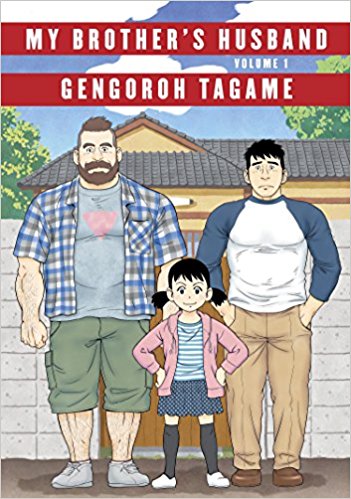
My Brother’s Husband is the story of Yaichi, who is forced to confront his feelings about his late twin brother, Ryōshi’s death and sexuality when Ryōshi’s widowed Canadian husband, Mike Flanagan, arrives at his doorstep to visit the town where the boys grew up. Mike is enthusiastically welcomed by Yaichi’s grade-school aged daughter, Kana, and this first of two volumes follows Yaichi through this brief visit as he struggles to balance his conflicted feelings about gay sexuality and his estrangement from his brother with his responsibility to his family and his love for his daughter. larger.jpg
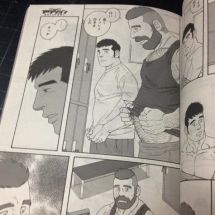
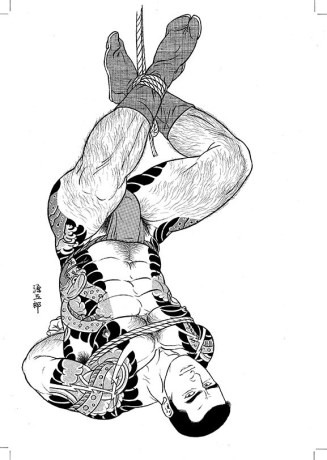
The sensuality of bodies is present on every page, in every panel. Tagame describes himself in his twitter bio as a “gay erotic artist,” and most of his work (which has not been officially published in English translation) is sexually explicit stories featuring BDSM themes and big, muscly, hyper-masculine men presented as both figures of fear and figures of desire. My Brother’s Husband, at least through the first volume, is completely G rated, however the art style is shot through with his aesthetic. When Yaichi meets Mike, he is overwhelmed by the reality of Mike and his brother’s relationship, but he is also overwhelmed by Mike’s physical self, his size, his strength, his beard, the hair on his body.
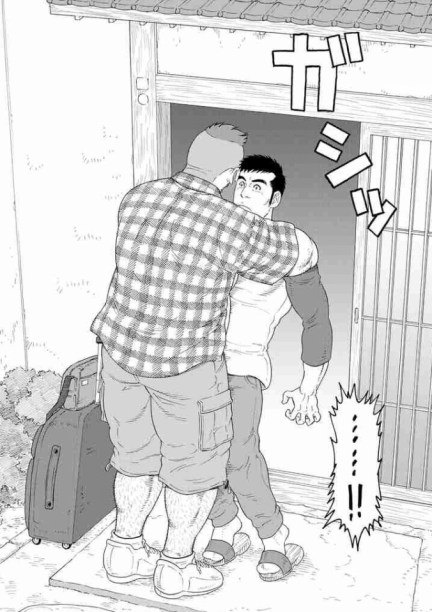
There’s not a whole lot of action on the surface; this is a very quiet domestic drama with lots of talking, Yaichi’s internal dialogues as he explores his own discomfort with Mike, and getting lost in his memories and regrets. But underneath all that is a whole story expressed through touch and care for the body. When Mike first arrives, he wraps Yaichi in a bear hug and calls him brother.
My-Brothers-Husband-1.jpg
This freaks Yaichi out, and he breaks out of the embrace and asks Mike not to call him that. As Yaichi explains to his daughter, Kana, “Japanese people don’t hug,” but he also admits to himself later that there is an undercurrent of homophobia and xenophobia to his response as well. Kana is completely unfazed by Mike, and is so excited to have a Canadian uncle that Yaichi’s standoffish attitude becomes rude by contrast. Yaichi’s comfort with Mike is shown without words through a growing physical intimacy, not through sex but through food, coffee and tea, the offer of a hot bath, a walk through a playground, and a shared visit to the gym.
I couldn’t help think about the deeper connection to Tagame’s erotic BDSM work. I only have an outsider’s understanding of that community, and on the kink spectrum, I think of myself as fresh vanilla bean ice cream (basic, but pretentious with an overinflated sense of self). That being said, I’ve always been fascinated to hear people share their experiences, and a big part of BDSM for a lot of people is that it provides a context for exploring pleasure and disgust, gender roles, toxic emotions, power dynamics, internalized homophobia, self-esteem, fight or flight responses, anxiety, sexual trauma, and a whole host of other really complex human experiences. Furthermore, it’s a way to cultivate an embodied understanding, completely different than understanding it intellectually. In other words, there’s a level of self-understanding that Tagame’s hypermasculine men can only access when they are having these heightened and risky sexual encounters. And in that same way, there is a level of acceptance of his dead brother that Yaichi can only get to, no matter what he thinks he thinks about him, that can only happen when he hugs his brother’s husband and feels love and connection and not discomfort.
53d0efd13ee39488a084f6514107ef5d.jpg
This is what really blew me away, and why I remain completely emotionally lit up about this manga: in some ways this is a very quiet, very small-scale, and almost a didactic domestic drama. These are the type of queer stories that are told to straight society, and every time there is a movement for queer liberation, there is a need to teach the same lessons: we’re just like everyone else, love is love, who I am is bigger than who I fuck, etc. And they’re beautiful stories, and they’re important stories. But they are the queer stories that are always told before the queer queer stories get told. But Tagame has told this very tame queer story in a very queer way, and in that sense he has queered the queer acceptance narrative*. That’s so cool, and it’s incredible that at this time, when LGBT visibility is still in early formation in Japan, that this artist has created this work with such a clear sense of social purpose without ceding any of his individuality and sensibility.

*Postscript: Queering the Text

I wanted to briefly explain what I mean by “queering the queer acceptance narrative,” which is an extension of the concept of queering the text. Wikipedia has a truly dreadful definition:

Queering is an interpretive method used in historical or literary study. It is based on the re-appropriated term “queer“, used for LGBT issues, but used as a verb. “Queering” means to reevaluate or reinterpret a work with an eye to sexual orientation and/or to gender, by applying interpretive techniques from queer theory. An example of “queering” would be to reexamine the primary sources from the life of King Richard I of England, to search for evidence that he exhibited homosexual behavior or attitudes.

This definition gets a little bit right, but a lot of bits wrong. Queering is definitely an interpretive theory, but it is way more of a reinterpretation (or reinvention) than it is a reevaluation. The way that queering works is to take something, and to upend it by changing some of its underlying assumptions. It’s similar to Juvenalian satire (treating something elevated with the contempt and disdain of the low, and treating the low with the seriousness and gravitas of the elevated), and has roots in one of the early forerunners of queer identity, the invert (the man who acts like a woman and the woman who acts like a man). Queering as a praxis is one of the true essentials of queer culture and you can spot it everywhere. Its in the mock seriousness (but also actual seriousness) with which queer culture treats reality television and campy melodramas. It’s there in the cultivated banal tone in which we talk about high culture.
So when I say that My Brother’s Husband queers the queer acceptance narrative, what I mean is that Tagame has taken something that is familiar, targeted towards a homophobic straight reader, and almost commodified, and told the story in a way that has roots in something edgy, sexual, and boundary-pushing, he changes it into something new.
Bookshelf: My Brother’s Husband, Vol. 1

516p0M0uyeL._SX349_BO1,204,203,200_The loveliest reading experience that exists is the experience of coming across the right book at the right time, and feeling so completely understood by it, and feeling like you completely understand it. I picked up My Brother’s Husband, by Gengoroh Tagame, because I read that it was going to be adapted into a live action TV series, and that made me think about how few Japanese LGBT narratives and stories I knew. There are many manga and anime series that play around with homoerotic subtexts and images (including my current favorite, Yuri on Ice!!!), however—and, please understand that I have a very superficial understanding of Japanese culture—my perception is that many of those tropes are a slightly performative and desexualized playgrounds of desire for (mostly) straight preteen girls. The other examples of queer tropes in the culture are probably worse, which are the eroticized bisexual/lesbian chic like Ghost in the Shell, a melange of  badass and charismatic characters that queer readers love but that were created for the pleasure of straight boys.
My Brother’s Husband is the story of Yaichi, who is forced to confront his feelings about his late twin brother, Ryōshi’s death and sexuality when Ryōshi’s widowed Canadian husband, Mike Flanagan, arrives at his doorstep to visit the town where the boys grew up. Mike is enthusiastically welcomed by Yaichi’s grade-school aged daughter, Kana, and this first of two volumes follows Yaichi through this brief visit as he struggles to balance his conflicted feelings about gay sexuality and his estrangement from his brother with his responsibility to his family and his love for his daughter. larger.jpg

The sensuality of bodies is present on every page, in every panel. Tagame describes himself in his twitter bio as a “gay erotic artist,” and most of his work (which has not been officially published in English translation) is sexually explicit stories featuring BDSM themes and big, muscly, hyper-masculine men presented as both figures of fear and figures of desire. My Brother’s Husband, at least through the first volume, is completely G rated, however the art style is shot through with his aesthetic. When Yaichi meets Mike, he is overwhelmed by the reality of Mike and his brother’s relationship, but he is also overwhelmed by Mike’s physical self, his size, his strength, his beard, the hair on his body.

There’s not a whole lot of action on the surface; this is a very quiet domestic drama with lots of talking, Yaichi’s internal dialogues as he explores his own discomfort with Mike, and getting lost in his memories and regrets. But underneath all that is a whole story expressed through touch and care for the body. When Mike first arrives, he wraps Yaichi in a bear hug and calls him brother.

My-Brothers-Husband-1.jpg

This freaks Yaichi out, and he breaks out of the embrace and asks Mike not to call him that. As Yaichi explains to his daughter, Kana, “Japanese people don’t hug,” but he also admits to himself later that there is an undercurrent of homophobia and xenophobia to his response as well. Kana is completely unfazed by Mike, and is so excited to have a Canadian uncle that Yaichi’s standoffish attitude becomes rude by contrast. Yaichi’s comfort with Mike is shown without words through a growing physical intimacy, not through sex but through food, coffee and tea, the offer of a hot bath, a walk through a playground, and a shared visit to the gym.

I couldn’t help think about the deeper connection to Tagame’s erotic BDSM work. I only have an outsider’s understanding of that community, and on the kink spectrum, I think of myself as fresh vanilla bean ice cream (basic, but pretentious with an overinflated sense of self). That being said, I’ve always been fascinated to hear people share their experiences, and a big part of BDSM for a lot of people is that it provides a context for exploring pleasure and disgust, gender roles, toxic emotions, power dynamics, internalized homophobia, self-esteem, fight or flight responses, anxiety, sexual trauma, and a whole host of other really complex human experiences. Furthermore, it’s a way to cultivate an embodied understanding, completely different than understanding it intellectually. In other words, there’s a level of self-understanding that Tagame’s hypermasculine men can only access when they are having these heightened and risky sexual encounters. And in that same way, there is a level of acceptance of his dead brother that Yaichi can only get to, no matter what he thinks he thinks about him, that can only happen when he hugs his brother’s husband and feels love and connection and not discomfort.
53d0efd13ee39488a084f6514107ef5d.jpg

This is what really blew me away, and why I remain completely emotionally lit up about this manga: in some ways this is a very quiet, very small-scale, and almost a didactic domestic drama. These are the type of queer stories that are told to straight society, and every time there is a movement for queer liberation, there is a need to teach the same lessons: we’re just like everyone else, love is love, who I am is bigger than who I fuck, etc. And they’re beautiful stories, and they’re important stories. But they are the queer stories that are always told before the queer queer stories get told. But Tagame has told this very tame queer story in a very queer way, and in that sense he has queered the queer acceptance narrative*. That’s so cool, and it’s incredible that at this time, when LGBT visibility is still in early formation in Japan, that this artist has created this work with such a clear sense of social purpose without ceding any of his individuality and sensibility.

*Postscript: Queering the Text

I wanted to briefly explain what I mean by “queering the queer acceptance narrative,” which is an extension of the concept of queering the text. Wikipedia has a truly dreadful definition:

Queering is an interpretive method used in historical or literary study. It is based on the re-appropriated term “queer“, used for LGBT issues, but used as a verb. “Queering” means to reevaluate or reinterpret a work with an eye to sexual orientation and/or to gender, by applying interpretive techniques from queer theory. An example of “queering” would be to reexamine the primary sources from the life of King Richard I of England, to search for evidence that he exhibited homosexual behavior or attitudes.

This definition gets a little bit right, but a lot of bits wrong. Queering is definitely an interpretive theory, but it is way more of a reinterpretation (or reinvention) than it is a reevaluation. The way that queering works is to take something, and to upend it by changing some of its underlying assumptions. It’s similar to Juvenalian satire (treating something elevated with the contempt and disdain of the low, and treating the low with the seriousness and gravitas of the elevated), and has roots in one of the early forerunners of queer identity, the invert (the man who acts like a woman and the woman who acts like a man). Queering as a praxis is one of the true essentials of queer culture and you can spot it everywhere. Its in the mock seriousness (but also actual seriousness) with which queer culture treats reality television and campy melodramas. It’s there in the cultivated banal tone in which we talk about high culture.

So when I say that My Brother’s Husband queers the queer acceptance narrative, what I mean is that Tagame has taken something that is familiar, targeted towards a homophobic straight reader, and almost commodified, and told the story in a way that has roots in something edgy, sexual, and boundary-pushing, he changes it into something new.

This Reader’s Digest, July 2013

Big reading month for me. Here’s the good, the bad, and the ugly, with some commentary. I get apathetic about rewriting what is easily Googleable, so no plot summaries. Unreservèd recommendations are marked with a star.

*The Little Way of Ruthie Leming Rod Dreher

The Little Way of Ruthie Leming – Rod Dreher

A truly unique project. Dreher’s book rarely strays beyond the borders of the small Louisiana hamlet in which he was raised and his sister lived, but it manages to be at once a small book about the complex relationships between siblings and a large book, a synecdoche of America’s relationship to the rest of the world. Dreher made me stop often to consider the way that the dynamics and attitudes he describes have played out in my own life. It was also consistently frustrating to me, as some of the insights that Dreher captures are so right, and others betray the same lack of flexible thinking and imagination that he sees as missing in his sister and father. Go forth and read this book.

Devices and Desires K.J. Parker

Right on the border between sci-fi and fantasy. If you look at a plot summary and think you might be interested, you’ll probably like it. If it sounds like it’s not for you, you’re probably right.

The War for Late Night Bill Carter

Bill Carter’s 1994 account of the Carson-Leno-Letterman Tonight Show saga, The Late Shift has become one of the canonical pieces of television writing and reportage. I haven’t read it, but I thought I would have more interest in this second book, because I remember the media nuttiness surrounding Conan O’Brien at NBC. Reading the book, I became aware of two things. First, I just care less about everybody involved in this story than I thought. Second, disciplined academic writing has spoiled me for easy narratives, characterizations, and explainations. After yet another TV executive’s negotiating style explained by their hardscrabble Brooklyn roots, I said fuck it and dropped the book.

*We The Animals Justin Torres

We The Animals – Justin Torres

One of the most intriguing debuts I’ve read. I hated this book when I finished it. I thought the ending was so cheap, so out of keeping with the rest of the novel. It was like watching somebody construct something amazing, then seeing them turn on the project and burn it down. Once I calmed down from that initial emotional reaction, I was able to consider that, no, it’s not the same thing as burning it down. The first three-quarters of the book are still great. Torres’ prose (prose poetry?) shows either stylistic precocity or stylistic vapidity. This is one of the few books these days that I wish would have a better constructed plot. The structure of the book is very loose, either a novel, novella, short story cycle, fictional memoir, or vignettes, depending on how you feel about it. I personally think its a fantastically successful short story cycle, and a poor novel. I eagerly await either Torres’ first volume of poetry or his third novel.

You Can Say You Knew Me When K. M. Soehnlein

I was excited to read this book because Soehnlien’s The World of Normal Boys, which I read a couple of years ago, is a true masterwork. While not breaking from the model established by Edmund White’s A Boy’s Own Story, Soehnlein’s specificity of character and setting elevates it above the many realization and coming out stories that are staples of gay lit. You Can Say You Knew Me When, about a self-destructive 30something gay in San Francisco discovering himself and shit, is not nearly as good. It was fine. If you’re like me, and will read any half-decent piece of trash if there are gay people in it, go ahead and pick it up. Otherwise, there’s only about three pieces of real interest. 1. The main character’s encounter with a rough-around-the-edges 19 year-old perfectly captures the appeal of rough trade. 2. The description of pre-90’s tech bubble craziness has come back around and become relevant again in this day of billion dollar aquisitions. 3. The main character’s father is compassionately portrayed, and is interesting and plausible as a person who had a bohemian youth and became more conservative in later life.   

Role Models John Waters

Reading this book is like listening to the filthy gay uncle you never had hold court. So there are bound to be great stories here (my favorite involved a one eyed, alcoholic, lesbian stripper named Zorro) and some sections that put you to sleep.

Gulliver Travels [since renamed Gulliver Takes Manhattan] Justin Luke Zirilli

Absurd book written by a gay club promoter that proves that endless fucking in New York is not, in itself, engaging absent any other point of interest.

*Far From the Tree Andrew Solomon 

Far From The Tree – Andrew Solomon

To me, Andrew Solomon’s project, which you can learn about in compressed form in this TED talk, boils down to this: what does the “normal” parent-child relationship look like when defined as the opposite of its variants? To that end, Solomon looks at situations where children best thrive by developing identity through peer relationships and opposed to familial relationships (deafness, dwarfism, homosexuality); where emotional relationships cannot be reciprocated (autism, multiple disabilities); where meaning of the child to the world shouts down meaning of the child to its parents (prodigies, criminals). The miracle of this book is that Solomon manages to balance on the knife’s edge between detachment and compassion towards his subjects, and has created one of the few recent pieces of writing that I might call wise. His prose has a razor sharpness to his conservatism of meaning and precision of language, and the through-line of his logic is consistent, and strong. He presents factual information straightforwardly, both communicating the best of what we know about these conditions while acknowledging that the science is in its infancy. At the same time, he is respectful of his subjects and their constructed identities, while refraining from adopting their communities’ jargon unless it edifies. This is not an easy read. The prose is dense, and because it is so carefully written it reads slow. And in focusing on this cohort of families, a major secondary theme that runs through the book are the profound bioethical questions that are going to come, with fury and anger and disruption and casualties, to our world.

The Elusive Embrace Daniel Mendelssohn

Could not surmount the twinned barriers of the solipsism of the writer and the indifference to classical studies of this reader. Abandoned.

A Cage of Bones Jeffrey Round

Yet another gay romance about an ennui filled gay man. Sexy location, competently written.

From Paris to the Moon Adam Gopnik

American in Paris memoir. I was expecting a little more. Tone was a little too Erma Bombeck/Sedarisy, his insights about the differences in American and French national culture were interesting, but a little too few and far between.

Wild Cheryl Strayed

Not only has this memoir been a breakout hit in the last two years, but Strayed is a hometown hero here in Portland. I thought the book was pretty good, mostly because Strayed has a distinctive voice, and is good company. After finishing the book, I began to explore some of her Dear Sugar columns, and I can see how this book would be of interest for those who are interested in how she cultivated her unique, and uniquely precious, moral sense. While I am mostly positive about the book, the material in it is half nature writing about the settings Strayed encountered on the Pacific Coast Trail, and half grief memoir about the loss of Strayed’s mother, and I thought both suffered for the attention given to the other. I found myself contradictorily wishing Strayed had given more time to the aftermath of the grief process, and more closely described her process of leveling out, while at the same time wanting her to take a little more time with the wildnerness locales she passed through rather than just talking about her condition on the trail.

Eleanor and Park Rainbow Rowell

Another straight teen romance in the vein of John Green’s Looking for Alaska. My pet theory about books like this is that it is an unintended consequence of the discovery of the gay YA market. Every one of Park’s (male protagonist) character notes—his love for new wave and punk, distance from authoritarian father, picked on at school—seem swiped from an Alex Sanchez or David Levithan book from ten years ago. Straight is the new gay. 

*CivilWarLand in Bad Decline George Saunders

Like one of my other favorite living writers, David Mitchell, Saunders is a profoundly moral writer that never moralizes. Though a couple of stories in this collection did not affect me profoundly, those that did kept me both at complete physiological attention to discover where the plot would go, and with a incessant lump in my throat as Saunders captures just how cruel we can be to each other, and how improbably kind.

Mysterious Skin Scott Heim

A better than average book that made a worse than average movie. Heim, with subtlety and empathy, explores the complicated role that sexual abuse plays in the formation of one gay man’s identity. Very dangerous subject to tackle.

This Reader's Digest, July 2013

Big reading month for me. Here’s the good, the bad, and the ugly, with some commentary. I get apathetic about rewriting what is easily Googleable, so no plot summaries. Unreservèd recommendations are marked with a star.

*The Little Way of Ruthie Leming Rod Dreher

The Little Way of Ruthie Leming – Rod Dreher

A truly unique project. Dreher’s book rarely strays beyond the borders of the small Louisiana hamlet in which he was raised and his sister lived, but it manages to be at once a small book about the complex relationships between siblings and a large book, a synecdoche of America’s relationship to the rest of the world. Dreher made me stop often to consider the way that the dynamics and attitudes he describes have played out in my own life. It was also consistently frustrating to me, as some of the insights that Dreher captures are so right, and others betray the same lack of flexible thinking and imagination that he sees as missing in his sister and father. Go forth and read this book.

Devices and Desires K.J. Parker

Right on the border between sci-fi and fantasy. If you look at a plot summary and think you might be interested, you’ll probably like it. If it sounds like it’s not for you, you’re probably right.

The War for Late Night Bill Carter

Bill Carter’s 1994 account of the Carson-Leno-Letterman Tonight Show saga, The Late Shift has become one of the canonical pieces of television writing and reportage. I haven’t read it, but I thought I would have more interest in this second book, because I remember the media nuttiness surrounding Conan O’Brien at NBC. Reading the book, I became aware of two things. First, I just care less about everybody involved in this story than I thought. Second, disciplined academic writing has spoiled me for easy narratives, characterizations, and explainations. After yet another TV executive’s negotiating style explained by their hardscrabble Brooklyn roots, I said fuck it and dropped the book.

*We The Animals Justin Torres

We The Animals – Justin Torres

One of the most intriguing debuts I’ve read. I hated this book when I finished it. I thought the ending was so cheap, so out of keeping with the rest of the novel. It was like watching somebody construct something amazing, then seeing them turn on the project and burn it down. Once I calmed down from that initial emotional reaction, I was able to consider that, no, it’s not the same thing as burning it down. The first three-quarters of the book are still great. Torres’ prose (prose poetry?) shows either stylistic precocity or stylistic vapidity. This is one of the few books these days that I wish would have a better constructed plot. The structure of the book is very loose, either a novel, novella, short story cycle, fictional memoir, or vignettes, depending on how you feel about it. I personally think its a fantastically successful short story cycle, and a poor novel. I eagerly await either Torres’ first volume of poetry or his third novel.

You Can Say You Knew Me When K. M. Soehnlein

I was excited to read this book because Soehnlien’s The World of Normal Boys, which I read a couple of years ago, is a true masterwork. While not breaking from the model established by Edmund White’s A Boy’s Own Story, Soehnlein’s specificity of character and setting elevates it above the many realization and coming out stories that are staples of gay lit. You Can Say You Knew Me When, about a self-destructive 30something gay in San Francisco discovering himself and shit, is not nearly as good. It was fine. If you’re like me, and will read any half-decent piece of trash if there are gay people in it, go ahead and pick it up. Otherwise, there’s only about three pieces of real interest. 1. The main character’s encounter with a rough-around-the-edges 19 year-old perfectly captures the appeal of rough trade. 2. The description of pre-90’s tech bubble craziness has come back around and become relevant again in this day of billion dollar aquisitions. 3. The main character’s father is compassionately portrayed, and is interesting and plausible as a person who had a bohemian youth and became more conservative in later life.   

Role Models John Waters

Reading this book is like listening to the filthy gay uncle you never had hold court. So there are bound to be great stories here (my favorite involved a one eyed, alcoholic, lesbian stripper named Zorro) and some sections that put you to sleep.

Gulliver Travels [since renamed Gulliver Takes Manhattan] Justin Luke Zirilli

Absurd book written by a gay club promoter that proves that endless fucking in New York is not, in itself, engaging absent any other point of interest.

*Far From the Tree Andrew Solomon 

Far From The Tree – Andrew Solomon

To me, Andrew Solomon’s project, which you can learn about in compressed form in this TED talk, boils down to this: what does the “normal” parent-child relationship look like when defined as the opposite of its variants? To that end, Solomon looks at situations where children best thrive by developing identity through peer relationships and opposed to familial relationships (deafness, dwarfism, homosexuality); where emotional relationships cannot be reciprocated (autism, multiple disabilities); where meaning of the child to the world shouts down meaning of the child to its parents (prodigies, criminals). The miracle of this book is that Solomon manages to balance on the knife’s edge between detachment and compassion towards his subjects, and has created one of the few recent pieces of writing that I might call wise. His prose has a razor sharpness to his conservatism of meaning and precision of language, and the through-line of his logic is consistent, and strong. He presents factual information straightforwardly, both communicating the best of what we know about these conditions while acknowledging that the science is in its infancy. At the same time, he is respectful of his subjects and their constructed identities, while refraining from adopting their communities’ jargon unless it edifies. This is not an easy read. The prose is dense, and because it is so carefully written it reads slow. And in focusing on this cohort of families, a major secondary theme that runs through the book are the profound bioethical questions that are going to come, with fury and anger and disruption and casualties, to our world.

The Elusive Embrace Daniel Mendelssohn

Could not surmount the twinned barriers of the solipsism of the writer and the indifference to classical studies of this reader. Abandoned.

A Cage of Bones Jeffrey Round

Yet another gay romance about an ennui filled gay man. Sexy location, competently written.

From Paris to the Moon Adam Gopnik

American in Paris memoir. I was expecting a little more. Tone was a little too Erma Bombeck/Sedarisy, his insights about the differences in American and French national culture were interesting, but a little too few and far between.

Wild Cheryl Strayed

Not only has this memoir been a breakout hit in the last two years, but Strayed is a hometown hero here in Portland. I thought the book was pretty good, mostly because Strayed has a distinctive voice, and is good company. After finishing the book, I began to explore some of her Dear Sugar columns, and I can see how this book would be of interest for those who are interested in how she cultivated her unique, and uniquely precious, moral sense. While I am mostly positive about the book, the material in it is half nature writing about the settings Strayed encountered on the Pacific Coast Trail, and half grief memoir about the loss of Strayed’s mother, and I thought both suffered for the attention given to the other. I found myself contradictorily wishing Strayed had given more time to the aftermath of the grief process, and more closely described her process of leveling out, while at the same time wanting her to take a little more time with the wildnerness locales she passed through rather than just talking about her condition on the trail.

Eleanor and Park Rainbow Rowell

Another straight teen romance in the vein of John Green’s Looking for Alaska. My pet theory about books like this is that it is an unintended consequence of the discovery of the gay YA market. Every one of Park’s (male protagonist) character notes—his love for new wave and punk, distance from authoritarian father, picked on at school—seem swiped from an Alex Sanchez or David Levithan book from ten years ago. Straight is the new gay. 

*CivilWarLand in Bad Decline George Saunders

Like one of my other favorite living writers, David Mitchell, Saunders is a profoundly moral writer that never moralizes. Though a couple of stories in this collection did not affect me profoundly, those that did kept me both at complete physiological attention to discover where the plot would go, and with a incessant lump in my throat as Saunders captures just how cruel we can be to each other, and how improbably kind.

Mysterious Skin Scott Heim

A better than average book that made a worse than average movie. Heim, with subtlety and empathy, explores the complicated role that sexual abuse plays in the formation of one gay man’s identity. Very dangerous subject to tackle.