
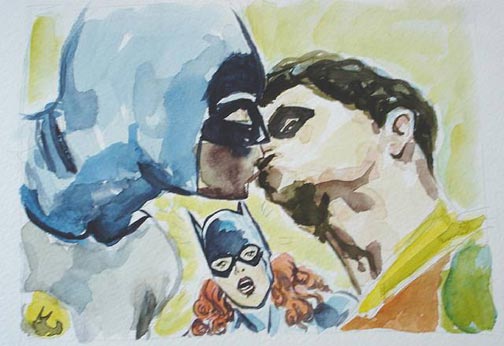
Batman and Robin kissing, as realized by Mark Chamberlain.
This is an item from late April, but I think it’s so good that I’m going to throw it up now:
Prompted by writer Grant Morrison’s assertion that “Gayness is built into Batman. … Batman is very, very gay. There’s just no denying it. Obviously as a fictional character he’s intended to be heterosexual, but the basis of the whole concept is utterly gay.”; Comics Alliance writer Andrew Wheeler put together this barnburner of a post, giving context and explanation in defense of Morrison’s words. There are pretty great tidbits in it:
When we talk about Batman’s gayness, we talk about presentation and perception. Writers as diverse as Bill Finger, Alan Grant, Devin Grayson and Frank Miller have all said that Batman is not gay; but they have all been asked the question. It’s not a question that generally gets asked about other heroes, but in the public imagination it’s one of the first questions asked about Batman. Psychologist Travis Langley, who co-wrote a book on the psychology of Batman, says it’s the question he was asked most often when he told people what he was working on.
and, after establishing Batman’s popularity among closeted gay men in the 1940’s:
We reject or deride the sexualization of Batman’s relationship with Robin precisely because of the worrying implications of eroticizing Robin, but that reading takes the roots of Batman’s gayness in the wrong direction. For gay readers in the 1940s, the introduction of Robin to Detective Comics did not sexualize Robin; it sexualized Batman. It created what Wertham called “a wish dream of two homosexuals living together,” a visible idealization of a same-sex relationship in an era when homosexuality had no mainstream recognition. The gayness of Batman was not just a joke about sidekicks, it was a scrap of identification for a starved gay audience. Robin established Batman as an early totem for a nascent and repressed gay subculture.
I think this is spot-on (though take a look at the original article’s comments to find plenty that disagree). A little over a year ago, in a post on Ta-Nehisi Coates’ blog, I made this comment:
I have nothing to contribute regarding In Memorium, however I do identify with l robert’s observation that “We each have a natural instinct to claim that love as “our own” in some way.”
Consider the great discrepancy between how heterosexual and homosexual relationships are modeled in the culture. Kids are exposed to normative models of heterosexual relationships constantly. Many are never exposed to homosexual relationships at all. Thus a young gay person’s understanding of themself goes hand in hand with an understanding that they are outside the mainstream.
That may seem like Queer 101, but it’s important to keep this in mind because I think it produces a (perhaps lifelong) hunger for representations of people like you in the relationships you want to be in. And because those themes have only been written about openly in Western culture in the past couple of hundred years, a lot of borrowing goes on.
Forgive the self-plagiarism, but I think the point stands. Please, read the Comics Alliance post.
postscript
in looking for a picture, I came across this:

also this Wikipedia page: Homosexuality in the Batman franchise.
 hammer & jack