Veneno

Veneno is a bio-drama miniseries from Spain about La Veneno—a trans hooker who was “discovered” by a TV tabloid show in the mid 1990’s and who became a hypersexualized, circus figure on talk shows. For a younger generation of trans women, she was a representational icon at a time where there was no room for anything but ridicule for them in Spanish society. Veneno dramatizes both La Veneno’s life, and the coming out and transition of a young teen fan that idolizes her and with whom La Veneno publishes a memoir, bringing her back to media attention in the weeks before her untimely and mysterious death.

Marcos Sotkovszki as a young Veneno in Veneno on HBO Max

Veneno takes several strains of queer TV/film aesthetics and turns up the volume and executes them very well. Operatic set pieces, bright and postmodern set designs and surreal storytelling devices from gay auteurs like Russel T. Davies, Pedro Almodóvar, and Ryan Murphy mark emotionally important moments in Veneno’s life. There is a commitment to queer actors playing queer parts and incorporating members of the communities depicted on screen, as in queer shows like Vida and Work in Progress. There’s some exploration of how queerness moves around in families across generations from Transparent, and the beautiful rush and heartbreaking pain that comes with depicting mental illness from close up and on the inside from Eurphoria and I May Destroy You. These are my points of reference, all excellent.

Isabel Torres as La Veneno and Paca la Piraña as herself in Veneno on HBO Max


Veneno is often beautiful—you can see the set design budget stretched when sets are reused one too many times, but everyone looks great—and there are several moments where costuming choices took my breath away, like when we first see teenage Veneno’s outfit to wear to a village festival. The writing is strong too, although there’s only so much I can say about that given that I am watching in a subtitled translation. Some emotional notes are hit a little too often for me, particularly in montages of the young trans writer, Valeria, gazing adoringly at Veneno, but any bum notes are saved by the incredible talent on screen. Highlights in the cast include Marcos Sotkovszki, Jedet, and Isabel Torres, who all play La Veneno at different ages, Paca la Piraña, Veneno’s longest friend and appearing as herself, Lola Rodriguez playing Veneno’s young disciple Valeria, and Lola Dueñas who plays the amoral TV producer that first finds La Veneno.

Lola Rodríguez as Valeria, Isabel Torres as La Veneno, and Paca la Piraña as herself in Veneno on HBO Max


Veneno was a charismatic monster to Spanish TV audiences in the 90’s, and she’s a bit of one now. Her understanding of queerness and sexuality, her love of commoditizing and sharing her body, her hunger to be objectified, these are all uncomfortable traits for queer heroes as we round into 2021. We are not supposed to so nakedly hang our self esteem on how we are desired by men. It has taken a whole apparatus of corporate gay organizations to send the message that being queer is not synonymous with risky sex, sex for money, sexual violence, mental illness and drug addiction, but these were all important parts of La Veneno’s story. At the end of her life, all of her friends that loved her wished that she had a different life. We get a sense of the arc of her whole life, how she hungered for safety and love in every chapter of her life. She didn’t often get it, and we have a chance to give her some of that love in death. She made for great television, and it appears that she still does, and we as viewers have to sit with that knowledge too. 

other voices

Get Used to It

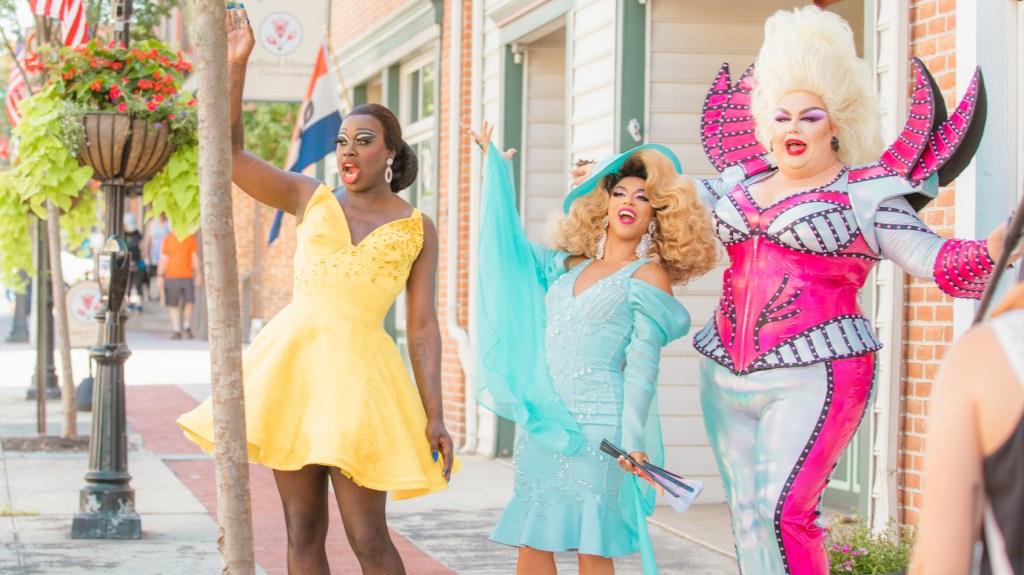
We’re Here [HBO]. Three drag queens not named RuPaul take a Priscilla/Too Wong Foo tour through small towns across America to stage drag shows and use their power to validate and heal local queer scenes.

I loved gay culture, like so many of us did, before I loved my gay self. I loved the sense of humor and the aesthetic and the love for the forgotten and the neglected. I learned to love myself eventually, and only now am I truly understanding what it means to love and to gather close to the most defiant and challenging of us: the sissies and the faggots, the bullied and abused.

There’s so much power in the experience of learning to love yourself. That’s something that Queer Eye taps into so deeply. The danger in Queer Eye is that it muddies the line between who you are and what you buy (although much much less than its original incarnation) and also in the sheer amount of space it occupies in queer representation. Some queer people, especially young people discovering themselves, may not have more access to queer adults than their Netflix account, and I worry that the aspirational devotion the show has towards its stars makes their confidence seem unattainable to younger queers.

I considered ditching We’re Here a few minutes into its first episode. I though its hosts, Shangela, Eureka, and Bob the Drag Queen, were doing a tired and derivative imitation of Queer Eye. I’m so glad that I gave the show a second chance, because once I figured out what it was doing it totally won me over.

The show has more or less a fixed format. Bob, Shangela, and Eureka roll into a small town (ranging from about 10k people to about 50k, from Pennsylvania to New Mexico). They explore downtown shops, locals don’t know what to make of them. They pick three locals to collaborate with to put on a free drag show: one is always a straight, cis guy. Another is a queer person who is trying with all of their might to be themself despite adverse conditions, like a wildflower in a thunderstorm. The third is a little loose, but the thread that connects them is that they are people who have chosen to stay in their home communities despite deep wounds, and who are in need of a little healing through community.

Bob the Drag Queen, Shangela and Eureka O’Hara/HBO’s We’re Here.

There is a little bit of “once in a lifetime experience”/“transformation” language—that’s what turned me off in the beginning—but the show is pretty straightforward about the fact that when the drag queens leave town, regular life will resume. “Your life is not going to change in one week” Shangela bluntly tells a young gay Latino man, José, in a Louisiana town. There’s a scene later in that episode where Shangela sits down with José’s mother so we can get the tearful scene where she tells him that she will always love him because he’s her son. What sets this show apart from the pack is the scene that comes afterward. “Moms always put on their best face for company,” Shangela says quietly. José’s face is guarded and ambivalent. He’s heard the love before. He’s also heard disappointment, disapproval, and scolding. It undercuts the drama of the moment, but it’s a thousand times more real than the staged scenes of reconciliation in Queer Eye, almost fraying in front of you at the edges of the frame.

This show would be so obnoxious and patronizing if it was about the big bad city queens showing small time yokels how it’s really done. What comes through so strongly is that, even though the locals are “crunchy,” according to an unusually shady Shangela in the episode in Twin Falls, Idaho, they have such respect for the people they are working with. The queers that stay in small towns are those who defy a whole host of voices—some loving, some hateful—that say that you are going to have a happier life if you don’t live it here. Queer people are delicate flowers. We flourish in environments where there is enough material abundance for beauty and grace to be valued, where self-expression is permitted, where difference is tolerated. Small town queer people are those flowers hanging on, fiercely, to life. The succulent rooted in sheer face of rock, the thistles growing on the side of the road, the tree that was uprooted by the storm but flowers anyway.

I was transfixed by the beauty of these people, the fierce way that they held on to their sense of themselves. A grandfather and a grandson, bonded so tight by love that there was no room for shame. Two gay men who have a beautiful friendship in which each is totally comfortable in the company of the other. The title carries a double meaning. It’s not just “we are now here” or “we’re here, we’re queer, get used to it,” it’s “look, we have always been here, right here, in your town. We’re your brother or cousin or granddaughter or boss or teacher.” The visiting drag queens are basically church planting. They are giving all of the local queer people a reason to gather together, a way for all of their allies to gather together by bringing this bubble of total queer acceptance and (almost) uncompromising queer aesthetic and letting everybody see each other and experience together what queer joy feels like. The shit that they stir up is the grit around which the pearl forms.

So in that way, it’s not like Queer Eye at all. It’s really the anti-Drag Race. (I think that Drag Race gets a lot of unfair hate. The critiques are totally valid, but they wouldn’t matter as much or sting when the show gets it wrong if there was a whole ecosystem of queer entertainment that was funded and promoted and critiqued and awarded like entertainment directed at straight audiences. That puts way more weight on Drag Race than it can support.) Drag Race is about gatekeeping, it’s about designating something as special, it’s about elevating regional talent into international spotlight. We’re Here is about recognizing that queer talent and beauty and joy is everywhere, and about the power of coming together and nurturing that in the places where you live.

This is for: queers who need a pick me up, people tired of LA/NY stories or having to pretend places like Houston, Chicago, or Atlanta are small towns because they are slightly smaller than those two cities, anyone really missing Pride this summer.

Not for: haters, cynics, the lactose intolerant.

Recommended. 🏳️‍🌈🏳️‍🌈🏳️‍🌈🏳️‍🌈/5

Bookshelf: My Brother’s Husband, Vol. 1

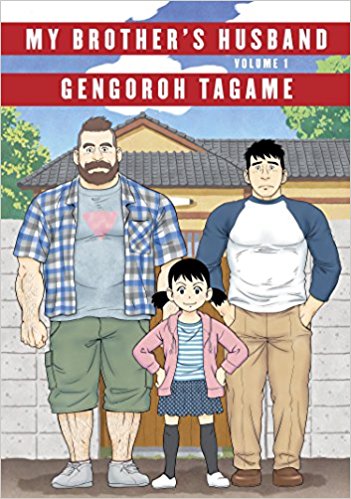
516p0M0uyeL._SX349_BO1,204,203,200_The loveliest reading experience that exists is the experience of coming across the right book at the right time, and feeling so completely understood by it, and feeling like you completely understand it. I picked up My Brother’s Husband, by Gengoroh Tagame, because I read that it was going to be adapted into a live action TV series, and that made me think about how few Japanese LGBT narratives and stories I knew. There are many manga and anime series that play around with homoerotic subtexts and images (including my current favorite, Yuri on Ice!!!), however—and, please understand that I have a very superficial understanding of Japanese culture—my perception is that many of those tropes are a slightly performative and desexualized playgrounds of desire for (mostly) straight preteen girls. The other examples of queer tropes in the culture are probably worse, which are the eroticized bisexual/lesbian chic like Ghost in the Shell, a melange of  badass and charismatic characters that queer readers love but that were created for the pleasure of straight boys.
My Brother’s Husband is the story of Yaichi, who is forced to confront his feelings about his late twin brother, Ryōshi’s death and sexuality when Ryōshi’s widowed Canadian husband, Mike Flanagan, arrives at his doorstep to visit the town where the boys grew up. Mike is enthusiastically welcomed by Yaichi’s grade-school aged daughter, Kana, and this first of two volumes follows Yaichi through this brief visit as he struggles to balance his conflicted feelings about gay sexuality and his estrangement from his brother with his responsibility to his family and his love for his daughter. larger.jpg

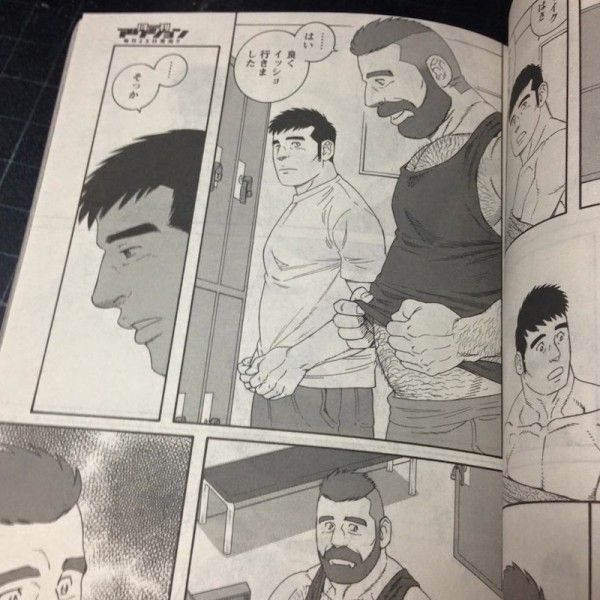
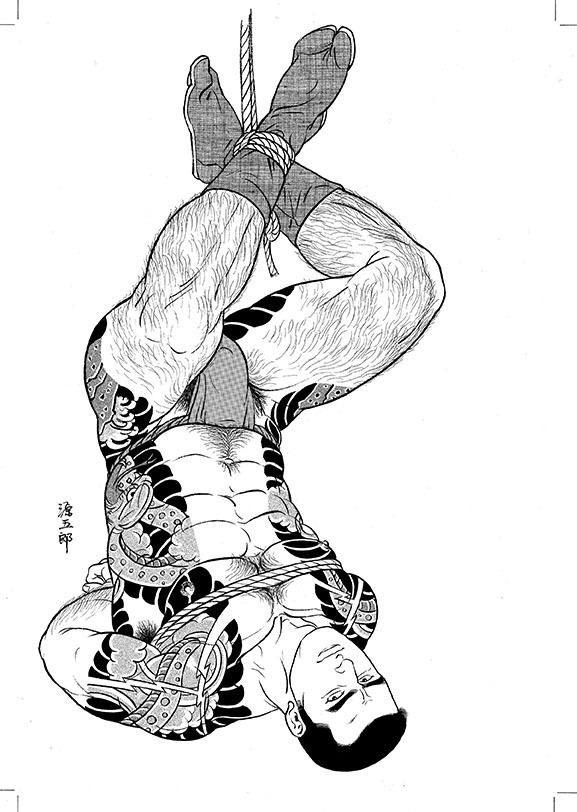
The sensuality of bodies is present on every page, in every panel. Tagame describes himself in his twitter bio as a “gay erotic artist,” and most of his work (which has not been officially published in English translation) is sexually explicit stories featuring BDSM themes and big, muscly, hyper-masculine men presented as both figures of fear and figures of desire. My Brother’s Husband, at least through the first volume, is completely G rated, however the art style is shot through with his aesthetic. When Yaichi meets Mike, he is overwhelmed by the reality of Mike and his brother’s relationship, but he is also overwhelmed by Mike’s physical self, his size, his strength, his beard, the hair on his body.

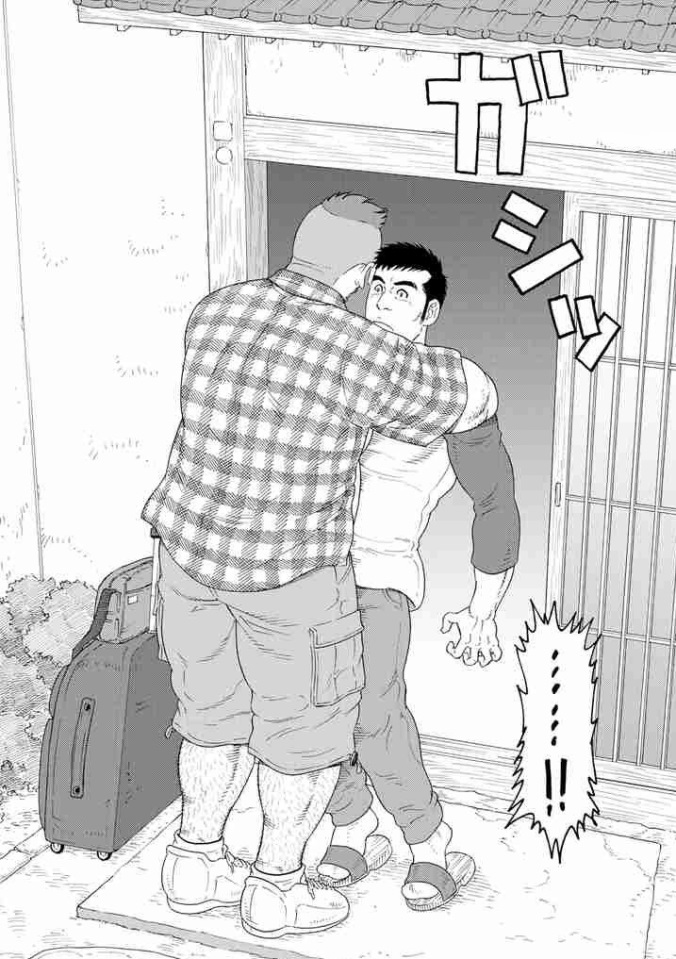
There’s not a whole lot of action on the surface; this is a very quiet domestic drama with lots of talking, Yaichi’s internal dialogues as he explores his own discomfort with Mike, and getting lost in his memories and regrets. But underneath all that is a whole story expressed through touch and care for the body. When Mike first arrives, he wraps Yaichi in a bear hug and calls him brother.

My-Brothers-Husband-1.jpg

This freaks Yaichi out, and he breaks out of the embrace and asks Mike not to call him that. As Yaichi explains to his daughter, Kana, “Japanese people don’t hug,” but he also admits to himself later that there is an undercurrent of homophobia and xenophobia to his response as well. Kana is completely unfazed by Mike, and is so excited to have a Canadian uncle that Yaichi’s standoffish attitude becomes rude by contrast. Yaichi’s comfort with Mike is shown without words through a growing physical intimacy, not through sex but through food, coffee and tea, the offer of a hot bath, a walk through a playground, and a shared visit to the gym.

I couldn’t help think about the deeper connection to Tagame’s erotic BDSM work. I only have an outsider’s understanding of that community, and on the kink spectrum, I think of myself as fresh vanilla bean ice cream (basic, but pretentious with an overinflated sense of self). That being said, I’ve always been fascinated to hear people share their experiences, and a big part of BDSM for a lot of people is that it provides a context for exploring pleasure and disgust, gender roles, toxic emotions, power dynamics, internalized homophobia, self-esteem, fight or flight responses, anxiety, sexual trauma, and a whole host of other really complex human experiences. Furthermore, it’s a way to cultivate an embodied understanding, completely different than understanding it intellectually. In other words, there’s a level of self-understanding that Tagame’s hypermasculine men can only access when they are having these heightened and risky sexual encounters. And in that same way, there is a level of acceptance of his dead brother that Yaichi can only get to, no matter what he thinks he thinks about him, that can only happen when he hugs his brother’s husband and feels love and connection and not discomfort.
53d0efd13ee39488a084f6514107ef5d.jpg

This is what really blew me away, and why I remain completely emotionally lit up about this manga: in some ways this is a very quiet, very small-scale, and almost a didactic domestic drama. These are the type of queer stories that are told to straight society, and every time there is a movement for queer liberation, there is a need to teach the same lessons: we’re just like everyone else, love is love, who I am is bigger than who I fuck, etc. And they’re beautiful stories, and they’re important stories. But they are the queer stories that are always told before the queer queer stories get told. But Tagame has told this very tame queer story in a very queer way, and in that sense he has queered the queer acceptance narrative*. That’s so cool, and it’s incredible that at this time, when LGBT visibility is still in early formation in Japan, that this artist has created this work with such a clear sense of social purpose without ceding any of his individuality and sensibility.

*Postscript: Queering the Text

I wanted to briefly explain what I mean by “queering the queer acceptance narrative,” which is an extension of the concept of queering the text. Wikipedia has a truly dreadful definition:

Queering is an interpretive method used in historical or literary study. It is based on the re-appropriated term “queer“, used for LGBT issues, but used as a verb. “Queering” means to reevaluate or reinterpret a work with an eye to sexual orientation and/or to gender, by applying interpretive techniques from queer theory. An example of “queering” would be to reexamine the primary sources from the life of King Richard I of England, to search for evidence that he exhibited homosexual behavior or attitudes.

This definition gets a little bit right, but a lot of bits wrong. Queering is definitely an interpretive theory, but it is way more of a reinterpretation (or reinvention) than it is a reevaluation. The way that queering works is to take something, and to upend it by changing some of its underlying assumptions. It’s similar to Juvenalian satire (treating something elevated with the contempt and disdain of the low, and treating the low with the seriousness and gravitas of the elevated), and has roots in one of the early forerunners of queer identity, the invert (the man who acts like a woman and the woman who acts like a man). Queering as a praxis is one of the true essentials of queer culture and you can spot it everywhere. Its in the mock seriousness (but also actual seriousness) with which queer culture treats reality television and campy melodramas. It’s there in the cultivated banal tone in which we talk about high culture.

So when I say that My Brother’s Husband queers the queer acceptance narrative, what I mean is that Tagame has taken something that is familiar, targeted towards a homophobic straight reader, and almost commodified, and told the story in a way that has roots in something edgy, sexual, and boundary-pushing, he changes it into something new.

Bookshelf: My Brother's Husband, Vol. 1

516p0M0uyeL._SX349_BO1,204,203,200_The loveliest reading experience that exists is the experience of coming across the right book at the right time, and feeling so completely understood by it, and feeling like you completely understand it. I picked up My Brother’s Husband, by Gengoroh Tagame, because I read that it was going to be adapted into a live action TV series, and that made me think about how few Japanese LGBT narratives and stories I knew. There are many manga and anime series that play around with homoerotic subtexts and images (including my current favorite, Yuri on Ice!!!), however—and, please understand that I have a very superficial understanding of Japanese culture—my perception is that many of those tropes are a slightly performative and desexualized playgrounds of desire for (mostly) straight preteen girls. The other examples of queer tropes in the culture are probably worse, which are the eroticized bisexual/lesbian chic like Ghost in the Shell, a melange of  badass and charismatic characters that queer readers love but that were created for the pleasure of straight boys.
My Brother’s Husband is the story of Yaichi, who is forced to confront his feelings about his late twin brother, Ryōshi’s death and sexuality when Ryōshi’s widowed Canadian husband, Mike Flanagan, arrives at his doorstep to visit the town where the boys grew up. Mike is enthusiastically welcomed by Yaichi’s grade-school aged daughter, Kana, and this first of two volumes follows Yaichi through this brief visit as he struggles to balance his conflicted feelings about gay sexuality and his estrangement from his brother with his responsibility to his family and his love for his daughter. larger.jpg
The sensuality of bodies is present on every page, in every panel. Tagame describes himself in his twitter bio as a “gay erotic artist,” and most of his work (which has not been officially published in English translation) is sexually explicit stories featuring BDSM themes and big, muscly, hyper-masculine men presented as both figures of fear and figures of desire. My Brother’s Husband, at least through the first volume, is completely G rated, however the art style is shot through with his aesthetic. When Yaichi meets Mike, he is overwhelmed by the reality of Mike and his brother’s relationship, but he is also overwhelmed by Mike’s physical self, his size, his strength, his beard, the hair on his body.
There’s not a whole lot of action on the surface; this is a very quiet domestic drama with lots of talking, Yaichi’s internal dialogues as he explores his own discomfort with Mike, and getting lost in his memories and regrets. But underneath all that is a whole story expressed through touch and care for the body. When Mike first arrives, he wraps Yaichi in a bear hug and calls him brother.
My-Brothers-Husband-1.jpg
This freaks Yaichi out, and he breaks out of the embrace and asks Mike not to call him that. As Yaichi explains to his daughter, Kana, “Japanese people don’t hug,” but he also admits to himself later that there is an undercurrent of homophobia and xenophobia to his response as well. Kana is completely unfazed by Mike, and is so excited to have a Canadian uncle that Yaichi’s standoffish attitude becomes rude by contrast. Yaichi’s comfort with Mike is shown without words through a growing physical intimacy, not through sex but through food, coffee and tea, the offer of a hot bath, a walk through a playground, and a shared visit to the gym.
I couldn’t help think about the deeper connection to Tagame’s erotic BDSM work. I only have an outsider’s understanding of that community, and on the kink spectrum, I think of myself as fresh vanilla bean ice cream (basic, but pretentious with an overinflated sense of self). That being said, I’ve always been fascinated to hear people share their experiences, and a big part of BDSM for a lot of people is that it provides a context for exploring pleasure and disgust, gender roles, toxic emotions, power dynamics, internalized homophobia, self-esteem, fight or flight responses, anxiety, sexual trauma, and a whole host of other really complex human experiences. Furthermore, it’s a way to cultivate an embodied understanding, completely different than understanding it intellectually. In other words, there’s a level of self-understanding that Tagame’s hypermasculine men can only access when they are having these heightened and risky sexual encounters. And in that same way, there is a level of acceptance of his dead brother that Yaichi can only get to, no matter what he thinks he thinks about him, that can only happen when he hugs his brother’s husband and feels love and connection and not discomfort.
53d0efd13ee39488a084f6514107ef5d.jpg
This is what really blew me away, and why I remain completely emotionally lit up about this manga: in some ways this is a very quiet, very small-scale, and almost a didactic domestic drama. These are the type of queer stories that are told to straight society, and every time there is a movement for queer liberation, there is a need to teach the same lessons: we’re just like everyone else, love is love, who I am is bigger than who I fuck, etc. And they’re beautiful stories, and they’re important stories. But they are the queer stories that are always told before the queer queer stories get told. But Tagame has told this very tame queer story in a very queer way, and in that sense he has queered the queer acceptance narrative*. That’s so cool, and it’s incredible that at this time, when LGBT visibility is still in early formation in Japan, that this artist has created this work with such a clear sense of social purpose without ceding any of his individuality and sensibility.

*Postscript: Queering the Text

I wanted to briefly explain what I mean by “queering the queer acceptance narrative,” which is an extension of the concept of queering the text. Wikipedia has a truly dreadful definition:

Queering is an interpretive method used in historical or literary study. It is based on the re-appropriated term “queer“, used for LGBT issues, but used as a verb. “Queering” means to reevaluate or reinterpret a work with an eye to sexual orientation and/or to gender, by applying interpretive techniques from queer theory. An example of “queering” would be to reexamine the primary sources from the life of King Richard I of England, to search for evidence that he exhibited homosexual behavior or attitudes.

This definition gets a little bit right, but a lot of bits wrong. Queering is definitely an interpretive theory, but it is way more of a reinterpretation (or reinvention) than it is a reevaluation. The way that queering works is to take something, and to upend it by changing some of its underlying assumptions. It’s similar to Juvenalian satire (treating something elevated with the contempt and disdain of the low, and treating the low with the seriousness and gravitas of the elevated), and has roots in one of the early forerunners of queer identity, the invert (the man who acts like a woman and the woman who acts like a man). Queering as a praxis is one of the true essentials of queer culture and you can spot it everywhere. Its in the mock seriousness (but also actual seriousness) with which queer culture treats reality television and campy melodramas. It’s there in the cultivated banal tone in which we talk about high culture.
So when I say that My Brother’s Husband queers the queer acceptance narrative, what I mean is that Tagame has taken something that is familiar, targeted towards a homophobic straight reader, and almost commodified, and told the story in a way that has roots in something edgy, sexual, and boundary-pushing, he changes it into something new.

On yesterday’s gay marriage rulings

My mom called yesterday morning, greeting me with a Good morning. I groaned something back.

 Oh, are you asleep? she asked.

 No, I lied, I was up to read the Supreme Court decision. That wasn’t a lie. I had woken up to read the papers, so dulled by sleep that I just stared at my phone in confusion for thirty seconds before realizing that there were about ten apps that would have the news and I just had to pick one.

 What was the decision about?

 Perry vs. Schwarzenegger, you know, the Prop 8 case. Basically DOMA is gone and gay marriage is legal in California again. She said something in response and we agreed to talk later. As I drifted back asleep, I was struck with how different things were now, nearly five years after the Prop 8 election results disrupted my complacency about the tolerance of my state and my country.

–––––––––––––––––––––––––––– ∆ –––––––––––––––––––––––––

In the summer of 2008, I was 18 years old, and excited to be voting in my first election. I was—and am—the type of person to be excited by an election. Like many, I was surprised that May when the California Supreme Court first legalized gay marriage in the state. In the year and a half since I had first come out to a close friend, I engaged in a dedicated program of independent study of how to be gay. That study, however, mostly consisted of a ravenous consumption of the past fifty years of gay cultural artifacts, and I was uninformed  about contemporary gay politics. The Court decision seemed a boon, and when the injunction against marriages followed and Prop 8 was put on the ballot, I barely noticed it. I assumed that the defeat of Prop 8 would be a formality, and California would assume its place as the great power of Western and liberal values and civil rights. That we had ceded such a place to the lesser states of Massachusetts and Iowa was an affront to state pride.

I was unforgivably complacent about that election. I vividly recall a long telephone conversation I had about the election with one of my high school teachers. I often talked about current events and politics with this teacher and, for a time, after leaving for college maintained the habit of calling him to shoot the breeze a couple of times a year. He was also, as I had come to understand, a deeply closeted gay man from three or four gay cultural generations previous to mine own (His present to me at my high school graduation—a DVD copy of the Merchant and Ivory adaptation of E.M. Forster’s Maurice—was an introduction to a lettered and more rarefied strain of gay culture than the Dan Savage columns and Queer as Folk episodes I had been pouring over). He kept insisting that the proposition would pass soundly. Even as opinion polls were showing a near even split in the state, he believed that people were afraid to express their prejudice to pollsters, but would behave differently in the voting booth. I insisted that it was impossible that such an initiative would pass in California—California!—of all places. I truly believed that while anti-gay prejudice was a significant force in other parts of the country, my state had, taken as a whole, grown out of that phase. I saw my teacher as a man scarred by the political fights of yesteryear, his memories blinding him to the new social reality. You’ll see in November, he said at the end of our conversation.

I saw.

It would take me a couple of years to read Randy Shilt’s And the Band Played On to learn that bureaucratic inaction can be the cruelest form of action, and that mass silence can equal mass death. It would take me a couple of years to read Eric Foner’s A Short History of Reconstruction to learn that civil liberties and the social protections of government can and have been taken away in this country. And it would take me a couple years of experiences of hearing the word faggot and becoming uncomfortable in and hyperaware of my surroundings, or hearing it shouted at me in the street, to learn that—like death in Arcadia—here, too, in one of the most liberal areas of the country, is prejudice.

––––––––––––––––––––––– ∆ –––––––––––––––––––––––––

I don’t know how many people have election rituals with their parents, but I have one with my mother. Every election, she fills out my absentee ballot for me while I’m on the phone, and we’ll usually talk through the ballot initiatives and candidates. She usually has more knowledge about local offices than I have, and I’m more willing to jump on the computer to research the statewide issues, and usually we vote the same way and for the same people. Sometimes, as with Prop 8 we differ. I don’t remember the specific content of my discussion with my mother. I do remember tiptoeing up to coming out to her and explaining that I had something of a personal stake in this issue, but never finding enough courage to say the words. Plus, the worst that could happen was that we would cancel each other’s votes out in an initiative fight that wasn’t going to pass anyway.

By the time the last California polls that night in November, the networks had all ready called the election for Obama and the atmosphere on campus was electric. An impromptu group of students were gleefully parading around campus playing will.i.am’s “Yes We Can” anthem with an unknowable admixture of irony and sincerity—or, if not sincerity, at least counter-irony. The memory I remember in most detail—noted for its subsequent entry into my personal Dorkiest Moments Hall of Shame—was inviting one of my friends to join me for a celebratory drink, just like a Big Man, leading both of us to uncomfortably sip straight citrus vodka from a plastic cup because I didn’t yet understand how alcohol worked. I also remember staying up into the early hours of Wednesday waiting for the full results for Prop 8 to come in. It was a couple hours after the networks and papers announced that it had passed when I finally accepted that the results of a few more precincts from Los Angeles County were not going to be enough to change the outcome.

Prop 8’s passage filled me with a deep sense of betrayal by my state and its voters, and also shame for myself and what I had not done. I knew that coming out to my mother would not have been a panacea. One vote wasn’t going to change the outcome of that election. But I knew that I didn’t just not come out to my mother, I didn’t post anything on Facebook, I didn’t make sure that people I knew voted, I didn’t email my relatives to come out to them and explain my position either. And it might be true that if I and everyone in my position had, maybe things would have been different.

I also understood immediately that I would be in for a long wait. As Ted Olsen and David Boies announced that they would be collaborating to bring a constitutional challenge to Prop 8, I waited. As, a few months later, Perry vs. Schwarzenegger was filed in California, I waited. As attorneys Olsen, Boies, Charles Cooper and Judge Vaughan Walker conducted what history will recognize as the trial of the century, I waited. As the 9th Circuit Court of Appeals upheld Walker’s decision, I waited. As the Supreme Court granted cert, I waited. As the Court conducted oral arguments last fall, I waited. Yesterday, that wait ended.

––––––––––––––––––– ∆ ––––––––––––––––––––

Prop 8 is dead. DOMA is dead. Code phrases like “not the marrying kind” or “confirmed bachelor” will lose their power, until some point in the future where those phrases will be identified with an note explaining their roots in pre-21st century prejudice against homosexual commitment ceremonies. And yet my joy in the political victory of my constituency and happiness for the people that this ruling will directly benefit is tempered by some feeling of ambivalence.

Some of my hesitation comes from a bad reason. This ruling is not very concrete for me yet. I don’t have a boyfriend, let alone one I would consider marrying. While this ruling has everything to do with the way that gays and lesbians are treated by civil society, marriage is a relationship entered in between one member of our community to another. Seen through that lens, this victory can seem like weak tea in the face of problems like employer and housing discrimination in the legal sphere, or simple prejudice in the social sphere in which we are directly asking those who disapprove of us for more tolerance—asking them to actively back down from their positions instead of leaving us alone while we marry each other. My hesitation also stems from a more nuanced understanding of how gay relationships have functioned outside of marriage, and the danger in trying obscure difference through shared conformities.

In this there is something unseemly: wedding boutiques expanding their offerings to cover same-sex weddings. Stores updating their gift registries. Jewelers advertising for his and his, and hers and hers. Articles about Washington, New York, and Los Angeles power couples consolidating their political and economic capital together. The faces of gay marriage, often wealthy white men, less often the not-wealthy, the nonwhite, the nonmen. Never all three. In all of this there is something unseemly. Gay men and women are being quickly assimilated into the iconography of this institution, and I cannot shake the sense that the community is trading something it doesn’t know the true value of for something it doesn’t need.

When I was first coming out to my friends, I kept the paranoia I developed in the closet about appearing “flaming,” or showing my interest in things that were “too gay.” Whenever I was confronted with any confrontational gay in news or media or life, be it the sissy, the queen, the activist, the sexual aggressor, I felt like I had to reassure my friends—but mostly myself—that I wasn’t going to be one of “those” gays. I was drawing a Chris Rock-like distinction between gay and faggot, and I didn’t want to be a faggot. In my mind’s eye, pictured my life as just like Straight Me’s life, just with shadowy figures of men instead of women. It took me longer to accept that Straight Me never existed, and therefore my life was going to look different from his. I recently came across Essex Hemphill’s poem “American Wedding,” written twenty-one years ago, which concludes:

 I vow to you.

I give you my heart,

a safe house.

I give you promises other than

milk, honey, liberty.

I assume you will always

be a free man with a dream.

In america,

place your ring

on my cock

where it belongs.

Long may we live

to free this dream.

Past me would have been threatened by the eroticism of the poem, with the radical subversion of ritual. Present me thinks fuck yeah.

I am reminded of the first act of The Godfather, Part II, where drunken paisano Frank Pentangeli makes a scene at little Anthony Corleone’s confirmation party on the shores of Lake Tahoe by demanding that the whitebread bandleader play some Sicilian songs. Frank’s outburst punctures the event’s veneer of Anglo gentility. Certainly not Michael Corleone, probably not Anthony either, but Anthony’s children will look at the Tahoe party not as a symbol of the family’s social achievement, but as a demeaning reminder of the extent toward which the family was required to change itself simply to keep the economic and social standing it already possessed. Or maybe they won’t even miss the songs they’ve never heard. Conditional acceptance is being permitted to enter the mainstream. True acceptance is changing the definition of mainstream.

–––––––––––––––––––––––  ∆ ––––––––––––––––––––––––––––––

I don’t want my reservations to obscure that I am very happy about yesterday’s rulings. Marriage is an invaluable institution to have access to, especially for couples with children. Even though I am nowhere near a marriage-level relationship—indeed, even if I never marry—this is a victory for me. DOMA was a sign of disrespect towards those gay couples who are married. Disrespect to those marriages is disrespect to the relationship the marriages encompassed. Disrespect to those to those relationships is disrespect to the type of relationship those couples have. Disrespect to the type of relationship is disrespect to those who want that type of relationship. Thus yesterday’s ruling was not just a victory for those in marriages a sign of respect for all of us who love like they love.

I’ve come to see the law as the shem in the mouth of the golem, both giving it power and power’s limits. Or as the lines in a pentagram, constraining the powerful demon within, the refinement of its shape reducing the possibility of escape or unintended action. Though I am always aware of the possibility of liberties being rolled back, I do also believe in the laws power, through precedent and time, to place certain incursions of liberty off the table. Yesterday’s ruling was one such precedent. It might be an incremental change, but in this small respect, the law has placed a part of my human dignity beyond debate. The hypocrite, the huckster, the two-bit fuckster, the douchebag, the crackpot, the fundie whackjob, all the bad actors that will someday take power, are forced to respect me in this small way. This is what makes me happy.