How to Do Nothing

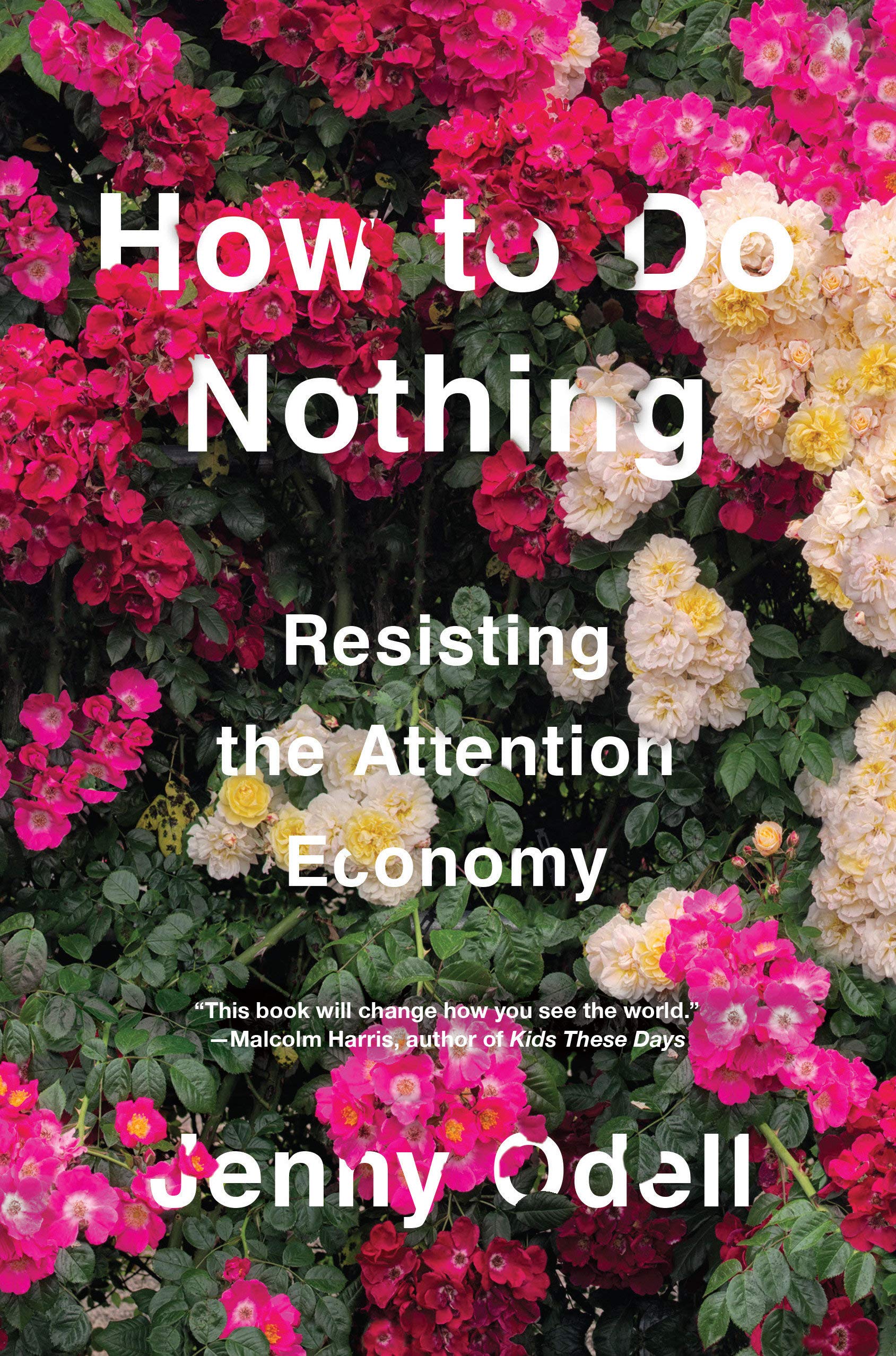
How to Do Nothing by Jenny Odell book cover.

My attention is important to me, and I’ve been writing and reading a lot this year about ways to navigate a world that is increasingly filled with traps designed to capture, monetize, and waste my curiosity. Earlier this spring, I came across Jenny Odell’s artist talk “How to Do Nothing”, given at EYEO in 2017, and I have been eagerly anticipating her full-length book expanding some of the ideas she shared in her talk. It’s here, and I finished it this week.

How to Do Nothing is anchored by the ideas Odell shares in her artist talk: that grounding oneself in specific real places and paying attention to their physical, geographic, ecological, historical, and social characteristics is an act of anti-capitalist refusal against the various social media and big data businesses who monetize our attention and behaviors. In her book, she expands her scope to consider other questions: How much of a real possibility is it to opt-out of digital connectedness, and would that be a good thing anyway? Does the act of refusing to follow directions have any power or meaning beyond our individual choice? How, specifically, does one “grounding oneself”? How are the attention economy and the fiction of independence linked? Can we change how we think about production to include not just making something that wasn’t there before, but maintaining something that was there before, or even removing something to make room for something else that hasn’t had any room to develop?

These are wonderful, rich questions, and one of the real pleasures of this book is that Odell draws on so many different ways to contextualize these questions. Odell draws on sociology and economics to explain shifts in how jobs are structured, and history and journalism to bring context to the history of the East Bay places that she spends time in. There’s a little smattering of philosophy and theory, which I am a little allergic to so I was happy there wasn’t too much of it. But where Odell really shines for me are in her close readings (and connecting to the other ideas in her book) of conceptual art pieces, the life of Diogenes the Cynic, John Cage’s sound pieces, Melville’s “Bartleby the Scrivener,” and David Hockney’s polaroid collage pieces.

Maybe these are ideas that you could find in other books, off the top of my head I’m thinking of Cal Newport’s Deep Work, Tim Wu’s The Attention Merchants, or Jaron Lanier’s Ten Arguments for Deleting Your Social Media Accounts Right Now. One thing that sets this book apart is Odell’s fierce resistance to framing her argument around “productivity.” This is not a book that argues that changing your frame of attention is going to make you better at your job, or faster at creating career ideas, or anything of the sort—in that respect, she is the anti-Cal Newport (who I respect a lot also, but I think his idea that we can all just be “winners” by becoming more productive is a bit shallow by ducking systemic questions). The other thing that sets her apart is a fierce, humanistic commitment to encouraging us to think in terms of ecosystems and social systems in which no individual is completely apart. I look forward to some of these most delicate and precious ideas continuing to move through my brain.

I loved this book. Read it and try something different.

Other perspectives I liked

  • Cory Doctorow, praises the book but thinks her central argument will continue to get sharper over time.
  • Terri Windling: an artist’s perspective.
  • Haley Haltom: a perspective from someone who spent a year sailing around the world.

Collideoscope

Wednesday

I’ve had so many days recently that were hard because work was hard, that they’re boring to write about and boring to read about and I’ve come to think of them in my head as Schmuck Days. Wednesday was a Schmuck Day.

On Wednesday evening, however, I had a great experience. I was relaxing, and searching around for something to watch. Last Saturday, I had such a great time watching Frida, that it made me aware of how thirsty my spirit is for stories and myths about artists and how they exist in the world. I decided on a whim to watch The Artist is Present, the documentary about the MOMA retrospective exhibition of Marina Abramovic. From her website:

THE MOUNTING OF THE RETROSPECTIVE AND ITS THREE-MONTH EXHIBITION AT MOMA IS THE NARRATIVE SPINE OF MARINA ABRAMOVIĆ THE ARTIST IS PRESENT, AND OVER THE COURSE OF THE FILM, WE RETURN AGAIN AND AGAIN TO THE MUSEUM. THERE, AS THE “SET” IS BUILT FOR THE NEW WORK THAT WILL BE THE CENTERPIECE OF SHOW, MARINA SKETCHES HER AMBITIOUS PLANS: ALL DAY, EVERY DAY, FROM EARLY MARCH UNTIL THE END OF MAY, 2010, SHE WILL SIT AT A TABLE IN THE MUSEUM’S ATRIUM, IN WHAT SHE DESCRIBES AS A “SQUARE OF LIGHT.” MEMBERS OF THE AUDIENCE WILL BE INVITED TO JOIN HER, ONE AT A TIME, AT THE OPPOSITE END OF THE TABLE. THERE WILL BE NO TALKING, NO TOUCHING, NO OVERT COMMUNICATION OF ANY KIND. HER OBJECTIVE IS TO ACHIEVE A LUMINOUS STATE OF BEING AND THEN TRANSMIT IT­­––TO ENGAGE IN WHAT SHE CALLS “AN ENERGY DIALOGUE” WITH THE AUDIENCE.

THE PIECE, APTLY ENTITLED THE ARTIST IS PRESENT, WILL BE THE LONGEST-DURATION SOLO WORK OF MARINA’S CAREER, AND BY FAR THE MOST PHYSICALLY AND EMOTIONALLY DEMANDING SHE HAS EVER ATTEMPTED. WHEN SHE CONCEIVED IT, SHE SAYS, SHE KNEW INSTANTLY THAT IT WAS THE RIGHT PIECE BECAUSE THE MERE THOUGHT OF IT “MADE ME NAUSEOUS.” THE WORK’S SIMPLICITY AND PURITY HAS THE POTENTIAL TO CRYSTALLIZE ALL THAT IS BEST ABOUT HER ART, BUT IT ALSO DEMANDS THAT MARINA RETURN TO HER ROOTS––AND FORGO THE OVERT THEATRICALITY THAT HAS CHARACTERIZED MANY OF HER RECENT PERFORMANCE PIECES. PERHAPS MORE THAN ANY PERFORMANCE SHE HAS DONE BEFORE, THE ARTIST IS PRESENT HAS THE POWER TO FULFILL MARINA’S OWN DICTUM ABOUT LONG-DURATIONAL WORK, IN WHICH, SHE SAYS, “PERFORMANCE BECOMES LIFE ITSELF.”

I had heard about the piece, and the film, when they came out in 2010/2012, but hadn’t gotten around to seeing them. I was so blown away by her spirit, her belief in herself, her joy for life, her complete melding of performance and life. Her work also explores themes like radical vulnerability, trust in others, inner stillness, and cultivating a life presence that intersects with other things that I’ve been exploring, like mindfulness meditation and the work of the western Buddhist writer Alan Watts. I felt myself really appreciative of Marina’s work because of my own practice that I’m trying to cultivate. I’ve become comfortable with the physical actions of sitting and contemplating, of shutting out external stimuli, however it is very difficult for me to shut down the background chatter of insecurity, self-criticism, and perfectionism. One of the many geniuses of her MOMA piece, or at least the facet that connected with me, was that she created physical conditions—sitting still and blank for 12 hours at a time for three months—in which one needed cultivate that inner blankness simply to survive. I found it very inspiring.

I used to make fun of performance art, as our culture does. My stereotype of it was Maureen in Rent, terrible, stupid performances that were cheap, pseudo-profound, annoying. One of the biggest changes that’s happened in my life so far is that when I was a young teenager, I was obsessed with the question “What is art?,” and had such strong (and wrongheaded) opinions about what was and wasn’t art. Hint: if it made me think too hard and made me feel weird, it probably wasn’t art. I remember a seed being planted that took many years to take root: a reprint in an art book I used to look at in high school of Nan Goldin’s Nan one month after being battered. The photo is like a snapshot, the photographer gazing into the camera with old bruises in the face and an eye still red from burst blood vessels. At the time, I remember being fascinated and repulsed by the ugliness of it. I could not understand why someone would display something so ugly, especially of their own body. I owe so much to that art room, the photo books there. What I’ve come to understand is that performance art uses as its canvas human experience and human emotional reactions. It is no more complicated than that. People often do not like having their reactions manipulated, and for that reason alone the form is always going to be controversial.

Back to The Artist is Present. I found a couple of biographical points very interesting. First is that the young Marina that let the public come up and cut her with scalpels in a piece if they chose, and rode in a van for five years begging for gasoline and money for groceries is clearly not the older performer that dresses in haute couture and has a team of security people that facilitate her performances. That difference is not commented upon. I don’t think she has to answer for them, but it did make me think that any of the voices represented in the film that rejected her work as just cheap provocation would not appreciate the evolution and negotiation of her work as she’s aged.

Second, she had a long relationship with a fellow performance artist, Ulay, and it was incredible to me that these two performers that practiced radical, violent vulnerability with each other still managed to break each other’s hearts.

This movie energized me after a Schmuck Day, and I’m going to be thinking about it for a long time.

Thursday

Thursday started off weird. I was going to start work late, so I had a lazy morning. The landlord was over to do some repairs to the downstairs bathroom, but our house looks like real people live in it so that wasn’t bad or weird. I got into a tense conversation with Luke Skywalker that came out of real feelings, but was mostly caused by my sunday night attack of lonelybrain that I’m still trying to beat back.

I was in charge of taking care of four kids all day that were taking part in a performance for a big annual fundraiser at work. The kids were fine, the performance was real rough, and overall it was a long day.

Friday

Today was a work day, where we were closed for after-school programs, but all working in the building. We spent all day sorting through and reorganizing our storage and supplies, which we’ve needed to do for a long time. We got so much done, and our hoarder boss was pretty chill about it, for the most part, and only got micromanagey about keeping garbage at the end of the day when most of the stuff was gone or away.

Quiet evening at home felt like the right call tonight.